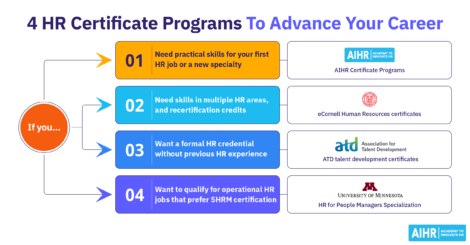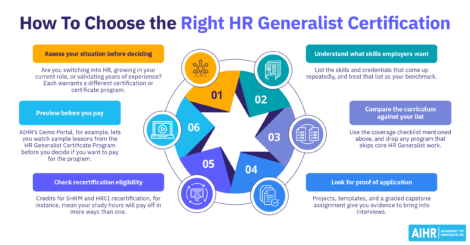


The most valuable HR certification or certificate program is the one that matches your career goal, region, experience level, and learning needs. For some HR professionals, it’s an exam-based credential, such as SHRM-CP, PHR, or CIPD. For others, a practical HR certificate program, like the ones AIHR offers, is the better move if they want to build job-ready skills.
The payoff can be meaningful. Full-time wage and salary workers with a certification but no license can earn nearly 30% more per week than workers with neither. This doesn’t mean a credential alone raises pay, but it does show why choosing the right one can support your long-term HR career plan.
So whether you’re thinking about starting a career in Human Resources or are an HR professional looking to upskill and make your next career move, this article will help you explore the most valuable HR certificate programs.
Contents
What’s the real value of HR certifications?
HR certification vs. HR certificate program
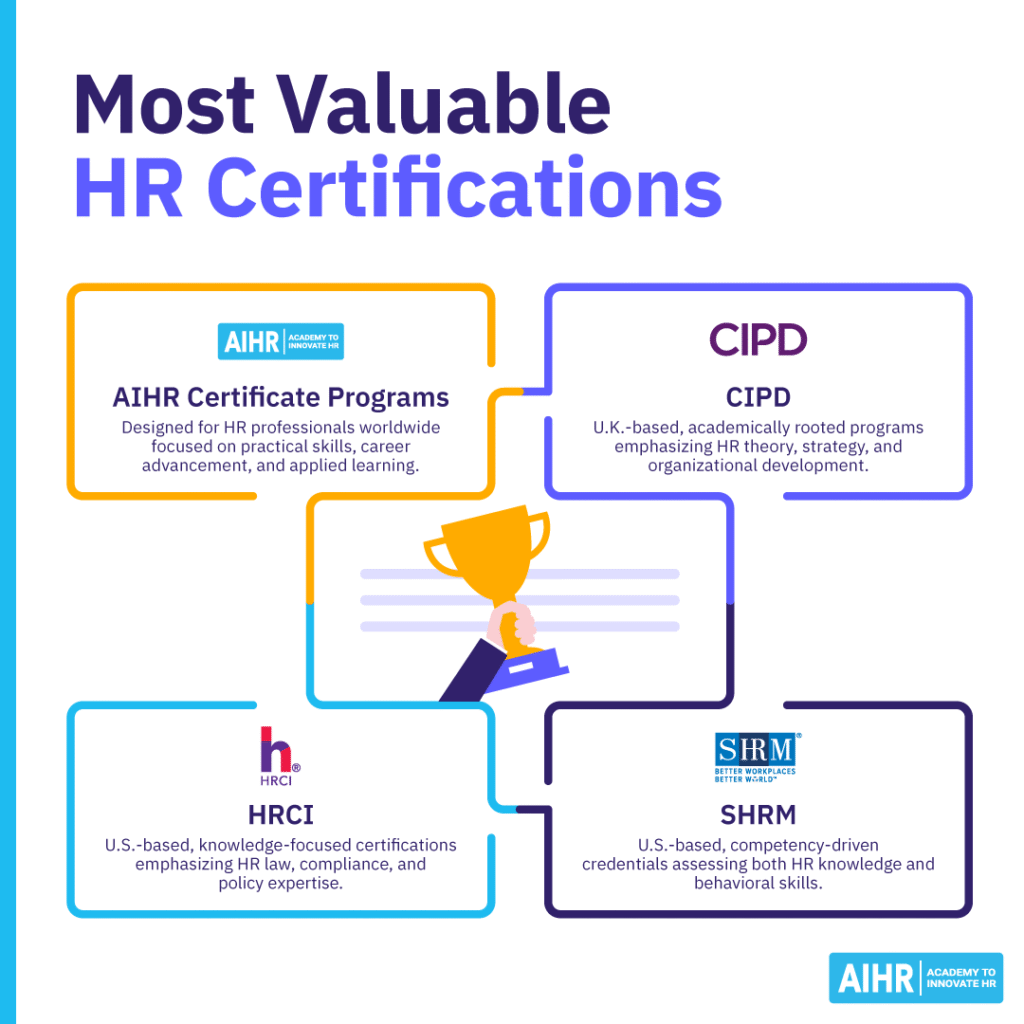
Most valuable HR certifications: An overview
Most valuable HR certifications, compared
How to choose the most valuable HR certification for you
FAQ
Key takeaways
- No single HR certification or certificate program is the most valuable for everyone. The right choice depends on your role, goals, region, and current skill gaps.
- SHRM and HRCI are strong options if you want an exam-based HR credential, while AIHR certificate programs are a strong fit if you want to build practical HR skills.
- A certification usually validates existing knowledge, and certificate program usually helps you build new skills through structured learning.
- Before you invest, check the curriculum, assessment method, provider reputation, cost, recognition, and how the credential supports your target role.
What’s the real value of HR certifications?
HR certifications and certificate programs can help you build confidence, show commitment to the HR profession, and make your skills more visible to employers. An exam-based HR certification, for instance, can show you understand HR principles, employment practices, and professional standards. This can help if you’re applying for roles where a recognized credential is preferred.
A practical HR certificate program, on the other hand, can help you close a specific skill gap. For example, you may want to build stronger people analytics skills, improve your HR business partnering approach, or learn how to use AI responsibly in HR work. Generally speaking, HR certifications and certificate programs can help you:
- Career advancement: A relevant program can prepare you for a promotion, specialist role, or move into a more strategic HR position.
- Salary growth: Credentials can support salary growth when they connect to real skills, experience, and role requirements.
- Gaining credibility as an HR professional: A recognized credential can help employers, managers, and peers better understand the extent of your HR knowledge.
- Advantage when competing for specialized roles: Some employers look for specific HR credentials for generalist, compliance, business partnering, or leadership roles.
- Staying current: HR changes quickly. Structured learning can help you keep pace with new tools, laws, analytics practices, and workforce trends.

HR certification vs. HR certificate program
Some people use the terms ‘certification’ and ‘certificate’ interchangeably, but they’re distinct. A certification is usually a formal credential from a professional body that validates knowledge, skills, or competencies you already have, often through an exam. SHRM-CP, SHRM-SCP, PHR, and SPHR are examples of exam-based HR certifications.
A certificate program, however, is usually a structured learning program that helps you acquire specific skills, then awards a certificate when you complete the program requirements. AIHR’s HR certificate programs fit this skills-building category. Here’s a simple way to think about it:
Goal | Suitable choice | Reason |
Validate HR knowledge you already have | HR certification | It proves you meet a recognized standard of HR knowledge, supporting your professionalism in HR. |
Build new HR skills | HR certificate program | It can teach you practical HR skills you can apply to your current and future HR roles. |
Meet an HR job posting requirement | HR certification | Prospective employers may prefer specific credentials for certain Human Resources positions. |
Transition into a new HR specialty | HR certificate program | It can help you close a targeted skills gap, strengthening your suitability for the role. |
Maintain an existing HR credential | Eligible HR learning or recertification credits | It helps you keep any HR certifications you already have active. |
An HR professional may use both throughout their career. For example, you might complete an HR certificate program to build practical data skills, then pursue a SHRM or HRCI credential later to validate broader HR knowledge.
Most valuable HR certifications: An overview
What’s the most valuable HR certification or certificate program for you? The answer depends on the following factors. For example:
- Your current HR experience
- The type of role you want next
- Your location and employer expectations
- Your budget
- Your preferred learning format
- The skills you need to build or prove.
Do you want to build new skills, validate existing knowledge, meet a job requirement, or prepare for a future specialization? Determining this will help you choose the right certification or certificate program for you.
Please note that this list is compiled based on publicly available information. We have not tried the certifications ourselves, with the exception of AIHR’s certificate programs.
AIHR certificate programs
AIHR’s HR certificate programs are designed for HR professionals who want to build practical, job-ready skills across specific HR specialties. It offers 16 programs covering major HR areas, and learners earn a digital certificate after completing each program. They’re also largely eligible for recertification activities with renowned professional HR organizations like SHRM, HCI, HRCI, and CIPD.
The certificate programs AIHR offers include:
- Artificial Intelligence in HR: Helps you use AI more confidently in daily work, with no prior AI experience required. You’ll learn AI fundamentals, prompt design, generative AI (GenAI) tools, responsible use, and AI strategy, so you can improve HR workflows and support better decisions.
- HR Business Partner 2.0: For HR professionals who want to move from operational HR into a more strategic role. You’ll build skills in business acumen, HR metrics, employee experience, consulting, and AI fluency so you can connect people strategy to business outcomes.
- People Analytics: Helps you close data literacy gaps and turn HR data into useful business insights. You’ll learn to use Excel and Power BI, build dashboards, and translate people data into clear recommendations leaders can act on.
- Learning & Development: Teaches L&D Specialists and HRBPs to design, deliver, and evaluate learning strategies that support business goals. You’ll be able to assess learning maturity, design formal programs, improve informal learning, and use learning analytics to show impact.
- Organizational Development: Teaches you how to diagnose organizational issues and lead effective change. You’ll learn to apply organizational development models, design structures, run OD interventions, and complete a graded capstone based on a practical case study.
- HR Generalist: Helps you build practical skills across the full HR function, especially in small to mid-sized organizations. You’ll gain the skills to strengthen HR operations, connect policies to business goals, support company culture, and create measurable people and business impact.
You can also opt for Full Academy Access, which gives you access to all 16 certificate programs for 12 months.
Learner testimonials
Here are reviews from people who have completed AIHR certificate programs and found them valuable.
“I really enjoyed the HR Business Partner 2.0 course. It gave me a fresh perspective on how HR can move beyond administrative tasks and play a truly strategic role in driving business results. I especially liked the focus on data-driven decision-making, agility, and aligning HR practices with organizational goals. Overall, the course was practical, insightful, and very valuable for my professional growth.” – Anna
“The Compensation & Benefits Certificate Program is a well-structured and practical learning experience that provides a solid foundation in reward strategy, pay structures, benefits design, and analytics. The program combines theory with real-world case studies, making it highly relevant for HR professionals looking to strengthen their expertise in total rewards. One of its key strengths is the focus on linking compensation strategies to business goals, while also addressing modern challenges like pay equity and global benchmarking. Overall, it’s a valuable program for HR practitioners aiming to advance their careers and make data-driven, strategic contributions in the area of C&B.” – Sanjay
A practical and insightful program that blends theory with real-world application. It covers core L&D topics—from learning culture and design to workforce planning, coaching, and ROI—while keeping a strong focus on business impact. Well-structured, relevant, and highly valuable for any L&D professional. – Sfanh
SHRM certifications
The Society for Human Resource Management (SHRM) offers two main HR certifications: SHRM-CP and SHRM-SCP. The SHRM-CP is for people performing HR-related duties or pursuing a career in Human Resources. SHRM says candidates do not need an HR title, degree, or previous HR experience to apply, although basic working knowledge of HR is recommended.
The SHRM-SCP is for HR professionals with at least three years of strategic-level HR work. It’s also available to SHRM-CP credential holders who have held the credential for at least three years and are moving into a strategic role. SHRM certifications are competency-based and aligned to the SHRM Body of Applied Skills and Knowledge (SHRM BASK).
An HR certification can help you show commitment to the field, and a reputable certificate program can help you build practical, applicable skills you can apply immediately to your HR role.
AIHR’s Demo Portal lets you explore practical HR learning by:
✅ Sampling HR lessons to see which topics match the roles you’re aiming for
✅ Browsing practical tools, templates, and guides used in day-to-day HR work
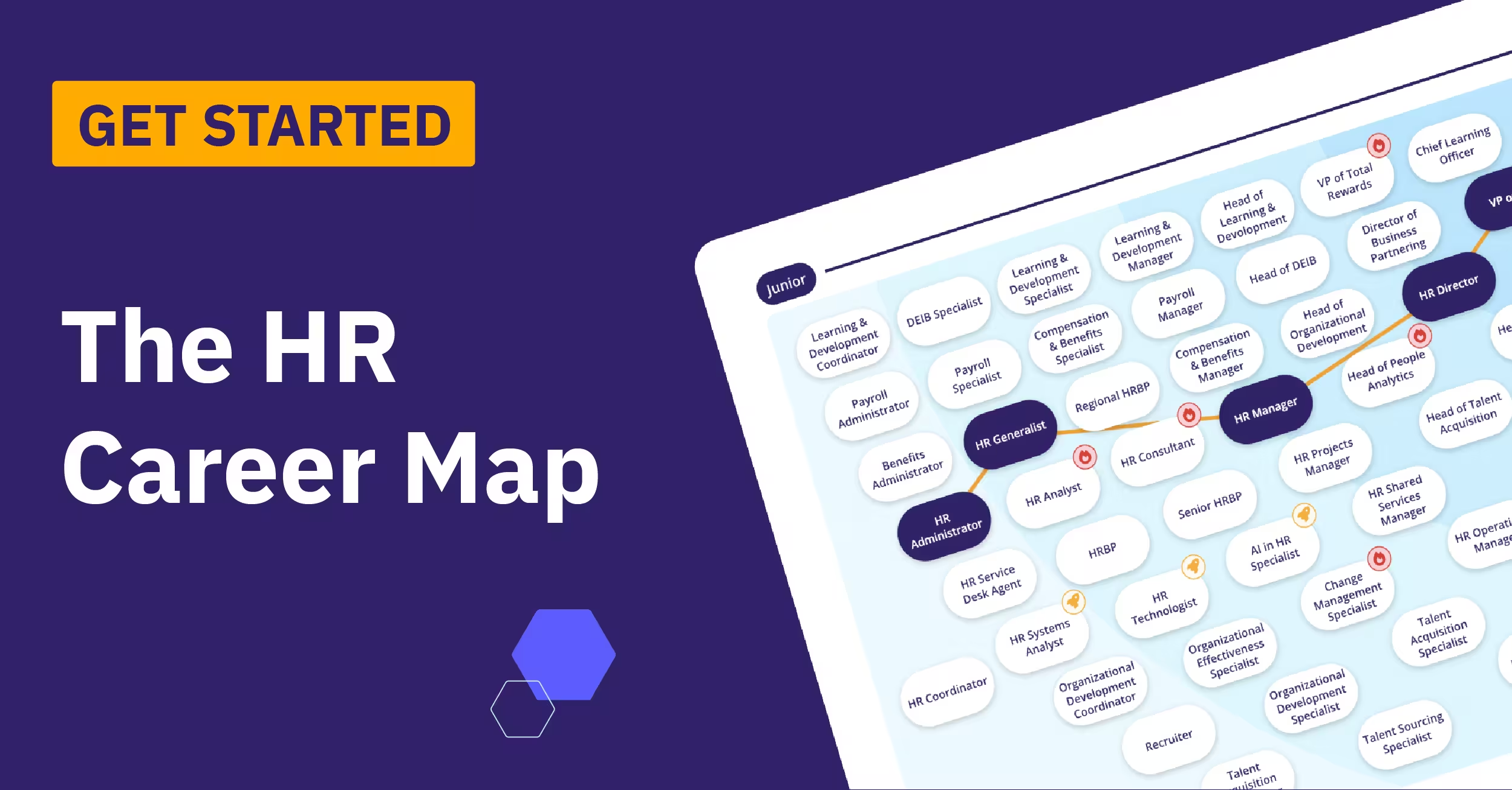
✅ Exploring different HR career paths and identifying the skills each one requires
✅ Using AIHR Copilot to get learning suggestions based on your goals and interests
🎓 Use the Demo Portal for a closer look at learning that can support your next HR career move.
HRCI certifications
The HR Certification Institute (HRCI) offers a portfolio of HR credentials across career stages. The aPHR is designed for people starting their HR journey or exploring a path into HR, while the PHR is for HR professionals focused on implementing programs and supporting day-to-day operations. The SPHR, on the other hand, is for leaders who shape HR strategy and policy.
The PHR has a clear U.S. HR focus, validating technical and operational HR knowledge grounded in U.S. laws and regulations. To qualify for the PHR, candidates need one year of professional-level HR experience with a master’s degree, two years with a bachelor’s degree, or four years without those degree requirements. HRCI also offers international credentials, such as PHRi and SPHRi, for HR professionals working outside the U.S.
CIPD qualifications
The Chartered Institute of Personnel and Development (CIPD) offers HR and L&D qualifications, mainly through external study centers. CIPD qualifications are awarded by CIPD and include three levels: Foundation Certificate, Associate Diploma, and Advanced Diploma. Completing a CIPD qualification can also lead to Foundation Membership or Associate Membership, depending on the qualification level.
The Foundation Certificate is for HR and L&D beginners, the Associate Diploma for HR and L&D professionals who want to develop further, and the Advanced Diploma for professionals aiming for strategic and leadership roles. CIPD is especially relevant if you work in the U.K., Europe, or an organization that recognizes CIPD qualifications.
Most valuable HR certifications, compared
Provider | Key certificate programs/certifications | Most valuable for | Main focus | Exam/program cost |
AIHR | Artificial Intelligence for HR, HR Business Partner 2.0, People Analytics, Learning & Development, Organizational Development, HR Generalist | HR professionals who want practical, applied HR skills | Skills building, real-world application, templates, projects, and digital certificates | $1,125 for each certificate program, $1,850 for Full Academy Access |
SHRM | SHRM-CP, SHRM-SCP | HR professionals who want a recognized exam-based credential | Behavioral competencies and technical HR knowledge | $399 for SHRM members, $499 for non-members |
HRCI | aPHR, PHR, SPHR | HR professionals who want credentials across career levels | HR operations, compliance, strategy, and professional credibility | aPHR: $400 PHR: $495 SPJR: $595 Each price includes a $100 application fee. |
CIPD | Foundation Certificate, Associate Diploma, Advanced Diploma | HR and L&D professionals in the U.K., Europe, or CIPD-recognizing organizations | HR theory, professional standards, and people practice | Foundation Certificate: £1,300 – £2300 Associate Diploma: £1,600 – £3,600 Advanced Diploma: £3,000 – £7,000 |
How to choose the most valuable HR certification for you
Use the following tips to help you choose the most valuable HR certification or certificate program for your specific needs:
Start with your career goal
Begin with the role you want next. Are you trying to enter HR, move into a generalist role, specialize, or step into leadership? If you want to enter HR, a practical certificate in HR fundamentals may help you build confidence and proof of learning. If you already have HR experience and want a recognized credential, SHRM-CP, PHR, or a similar certification may fit better.
If you want to specialize, choose a program that matches the target skill. This could be people analytics, compensation and benefits, HR business partnering, sourcing and recruitment, learning and development, or talent acquisition.
Decide if you need to build or prove skills
If you need to learn and practice new skills, choose a certificate program. However, if you need to validate knowledge you already have, go for a certification. For example, if you want to learn how to build an HR dashboard, AIHR’s People Analytics Certificate Program may be more useful than exam prep. If a job posting names SHRM-CP or PHR as a preferred credential, an exam-based certification may give you a stronger signal.
Assess regional recognition
Different credentials carry different weight in different markets. SHRM and HRCI are typically most relevant for U.S.-based HR professionals, while CIPD is more relevant in the U.K. and Europe. AIHR certificate programs are online and skills-focused, so you can attend them regardless of where you’re based. But before you enroll in any program, scan job postings for your target role and location to see which credentials employers mention most.
Review the curriculum and assessment
When selecting a credential or program, consider the following:
- Topics covered
- Learning format
- Time commitment
- Assessment method
- Practical assignments
- Access to templates, tools, and examples
- Support from instructors, coaches, or community
- Recertification credit eligibility.
A strong program should help you do something useful at work, not just add a line to your résumé.
Compare cost against expected value
Costs differ widely. Some programs require exam fees, study materials, memberships, or renewal costs, while others bundle learning, resources, and community access into one price. Before you enroll, ask yourself:
- Will this certification or certificate program help with my next role?
- Does it close an urgent skills gap I have?
- Will my employer pay for it?
- Can I apply the learning within the next three to six months?
- Does it support long-term career growth?
Budget is also an important consideration. A more expensive certification or certificate program isn’t necessarily superior to a cheaper one, but you should also assess how well each one on your shortlist can support your career goals. The best investment is the one you can connect to your career plan.
Speak to experienced HR professionals
Talk to HR peers, mentors, managers, or recruiters before you commit to any certification or certificate program, and ask them which credentials your market and role type value. You can also review LinkedIn profiles of people in your target role, and look for patterns.
If you’re aiming for an HRBP role and find that many HRBPs in your region hold a SHRM-CP credential, you know which certification to take. If a people analytics role emphasizes Excel, dashboards, and data storytelling, prioritize practical analytics skills via a certificate program.
Check provider credibility
Review the provider’s reputation before you invest in a certification or certificate program. Consider factors such as curriculum transparency, assessment requirements, and the presence (or absence) of recognized instructors or subject matter experts. At the same time, assess the program’s content, read student reviews, verify recertification credit eligibility, and confirm that the provider has clear pricing and refund policies.
For formal certifications, check the certifying body’s eligibility requirements and exam requirements. For certificate programs, check the learning outcomes and proof of application.
Next steps
The most valuable HR certification or certificate program is the one that helps you move closer to your next career goal. This could mean earning a recognized credential, building practical HR skills, or combining both over time. Before you choose, look at the positions you want next, what credentials employers prefer for those roles, and what skills show up repeatedly in the relevant job postings; you can use this as your decision filter.
To preview the AIHR learning experience and explore practical HR skills, check out AIHR’s Demo Portal before deciding and enrolling. This way, you can sample lessons, browse HR tools and templates, explore different HR career paths, and see which learning path best fits your goals.
FAQ
Some of the best-known HR credentials include SHRM-CP, SHRM-SCP, aPHR, PHR, SPHR, and CIPD qualifications. AIHR certificate programs are also valuable if your goal is to build practical HR skills in areas such as people analytics, HR business partnering, learning and development, compensation and benefits, or AI in HR.
Yes. Many people enter HR through administrative, recruiting, operations, or people support roles. A certificate can help if you need to show practical HR knowledge, especially when you’re early in your career or changing fields. It works best when you connect it to specific skills, such as onboarding, HR administration, employee relations, or HR data.