
Future HR skills are changing faster than many professionals can keep up with. AIHR’s research found that only 50% of the HR teams believe they have the right skills to deliver impact. HR professionals who don’t build new capabilities risk losing relevance as AI, analytics, and constant change reshape the role’s requirements.
These skills combine technology, human judgment, and business acumen. They help HR professionals make better people decisions, improve business outcomes, and stay effective as technology and work continue to change. This article breaks down the future HR skills that will matter most by 2027, and how to start building them today.
Contents
Why HR skills are changing faster than ever
What “future-ready” actually means for HR
8 future HR skills that will matter most in 2027
How to prioritize which skills to build first: 4 steps
How to start building future-ready HR skills
Why HR skills are changing faster than ever
The scope of HR work is expanding fast. AI adoption, workforce analytics, employee wellbeing, sustainability reporting, and organizational change are now all part of the role. HR has to help the business manage these shifts while also adapting its own work.
According to the World Economic Forum’s Future of Jobs Report 2025, nearly 40% of core skills are expected to change by 2030. The report also notes that 22% of current jobs are expected to be disrupted by technological advances, demographic shifts, geoeconomic tensions, and economic pressures.
At the same time, HR.com’s research shows that only 44% of HR professionals say they’re an equal partner in business planning. In 30% of cases, HR executives contribute to strategic planning but only provide talent-related input. The data also points to three areas where HR has the biggest gap between importance and proficiency:
Thinking strategically
92%
51%
Facilitating change
89%
47%
HR data and analytics
80%
34%
That gap between knowing a skill matters and being able to apply it is where careers stall. Awareness alone won’t move you forward, and these shifts are happening now. To be visibly capable by 2027, the next 18 to 24 months matter.

What “future-ready” actually means for HR
AIHR believes HR professionals should use the T-Shaped HR Competency Model to build the HR skills of the future. This model helps HR professionals develop both broad HR capability and deeper expertise in a specific area.
AIHR’s HR Competencies for 2030 identifies six core competencies that sit across the bar of the T. This model helps HR professionals develop both broad HR capability and deeper expertise in specific areas, namely:
- Business Acumen: Understanding business trends and aligning people strategies with organizational goals.
- Data Literacy: Using data to analyze people issues, make informed decisions, and show HR’s impact.
- Digital Agility: Using digital tools to improve efficiency, collaboration, and readiness for continuous change.
- AI Fluency: Applying artificial intelligence responsibly to improve HR outcomes and business value.
- People Advocacy: Building human-centered organizational cultures that support wellbeing, performance, ethics, and sustainability.
The stem of the T represents specialist domains tied to your role. These include talent acquisition and employer branding, learning and development, total rewards and compensation, people analytics, and employee relations. Future-ready HR skills require you to build capabilities that transfer across new tools, work structures, and business priorities.
The HR skills that matter most are changing fast, from data literacy and digital agility to AI fluency and strategic thinking. To remain relevant, it’s important to continuously explore what to learn next and build practical skills you can apply in your role.
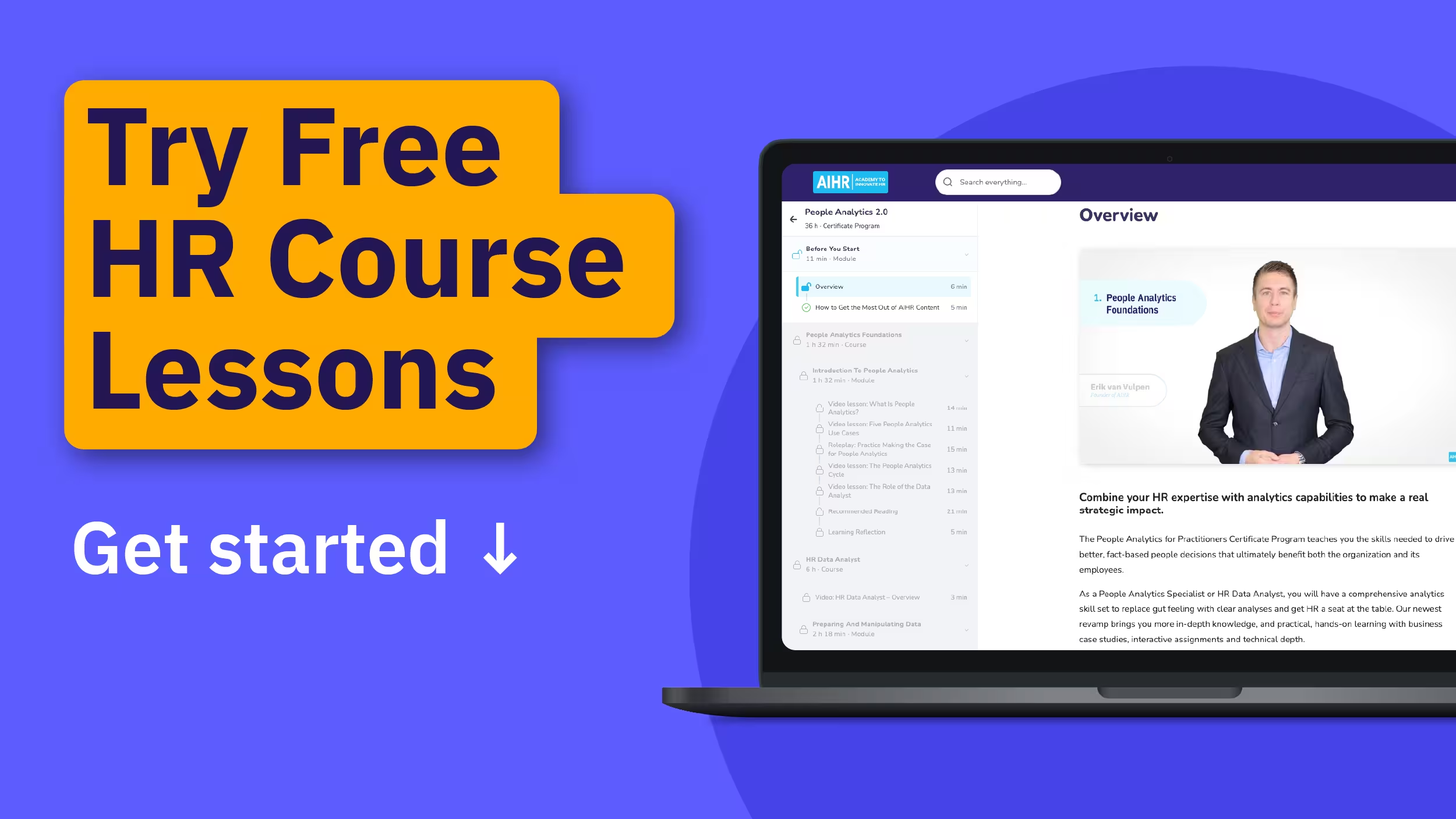
AIHR’s Demo Portal gives you a preview of the learning tools, lessons, and resources designed to help you grow as a future-ready HR professional:
✅ Explore preview lessons across key HR topics and discover which skills align with your career goals
✅ Access practical guides, templates, and resources you can use to improve your day-to-day HR work
✅ See how AIHR Copilot can support faster problem-solving and learning exploration
✅ Identify the certificate programs and learning paths that match your next development priority
💡 Use the Demo Portal to explore the skills that will help you stay relevant, credible, and ready for what’s next in HR.
Previous vs. future HR skills
The table below shows how HR skill requirements have changed over time, from traditional HR skills to future-ready HR skills:
AI and technology
Basic HRIS data entry and system administration
Digital agility and AI fluency: Confidently using digital tools and AI to work smarter, improve decisions, and adapt as work changes.
Data
Generating standard HR reports and tracking headcount metrics
Data literacy and people analytics: Interpreting workforce data and turning insights into decisions leadership can act on.
HR tech
Managing one core HR system, and logging support tickets
Digital agility: Evaluating, adopting, and connecting HR tools without weakening the employee experience.
Change management
Communicating change from the top down after decisions are made
Change and resilience: Guiding people through continuous reorganization and AI-driven role shifts before resistance builds.
Thinking
Following established HR policies and escalating edge cases
Critical thinking: Making sense of complexity, challenging assumptions, and cutting through noise to make sound decisions.
Ethics and compliance
Ensuring legal and regulatory compliance
Ethical judgment: Making fair calls on AI use, data privacy, and bias.
Business contribution
Reporting HR metrics to your organization
Business acumen: Translating people decisions into business outcomes like revenue, cost, risk, and growth.
Influence
Advising managers on HR policy and process
Strategic influence: Shaping long-term business decisions in the language of the business, not just HR.
Core orientation
Working as a functional specialist in one HR domain
T-shaped capability: Building broad HR competency with deep expertise in at least one area.
8 future HR skills that will matter most in 2027
The most important future HR skills sit across three areas: technology and data, human-centered work, and business impact. HR professionals need all three to use new tools well, support employees through change, and make stronger decisions for the organization.
Bucket 1: Technology and data skills
This bucket covers the skills HR professionals need to use digital tools, AI, and workforce data with confidence. These skills help HR move from manual execution to smarter, faster, and more evidence-based work.
1. AI fluency for HR
AI fluency goes beyond just using ChatGPT to draft job descriptions. In fact, AI and automation proficiency are the biggest skills gaps HR needs to close.
You need to know where AI can speed up manual work, such as summarizing survey feedback or drafting learning recommendations. You must also know where human judgment is non-negotiable, such as making hiring decisions or handling employee complaints.
Application tip: Pick one HR task and redesign it with AI in the loop. For example, use AI to draft learning recommendations based on training needs analysis results, then review and refine the output before sharing it.
2. Data literacy and people analytics
AI can pull and summarize data in seconds; the harder skill is knowing what that data means and what decision it should support.
HR professionals need to move beyond reporting numbers and learn how to interpret patterns, spot risks, and translate findings into action. According to AIHR’s research, 60% of HR professionals feel they lag behind in digital and data competencies.
Application tip: Create a simple “insight-to-action” checklist for every HR report. Include the key finding, likely causes, business impact, recommended action, and owner.
3. Digital agility
Digital agility means adopting HR technology quickly, adapting workflows, and connecting systems without losing sight of the employee experience. In fact, 93% of HR leaders expect their teams to be involved in a major digital transformation initiative within the next two years.
To be digitally agile, you must understand how technology can improve HR work and where it may create friction, and apply it accordingly.
Application tip: Audit one tool your team already owns and identify features you’re not using. Then ask peers or stakeholders how those features could improve a current HR process.
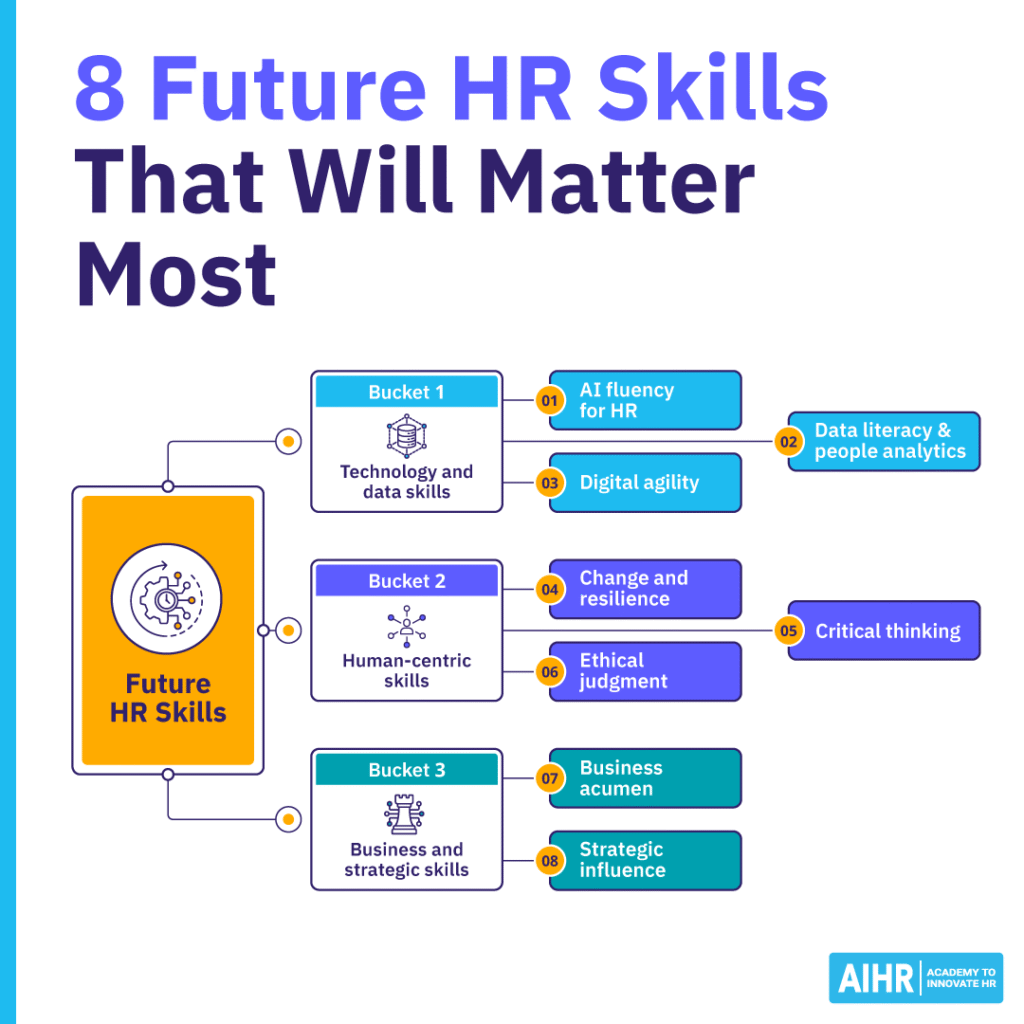
Bucket 2: Human-centric skills
This bucket covers the skills HR professionals need to guide people through uncertainty, make fair decisions, and keep the human side of work visible. As AI and automation grow, these skills will become even more important, not less.
4. Change and resilience
Transformation used to be occasional, but long planning cycles simply don’t hold up anymore. Organizations must be able to sense change and adapt fast when markets, technologies, and customer expectations constantly shift.
This also means HR professionals must help employees understand what’s changing, why it matters, and how it affects their work. They also need to build their own resilience so they can guide others through uncertainty without adding confusion.
Application tip: Build a lightweight change management template you can reuse. Include the change trigger, what’s changing, why it’s changing, what stays the same, who is affected, and how the change should be communicated.
5. Critical thinking
Critical thinking helps HR professionals make sense of complexity and cut through noise. AI can give you an answer in seconds, but critical thinking helps you decide whether that answer is accurate, relevant, and right for your context.
Gartner predicts that the weakening of critical thinking skills due to GenAI use will drive 50% of global organizations to require ‘AI-free’ skills assessments.
Application tip: Pick one recurring problem on your team and run a root cause analysis before proposing a solution. Use the 5 Whys method: State the problem, ask “why” five times, and let each answer guide the next question until you reach the underlying cause instead of the symptom.
For more complex problems, use a fishbone diagram to map possible causes across categories like people, process, tools, and data. Bring the root cause — not just the symptom — to your next manager 1:1 and build the solution from there. Ask: What could we be overlooking? What goal are we actually trying to achieve?
6. Ethical judgment
AI will increasingly influence hiring, performance reviews, workforce planning, and employee data analysis. You need to catch biased, inaccurate, or invasive outputs before they affect real people.
Ethical judgment means knowing when to question a recommendation, when to involve a human, and when to avoid automation completely. This is especially important in high-impact decisions that affect someone’s pay, benefits, career prospects, or wellbeing.
Application tip: ” Write a one-page ‘when not to automate’ guide for your team. For example, sensitive employee conversations should stay human-led. You can use AI to prepare questions or summarize non-confidential themes, but follow-up, judgment, and final decisions should stay with people.
Bucket 3: Business and strategic skills
This bucket covers the skills HR professionals need to connect people decisions to business outcomes. These skills help HR move beyond support work and become a stronger partner in decisions about growth, productivity, cost, and risk.
7. Business acumen
For years, HR’s job was to hire fast and keep costs low, but that’s no longer enough. HR professionals must demonstrate how people strategies affect profit, productivity, risk, growth, and customer outcomes. In fact, 67% of experts identify strategic business acumen as the most important non-negotiable capability for HR leaders.
Application tip: Connect one HR initiative to a revenue, cost, or risk metric. For example, if you invest in a new employee wellbeing program, show whether it could reduce turnover, absence, or productivity loss.
8. Strategic influence
Knowing the numbers isn’t enough if no one acts on your recommendation. Strategic influence helps HR professionals get support, secure buy-in, and shape decisions before they’re finalized.
This skill requires you to frame HR recommendations in business terms. Instead of saying, “We need a better onboarding process”, explain how poor onboarding affects time to productivity, retention, manager workload, and employee experience.
Application tip: Prepare a one-page business case template for HR recommendations. Link each proposal to cost, revenue, productivity, risk, or growth. It’s easier to win approval when you focus on outcomes the business already cares about.
The most future-ready HR professionals pair at least one strong technical skill with strong human judgment. That combination is hard to automate.
How to prioritize which skills to build first: 4 steps
Not sure where to begin to build your future HR skills? The following four steps will help you pinpoint which focus area and skill to prioritize.
Step 1: Assess
Most HR professionals already know future-ready HR skills matter, but may be unsure where to start. Use AIHR’s T-Shaped HR Assessment to assess your knowledge and skills across the six core HR competencies. This free, evidence-based tool can help you identify your development opportunities and compare results with your colleagues.
Step 2: Match to your role and next career move
So, what skills should HR have? The six core competencies apply to everyone, but their importance depends on your current role, experience, and career goals.
An HR Business Partner would lean heavily on business acumen and strategic influence, while a People Analytics professional would start with data literacy and digital agility. Your next career move should influence your starting point as much as your current role does.
Step 3: Pick two skills, not 10
Choose one technical skill and one human or business skill to focus on through 2027. For example, you could build AI fluency and ethical judgment together so you can use AI more responsibly at work. Trying to build everything at once will dilute your progress; a narrower focus makes it easier to practice, get feedback, and show growth.
Step 4: Build in public
Apply each skill to a live work problem so your learning becomes visible. This could mean presenting a cost-impact analysis in a leadership meeting instead of only studying the framework privately. Also, remember that no one can build all future-ready HR skills at once. The goal is steady, prioritized progress, not perfection.
How to start building future-ready HR skills
Once you’ve found your biggest HR skills gap, do the following:
Choose a structured learning path
Random free videos can help you understand a topic, but they’re unlikely to help you build transferable capability. To close the gap between theoretical knowledge and practical application, choose a practical learning path with assignments, examples, and real HR scenarios.
This is where AIHR Certificate Programs fit. Lessons are built around applied HR practice rather than theory, and the programs are self-paced. If you want to formalize your HR learning, you can also enroll with SHRM, HRCI, or CIPD. AIHR helps you build the applied capability behind those credentials.
Apply each new skill to a real project within 30 days
Pick one real work problem and use your new skill before the course ends to turn learning into capability. For example, if you’re building your critical thinking skills, choose one recommendation from a recent HR report. Find any evidence that supports it, think about what might be missing, and whether there’s another explanation before you present it.
Request feedback to pressure-test your progress
Ask a peer, manager, or community to help pressure-test your progress. Learning in isolation often doesn’t reveal the blind spots others can spot, and feedback from trusted parties in the same field can help you build confidence faster. It shows you your strengths and where you need to improve to build the skills you need.
Revisit and re-prioritize every few months
Your HR role will continue to evolve based on your career stage, business priorities, and the direction your organization is taking. Your biggest gap today may not be your biggest priority in Q3, and you need to build re-prioritization into your routine, not just your learning plan. Every few months, review what you’ve learned, where you’ve applied it, and what skill will create the most value next.
Next steps
The HR professionals who thrive by 2027 won’t be the ones who know the most. They’ll be the ones who started building before they felt ready. Pick two skills, apply them at work, and use each project as a chance to practice. The sooner you start, the easier it becomes to adapt as HR keeps evolving.
Not sure where to begin? AIHR’s Demo Portal is a low-friction way to explore what our certificate programs offer before you commit. You’ll also get a glimpse of what it’s like to learn and build practical skills with AIHR.