
A well-executed hiring plan can be the difference between a company that reaches its strategic business goals and one that’s outperformed by its rivals.
Just ask Marc Benioff, co-founder and CEO of tech giant Salesforce. “Acquiring the right talent is the most important key to growth. Hiring was – and still is – the most important thing we do,” he says. And he should know. Having launched the business in 1999 from a one-bedroom apartment, Salesforce is now a juggernaut boasting best-in-class software for 11 straight years, as well as a team of over 80,000 employees.
What’s the key to acquiring the right talent? It’s about so much more than simply filling vacancies. It’s strategically acquiring talent to fuel growth, innovation, and competitive advantage – and it all begins with a strategic hiring plan.
Contents
What is a hiring plan?
Why your organization needs a hiring plan
7 considerations for an effective hiring plan
How to forecast hiring needs for the next year in 7 steps
How to create a hiring plan: Best practices
Free hiring plan template
Startup hiring plan vs. established company hiring plan
Hiring plan example: AccounTech

What is a hiring plan?
A hiring plan, also referred to as a recruitment plan, is a structured roadmap that outlines which roles your organization needs to fill, when, and why over a defined period (typically a quarter or a year). It’s a practical way to turn business targets and a broader talent acquisition strategy into clear hiring priorities. Instead of reacting to open roles as they appear, you plan ahead, aligning headcount, timing, skills, and budget with what the business actually needs to deliver results.
An effective hiring plan should include the following:
- Roles to be filled and the required headcount for each, factoring in new positions and replacements for employees leaving the company
- Key capabilities or experience profiles required per role, especially for business-critical or hard-to-fill positions
- The timeline for when those positions should be filled, to ensure your company has the right people in place to meet its business goals
- The budget allocated for the recruitment process. This includes the hard costs of advertising job openings, recruitment agency fees, and the soft costs associated with administration, interviewing candidates, and onboarding new hires.
HR and talent acquisition leaders typically own the hiring plan. They work with business leaders to define workforce needs, clarify role scope, and align hiring budgets and timelines. Throughout the year, they also track and report on key hiring metrics to ensure delivery stays on target.
Why your organization needs a hiring plan
When you don’t have a hiring plan, recruiting becomes reactive. Business leaders submit urgent requests to hire for critical vacancies, priorities clash, and your TA team rushes to fill roles without clear direction. A hiring plan puts you in control and ensures hiring supports real business outcomes.
Your organization needs a hiring plan to:
- Align hiring with business strategy: Revenue targets, expansion plans, and product roadmaps translate into concrete hiring needs.
- Set clear role priorities: Instead of filling roles based on urgency alone, the business agrees on which positions deliver the most impact.
- Control hiring costs: Forecasting recruiting expenses and internal capacity helps prevent budget overruns and last-minute trade-offs.
- Give TA a clear execution roadmap: Defined hiring waves, seniority levels, and timelines allow recruiters to plan sourcing and pipeline building in advance.
- Create accountability across stakeholders: Clear ownership of headcount approval, delivery, and progress tracking reduces friction between TA, HR, and Finance.
- Reduce hiring risk: Early visibility into hiring needs, timelines, and hard-to-fill roles prevents delays that slow growth.
A hiring plan sets direction, but delivering on it requires strong execution across sourcing, candidate evaluation, and collaboration with hiring managers. AIHR’s Talent Acquisition Boot Camp builds these capabilities through practical learning that integrates with your team’s daily work. Teams begin applying new approaches immediately and typically see measurable improvements already within the first 1–3 months.
In the program, your team will learn how to:
✅ Apply proven sourcing frameworks and outreach approaches that raise candidate quality
✅ Collaborate more effectively with hiring managers to align hiring goals and workforce needs
✅ Monitor and improve key hiring metrics such as time-to-fill and quality-of-hire
✅ Contribute strategically as talent advisors to the business
🎯 Turn your hiring plan into measurable hiring outcomes starting today.
7 considerations for an effective hiring plan
If you want your hiring plan to drive results, it needs structure and clear decision-making. The seven considerations below will help you build a plan that is realistic, aligned, and executable.
Company objectives
Does your hiring plan align with your company’s long-term goals? Are you planning a major product launch, market expansion, or scaling operations in the coming year?
These business initiatives should guide your recruitment needs and the types of talent you seek. For example, a product launch may require you to hire engineering and marketing talent early, while a market expansion might increase demand for sales, customer support, or local compliance expertise.
Avoid over-recruiting, which strains budgets and onboarding capacity, or under-recruiting, which delays execution and puts pressure on existing teams. Regular workforce planning helps you adjust hiring plans as business conditions shift.
1. Budget constraints
Is your recruitment plan budget realistic?
Consider job posting costs, agency fees, referral bonuses, and ATS expenses. A clear budget helps prioritize efforts and allocate resources effectively. Invest in quality recruitment tools and technologies to improve efficiency and reduce long-term costs.
2. Labor market conditions
Understanding the labor market is crucial. Are you facing a talent shortage or high-demand skills?
Analyze labor market trends to adjust your recruitment strategy and attract top talent. For instance, if the market for the skills you need is tight in your area of operation, you might consider partnering with educational institutions to build a talent pipeline or expand your search to remote candidates to fill skills gaps.
3. Technology
Are you using technology to streamline recruitment?
Applicant tracking systems (ATS) help manage job postings and candidate progress in the selection process. AI tools can automate tasks like résumé screening, pre-employment assessments, and scheduling, reducing time to hire and improving efficiency. However, they must involve human judgment to ensure fairness and avoid biases.
4. Diversity and inclusion
Are your hiring plans aligned with your organization’s diversity and inclusion goals?
Review your hiring processes for potential bias and ensure your recruitment strategy supports equitable access to opportunities. A structured, inclusive approach helps you widen your talent pool, strengthen decision-making, and build teams that reflect the markets and communities you serve.
5. Legal compliance
Is your company up-to-date with employment laws?
Review and update recruitment policies regularly to avoid legal issues. Consult legal counsel to ensure compliance with relevant laws, especially when hiring in multiple areas.
6. TA capability
Does your TA team have the capability to deliver on the hiring plan?
Assess whether your team has the right skills across workforce planning, sourcing, stakeholder management, and recruitment analytics to execute your recruitment plan. If gaps exist, you need to address them early through upskilling, process improvements, or additional hiring.
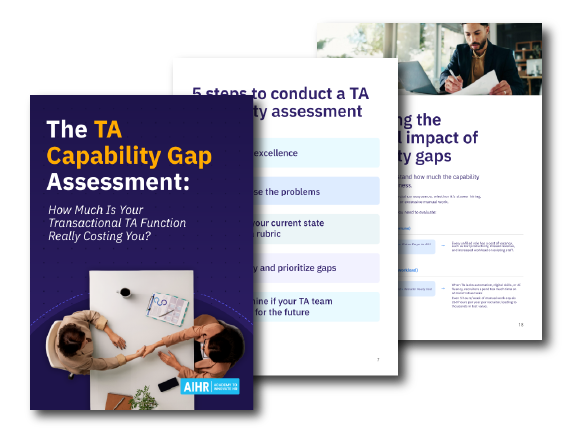
You can use AIHR’s TA Capability Gap Assessment to identify strengths and prioritize development areas.
How to forecast your hiring needs in 7 steps
A hiring plan is only as strong as the forecast behind it. For HR and TA leaders, forecasting hiring needs means turning business strategy, growth targets, and operational plans into a clear view of future talent demand. A structured forecast helps you secure critical skills in time, plan budgets effectively, and give your TA team realistic timelines to deliver.
Here’s how to forecast hiring needs for the period ahead:
Step 1: Consult with department heads
It’s virtually impossible to forecast your organization’s hiring needs without consulting widely with department heads. Only once you have a firm grasp on their strategic goals, expansion plans, and potential challenges can you pinpoint areas where additional staffing may be required.
Maintaining ongoing communication and collaboration with division heads will also help ensure your hiring plans remain on track and aligned with business objectives.
Step 2: Leverage data analytics
Company data is another essential source of information for forecasting hiring needs.
Analyzing your historical hiring trends, turnover rates, and workforce demographics will better equip you to identify patterns and predict future requirements. For instance, if a particular department has experienced high turnover in the past, you can use this data to anticipate the need for additional hiring in that area.
Step 3: Align with business growth projections
Understanding your organization’s growth projections is a key factor in forecasting hiring needs.
If your company is experiencing rapid growth, you will likely need to increase hiring to support this expansion. Conversely, if your business or industry is facing economic uncertainty or a slowdown, you’ll need to adjust your hiring plans accordingly.
Step 4: Plan for employee turnover
Employee turnover is a natural part of any business cycle. By analyzing historical turnover rates, identifying factors that contribute to turnover, and conducting stay interviews, your team can proactively anticipate future departures and plan for replacements.
Step 5: Consider the impact of tech advancements
Technological advancements, such as automation, artificial intelligence (AI), and other emerging technologies, can significantly alter workforce needs and require hiring for new skills and expertise.
Keep on top general and industry-specific technological trends and their potential impact on your workforce.
Step 6: Assess skill gaps
Conducting skills gap analyses can help you identify areas where employees lack the relevant skills and knowledge they need to perform their roles effectively.
The analysis will also help to inform your future hiring decisions and training initiatives for existing staff.
Step 7: Incorporate succession planning
Factor succession planning into your hiring forecast by identifying which critical roles may become vacant in the next 12 to 24 months due to promotions, retirements, or expected turnover.
At the same time, assess whether ready or near-ready successors exist for those roles. Where internal successors are strong, you can prioritize development. Where gaps remain, you can plan external hiring early and avoid rushed searches.
HR tip
Does your hiring plan account for the unexpected?
Consider various scenarios to ensure your hiring plan is adaptable. For example, an economic downturn could mean that a hiring freeze is necessary. Similarly, if the business’s strategic goal is to grow rapidly, you might need to accelerate recruitment. By anticipating potential shifts, you can proactively build different strategies based on various scenarios. For example, you could pre-screen candidates for future needs or build a flexible budget to accommodate unexpected opportunities.
How to create a hiring plan: Best practices
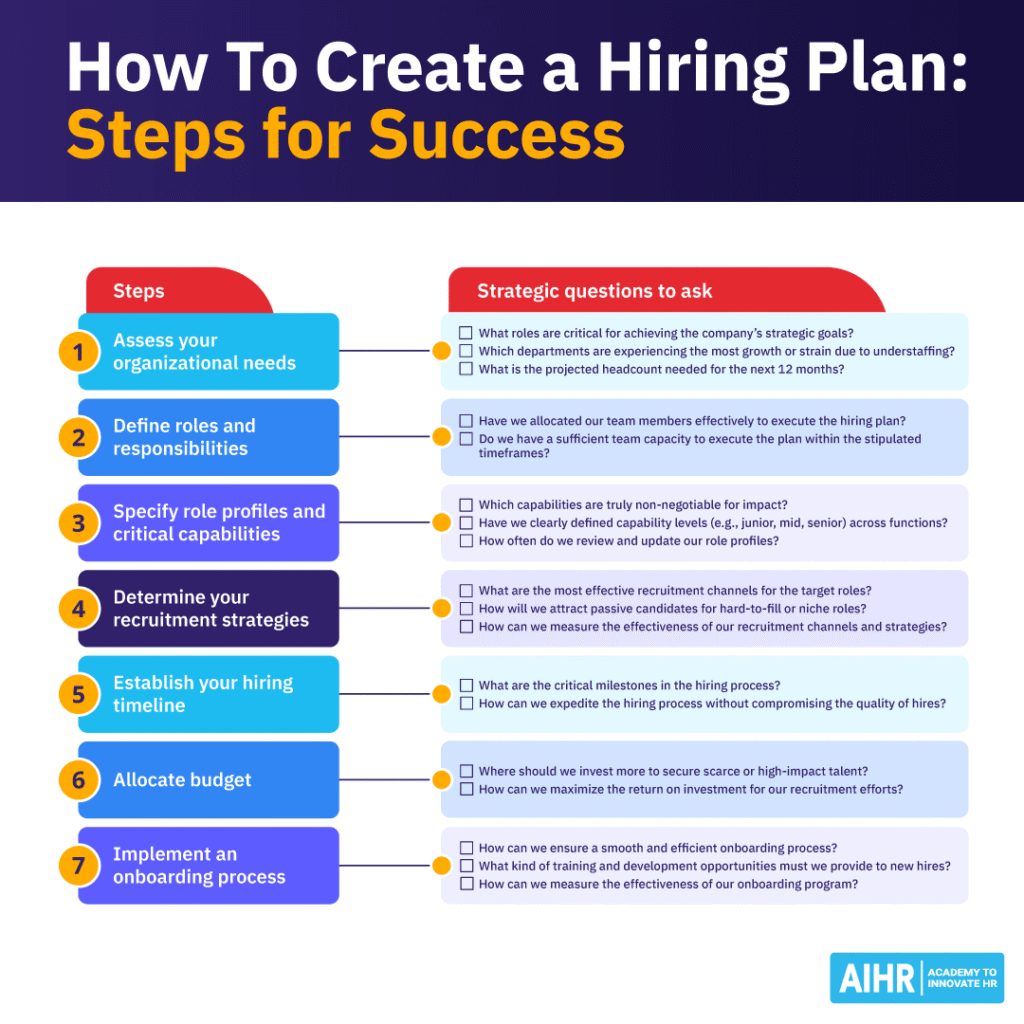
A hiring plan turns business demand into clear hiring commitments for the TA team: actions, ownership, and timelines. The following best practices help you create a hiring plan that’s realistic, aligned, and executable.
Assess your organizational needs
The first step in building a hiring plan is assessing your current workforce and identifying the positions that need to be filled in the short-, medium-, and long-term.
To do this effectively:
- Analyze your current workforce data: Review headcount, turnover rates, and time to fill. Identify skills gaps and roles with high attrition or performance risk.
- Consult with business leaders: Speak with department heads about upcoming projects, expansion plans, and capability gaps. Clarify which roles are critical and when they’ll be needed.
- Review growth projections: Align with Finance or Business Development to understand revenue targets, regional expansion, or new product plans that may drive hiring demand.
By combining workforce data with business input, you create a fact-based view of future talent needs instead of relying on ad hoc hiring requests.
Strategic questions to ask
- What roles are critical for achieving the company’s strategic goals?
- Which departments are experiencing the most growth or strain due to understaffing?
- Are there internal candidates whom you can promote or retrain to fill upcoming roles?
- What is the projected headcount needed for the next 12 months?
- Should we consider a mix of full-time, part-time, and contract employment types to match evolving growth needs?
Define roles and responsibilities within the TA team
Clear ownership keeps your hiring plan on track. Before hiring ramps up, define who within the TA team drives delivery, stakeholder alignment, and reporting.
Clarify responsibilities across:
- TA leadership: Sets hiring targets, manages capacity, aligns with business stakeholders, and tracks performance.
- Recruiters or talent acquisition specialists: Run intake meetings, build sourcing strategies, manage pipelines, and deliver against timelines.
- Sourcing specialists (if applicable): Develop proactive pipelines for critical or hard-to-fill roles.
- Recruitment operations: Manage systems, reporting, interview processes, and data quality.
Defined responsibilities reduce confusion, speed up decisions, and make it easier to course-correct when priorities shift.
Beyond role clarity, you need to ensure your team members have the capabilities required for the complexity of the roles you’re hiring for. Complex hiring plans often fail due to capability gaps, not just workload constraints.
Strategic questions to ask
- Have we allocated our team members effectively to execute the hiring plan?
- Do we have a sufficient team capacity to execute the plan within the stipulated timeframes?
- Do our TA team members have the right capabilities to support this plan?
- Where do capability gaps create execution risk?
Define role profiles and critical capabilities
A hiring plan should clarify what “good” looks like for each priority role before recruiters enter the market. Without clear capability profiles, hiring slows down, and stakeholders disagree on candidate quality.
When defining role requirements, focus on:
- Core responsibilities: What outcomes must this role deliver in the first 12 months?
- Critical capabilities: Which skills or experience are essential for business impact, especially for revenue-generating or business-critical roles?
- Level and scope: What seniority, decision-making authority, and ownership does the role require?
- Must-have vs. nice-to-have criteria: Separate non-negotiables from preferences to avoid over-screening and extended time to fill.
For hard-to-fill roles, invest more time upfront to align stakeholders on capability expectations. This reduces rework, shortlists misalignment, and late-stage offer rejections.
Strategic questions to ask
- Which capabilities are truly non-negotiable for impact?
- Have we clearly defined capability levels (e.g., junior, mid, senior) across functions?
- How often do we review and update our role profiles?
Determine your recruitment strategies
Your hiring plan should define how you’ll source talent for different role categories. Not all roles require the same approach. High-volume hiring, niche technical roles, and leadership searches demand different sourcing models and timelines.
When defining your recruitment strategy, consider:
- Channel mix by role type: Decide which sourcing channels work best for critical, high-volume, or hard-to-fill roles (e.g., direct sourcing, referrals, agencies, campus programs).
- Build vs. buy decisions: Determine when to develop internal talent and when to hire externally.
- Capacity planning within TA: Align recruiter workload with projected hiring volume to avoid bottlenecks.
- Pipeline strategy: Identify roles that require proactive pipeline building rather than reactive posting.
- Timeline alignment: Set realistic hiring timelines based on market conditions and role complexity.
Define milestones for sourcing, screening, interviewing, and onboarding, and review progress regularly. Adjust your strategy when market response, candidate quality, or time-to-fill data signals a gap.
Strategic questions to ask
- What are the most effective recruitment channels for the target roles?
- How will we attract passive candidates for hard-to-fill or niche roles?
- How can we measure the effectiveness of our recruitment channels and strategies?
Establish a hiring timeline
A hiring plan should map out the end-to-end hiring process and define realistic timeframes for each phase. Clear milestones help TA teams manage expectations, coordinate stakeholders, and prevent delays.
Outline the process across key stages:
- Role approval and intake: Confirm role scope, success profile, budget, and timeline with the hiring manager before launching the search.
- Sourcing and pipeline building: Activate agreed sourcing channels and build a qualified candidate pool.
- Screening and shortlisting: Assess candidates against the defined capability profile and align with the hiring manager on a shortlist.
- Interview and evaluation: Conduct structured interviews and ensure timely feedback from stakeholders.
- Offer and acceptance: Align on compensation, extend the offer, and manage negotiation timelines.
- Pre-boarding and onboarding: Prepare documentation, systems access, and onboarding plans to ensure a smooth start.
For each stage, define target timelines and decision ownership. Regularly review progress against these milestones and address bottlenecks early, especially for business-critical roles.
Strategic questions to ask
- What are the critical milestones in the hiring process?
- How can we expedite the hiring process without compromising the quality of hires?
Allocate budget
You’ll need to allocate a sufficient budget to execute your hiring plan effectively. Consider the following costs:
- Sourcing investments: Job boards, direct sourcing tools, employer branding campaigns, and referral programs.
- Agency and search fees: Especially important for leadership or hard-to-fill roles.
- Assessment and background checks: Tools used to evaluate and verify candidates.
- Recruitment operations costs: Technology, ATS, and interview infrastructure.
- Onboarding expenses: Equipment, training, and initial enablement support.
Prioritize budget allocation toward business-critical and revenue-generating roles. High-impact positions may justify higher sourcing spend or external search support. At the same time, track spend against hiring outcomes throughout the year. If cost per hire increases or timelines extend, reassess your channel mix, role requirements, or capacity assumptions.
Strategic questions to ask
- Where should we invest more to secure scarce or high-impact talent?
- What are the most cost-effective recruitment strategies we can use without compromising top-talent hires?
- How can we maximize the return on investment for our recruitment efforts?
- Which roles can we fill more efficiently through internal mobility or referrals?
Implement an onboarding process
A robust onboarding process can help new hires feel welcome and productive from day one. Key components of an effective onboarding process include:
- Preboarding: Make a good impression by sending a welcome email and providing essential information about the company and the role.
- Orientation: Conduct a comprehensive orientation program to introduce new hires to the company culture, values, and policies.
- Role-specific training: Provide training on the specific skills and knowledge required for the job.
- Mentorship: Assign a “buddy” to guide new hires and answer their questions.
- Regular check-ins: Schedule regular check-ins with new hires to assess their progress and address any concerns.
Strategic questions to ask
- How can we ensure a smooth and efficient onboarding process?
- What kind of training and development opportunities must we provide to new hires?
- Do we have mentors we can assign to new recruits?
- How can we measure the effectiveness of our onboarding program?
HR tip
Embrace inclusive hiring practices
To build a truly inclusive workplace, begin by reimagining your hiring process.
- Expand your talent pool: Partner with organizations supporting underrepresented groups, use diverse job boards and explore non-traditional recruitment channels.
- Enhance your interview process: Train your interviewers to ask unbiased questions, actively listen, create a welcoming environment, and implement structured interviews with standardized scoring to minimize bias.
- Assemble diverse interview panels: Consider factors like gender, race, ethnicity, age, ability, and sexual orientation when forming your panels. This helps to support varied perspectives, reduce bias, and signals your organization’s commitment to inclusion.
Hiring plan template
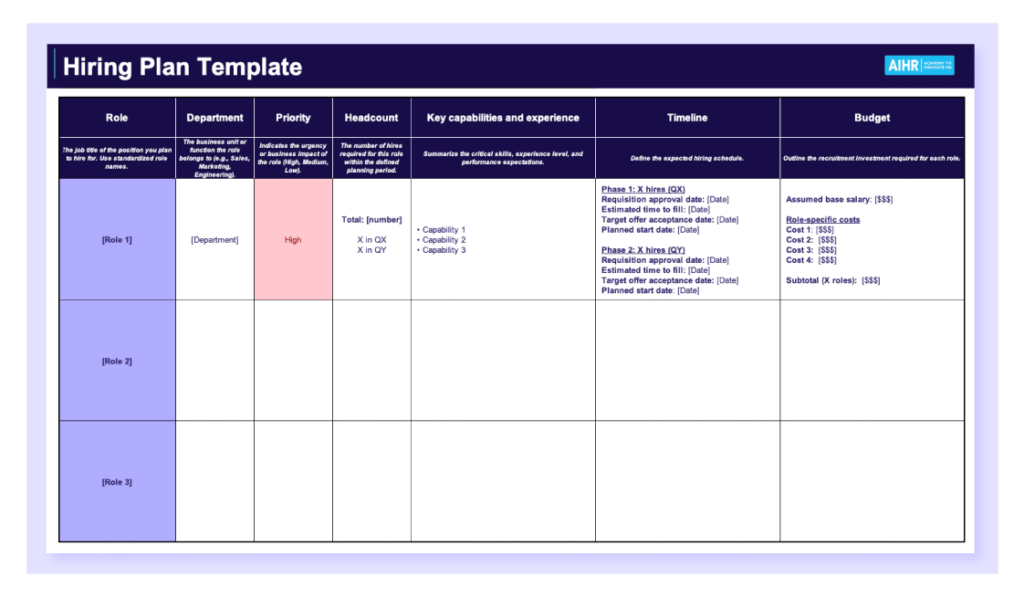
A clear hiring plan brings structure to your recruitment efforts and keeps business expectations grounded in reality. This Excel template helps you organize roles, priorities, headcount, timelines, and budget in one place so you can plan hiring proactively instead of reactively. Use it as an overview to ensure your TA team has the clarity and capacity to deliver.
Startup hiring plan vs. established company hiring plan
The structure of your hiring plan should reflect your organization’s maturity and growth stage. Startups optimize for speed and adaptability, while established companies focus on scalability, governance, and long-term workforce planning. The comparison below outlines the key differences.
Primary objective
Build core capability quickly to support early growth and product development.
Align hiring with long-term strategy, operational efficiency, and sustained growth.
Speed and flexibility
Prioritizes rapid hiring and adaptability as business priorities shift.
Emphasizes structured processes and predictable delivery timelines.
Role design
Broad, flexible roles; generalists are common.
Clearly defined roles with structured leveling and specialization.
Budget approach
Operates with tighter budgets and relies on referrals, networks, and lean sourcing.
Uses allocated budgets across channels, agencies, and recruitment technology
Workforce planning horizon
Short- to mid-term planning with frequent adjustments.
Mid- to long-term workforce planning tied to strategic roadmaps.
Succession planning
Limited formal succession planning; leadership gaps often filled externally.
Formal succession planning for critical roles to reduce risk.
Governance and compliance
Lean processes with fewer approval layers.
Strong governance, compliance requirements, and structured approval processes.
Hiring plan example: AccounTech
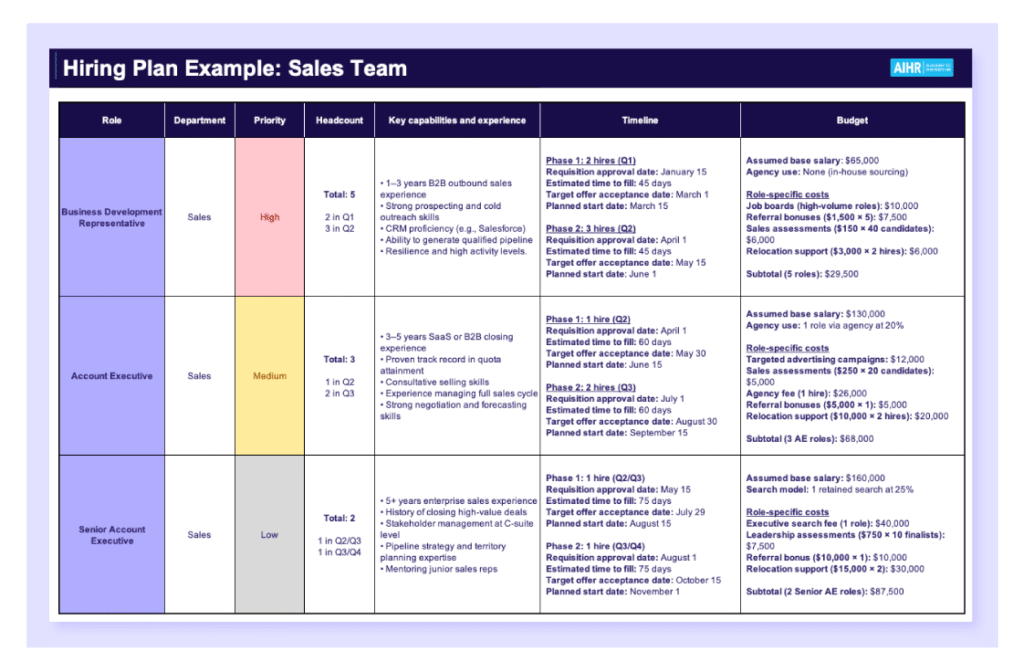
Now that we’ve reviewed the steps and considerations involved in building a hiring plan, let’s look at what one might look like in practice. In this example, AccountTech, an accounting software company preparing to expand its customer base, needs to scale its sales team to support growth and drive adoption of its upgraded software platform.
To sum up
Legendary business author Jim Collins’ adage, “great vision without great people is irrelevant”, underscores the critical role of talent in achieving organizational goals and the immense importance of building strategic hiring plans.
Without a well-executed, aligned hiring plan, attracting the right talent to drive innovation and fuel long-term business growth is virtually impossible.