
‘Supporting and helping employees’ is the number one reason why people like working in HR, according to a survey by Ciphr. A more competency-oriented way of describing this would be that HR professionals like the People Advocacy side of their jobs, which is about driving inclusion, fairness, and culture.
Let’s take a closer look at People Advocacy in HR: what it is, why it matters, what behaviors it encompasses, and how to develop it.
Contents
What is People Advocacy in HR?
People Advocacy within AIHR’s T-Shaped HR Competency Model
What does People Advocacy look like in practice for HR professionals?
Why you need to develop People Advocacy
How you can develop People Advocacy
How HR leaders can upskill their teams in People Advocacy
Key takeaways
- People Advocacy in HR puts people, inclusion, ethics, and sustainability at the center of workplace decisions.
- It includes four main areas: shaping culture, enabling change, owning ethics, and driving sustainability.
- Building this capability helps HR professionals handle complexity and shape organizational culture.
- HR leaders can strengthen people advocacy by addressing AI ethics and embedding ESG into HR practices.
- This role helps HR balance business performance with integrity and employee wellbeing.
What is People Advocacy in HR?
People Advocacy in HR is about championing a human-centered culture that balances people, performance, ethics, and sustainability. It includes navigating change with integrity, advocating for ethics, and building a culture that prioritizes wellbeing and performance.
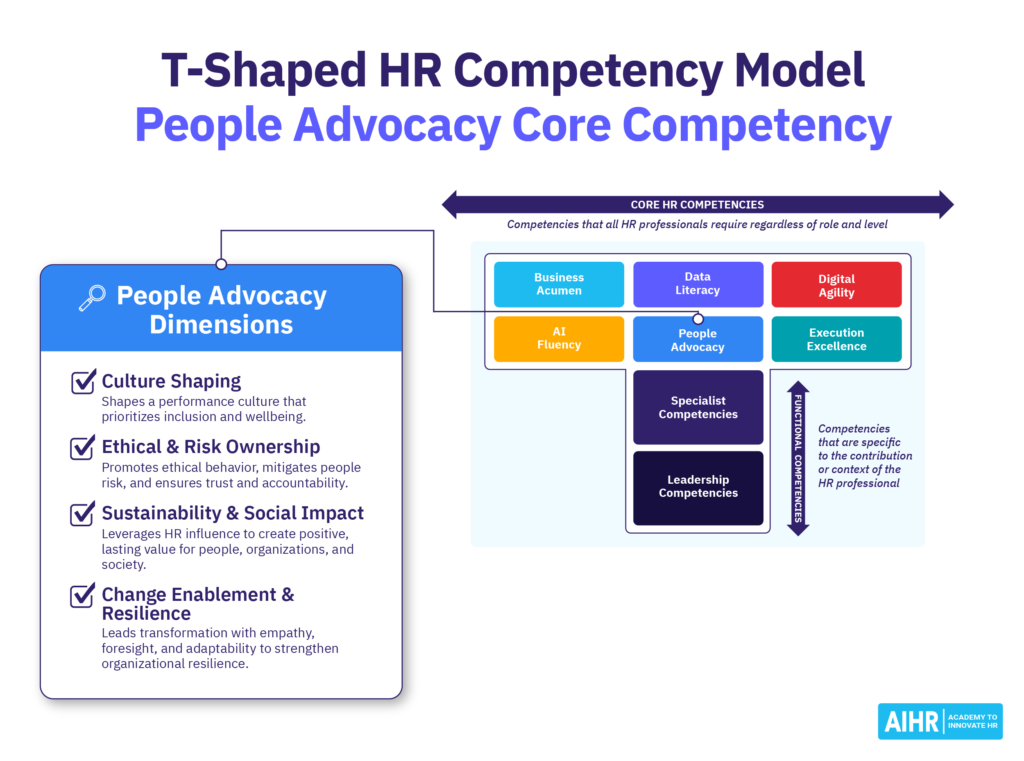
The People Advocacy competency comprises four different dimensions that are key parts of every HR professional’s people skill set. These are:
- Culture Shaping
- Change Enablement & Resilience
- Ethical & Risk Ownership
- Sustainability & Social Impact
Let’s unpack this.

Culture Shaping
This dimension of the People Advocacy competency focuses on shaping a performance culture that prioritizes wellbeing and inclusion.
Driving commitment to the organizational vision and goals, championing the organizational values, and fostering inclusion and belonging are important elements here.
Change Enablement & Resilience
People Advocacy also involves planning and implementing sustainable change (strategies). This includes building stakeholder alignment and fostering the organizational resilience needed for people and systems to adapt to and recover from challenges.
Ethical & Risk Ownership
This dimension centers on ethical judgment and proactive risk management. It highlights the ability to model ethical leadership, anticipate and address risks related to people, culture, and reputation, and uphold strong regulatory accountability.
Sustainability & Social Impact
People Advocacy in HR (and the impact it creates) goes beyond the organization and its employees. It also includes building programs and partnerships that benefit broader communities, and leveraging HR for good, as well as integrating ESG principles into HR practices.
People Advocacy within AIHR’s T-Shaped HR Competency Model
People Advocacy is one of the six core HR competencies in AIHR’s T-Shaped HR Competency Model. The other five are:
AIHR’s T-Shaped HR Competency Model defines what effective HR performance looks like today and in the years ahead. It brings together six core HR competencies with deeper expertise in one or more specialist domains, enabling HR professionals to deliver consistent business impact.
What does People Advocacy look like in practice for HR professionals?
How do you know if you and your team are true people advocates? Here are some of the behaviors that indicate strong People Advocacy:
Building cultures where performance and wellbeing reinforce each other
People Advocacy for HR professionals means first and foremost thoroughly understanding the organization’s mission, vision, and purpose and translating them into everyday expectations. These HR professionals align performance goals with behaviors that support collaboration, respect, and accountability, for example, by linking leadership bonuses to engagement and retention outcomes. They consistently role-model the company’s core values and norms in their work and everyday interactions.
This competency is also about cultivating psychological safety across the organization, encouraging inclusion and diverse perspectives in team settings, and designing processes and practices that foster belonging and equity.
Turning change into sustainable progress
HR professionals with well-developed People Advocacy know how to plan and implement change strategies that last and align with broader goals of the business. They communicate change effectively and from different perspectives to build understanding among various stakeholder groups. For example, they don’t just design a new performance management system; they train managers, track adoption, gather feedback, and adjust the approach based on real-world impact.
People advocates also demonstrate adaptability in the face of challenges, support others in managing change and uncertainty, and build team resilience through proactive planning and learning from setbacks.
Want to know how your business acumen fits into your wider HR skill set?
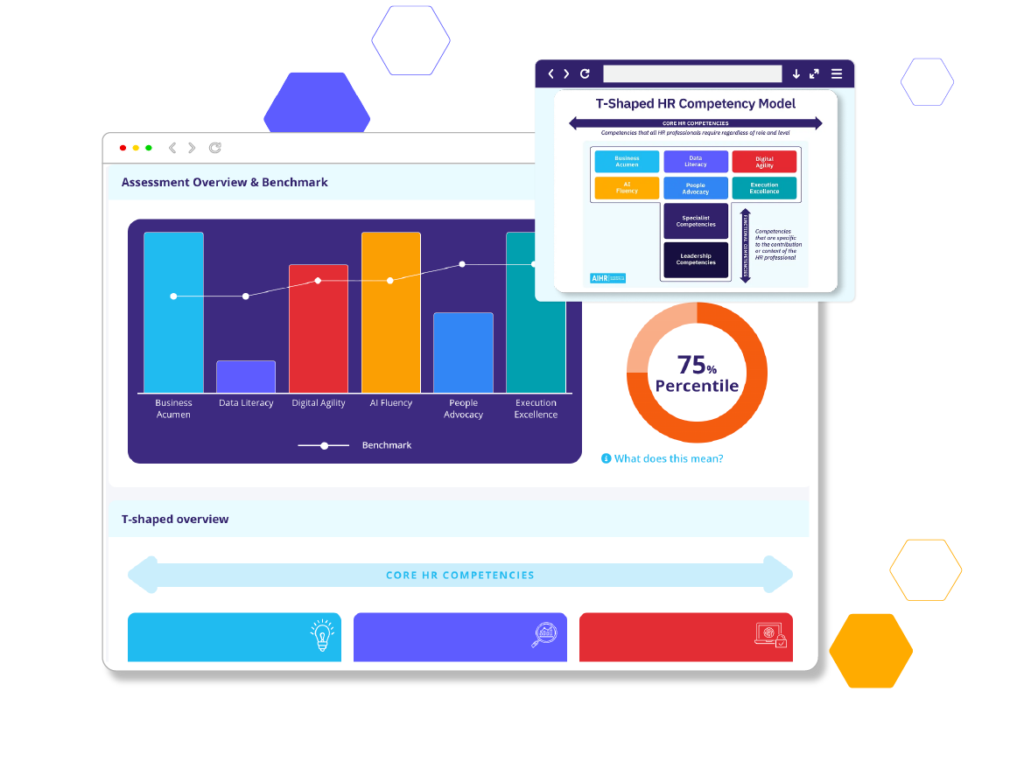
AIHR’s T-shaped assessment helps you assess yourself across six core HR competencies, see how you compare with HR professionals globally, and pinpoint the areas where you can deepen your expertise. It’s a useful first step toward more targeted development and career progression.
Protecting people and organizational trust
These HR practitioners show integrity in all their interactions and make fair and consistent decisions that reflect the organization’s values. As such, they role-model ethical leadership and decision-making, especially in complex situations such as restructures, promotions, or policy enforcement.
They recognize potential people and compliance risks, such as rising grievances, inconsistent manager behavior, or data privacy concerns, and address them proactively. HR professionals with this competency understand and follow established governance and compliance procedures to protect both employees and the organization.
Extending HR’s impact beyond the organization
An HR professional who excels as a people advocate builds impact beyond the business. For example, they design inclusive hiring programs that expand access to underrepresented talent pools or partner with community organizations to build future skills pipelines.
They integrate ESG principles into HR practices by aligning learning, diversity, wellbeing, and workforce planning initiatives with long-term sustainability goals. In doing so, they position HR as a driver of both business performance and societal value.
People Advocacy in action: A real-life example
One company that takes the role it plays beyond its own four walls very seriously is Walmart. In a podcast interview, the company’s former SVP of Global Talent, Workforce Strategy and OD, Amy Goldfinger, explained:
“90% of people in the US live within 10 miles of a Walmart or Sam’s Club, so we have a responsibility. And there are a few aspects of that. One is sustainability. There’s also community involvement, and there’s also disaster relief, and we play roles in all of those.”
Here are a few examples of what this translates into in practice:
- As for sustainability, Walmart is, among other things, working with its suppliers to avoid one gigaton of emissions by 2030 (which is the equivalent of taking 200 million cars off the road for a year).
- The company serves its communities with local grant programs and access to healthier food and products.
- The company is very committed to the veteran community, helping them gain entrepreneurial experience or education as they come out of the military.
- In times of (natural) disasters, they do a lot of relief work. For example, Walmart stores are often a triage point for emergencies given their footprint, assets, and scope.
Why you need to develop People Advocacy
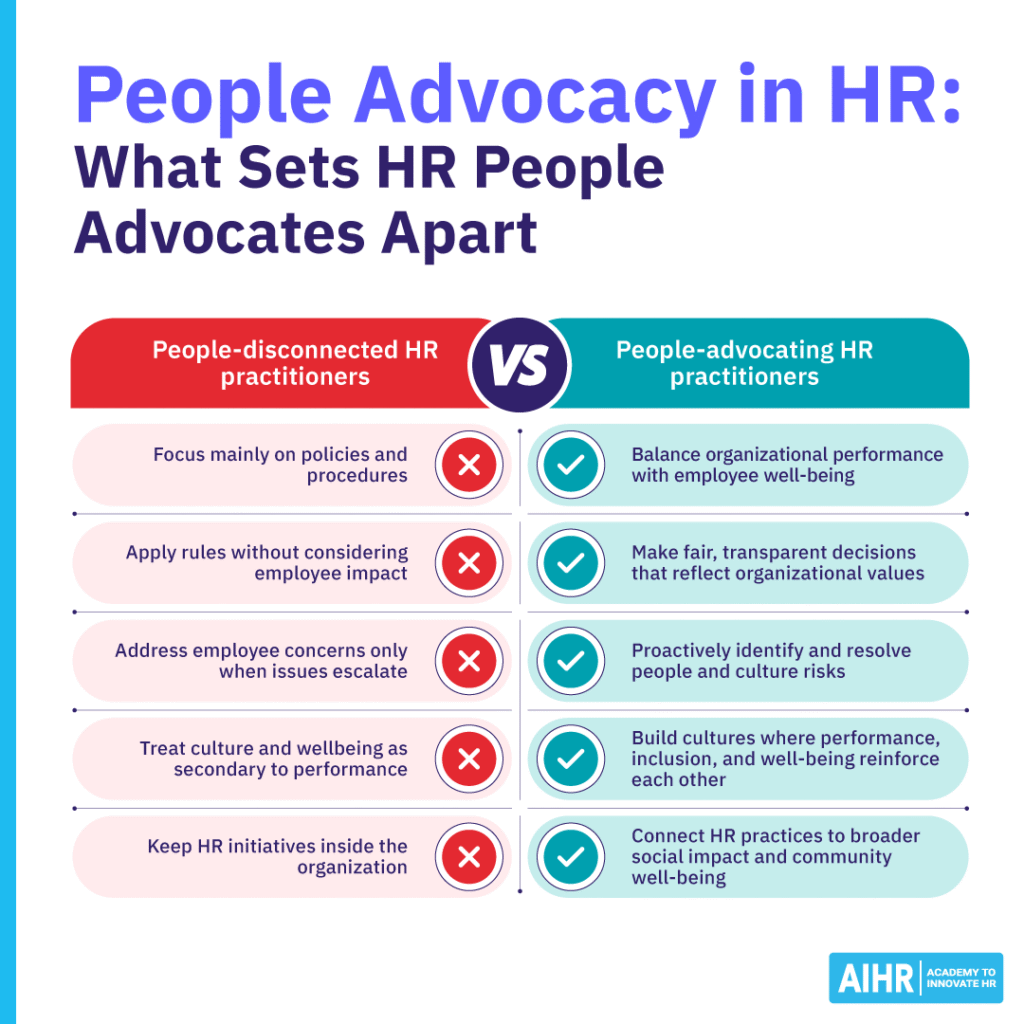
Work is transforming, and so is the responsibility of HR to represent and protect people. Strengthening People Advocacy equips HR professionals and teams to influence culture, guide leaders, and uphold values in an increasingly complex work environment.
Here’s why you should focus on developing People Advocacy:
- Continue advocating for people as AI, automation, and new work models reshape the workplace
- Shape culture so performance, wellbeing, and ethics reinforce one another
- Guide leaders in balancing business goals with employee impact
- Navigate conflict, uncertainty, and transformation with integrity
- Apply values-driven HR practices in increasingly complex environments
- Represent employee perspectives in strategic and technology-related decisions
- Align employee experience with long-term organizational sustainability.
How you can develop People Advocacy
While natural talent or affinity with this area likely led you to (consider) a career in HR, there are many things you can do to grow even more as a people advocate. Here are eight practical ways to develop the People Advocacy competency:
1. Develop your communication skills
HR needs to communicate with all stakeholders, from CEOs and investors to entry-level employees. If your organization operates across the world, your job just became more complicated. How do cultures differ internally within the company and externally with your customers? Strategies that work well with the headquarters employees may fall flat with frontline workers.
Practice active listening and focus on other people’s communication preferences to improve how you communicate at work.
Also, in today’s world of work, where a lot of communication happens remotely, we cannot rely on body language (as much) when we communicate. So, make sure your ‘electronic communication skills’ are polished.
2. Learn how to give and receive feedback
To embody the company culture and values and to model ethical leadership even better, you need to know how people perceive you, work on yourself, and make changes where necessary. An important part of this is knowing how to receive and recognize feedback, but make sure you practice giving constructive feedback as well.
3. Understand different roles within your organization
Do you know what it’s like to stand on a factory floor for eight hours? Have you ever been on a sales call? It’s hard to be a people advocate if you don’t know your people’s reality. By getting to know what people at your organization do, you can amplify their impact. Talk with team leads, but also shadow individual contributors; they’re the ones doing the actual work.
4. Create opportunities to speak with employees
In the same vein as the previous point, create opportunities to learn from the employees in the organization. If everyone works remotely, schedule a time on Slack (or a similar tool) and respond as soon as possible – like your open-door time.
If you’re in the office, walk the floor from time to time and speak with people. Use Q&A sessions, suggestion boxes, and engagement surveys (but only if you’re conducting a thorough survey analysis and will act on what you learn).
5. Take time to learn about organizational culture and inclusion
In your role, actively look for ways to align the organization’s culture with its goals and enable employees to feel heard, respected, and productive, using, for example:
- The above-mentioned engagement surveys
- Employee focus groups
- Stay interviews
- Exit interviews.
For instance, let’s say you find out that employees often fail to give two weeks’ notice when they resign, something that would make your life as an HR professional just that much easier.
Instead of making assumptions, try to find out why this happens. Maybe people don’t feel appreciated, or they have seen managers retaliate against employees during their notice period. Once you identify the cause(s), you can start remedying them one step at a time. Here’s what you could do:
- Create a policy that explains why you want people to give notice when they resign
- Ensure managers respect employees during their last two weeks of work (or for the duration of their notice period)
- Provide support and ensure positive communication with employees during their notice period
- Create a garden leave policy in case an employee is leaving for a competitor, and you or their manager doesn’t want them to continue working.
What you want to avoid:
- Asking employees to turn over their company equipment (laptops, phones, etc.) as soon as they give notice
- Angry managers who give the worst assignments to employees during their last weeks or days
- A no-rehire policy, because why should employees care if they burn a bridge with your company if you’ve already made it clear you’ll never rehire a former employee?
6. Continuously educate yourself
To be a true HR advocate for employees, HR practitioners need to stay up to date, something that takes time and effort. The good news is, though, that there are countless (free) ways to educate yourself in the format of your choice:
- Listen to HR podcasts
- Read HR blogs and newsletters
- Attend (virtual) HR conferences
- Join webinars.
Additionally, identify areas you would like to develop your skills in further to better represent and serve the company’s employees, and consider enrolling in a dedicated HR certificate program.
7. Consider finding a mentor
People advocacy is a competency that grows steadily with experience, especially from the 5-year mark onward, according to AIHR’s Future-Ready HR Skills Report. But while real-world exposure helps shape depth, it’s something that can’t be bought or taught in a course.
It’s the type of experience that can, however, be transmitted from one person to another, in the form of a mentor-mentee relationship, for example. This is why seeking a mentor you resonate with can be highly beneficial for your development as a people advocate.
8. Work on your change management skills
Change enablement is an important pillar of the People Advocacy competency. Planning, implementing, communicating, and leading change initiatives are all part of the proverbial job.
To navigate the changes your organization will undoubtedly go through in the best way possible, you want to make sure your change management skills are fully up to date. If this is not (yet) the case, consider upskilling yourself in this area.
How HR leaders can upskill their teams in People Advocacy
As mentioned earlier, People Advocacy is one of the six core HR competencies for future-ready HR professionals. As such, it’s an important ability for every HR professional to have, regardless of their role or level of experience.
HR leaders should support their teams in building People Advocacy. Here are a few ways to get started today:
- Lead discussions about AI decision-making in HR: AI is transforming how HR works, including its role as a people advocate. Have open discussions with your team about how AI decision-making is changing the way you operate and deliver value, and be sure to address all questions or concerns.
- Educate your team in technology, AI ethics, and fairness: These topics directly impact your workforce and you as their advocates. Consider educating your team (and yourself) in technology, AI ethics, and fairness. You can, for example, enrol your team in AI for HR Boot Camp to build the AI mindset and ensure AI usage that is in your employees’ best interest.
- Upskill your team in ESG: As we’ve discussed earlier, People Advocacy has a sustainability and social impact dimension that’s growing in importance. Part of this is knowing how to integrate ESG principles into your HR practices and advancing human, social, and environmental wellbeing. To get there, start by bringing ESG thinking into your discussions on HR priorities.
- All of the methods mentioned in the previous section: Strong communication skills, speaking with employees, knowing how to receive feedback, learning about the organizational culture, every aspect we discussed in the previous section about how to develop People Advocacy is also relevant when you’re training your team. Encourage them to work on these things either individually or together with (part of) the team. If you’re looking for structured support, AIHR’s Soft Skills Hub offers focused training on communication, influencing, feedback, coaching, and conflict resolution. It can serve as a practical resource to help your team build the interpersonal capabilities that underpin effective People Advocacy.
To sum up
While we often hear that HR needs to be more business-oriented, data-driven, and digitally agile, we shouldn’t forget that being a people advocate is an essential part of being a competent, future-ready HR professional.
People Advocacy is, in fact, key in creating a human-centric organizational culture that balances people, performance, ethics, and sustainability. Strengthening this competency is especially critical as technology reshapes roles, expectations shift, and leaders face complex trade-offs, requiring HR to guide decisions with integrity, fairness, and a long-term perspective.