

The PHR and SHRM-CP sit at the same career level, cost roughly the same, and both add value to your resume. So how do you choose? The answer comes down to what each credential actually tests, where you want your HR career to go, and how a practical HR upskilling platform like AIHR belongs in your professional development mix.
This article breaks down the options side by side so you can make the call.
Contents
PHR vs SHRM-CP at a glance
What is the PHR?
What is the SHRM-CP?
PHR vs SHRM-CP: Key differences
Which HR certification should you choose?
Building the skills behind the credentials
PHR vs SHRM-CP at a glance
Category | PHR | SHRM-CP |
Issued by | HRCI | SHRM |
Focus | Operational HR, U.S. employment law | Behavioral competencies + HR knowledge |
Eligibility | 1–4 years HR experience (varies by degree) | No degree or HR experience required |
Exam questions | 115 (90 scored + 25 pretest) | 134 |
Exam format | Knowledge-based (multiple choice) | Knowledge-based + situational judgment |
Exam delivery | In-person (Pearson VUE) or remote (OnVUE) | In-person only (Prometric) |
Testing schedule | Year-round | Two windows per year |
Cost / Exam fee | $495 (exam fee of $395 + application fee of $100) | $350–$499 (rates vary based on time of application and membership status) |
Pass rate | 72% (HRCI, Dec 2025) | 67–71% (SHRM, 2023–2025) |
Validity | 3 years | 3 years |
Recertification | 60 credits over 3 years | 60 PDCs over 3 years |
What is the PHR?
The Professional in Human Resources (PHR) is a mid-level certification issued by the HR Certification Institute (HRCI). It’s designed for HR professionals who work primarily at the operational level: implementing programs, managing day-to-day HR activities, and applying U.S. labor law in real-world settings.
What it tests
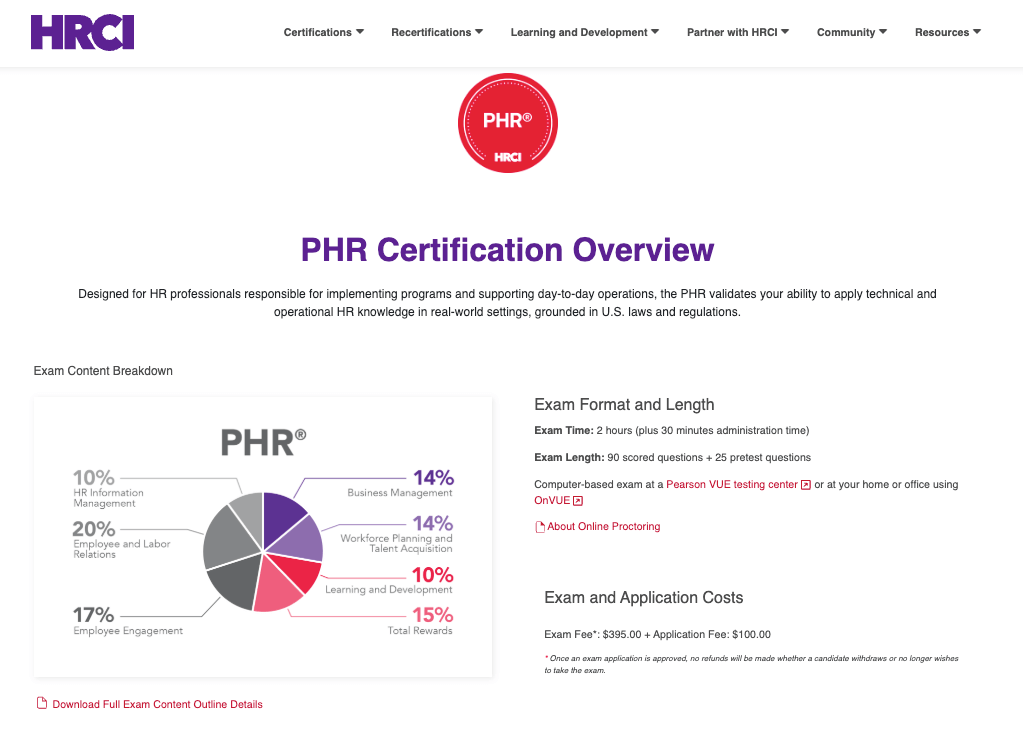
The PHR covers five functional areas: Business Management, Talent Planning and Acquisition, Learning and Development, Total Rewards, and Employee and Labor Relations. The exam places a strong emphasis on U.S. laws and regulations, with Employee and Labor Relations alone accounting for 39% of the exam. It’s most relevant if you’re working in the United States or in a role where domestic compliance is a core part of your job.
The exam consists of 115 questions (90 scored, 25 pretest), and you have two hours to complete it. All questions are knowledge-based multiple choice, so you’re tested on what you know, not how you’d handle a specific situation.
Eligibility
To sit for the PHR, you need to meet one of the following:
- A Master’s degree or higher, plus at least one year of professional-level HR experience
- A Bachelor’s degree, plus at least two years of professional-level HR experience
- At least four years of professional-level HR experience (no degree required)
Cost and scheduling
The PHR costs $495 total: a $100 application fee and a $395 exam fee. HRCI doesn’t tier pricing by membership, so every candidate pays the same rate. You can apply and test year-round through Pearson VUE testing centers, or take the exam remotely via OnVUE from your home or office.
Exam preparation
HRCI treats certification and learning as separate activities. Study materials are not bundled into the exam fee. For official prep, HRCI offers several products through its Learning Center, ranging from standalone practice exams ($85) to full Cert Prep packages with video ($699). If you prefer a more structured format, HR.com offers a live online instructor-led PHR Certification Preparation Class at $1,180, which includes a companion textbook.
Beyond HRCI’s own offerings, a wide range of third-party study guides and practice question banks are available from independent publishers. Most candidates combine a structured study resource with practice exams to cover both content recall and exam technique.
It’s worth noting that HRCI’s offering is focused on exam preparation specifically. Practical tools, templates, and ongoing development resources are not part of the certification package. Most HR professionals piece together their learning journey across multiple platforms depending on what they need at each stage.
Pass rate and recertification
The most recently reported PHR pass rate is 72%, according to HRCI’s published figures. To keep the credential active, you’ll need to earn 60 recertification credits over three years or retake the exam.
What is the SHRM-CP?
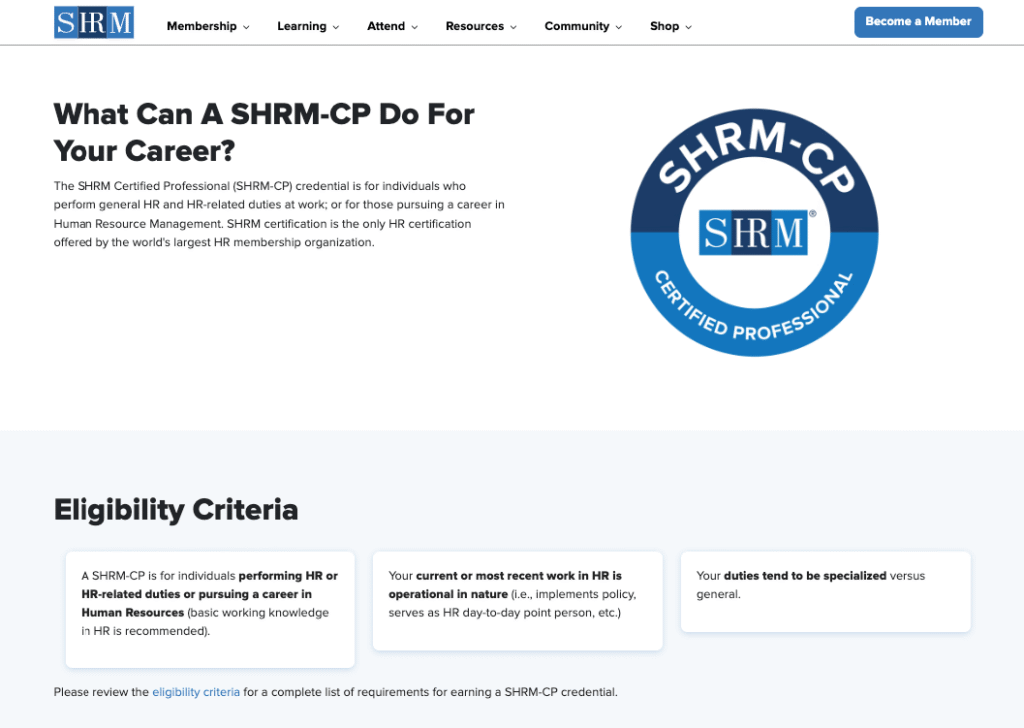
The SHRM Certified Professional (SHRM-CP) is issued by the Society for Human Resource Management (SHRM) and targets HR professionals working at the operational level: those who implement policies, serve as a point of contact for staff and managers, and handle day-to-day HR delivery.
What it tests
The SHRM-CP is built around SHRM’s Body of Applied Skills and Knowledge (BASK). The exam covers both behavioral competency clusters (leadership, interpersonal, and business) and HR knowledge domains (people, organization, and workplace). Each half of the exam carries equal weight.
What makes the SHRM-CP different from the PHR is the inclusion of situational judgment items. These scenario-based questions ask candidates to apply HR competency in realistic workplace situations. Many candidates find this section challenging, as the answers are grounded in SHRM’s framework and best-practice approach rather than any single organization’s way of doing things.
The exam has 134 questions and takes around three to four hours to complete.
Eligibility
The SHRM-CP has no degree or experience requirement. You don’t need an HR title, prior HR experience, or a completed degree to apply. SHRM recommends a basic working knowledge of HR practices or enrollment in an academically aligned program, but neither is mandatory. This makes the SHRM-CP significantly more accessible than the PHR, which still requires 1–4 years of professional HR experience depending on education level.
Cost and scheduling
Unlike HRCI, SHRM tiers its pricing by membership status, so joining SHRM before you apply can save you $100. The SHRM-CP costs $399 for SHRM members and $499 for non-members. Early bird pricing offers a $50 discount for both.
The exam is taken in person at an authorized Prometric testing center. There’s no remote testing option. SHRM offers two testing windows per year, so you’ll need to plan ahead.
Exam preparation
SHRM offers its own official prep resource, the SHRM Certification Prep System, which covers the full BASK framework in a self-paced online format with a customized study plan, flashcards, and practice questions. It’s available with or without printed materials and includes 18 months of access.
Like HRCI, SHRM treats certification and ongoing learning as separate offerings, so the prep system is an additional cost on top of the exam fee. Third-party study guides and practice question banks are also widely available for candidates who prefer a more affordable route. The situational judgment section is where most candidates struggle, so scenario-based practice is worth prioritizing regardless of which prep resource you choose.
Pass rate and recertification
Based on SHRM’s published data across recent testing windows, the SHRM-CP pass rate has ranged from 67% to 71%. To maintain your credential, you’ll need 60 Professional Development Credits (PDCs) over three years, or you can retake the exam.
PHR vs SHRM-CP: Key differences
Content focus
This is the most important distinction. The PHR is grounded in U.S. employment law and operational compliance. If your role involves navigating FMLA, FLSA, EEO regulations, or multi-state compliance, the PHR’s content maps closely to your daily work.
The SHRM-CP takes a wider lens. It tests your competency as an HR professional: not just what you know about HR rules, but how you apply judgment, communicate with stakeholders, and align HR activities with business goals. It also has no U.S.-only orientation, which makes it more portable if you work across geographies or plan to.
Exam format and difficulty
Both exams are challenging, but they’re hard in different ways. The PHR tests knowledge recall across HR functional areas. If you’ve put in the study time, the questions are fairly direct.
The SHRM-CP mixes knowledge questions with situational judgment items, and the situational questions can be counterintuitive. HR communities online are full of advice to “answer the SHRM way,” meaning the expected answer sometimes prioritizes process or policy over the instinct you’d develop on the job. That’s not a flaw in the exam; it’s how SHRM measures whether you understand best-practice frameworks, but it’s worth knowing before you sit down to study.
Scheduling flexibility
PHR testing is available year-round. If your schedule changes or you need more prep time, you can adjust your date without losing a full testing window. The SHRM-CP runs on two fixed windows per year, so if you miss an application deadline, you’re waiting several months for the next opportunity.
Testing format
The PHR offers in-person testing at Pearson VUE test centers and a remote option via OnVUE, so you can take it from home or your office if that’s more convenient. The SHRM-CP requires you to sit at an authorized Prometric testing center in person.
Recertification
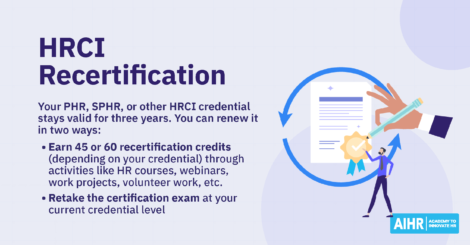
Both credentials require 60 recertification credits over three years.
PHR holders earn recertification credits through HRCI-approved activities like continuing education, research, instruction, or leadership in the HR field. SHRM-CP holders earn Professional Development Credits (PDCs) through SHRM-approved providers, covering a similar range of activities, including courses, conferences, and on-the-job experience.
There’s no shortage of providers offering approved credits for either credential. AIHR is one of them, recognized by SHRM to offer PDCs and by HRCI for recertification credits, so certificate programs you take and events you attend through AIHR count toward maintaining whichever certification you hold.
Which HR certification should you choose?
Choose the PHR if:
- Your role is focused on U.S. employment law and compliance
- You want flexible scheduling and the option to test remotely
- You prefer a knowledge-based exam with a straightforward study path
- Your day-to-day work is primarily operational and execution-focused.
Choose the SHRM-CP if:
- You want a credential that reflects broader HR competency, not just U.S. law
- You’re moving toward an HRBP or strategic generalist role
- Your organization uses SHRM’s frameworks or values SHRM membership
- You’re comfortable planning around two fixed testing windows per year.
If you’re based outside the U.S. or work in a globally distributed team, the SHRM-CP travels better. If domestic compliance is central to your role, the PHR’s content is a closer match.
Worth noting: both certifications validate what you know. Neither is designed to teach you how to apply skills on the job. That’s where ongoing learning comes in.
Building the skills behind the credentials
Passing an exam proves you understand HR principles. Teaching you to apply people analytics to a workforce problem, build a talent strategy from scratch, or lead an organizational change initiative is a different matter. Those skills come from structured learning and applying what you’ve learned on the job.
That’s where AIHR comes in.
What is AIHR?
AIHR (Academy to Innovate HR) is an online learning platform built for working HR professionals. Where the PHR and SHRM-CP validate your knowledge, AIHR builds your practical capability: the skills you apply on the job, not just recall in an exam.
It’s a good fit if you want to go deeper in a specific HR domain, develop skills your current role doesn’t fully expose you to, or stay current as the HR function evolves.
What you get
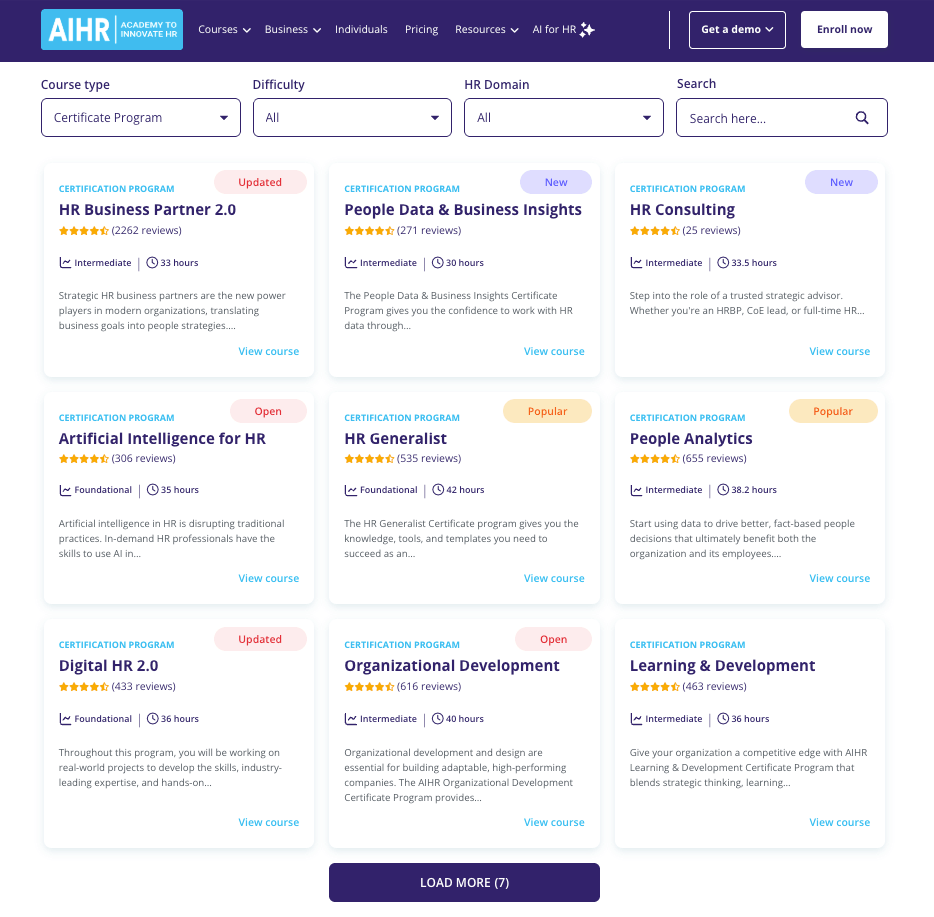
AIHR offers 16 certificate programs and 85+ courses covering every major HR domain: HR Business Partnering, AI in HR, People Analytics, Talent Acquisition, Compensation and Benefits, Organizational Development, Learning and Development, and more. All programs are online and self-paced, typically requiring around 30 to 40 hours to complete, so you can work through them around your job.
Courses are built around the T-Shaped HR Competency Model, which reflects the combination of broad HR knowledge and deep specialist skills that modern HR roles demand. The learning methodology follows a Tell-Show-Do-Apply approach: you don’t just read about concepts, you work through real scenarios and complete tasks you can bring directly into your role.
Full Academy Access also includes:
- AIHR Resource Library: Templates, frameworks, and tools you can use at work
- AIHR Copilot: An AI assistant trained on HR content to support your learning and day-to-day work
- Personalized Learning Journeys: A recommendation engine maps out a learning path based on your skills gaps and career goals, so you always know what to focus on next
- Weekly live events and a global community of 25,000+ active HR professionals
AIHR is recognized by SHRM to offer Professional Development Credits (PDCs) for SHRM-CP and SHRM-SCP recertification activities, and AIHR’s programs also count toward HRCI recertification credits. If you hold or are pursuing either credential, your AIHR learning helps keep it active.
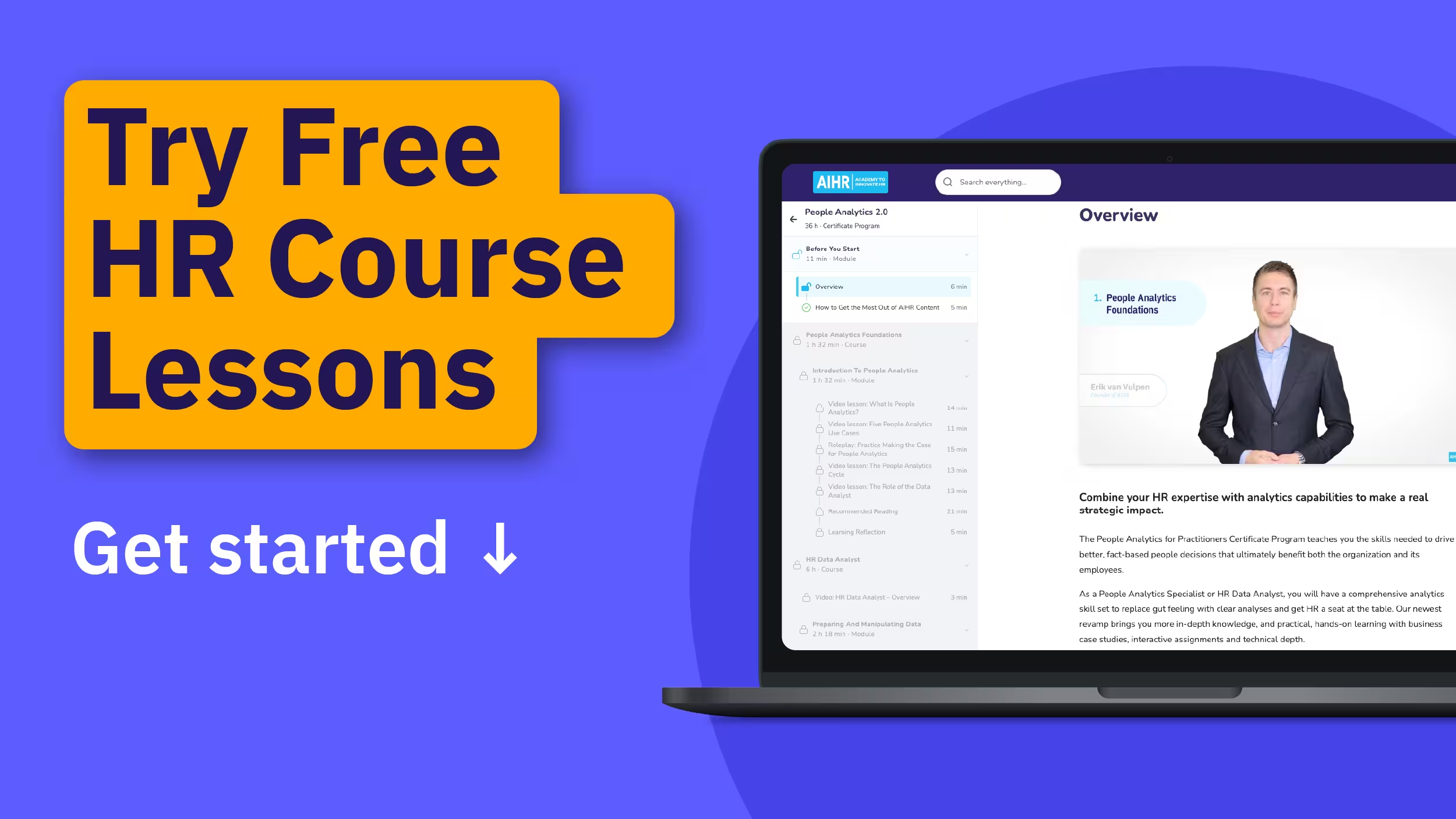
AIHR’s Demo Portal gives you a free preview of practical HR lessons, templates, and resources. See how the learning experience is designed to help HR professionals build relevant, up-to-date skills.
Pricing
Certificate Program | Full Academy Access | Team License | |
About the membership | Focused access to one AIHR certificate program so you can build expertise in a specific HR domain. | Full access to AIHR’s learning library for ongoing development across multiple HR domains. | Full AIHR Academy access for teams, with added support for team-wide development and visibility. |
Pricing | $1,125 / year | $1,850 / year | From $2,990 / year |
Core features | • Fully online, self-paced learning • Recertification credits • Expert community and support • Digital certificate | Everything in Certificate Program Membership plus: • 85+ courses and mini-courses • Resource Library with 300+ downloadable templates and resources • AIHR Copilot • Weekly webinars with HR experts • Soft Skills Hub • Personal coaching | Everything in Full Academy Access plus: • Team reporting and analytics • Dedicated Learning Consultant (from 15 users) |
Access period | 12 months | 12 months | 12 months |
Money-back guarantee | 30 days | 60 days | 60 days |
Best for | HR professionals who want to go deep in a particular specialization or close a clear skill gap. | HR professionals who want continuous learning, broader career development, and more flexibility. | HR teams that want to build skills together in a structured way. |
To sum up
The PHR and SHRM-CP are both credible, well-recognized certifications at the same career level. The right one depends on your role, your geography, and where you want your HR career to go.
If compliance and U.S. employment law are core to what you do, the PHR is the more targeted choice. If you’re building toward a broader strategic role and want a credential that reflects HR competency as a whole, the SHRM-CP is worth the investment.
Whichever path you choose, pair it with applied skill-building. A credential validates what you know. Platforms like AIHR help you develop the practical skills to put that knowledge to work and keep building from there.