
If you’ve built a strong HR foundation and started taking on more responsibility, but your career path now feels less clear, you may be asking, “How can I advance my HR career?” Should you earn another credential, further your expertise in one HR domain, or build broader business exposure? That choice will shape the roles you can move into next.
This article will look at common advancement routes for HR professionals, as well as the ways you can progress in your own career. It will also explore the skills you can learn to help you reach your professional goals, and what you should do to move forward based on where you are in your HR journey.
Contents
What does career advancement in HR look like?
HR career path: Common routes to advance in Human Resources
5 ways you can advance your HR career
How to advance your HR career at each stage
Key skills you need to advance in your HR career
Do HR certifications help you advance your career?
FAQ
Key takeaways
- Real progression means taking on more strategic work and solving more complex problems, while receiving compensation that reflects your increased impact.
- Whether you go vertical, specialize in a high-value domain, or move into a business partnering role, be proactive instead of waiting for the next opportunity to present itself.
- If you’re interested in a senior HR role, you’ll need business acumen, data literacy, and stakeholder influence.
- Building these competencies early, in addition to developing a clear HR specialty, is what separates top candidates from the rest at the shortlist stage.
What does career advancement in HR look like?
A new HR title doesn’t always mean you’ve advanced in your career. A title change may look like progress, but real HR career development happens when your responsibilities, skills, or impact grow. HR career advancement usually involves one or more of the following:
- More strategic scope: Shifting from execution to design, such as moving from administering reviews to redesigning the performance system.
- More complex problems: Solving unique challenges like retaining talent in hybrid models, rather than just processing standard leave requests.
- More influence on business outcomes: You go from largely admin and operational work to having a say in business decisions. This might mean contributing to budget conversations, headcount planning, or organizational restructures.
- More compensation that reflects these changes: Your compensation should increase as your job scope expands. For example, if you’re promoted from HR Coordinator to HR Manager, your employer should adjust your salary accordingly.

HR career path: Common routes to advance in Human Resources
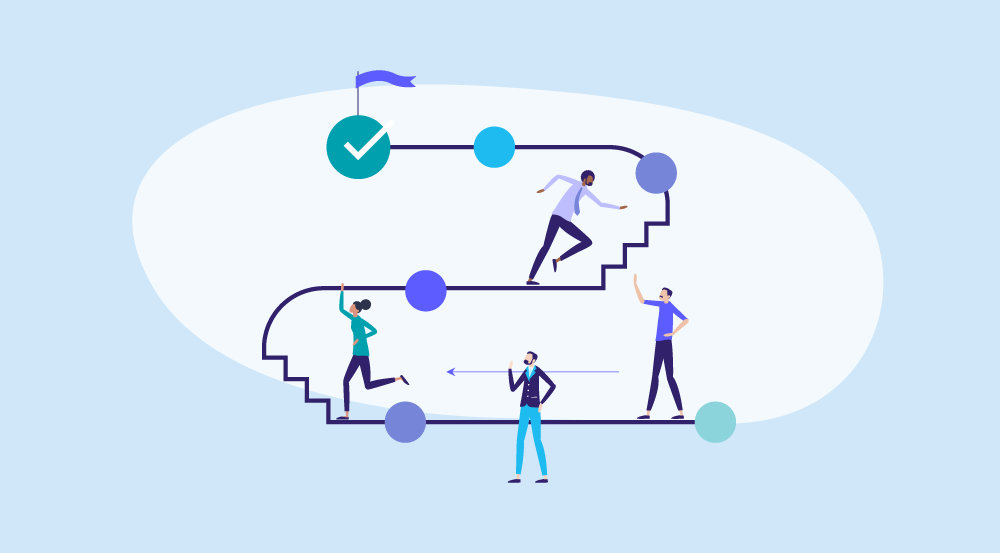
HR career progression doesn’t move only in an upward direction, and looking out only for vertical advancement routes can keep you stuck in a role you’re no longer interested in (or one you’re overqualified for). You can also consider lateral or strategic progression when planning your next career move.
Here are the common routes you can take to advance in HR:
Vertical
A traditional vertical career path follows a linear progression from entry-level roles into increasingly senior positions. HR professionals who pursue this path are often motivated by greater responsibility, leadership opportunities, status, and recognition. Moving up typically requires strong functional skills, the ability to manage others, and a strategic vision for guiding the organization forward.
The main advantage of a vertical career path is faster progression, often with higher visibility, responsibility, and pay. However, it can also create pressure to keep advancing, increasing the risk of overwork and burnout. In some cases, more senior titles may be awarded before someone has built the skills or experience needed to meet the role’s expectations.
Vertical progression doesn’t automatically come with tenure. It requires people management capability, business impact, and visibility with the right stakeholders. For example, an HR Coordinator may be promoted to the role of HRBP after two to three years on the job. They might later also progress to an HR Director position, Head of HR role, and eventually, Chief HR Officer (CHRO).
Lateral
A lateral career move means moving across HR disciplines rather than progressing straight upward into more senior roles. For example, you might move from recruitment into learning and development, or from employee relations into people analytics. HR professionals who choose this path often want variety, broader exposure, and a deeper understanding of how different HR functions connect.
This path can happen within your current organization or through a move to another company, making it more flexible than a traditional vertical career path. The main advantage is that you build a broader skill set and stronger cross-functional HR knowledge. However, lateral moves also require strong transferable skills, patience to prove your impact in a new area, and enough exposure to different HR domains to keep developing with purpose.
A lateral move might involve going from an OD Administrator or HR Coordinator role into a high-value HR specialty, such as People Analytics, Talent Acquisition (TA) Leadership, Learning and Development (L&D), and Total Rewards. Specialist skills are harder to replace, easier to price, and more easily transferable across industries. However, specializing limits the roles you qualify for, so consider your choice of specialty carefully.
5 ways you can advance your HR career
Here are five practical ways to grow your HR career using AIHR’s T-Shaped HR Competency Model. Focus on building strong core HR skills while also becoming an expert in one area.
1. Build core HR competencies
To grow your HR career, start with a solid foundation. According to AIHR’s T-Shaped HR Competency Model, every HR professional should develop six core skills: Business Acumen, Data Literacy, Digital Agility, AI Fluency, People Advocacy, and Execution Excellence.
These skills help you go beyond routine HR tasks. They make it easier to understand business goals, use workforce data, work with new technology, use AI responsibly, support employees, and achieve reliable results.
Example: An HR Coordinator who wants to become an HR Generalist can start by improving their data literacy. Instead of just tracking turnover, they can learn to spot trends, explain what those trends mean, and suggest practical ways to keep employees.
2. Develop deeper expertise in one HR specialty
After building a strong HR foundation, pick an area where you want to become an expert. This might be People Analytics, Talent Acquisition, Learning and Development, Organizational Development, Total Rewards, HR Operations, or another HR field.
This focus is the vertical part of the T-shaped model. It gives you specialist knowledge, while your core skills help you link that expertise to the bigger business picture.
Example: An HR Generalist who likes working on compensation projects might choose to specialize in Total Rewards. To move in that direction, they can learn more about pay structures, benefits design, market benchmarking, and data analysis.
3. Earn credentials that bring you closer to your goal
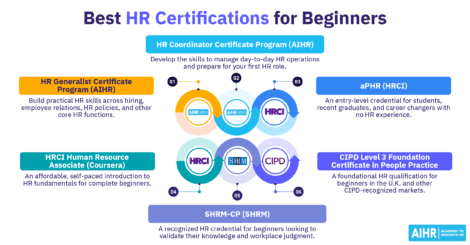
Credentials matter when you’re taking on a new specialty, targeting a role that requires them, or attempting a career pivot to a new industry. The right credentials can validate skills, signal commitment, and open doors that experience alone can’t. SHRM and HRCI are established professional HR bodies that validate HR knowledge through exams.
AIHR’s certificate programs, on the other hand, focus on building applied, job-ready skills rather than exam-based validation. As certifications require significant time (and often, financial) investment, ensure the one you choose has practical applications that will drive your career growth.
Example: A mid-career HR professional pursuing an HRBP role earns the SHRM-CP to validate their generalist experience. They also complete an AIHR certificate program to build applied business-partnering skills.
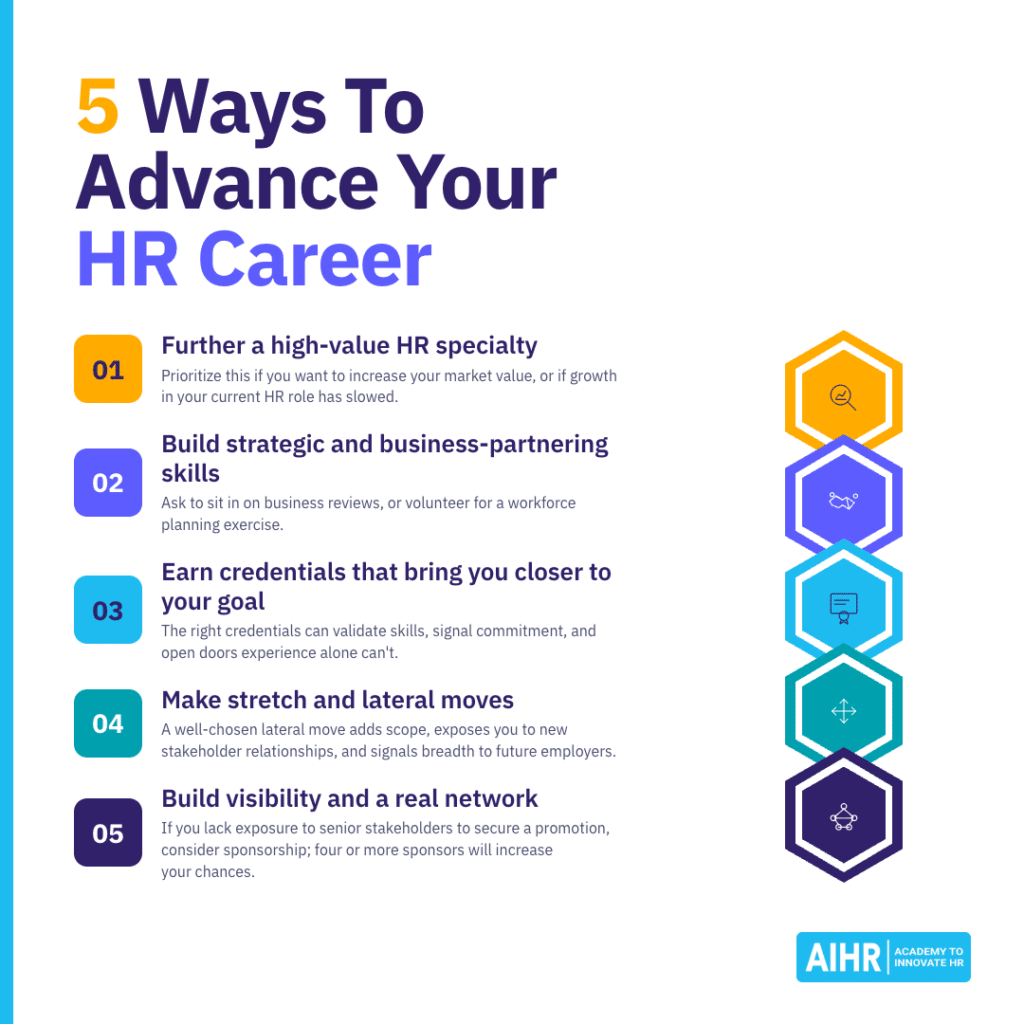
4. Make stretch and lateral moves
A well-chosen lateral move can do more for an HR career than waiting in vain for a vertical promotion that may never happen. It adds scope, exposes you to new stakeholder relationships, and signals broad expertise to future employers.
You could, for instance, move from a C&B Specialist role to an HRBP position. You could also go from being an HR Generalist to an L&D Lead, or pivot from regional HR into a global program role.
Example: A regional HR Manager with eight years of generalist experience moves into a global L&D program position. Two years later, their new job scope (new stakeholders, cross-border projects, a bigger budget) positions them for a Head of L&D role.
5. Build visibility and a real network
Doing your job well is not enough to support career advancement; the right people must also know you’re doing it. If you lack exposure to senior stakeholders to secure a promotion, consider sponsorship, which can increase your promotion chances by 10%, and, having four or more sponsors makes you five times more likely to be promoted.
Remember that building visibility requires time and effort beyond your core responsibilities. It may involve stepping into unfamiliar situations, such as participating in external HR communities where you don’t know anyone.
Example: Leading a visible project or presenting workforce data to leadership can build the kind of evidence sponsors and decision-makers remember.
Explore the AIHR learning experience from the inside, and discover how it can support you in building practical, relevant skills to help further your HR career.
AIHR’s Demo Portal allows you to:
✅ Preview AIHR lessons before committing to a course or certificate program
✅ Explore guides, templates, and tools you can use in your day-to-day HR work
✅ Browse different learning paths to find topics that match your role and goals
✅ Get a feel for AIHR’s learning experience and resources for ongoing development.
How to advance your HR career at each stage
The career stage you’re in will influence your advancement strategy. Here are some tips on what you can do to further your career, depending on your level of experience and seniority:
Early-career HR (up to three years): Build your base
Focus on building the horizontal bar of the T-shaped HR model. The goal is to understand how the HR function works end-to-end. This means rotating across various HR operations like recruitment, employee onboarding, employee relations, payroll, and L&D, where possible.
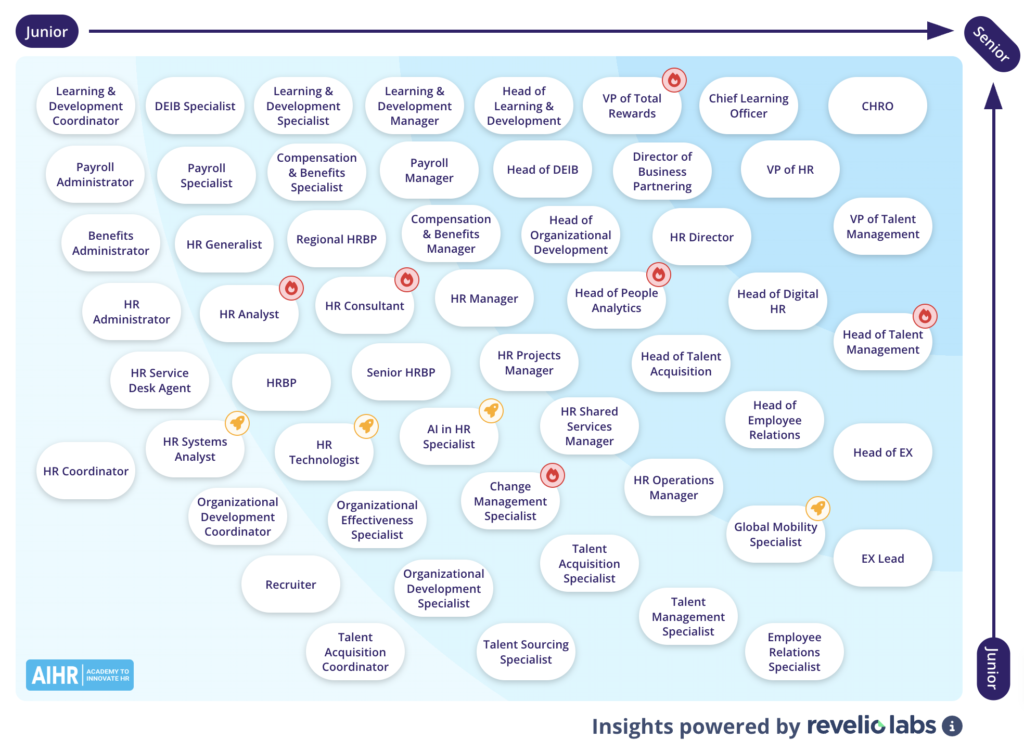
AIHR’s HR Career Map helps you explore entry-level and mid-career roles, and can guide you through the required skills and realistic next steps for your next HR role. Do be careful not to simply chase title bumps or a more strategic role before mastering HR fundamentals, as you’ll be unprepared for the position and therefore, unlikely to get it.
Mid-career HR (three to eight years): Plan your next move
At this stage, you should decide what kind of HR professional you want to be. This connects to the vertical stem of the T-shaped model, where you build depth in a specific HR function. Doing so helps you avoid the common mistake of staying in a generalist role too long without specializing. Waiting for a promotion instead of actively seeking your next role can also stall your growth.
In addition to furthering a specialty (e.g., People Analytics or TA Leadership), you can move into an HRBP track, or build people management experience. Recognized credentials, such as a SHRM-CP or PHR certificate, can strengthen your prospects. An AIHR certificate program in a target specialty is also worth considering, as it signals commitment and validates relevant skills.
Senior HR (eight or more years): Moving into leadership
This stage entails shaping business outcomes through people strategy. You’re targeting role such as HR Director, Director of Business Partnering, Head of Digital HR, Head of Talent Management and ultimately, CHRO. You want to avoid the senior HR trap of being the most experienced person in the room still stuck doing mid-level work, as this delays progression to VP and CHRO roles.
To compare the senior roles mentioned above more comprehensively, you can use AIHR’s HR Career Map to obtain relevant information. Your priorities at this stage include workforce cost, productivity, M&A support, operating model design, executive stakeholder management, and visibility outside the company.
Key skills you need to advance in your HR career
AIHR’s T-Shaped HR Competency Model identifies the specific skills that separate top candidates at the shortlist stage. It balances broad foundational capabilities with deep expertise in a chosen domain.
Core competencies (the horizontal bar of the T):
These competencies form the foundation every HR professional needs, regardless of specialty or seniority level:
- Business Acumen: Frames HR decisions to support organizational goals.
- Data Literacy: Owns the data conversation, understands, analyzes, and presents workforce data accurately. This is now a baseline for any senior HR role.
- Digital Agility: Navigates HRIS, ATS, and analytics tools confidently enough to extract insights and independently act on them.
- AI Fluency: Knows when to use AI in high-stakes HR functions like hiring, performance, and employee relations. Also knows when human judgment must have the final call. As 43% of organizations already use AI in HR, this is a baseline capability, not a niche skill.
- People Advocacy: Represents employee voice and shapes employee experience while balancing organizational priorities.
- Execution Excellence: Delivers reliably, on time, with attention to quality.
You don’t need to be an expert in all six competencies, but you should have solid foundational capability across them. Focus on the one or two most relevant to your next role, such as Data Literacy for a People Analytics role, or Business Acumen for an HRBP position.
Specialist skills (the vertical stem of the T)
You need deep functional expertise in one or more of these HR specialist domains. Pick a specialty aligned with both market demand and what you genuinely enjoy:
- People Analytics: Translates workforce data into business decisions; high demand, scarce supply.
- Talent Acquisition leadership: Owns hiring strategy, employer brand, and TA technology.
- Total Rewards: Designs compensation and benefits programs that serve as a gateway to senior leadership roles
- Learning & Development: Drives skill strategy across the workforce.
- Organizational Development: Leads the organization’s structure, culture, and change interventions.
- Diversity, Equity, Inclusion, and belonging (DEIB): Embeds DEIB strategies throughout the entire employee life cycle.
- HR Technology/HRIS: Owns the systems that form the backbone of the HR function.
- Employee Relations: Manages complex case work, investigations, and labor relations.
If you’re targeting any role above HR Manager (e.g., HR Director, VP of People, or CHRO), you also need to build people leadership, skills such as managing teams, influencing, and leading change. You can use AIHR’s HR Competency Model template to conduct a skills gap analysis, and identify one core and one specialist competency to prioritize over the next 12 months.
Do HR certifications help you advance your career?
HR certifications can support your career progression, but only if you match them to your current stage and target role. While they can reinforce your HR experience or applied skills, they shouldn’t be considered substitutes for either.
The SHRM-CP, for instance, is suitable for HR practitioners in operational or generalist roles, while the SHRM-SCP is designed for those already operating at a strategic or senior level. Like SHRM’s credentials, HRCI’s PHR and SPHR are exam-based, and focus on technical HR knowledge and U.S. employment law.
The PHR is a good option for mid-career practitioners, and the SPHR is for senior HR professionals with demonstrated strategic responsibility. These certifications are worth pursuing if you’re targeting roles that explicitly require an HRCI certification.
If you don’t require the type of credentials organizations like SHRM or HRCI offer, consider AIHR’s certificate programs. While they’re not exam-based or built around a single, globally standardized accreditation model, they help you obtain practical skills you can apply to your current and target HR roles (e.g., L&D, C&B, People Analytics, and Talent Acquisition).
AIHR is also recognized by SHRM and HRCI to offer professional development credits (PDCs) for SHRM-CP, SHRM-SCP, PHR, SPHR, and aPHR recertification activities.
At the same time, you can look into specialist credentials. Some of the more well-renowned credentials include ATD’s CPTD for L&D professionals, CIPD qualifications for those working in or targeting U.K. or European markets, and HRPA’s CHRP and CHRL for Canada-based HR practitioners.
If you’re at the early or mid-career stage, SHRM-CP, PHR, or an AIHR certificate program in your target domain is typically the most practical starting point. For senior HR professionals already operating strategically, the SHRM-SCP or SPHR can formally prove that credibility. However, at this stage, your track record is more important than any credential.
Next steps
Advancing in Human Resources requires careful consideration and planning before making any moves. The HR professionals who move fastest in terms of career progression are the ones who know exactly what they want and work deliberately to close the gaps. Genuine HR career progress comes down to three things: picking a direction, building the right skills, and making sure the right people see your progress.
You can explore credentials like those offered by SHRM and HRCI to validate your HR expertise, or a certificate program like those by AIHR. If you’re not sure where to start, AIHR’s Demo Portal lets you explore what each certificate program covers before committing.
FAQ
HR career advancement comes from making deliberate moves in a specific direction, which can include building a specialty, developing strategic skills, and earning relevant credentials. It’s also important to make sure your contributions are visible to the right people. Identify which of the four factors (scope, complexity, influence, or compensation) is currently missing from your role; this gap usually tells you which area to prioritize.
An HR degree offers transferable skills for roles in workforce strategy, talent advisory, and organizational development. Your career trajectory depends on the specialized certifications and practical experience you build upon that academic foundation.