
AI agents for recruiting are slowly gaining traction, with 13% of HR professionals saying they are actively using AI agents for recruiting tasks, and 50% are exploring them. It’s important to note that, unlike basic automation that handles one fixed task, an agent works across multiple steps toward an outcome.
Not every AI recruiting tool qualifies. Some only write job ads or emails, while others automate a single step. This article explores what AI agents for recruiting are, how they work, nine such agents to consider, and how to choose the right one.
Contents
What are AI agents for recruiting?
AI agents for recruiting: Key benefits
How are AI agents used in recruiting? 7 examples
9 best AI agents for recruiting to consider
How to choose the right AI agent for recruiting
How to use AI agents for recruiting responsibly
Key takeaways
- More hiring teams are exploring AI agents that can handle several connected recruiting tasks, not just one isolated step.
- Unlike single-task tools, AI agents can move from actions like sourcing and screening to outreach and scheduling in support of a hiring goal.
- AI agents can improve speed, consistency, and follow-through at the top of the funnel, but recruiters must still assess quality, bias, accuracy, and candidate experience.
- The best AI agents for recruiting will depend on your hiring volume, role types, workflow, integrations, data quality, and how much control and visibility your team needs.
What are AI agents for recruiting?
AI agents for recruiting are software systems that can take a goal, such as creating a candidate shortlist for a role, and carry out the necessary actions to achieve it. Unlike a basic automation tool, a recruitment agent doesn’t just complete one isolated task. It can move through multiple stages of the hiring process, with less manual recruiting input needed.
They may start by turning a job brief into a talent database search, ranking likely-fit candidates, and drafting personalized outreach messages. More advanced systems can also engage candidates, screen responses, and schedule interviews. This makes them especially useful for teams that need to move faster without compromising their recruitment processes.

Technically, these systems combine several layers of technology. One layer may use large language models (LLMs) to understand a job brief, extract key requirements, and generate a structured search query. Another may connect to talent databases, an ATS, a CRM, email, calendar tools, and other recruitment technology tools to retrieve information and act on it.
Some also use ranking models, matching logic, workflow rules, and memory of previous steps to help the system find candidates, prioritize likely-fit profiles, draft outreach, respond to candidate inputs, and move the process forward. In other words, the “agent” is not just the AI model itself but a combination of reasoning, data access, and workflow orchestration.
However, not every AI recruiting tool is a true agent. Some only handle one task, such as writing job ads, suggesting interview questions, or summarizing CVs. Others are simply content generators, not systems that can plan or act across workflows. A true agent can work toward an outcome across several steps, while a single-task tool supports just one part of the process.
Agentic vs. generative vs. other types of AI in recruiting
Not all artificial intelligence for recruiting works the same way. That’s why it’s useful to compare AI agents in recruiting with other recruitment technology tools. Below are the main differences between different AI types in a recruiting context:
Agentic AI
Works toward a goal and can complete multiple connected actions across a workflow
Sourcing candidates, sending outreach, screening replies, scheduling interviews
Multi-step task execution across the early recruiting workflow, with limited manual input required
Generative AI
Creates new content based on prompts or source material
Writing job ads, emails, interview questions, and candidate summaries.
Content creation (quick drafting, improved consistency, or time-saving on writing-heavy tasks)
Conversational AI
Interacts with candidates through chat, SMS, or voice in real time or near real time.
Answering FAQs, SMS screening, interview scheduling, and high-volume hiring support
Candidate interaction at scale; good for large volumes of questions, screening exchanges, and efficient touchpoint-scheduling
Rule-based automation
Follows predefined logic, triggers, and workflows
Reminders, interview coordination, status updates, and process triggers
Deterministic workflows with a clear, repeatable process based on fixed rules rather than judgment (e.g., reminders, routing, status changes)
The main difference is agentic AI can work toward a goal, while generative AI mainly creates content. Generative tools can save time, but they can also sound convincing while getting details wrong.
Conversational AI, on the other hand, helps manage candidate communication at scale, while rule-based automation is best for predictable, repeatable tasks. Many recruitment technology tools combine multiple AI types, so focus less on labels and more on what a tool can actually do in your workflow.
AI agents for recruiting: Key benefits
Recruiter automation and other tools for recruiters make the early stages of hiring faster, more consistent, and easier to manage. Here are their key benefits:
Faster sourcing and shortlist creation
AI recruiting agents can parse a job brief into structured search criteria, query multiple sources in parallel (ATS, LinkedIn, internal talent pools, job boards), and enrich candidate profiles with public signals. They can also score each against role-specific criteria, and return a ranked shortlist with reasoning, turning what’s usually a multi-day sourcing sprint into a single run.
Better follow-through across tasks
Unlike a generative tool that stops at a draft, an agent maintains state across the full workflow, from candidate sourcing and drafting personalized outreach to scheduling an interview and updating the hiring manager without a recruiter re-prompting at each step. The handoff between subtasks happens inside the agent, not in the recruiter’s inbox.
Quicker candidate engagement
Agents can respond to candidate replies in minutes rather than days, branch on intent, and trigger the next step automatically (e.g., calendar invites, assessment links, or recruiter handoffs). Because they operate continuously, there’s no need to wait for a recruiter to manually reply to candidates, cutting the silence gaps where candidates typically drop off.
More consistent early-stage screening
An agent applies the same rubric, questions, and evaluation logic to every candidate, with every decision logged and auditable. This means there’s no fatigue by the 200th application, and no inconsistency among recruiters. Additionally, you can explicitly exclude bias-prone shortcuts (e.g., school name, employer prestige) from the scoring function.
More recruiter time for judgment
Agents can autonomously execute workflows, not just produce isolated outputs, letting recruiters spend significantly less time on sourcing, enrichment, outreach, follow-up, and scheduling. As such, they can focus on areas where humans still outperform, like reading nuance in interviews, calibrating with hiring managers, and offer negotiations.
Greater recruiting efficiency
AI recruiting agents operate across tools (email, ATS, calendar, Slack) and not within a single window, chaining together small, repeatable steps that normally fragment a recruiter’s day (drafting personalized outreach, sending reminders, queuing up the next action). This reduces manual work for recruiters and ensures systems aren’t overly reliant on them.
A more connected hiring workflow
Sourcing, outreach, screening, and scheduling are usually separate tools with separate logins and handoffs, which allows candidate data to stagnate. An agent treats the talent pipeline as one continuous workflow, so by the time a hiring manager sees it, the full context (e.g., reasons for candidate selection and shortlisting, outstanding items) is automatically clear.
Improved candidate reach
AI agents can expand sourcing beyond widely used lanes by translating role requirements into structured search criteria and querying multiple talent sources. This helps them find candidates whose backgrounds don’t match keyword searches but align with underlying requirements (e.g., a logistics analyst with a junior data scientist’s quantitative profile).
Bear in mind that these benefits come with a trade-off. Recruiters still need to assess quality, bias, accuracy, and fit at each stage. AI agents are generally most effective in top-of-funnel work, not final hiring decisions.
How are AI agents used in recruiting? 7 examples
One of the easiest ways to understand agentic AI for recruiting is to map it to the steps your recruiting team already follows, from opening a role to making a hire. Below are some practical examples of how AI agents are employed in recruiting:
Example 1: Job opening and search setup
An AI agent can turn the job brief into a structured candidate persona, suggest sourcing channels you’ve successfully used before, and create an initial search strategy. It can also draft the job ad, propose skills and keywords most likely to improve match quality, and adjust those suggestions based on your feedback. This means the search criteria evolves, instead of being set once and forgotten.
Example 2: Sourcing and talent discovery
After the role goes live, an agent can search CV databases, LinkedIn, GitHub, and niche platforms simultaneously, pulling in both active applicants and passive talent without a recruiter running each query manually.
Some agents also enrich profiles with public signals (e.g., open-source contributions, conference talks, publications) and can anonymize candidate data at this stage to keep early review focused on skills and experience, not names or schools.
Example 3: Screening and shortlisting
As candidates come in, AI agents can parse CVs, match profiles against role requirements, rank likely-fit candidates, and send assessments or screening questions automatically. An agent applies the same criteria to every applicant, so recruiters get a more consistent shortlist at the top of the funnel, and an audit trail explaining each candidate’s ranking.
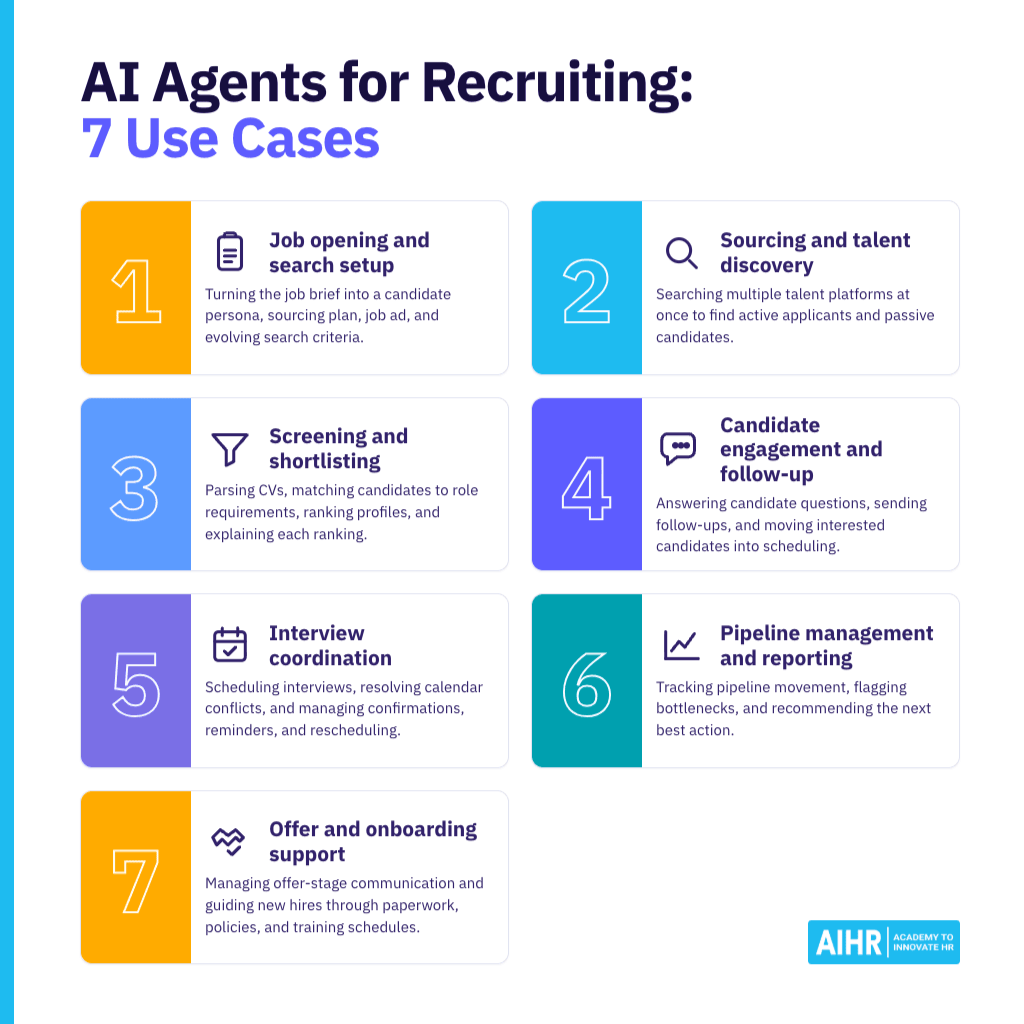
Example 4: Candidate engagement and follow-up
AI recruiting agents can help you manage ongoing communication by responding to candidate inputs and choosing the next most appropriate action. If a candidate asks a question, the agent can answer from an approved knowledge base. If they go quiet, it can send a nudge. And if they show strong interest, it can move them straight into scheduling.
Example 5: Interview coordination
Once a candidate moves forward, an AI agent can schedule interviews across multiple calendars, resolve scheduling conflicts, send confirmations and reminders, and reschedule automatically when something falls through. You’ll only need to loop in the hiring manager when a real human decision is needed, rather than for every back-and-forth.
Example 6: Pipeline management and reporting
AI recruiting agents can monitor pipeline movement, identify where candidates are slowing down, and recommend the next action. An agent might flag a drop-off after screening, suggest changing the outreach sequence, or show which source produces the best candidates.
It can also track market signals (e.g., salary benchmarks and competitor hiring activity), and suggest adjustments to compensation, sourcing channels, or role requirements based on market changes.
Example 7: Offer and onboarding support
After selection, an agent can support offer-stage communication, and answer common candidate questions about salary or start dates. It can also guide new hires through paperwork, policies, and training schedules in their first weeks. This keeps momentum during the volatile window between offer acceptance and the first day, where drop-offs are common.
Learn how to effectively use AI agents for recruiting to ensure a more efficient hiring process that increases recruiter productivity, minimizes bias, and improves the candidate experience.
AIHR’s Artificial Intelligence for HR Certificate Program will help you:
✅ Understand how to apply AI solutions to drive productivity and efficiency
✅ Apply an AI adoption framework to transform HR workflows and processes
✅ Understand AI capabilities and how to build AI skills for success
9 best AI agents for recruiting to consider
Below are nine AI agents you can consider for recruiting purposes. However, do note that not all of them are fully autonomous recruiting agents, and some may be better understood as AI sourcing agents, conversational assistants, or ATS-based workflows.
1. Juicebox Agents
Juicebox’s AI Recruiting Agents source, screen, and engage candidates automatically. Its positioning is strongest in always-on sourcing and continuous outbound outreach that run in the background.
Best for: High-volume outbound sourcing, where the bottleneck is consistently reaching enough candidates rather than evaluating them.
Main strength: Continuous, automated outreach that doesn’t require a recruiter to launch each sequence or check in between steps.
Key limitation: It’s lighter on later-stage workflow (e.g., interview operations, hiring manager collaboration) than full-cycle recruiting suites.
2. Beam’s AI agents
Beam’s AI agents for HR, RPO, and recruitment screen and recommend suitable candidates. It provides an agentic workflow layer for recruiting operations, instead of a standalone sourcing database.
Best for: RPOs and in-house talent acquisition teams that already have a candidate source-of-truth, and want to automate the operational workflow on top of it.
Main strength: Agentic orchestration across candidate screening and recommendation (i.e., the operational middle of the funnel).
Key limitation: Beam AI is not a sourcing database in its own right, so you need to incorporate your candidate pool using another tool.
3. Braintrust Nexus
Braintrust Nexus is a platform for building custom AI agents that can automate recruiting tasks, such as candidate sourcing, screening, and credentialing. This is more configurable and workflow-driven than a single packaged recruiting agent.
Best for: Teams that want to design their own recruiting agents rather than adopt a packaged workflow.
Main strength: Configurability that allows agents to be shaped around unusual hiring processes, niche credentialing requirements, or specific compliance steps.
Key limitation: Braintrust Nexus requires higher setup effort than ready-made tools, as you’re building rather than buying a workflow.
4. hireEZ
hireEZ is one of the stronger top-rated AI agents for outbound recruiting if your priority is to search for candidates quickly across the open web and your ATS. It sources, matches, engages, and schedules inside a broad recruiter automation suite.
Best for: Teams looking for a single platform that spans sourcing through interview coordination, instead of stitching multiple point tools together.
Main strength: Breadth of coverage across the funnel within one agentic system, which keeps candidate context intact between stages.
Key limitation: The tool’s broader scope can mean less depth in a single area, compared with specialist tools focused only on sourcing or scheduling.
5. Gem’s AI Sourcing Agent
Gem’s AI Sourcing Agent is a focused sourcing tool that works 24/7 across over 800 million profiles. It uses job context, past interactions, and talent-market signals to recommend candidates.
Best for: Teams whose primary gap is finding and matching the right candidates at the top of the funnel, especially at scale.
Main strength: Depth of profile data and match quality for sourcing, along with engagement features that move candidates from sourced to interested.
Key limitation: This agent focuses on sourcing and outreach, so you’ll need other tools for screening logic, interview workflow, and offer-stage tasks.
6. Workable’s AI Recruiting Agent
Workable’s AI Recruiting Agent is an ATS-native agent that creates job briefs, sources passive talent, screens applicants, engages candidates, and delivers shortlists. It does so while keeping the recruiter in control of approvals and decisions.
Best for: Existing Workable customers who want agentic capabilities without adding another system to their stack.
Main strength: Native ATS integration that allows candidate data, pipeline stages, and outreach history to stay in one place.
Key limitation: Its value is tied to using Workable as the underlying ATS, making it less useful for teams using other platforms.
7. SeekOut Spot
SeekOut Spot is a hybrid service that combines agentic AI with human recruiter support. It sources, engages, and screens against a custom rubric, then delivers interview-ready candidates quickly.
Best for: Teams that want agentic sourcing with the option of layering in human recruiter support through the Spot service.
Main strength: Combination of agentic AI with an optional human-in-the-loop layer, which gives teams flexibility on how much to outsource and how much to automate.
Key limitation: SeekOut Spot isn’t just software you license; it bundles in human recruiter support, which means an extra service cost on top of the platform fee.
8. Eightfold
Eightfold Agentic AI and talent agents for recruiting go beyond sourcing alone, supporting recruiting tasks through conversational assistance and process augmentation.
Best for: Enterprises building a long-term talent intelligence layer that includes recruiting, internal mobility, and workforce planning.
Main strength: Agents sit on top of a deep talent graph that covers more than just recruiting, making internal candidate matching and skills-based decisions more impactful.
Key limitation: The tool’s scope and implementation complexity can be heavier than mid-market teams or single-use-case buyers need.
9. ICIMS Coalesce AI
ICIMS Coalesce AI is an agent-based recruiting suite inside the wider iCIMS platform. It includes intelligent agents that support sourcing, matching, engagement, and coordination across the hiring journey.
Best for: Enterprises already on ICIMS that want native agentic features without moving to a separate vendor.
Main strength: Tight integration with the broader ICIMS platform, so agents operate on the same candidate, requisition, and workflow data that the rest of TA already uses.
Key limitation: Value is strongest for existing ICIMS customers, and it’s harder to justify as a standalone purchase if you’re not already in the ICIMS ecosystem.
How to choose the right AI agent for recruiting
When comparing AI agents for recruiting, start with the problem you want to solve, whether it’s sourcing or screening candidates, scheduling interviews, high-volume hiring, or end-to-end recruiting. The most efficient AI agents for recruiting are usually those that fit your workflow, not those with the longest feature lists. Use these criteria to help you decide:
- Main use case: Decide whether you need help with sourcing, outreach, screening, scheduling, or full-cycle support.
- Hiring volume: A team hiring occasionally needs something different from a team recruiting at scale every week.
- Role type: Some tools are more effective for hiring hourly and frontline workers, whereas others excel in recruiting for corporate, technical, or executive positions.
- Workflow fit: Check whether you need a standalone product, or an AI agent you can easily incorporate into your organization’s ATS.
- Data quality: AI is only as good as the talent and workflow data, and search inputs behind it. Weak data leads to weak results, so be sure your information is accurate.
- Integration potential: Review how the AI agent you’re considering can connect with your company’s ATS, calendar, email, CRM, and assessment tools.
- Human control: Make sure recruiters can approve, edit, override, and audit what the system does.
- Reporting: Look for visibility into conversion rates, quality, speed, and fairness.
- Candidate experience: Good AI agents for recruiting should be helpful and responsive, not cold or confusing.
- Budget and implementation: Some talent sourcing agentic AI tools require minimal setup, while others demand more training and change management.
Finally, before making a buying decision, request live demos from vendors. A good demo should be based on a real open role, not an unrealistic made-up scenario. This is the fastest way to see if the tool will actually work for your team.
How much do AI recruiting agents cost?
Pricing for AI recruiting agents ranges widely, and the sticker price isn’t always the full picture. You’ll want to budget not just for the platform itself, but also for seats, integrations, and any implementation or service costs that come with more configurable tools.
Where possible, run a short trial or pilot on a couple of live requisitions before committing. Agentic AI is still a fast-moving category, and how a tool performs in a demo can look very different from how it performs inside your actual workflow.
At the lower end, self-serve tools often start in the low hundreds per month. Juicebox lists Starter at $139 per seat/month, Growth at $199 per seat/month, and its agent add-on at $199 per agent/month. Workable’s agent pricing is available on request, while Gem offers a Startups plan (in addition to custom-priced Growth and Enterprise tiers).
At the higher end, broader recruiting platforms are often priced through custom quotes, and total spend depends on seats, integrations, and workflow complexity. Workable’s ATS pricing guide says recruiting software can range from free to more than $100,000, depending on company size and pricing model. Additionally, these platforms are now incorporating agentic features into their AI offerings.
How to use AI agents for recruiting responsibly
Artificial intelligence for recruiting can streamline sourcing, screening, outreach, and scheduling. However, these tools should support, not replace, a recruiter’s decision-making. You should still make key hiring decisions, especially if the technology suggests which applicants to advance or reject.
Here’s a quick guide to responsible AI agent use in recruiting:
- Ensure compliance with anti-discrimination laws: The EEOC is clear that employers can still be liable when AI is used in recruiting and selection. See its Employment Discrimination and AI for Workers document, and broader AI resources for further information.
- Validate tools before rollout, then test them regularly: Don’t assume outputs will stay reliable over time. NIST’s AI Risk Management Framework is a practical guide for testing, governance, documentation, and ongoing monitoring.
- Check for adverse impact on protected groups: Review outcomes by race, sex, age, disability, and other protected characteristics, and make sure disabled candidates can request accommodations. The EEOC’s Artificial Intelligence and the ADA page is a good starting point, and its AI publications hub also links to guidance on adverse impact in AI-based selection tools.
- As far as possible, be transparent with candidates: Candidates should know when and where in the hiring process you use AI. This transparency aligns with the EEOC’s broader guidance on AI in employment decisions.
- Review privacy, retention, and vendor security terms carefully: Know what data is collected, how long it’s kept, and who can access it. It helps to follow NIST’s protocol, and treat this as part of full life cycle AI risk management.
- Avoid black-box scoring: If your team can’t explain how they arrived at a score, it becomes harder to review decisions, spot bias, or defend outcomes. NIST’s framework is useful here, as it emphasizes trustworthiness in AI system design, development, use, and evaluation.
- Standardize how recruiters use the tool: Clear internal guidance helps prevent one team from trusting the system too much, while another ignores it. The NIST AI RMF is useful for helping you set shared governance and operating practices.
- Train recruiters on when to accept and challenge AI recommendations: These tools should support or complement human judgment, not replace it. The EEOC’s AI materials are useful for grounding that training in employment law risk.
- Build an escalation path for complaints and accommodation requests: Teams should know who reviews concerns, and how to document and resolve issues. Refer to the EEOC’s How to File a Charge of Employment Discrimination guidance to assist you.
- Familiarize yourself with state-level rules: For instance, Illinois’ Artificial Intelligence Video Interview Act sets requirements for notice, explanation, consent, and deletion regarding AI analysis of recorded video interviews.
Next steps
AI recruitment agents enable hiring teams to operate more productively, identify suitable candidates, minimize time spent on routine admin work, and maintain consistent early-stage hiring processes. These tools deliver optimal results when embedded within transparent workflows and complement, rather than replace, recruiters’ expertise and supervision.
Success depends not just on technology, but also its users’ expertise. You must know where AI agents can add value, how to recognize potential risks, and how to use them responsibly in hiring. If you want to learn more, AIHR’s Artificial Intelligence for HR Certificate Program is an effective way to develop skills that will help you confidently use AI in recruitment.