
A people analytics certification should help you build the skills to use workforce data with confidence. But not every program offers the same level of training, assessment, or practical application.
Some providers use “certification” to describe a formal credential earned after passing an assessment. Others use it for structured learning that ends with a certificate of completion. Before you choose a program, look beyond the title. Check what it covers, how you’ll be assessed, and whether it fits your career goals.
This guide explains what a people analytics certification is, how it differs from a certificate program, and how to choose the right option for your goals.
Contents
What is a people analytics certification?
Why should you pursue a people analytics certification?
7 best people analytics certifications and certificate programs
How to choose the right people analytics certification for your career
FAQ
Key takeaways
- A people analytics certification helps you build or validate your ability to use workforce data in HR decisions.
- The right option depends on whether you want practical skills, a stronger credential, or both.
- Some programs are more strategic, while others are more technical or tool-based.
- To choose well, look beyond the label and focus on the curriculum, format, assessment, and career fit.
What is a people analytics certification?
A people analytics certification is a credential focused on using workforce data to support better HR decisions. Traditionally, certification means your knowledge or skills are measured against a defined standard, usually through an exam or formal assessment.
In practice, though, providers do not always use the term consistently. Some use certification for programs that focus more on learning than formal competency testing. That is why it’s worth checking what the program covers, how you are assessed, and how the credential is recognized before you decide.
Common topics in people analytics certifications
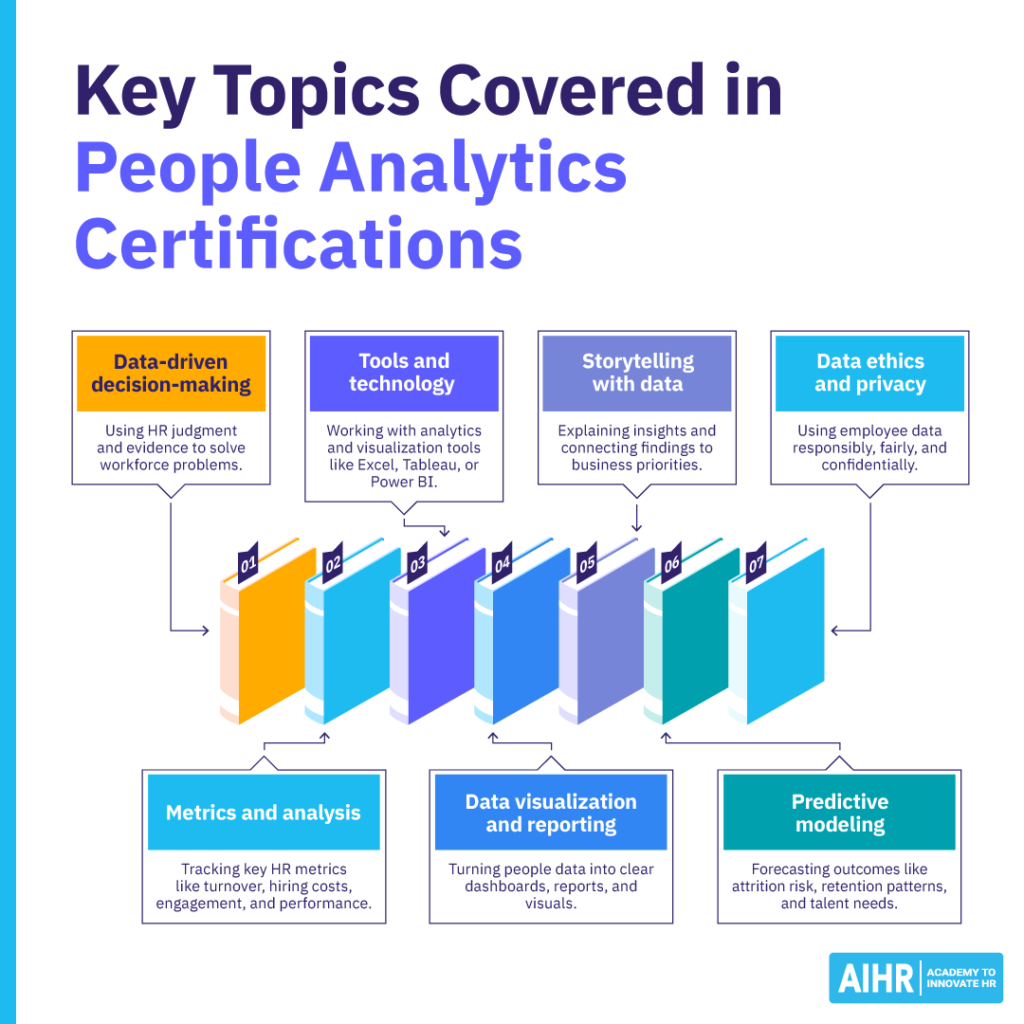
Most people analytics certifications and certificate programs cover a similar set of core topics, although the depth and what’s covered varies by learning provider:
- Data-driven decision-making: You learn how to combine HR judgment with evidence so you can solve workforce problems more effectively.
- Metrics and analysis: Most programs introduce core HR metrics such as turnover, hiring costs, engagement, performance, and survey data.
- Tools and technology: Many programs expose learners to tools used for analysis and visualization, such as Excel, Tableau, or Power BI.
- Data visualization and reporting: You learn how to turn people data into clear dashboards, reports, and visuals that leaders can understand and act on.
- Storytelling with data: Many programs teach you how to explain insights, connect findings to business priorities, and make stronger recommendations.
- Predictive modeling: Some programs go further and cover analytical techniques for forecasting outcomes, such as attrition risk, retention patterns, and future talent needs.
- Data ethics and privacy: You learn how to handle employee data responsibly and consider fairness, confidentiality, and privacy when using workforce insights.
Some newer or revised programs or courses, like AIHR’s People Analytics Certificate Program, include how to use AI when analyzing workforce data
Not every program covers these topics in the same depth, so choose based on whether you want stronger data literacy, more strategic interpretation, or deeper technical analytics skills.
Why should you pursue a people analytics certification?
A people analytics certification can help you build skills that are becoming more valuable across HR. As teams are expected to show business impact more clearly, HR professionals who can work with data are often better positioned to influence decisions, support leaders, and grow their careers.
Here are some of the main reasons to pursue one:
- Career advancement: Employers increasingly value HR professionals who can combine people expertise with data skills. A people analytics certification can help you stand out for specialist, business partner, and strategic HR roles.
- Strategic impact: People analytics helps you connect HR work to business outcomes. That makes it easier to contribute to decisions on retention, workforce planning, hiring, and performance.
- Evidence-based decisions: Certification can help you move beyond intuition alone and use data to support more consistent, credible decisions.
- Stronger data literacy: Even if you do not want to become a technical analyst, these programs can help you understand metrics, ask better questions, and interpret findings with more confidence.
- Better stakeholder influence: When you can translate workforce data into a clear story, it becomes easier to get leadership buy-in and position HR as a strategic partner.
- Practical problem-solving: Many programs focus on real HR challenges, such as attrition, engagement, or hiring efficiency, so you can apply what you learn directly at work.
- Credibility in a growing field: A credential can signal that you have invested in a skill set that is becoming more important as HR becomes more data-driven.

7 best people analytics certifications and certificate programs
Below are seven online people analytics certifications, certificate programs, and courses for HR professionals to consider. They vary in depth, format, and focus, so the right fit depends on whether you want a recognized credential, practical analytics skills, or a faster way to build foundational knowledge.
1. AIHR People Analytics Certificate Program
AIHR’s People Analytics Certificate Program is an online certificate program for HR professionals who want to build practical analytics skills.
It covers people analytics foundations, HR data analysis, using generative AI as your research assistant, dashboarding, and reporting, with hands-on work in tools such as Excel and Power BI.
It’s a good fit for HR professionals who want to become more confident using workforce data in day-to-day decisions. It can help support career growth in people analytics, HR business partnering, and other data-driven HR roles.
2. SHRM People Analytics Specialty Credential
The SHRM People Analytics Specialty Credential is a structured program designed for HR professionals who want to strengthen their ability to use data in business decisions.
It covers data literacy, people analytics methods, and how to translate data into insights that support organizational goals, combining self-paced learning with guided instruction and a final assessment.
This is a good option if you already work within the SHRM ecosystem and want to add a focused analytics credential. It can help you build credibility with leaders and position yourself as a more strategic HR partner.
3. HCI People Analytics for HR (PAHR) Certification
The People Analytics for HR (PAHR) Certification from HCI focuses on helping HR professionals apply data in real business and talent decisions.
The program emphasizes stakeholder consulting, hypothesis building, interpreting workforce data, and communicating insights, with less focus on technical tools and more on practical application.
It’s well-suited for HR Business Partners, managers, and talent professionals who want to become more evidence-based. It can help you strengthen your influence in decision-making without needing deep technical analytics expertise.
4. eCornell HR Analytics Certificate
The HR Analytics Certificate from eCornell is an online university-backed certificate program with a stronger analytical focus.
It covers topics such as HR metrics, Excel-based analysis, data visualization, correlation, regression, and predictive approaches, all applied to real HR use cases and business outcomes.
This program is a good fit if you want to build more confidence working with data and presenting insights to senior stakeholders. It can support career growth into more analytical HR roles or strengthen your position in strategic HR functions.
5. Wharton Online / Coursera: People Analytics
Wharton’s People Analytics on Coursera is an online course that introduces how data is used in workforce-related decisions.
It focuses on applying analytics to areas such as hiring, performance management, collaboration, and talent development, with an emphasis on concepts rather than technical implementation.
This is a good starting point if you want to understand the field before committing to a larger program. It can help you build foundational knowledge and confidence in discussing people analytics in a business context.
6. Coursera People Data Foundations: Metrics & Visualization
The People Data Foundations: Metrics & Visualization specialization on Coursera is a series of online courses focused on building practical data skills for HR.
It covers extracting and preparing HR data, working with key workforce metrics, building dashboards, and applying basic statistical thinking to support decision-making.
It’s a good fit for beginners who want a more hands-on learning path than a single course. It can help you develop core analytics skills and move toward entry-level people analytics or data-focused HR roles.
7. FutureLearn: Human Resource Analytics
Human Resource Analytics on FutureLearn is an online course that introduces how analytics can support HR decision-making.
It explores how data can be used to improve workforce decisions and reduce bias, focusing on broader analytics applications rather than technical depth.
This option works well as a lightweight introduction to the topic. It can help you build awareness of people analytics concepts before investing in a more comprehensive certification or certificate program.
Testimonial: From Intern to Strategic Data Partner
People analytics skills often become most valuable when they help you move from basic HR tasks to more strategic contributions.
That shift is reflected in the experience of Dawid Mont-Niewdana, who started his HR career as a recruitment intern and now specializes in talent acquisition analytics at McCain Foods. As his role evolved, he realized that basic reporting was not enough. He wanted to understand trends, spot bottlenecks, and build more useful, business-relevant insights from workforce data.
Through AIHR’s People Analytics Certificate Program, Dawid built stronger skills in Excel, Power BI, and statistics. He used those skills to move from static reports to interactive dashboards that gave talent acquisition partners real-time, self-service access to metrics. That shift helped reduce manual reporting work and created more room for higher-impact analytics projects and better-informed hiring conversations.
His experience shows how people analytics training can help HR professionals build confidence with data, improve decision-making, and grow into a more strategic, business-facing role.
How to choose the right people analytics certification for your career
The best people analytics program is the one that aligns with your current level, career goals, and preferred learning style. A recognizable name can help, but it should not be the main reason you choose a program. What matters more is whether the content is relevant, practical, and aligned with the kind of role you want next.
You can make the decision easier by breaking it into a few practical steps:
1. Start with your current role and experience
Your current level of exposure to data should shape your choice. If you are new to people analytics, look for a program that covers the foundations and explains how analytics supports everyday HR decisions. If you already work with dashboards, reporting, or workforce metrics, a more advanced or specialized option may be a better fit.
2. Match the program to your career goal
Not every learner is aiming for the same outcome. Some HR professionals want to move into a dedicated people analytics role. Others want to become more data-driven in their current job.
That difference matters because it affects the kind of program you need:
- A more technical or tool-based program may suit someone moving into analytics. For example, AIHR’s People Analytics Certificate Program or eCornell’s HR Analytics Certificate includes hands-on data analysis and tools.
- A more strategic program may be enough for someone in an HRBP or leadership track. Programs like SHRM’s People Analytics Specialty Credential or HCI’s PAHR Certification focus more on decision-making and stakeholder influence.
- A broader foundational program may work best if you are still exploring the field. Courses like Wharton’s People Analytics on Coursera offer a lighter introduction before committing to a full program.
3. Decide whether you want skills, a credential, or both
Some programs are most valuable because they build practical capability. Others are appealing because they offer a more recognizable credential. Ideally, you want both, but one may matter more depending on your situation.
If your priority is immediate application, look for strong hands-on learning. If your priority is signaling expertise to employers, the credential itself may carry more weight.
4. Choose a format that fits your schedule
A program only helps if you can realistically complete it. Self-paced learning offers more flexibility, which can be useful if you are balancing study with a full-time role. Live online learning offers more structure and interaction, which may help if you learn better with deadlines and discussion.
5. Look closely at the curriculum
The title can sound impressive, but the curriculum tells you what you are actually paying for. Focus on the practical relevance of the content, including whether it covers topics such as:
- Workforce metrics and analysis
- Dashboards and data visualization
- Excel, Tableau, or Power BI
- Predictive modeling
- Strategic interpretation and storytelling with data.
6. Prioritize practical relevance
The strongest program is one that helps you use what you learn in your actual role. Look for content that connects clearly to workplace challenges, such as turnover, hiring, retention, workforce planning, or engagement.
Programs vary in how applied they are. Some focus more on concepts, while others include hands-on work with dashboards, case studies, projects, or real HR data. If your goal is career growth, practical relevance often matters more than a well-known label.
To sum up
A people analytics certification helps HR professionals build or validate their ability to use workforce data to make better decisions. It is especially useful for practitioners who want to become more data-driven, grow into more strategic roles, or move into people analytics.
The right option depends on your goals, experience level, and preferred learning style. To choose well, look beyond the program title and consider the curriculum, format, assessment, practical relevance, and how closely it aligns with the role you want next.
FAQ
The best people analytics certification depends on your goal. If you want practical, hands-on HR analytics skills, a certificate program like AIHR’s People Analytics Certificate Program may be a strong fit. If you want a more recognized credential from an established HR body, a specialty credential like SHRM’s may be more appealing.
For beginners, the best option is usually a program or course that builds a strong foundation without assuming deep analytics experience. Introductory online courses can be a good starting point, while beginner-friendly certificate programs are better if you want more structured learning and practical application.
They can, especially when they signal relevant skills in data analysis, reporting, and evidence-based decision-making. In most cases, employers are likely to value the combination of the credential and your ability to apply what you learned in real HR situations.
Yes. Many people move into people analytics from general HR, HR operations, talent acquisition, or HRBP roles. A certification or certificate program can help you build the analytics skills, tools, knowledge, and confidence needed to make that transition