

Most organizations believe they’re collaborative. They point to their values, agile ways of work, and investment in cross-functional teams to prove the point. But when you look at how work actually gets done, a different picture emerges. Teams align, share updates, avoid friction, and coordinate effectively. But true collaboration, the kind that requires shared ownership, real interdependence, and collective problem-solving, is far less common.
This is not a failure of effort but a failure of understanding what collaboration actually demands, and how it’s built. In this article, we explore how organizations can build a collaborative culture and how HR can use play to foster sustainable collaboration.
Contents
What is a collaborative culture?
Coordination vs. cooperation vs. collaboration
Why collaboration is important for organizational culture
The barriers to creating a collaborative culture
Using “play” as an approach to develop a collaborative culture
How HR can use play-based interventions to build collaboration

What is a collaborative culture?
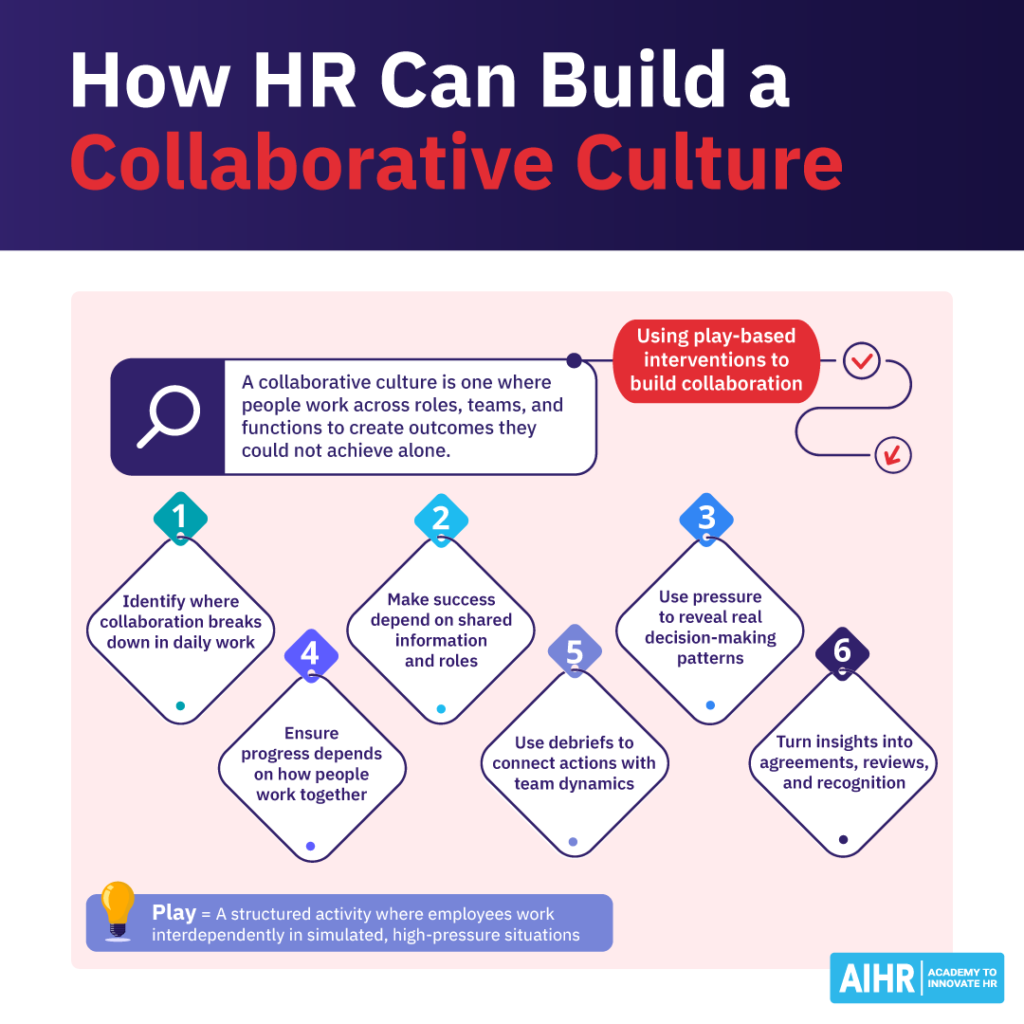
A collaborative culture is one where people work across roles, teams, and functions to create outcomes they could not achieve alone. At its core, it’s about interdependence. Collaboration is not an individual capability that you can just train your employees in. The organization builds it through its norms, incentives, leadership behaviors, and everyday ways of working.
A collaborative culture is more visible in how work actually gets done than in what organizations say. You see it in decision-making practices, rarely in isolation and often through shared input and constructive challenge.
Information flows across boundaries without excessive friction, and teams do not wait for perfect clarity before engaging others. They share ownership where needed and measure success not just by individual contribution, but by the quality of the outcome created together.
Collaboration becomes most visible under pressure. When timelines tighten or ambiguity increases, people lean into each other rather than retreat into their own domains. They surface disagreement early and handle it productively, and roles remain clear but not rigid.
People also step in where needed without overstepping. In these environments, collaboration becomes second nature and the default way of working. The organization reinforces it through its design, performance evaluation, and how leaders show up every day.
We discussed collaboration and team building with Alex Suchman, CEO and co-founder of workplace culture and development company Barometer XP. Watch the full interview below:
Coordination vs. cooperation vs. collaboration
Organizations may mistake collaboration for coordination and cooperation, but they’re not the same, and they don’t aim to achieve the same outcome. Put simply:
- Coordination: Staying out of each other’s way to drive efficiency.
- Cooperation: Helping each other when interests align.
- Collaboration: Co-creating outcomes through shared ownership and dependence.
As organizations move from coordination to collaboration, the way of working changes. People are asked to give up autonomy, share control, and rely on others under conditions of ambiguity and pressure.
Let’s take a look at a practical example of launching a new performance management approach. Peter, an HR Business Partner (HRBP), needs to roll out a new performance management approach to the business. To succeed, he needs input from Talent, L&D, HR Operations, and business leaders.
- Coordination: Peter defines the plan and assigns responsibilities, so Talent designs the framework, L&D builds the training, HR Operations updates the system, and business leaders are briefed. Each function plays its part, and Peter brings everything together for the rollout.
→ Work is aligned but largely siloed, and success depends on timelines and handoffs.
- Cooperation: Peter involves stakeholders for input along the way. Talent shares drafts for feedback, L&D adapts training based on business input, and HR Operations adjusts processes where needed.
→ There is active support and information sharing, but ownership remains within functions. The solution improves, but integration remains partial.
- Collaboration: Peter brings all stakeholders together from the outset. Together, they define what “good performance” means, co-create the approach, and iterate in real time. This helps them balance business needs, system constraints, and development goals.
→ The solution is co-created. Success depends on interdependence, shared ownership, and continuous adjustment.
Here’s an overview of coordination vs cooperation vs collaboration side by side:
Coordination | Cooperation | Collaboration | |
Core idea | Staying out of each other’s way | Helping each other toward compatible goals | Creating something neither could do alone |
Interdependence | Low | Medium | High |
Goal | Efficiency | Mutual benefit | Innovation and outcomes |
Information flow | Need-to-know | Selective sharing | Open and ongoing |
Relationship | Transactional | Goodwill-based | Trust-based |
What breaks it? | Poor planning | Misaligned interests | Lack of psychological safety |
Why collaboration is important for organizational culture
There are numerous benefits to greater collaboration within organizations. Many studies show a meaningful impact on individual and team performance, and higher levels of trust and organizational resilience. Embedding collaboration into culture helps organizations:
- Make faster decisions: Teams can bring the right expertise into the conversation earlier, reducing delays and rework.
- Integrate expertise more effectively: Business functions do not solve problems in isolation. They combine knowledge to create better solutions.
- Respond to complexity with more agility: When priorities shift, collaborative teams can adapt together instead of waiting for perfect clarity.
- Improve execution speed: Shared ownership helps teams move from planning to action more quickly.
- Improve the quality of outcomes: Collaboration turns interdependence from a source of friction into a driver of performance.
The barriers to creating a collaborative culture
When collaboration initiatives don’t stick, the instinct is to double down, more workshops, clearer frameworks, stronger messaging. But the issue is rarely about effort; mostly, it relates to structural failures that inhibit collaboration. There are three common barriers to collaboration that organizations experience:
- Barrier 1: “Teaching” people how to collaborate in a cognitive way. Organizations often assume people will collaborate better if they understand the right frameworks, tools, and models. But collaboration is shaped through daily practice. People build it by sharing ownership, making decisions together, handling tension, and relying on each other in real work.
- Barrier 2: Assuming people know that collaboration is good for everyone. Collaboration requires people to give something up: control, speed, recognition. Without a strong sense of shared intent, participation remains performative. Research published in Harvard Business Review has shown that collaboration, when unmanaged, becomes a burden rather than a benefit, with high performers experiencing it as a drain on time and autonomy. If the cost of collaboration is not made explicit and worthwhile, people will default to protecting their own outcomes.
- Barrier 3: Believing that collaboration develops naturally. Collaboration is a capability that develops through experience, yet organizations expect it to emerge in high-stakes environments without ever being practiced in low-risk ones. Very few opportunities exist for individuals to learn how to collaborate in low-stakes or simulated environments.
These three barriers are not insurmountable. Yet many traditional HR interventions struggle to address them effectively. Adopting team-based play as an approach offers a different path, enabling more collaborative teams and cultures by focusing on how collaboration is actually experienced, not just how it is described.
Using “play” as an approach to develop a collaborative culture
In an organizational setting, play is defined as a structured, goal-oriented activity that places employees in simulated, high-stakes situations where they must act interdependently. Far from being recreational, this intentional approach mirrors the cognitive and social pressures of real work, while removing the associated material risks. In practice, HR can use this approach in areas such as:
- Leadership development: Simulate situations where leaders must share control, make decisions with incomplete information, and manage disagreement.
- Team effectiveness and reset interventions: Help teams surface decision-making habits, trust issues, and unspoken working norms.
- Cross-functional collaboration: Create scenarios where teams combine expertise, negotiate trade-offs, and solve a shared business problem.
- Culture transformation initiatives: Let employees practice behaviors such as openness, shared ownership, and constructive challenge.
- Onboarding and integration: Help new employees experience how collaboration works in practice.
When a team of people who work together play together, it never ceases to amaze me. People cannot help but show up as themselves. In playing together, you’re essentially creating a controlled experiment to simulate how people work together. You remove the need for subject matter expertise, the usual power dynamics, and the narrow actions people can take.

How play helps people practice collaboration
When done well, team-based play puts people in scenarios where they must navigate ambiguity and pressure together, without the career-limiting consequences that can exist in the daily work environment.
This is a significant shift from conventional collaboration interventions. Traditional workshops and frameworks aim to foster collaboration by using principles and reflection to define what effective collaboration looks like. However, they often stay conceptual. Participants may discuss collaboration, but they are not always put in situations where they need to rely on one another to succeed.
The concept of play should not be confused with icebreakers or superficial gamification. While these might boost engagement, they fail to recreate the structural conditions that either enable or impede collaboration. Such activities simulate participation but do not create true interdependence.
Play does just that. It directly dismantles the barriers to collaborative success by:
- Translating collaboration from an abstract idea into observable, daily behavior
- Making the inherent costs and trade-offs of collaboration visible and tangible
- Providing a low-risk environment for individuals to practice under realistic, high-pressure conditions.
In this way, play reflects the evolution of leadership development. Behavior change comes through experience, not instruction alone. People only internalize new ways of working when they are placed in situations where they need those behaviors to achieve the outcome.
The value of play lies in whether it transfers back to real work. To make that happen, HR must connect the activity to everyday work, use reflection to analyze what happened, and define the shifts needed to embed those insights into the culture.
“I also make it very, very clear upfront that we’re not playing for fun. In a work setting, fun is never the purpose. The purpose is always to get better in some way. We have several different tools and assessments to look at how people on a team experience their culture, what they see as strengths, and what they see as challenges. Then, you essentially have, in their own words, the purpose for why we’re doing this. You can say, ‘Hey, I recognize that you feel a really strong sense of solidarity and team identity, but there are also misunderstandings, communication challenges, and a lack of clarity about who does what and when things are supposed to happen. So, we’re going to work on that.’
How HR can use play-based interventions to build collaboration
For HR, the key question is how to use play with intent. A meaningful HR intervention requires clear design, defined outcomes, and a direct connection to daily work. Here’s a six-step approach illustrated on a company example to put play into action at your organization:
1. Start with the friction, not the format
Resist the temptation to begin with the activity. Start with the breakdown:
- Where does collaboration actually fail?
- Between which roles, teams, or decision points?
- What tension are people navigating in their day-to-day work?
The closer the intervention mirrors real organizational friction, the more relevant and transferable the insight.
| Real-life example: A large multinational bank A large financial services organization struggled to get Business Analysts and Developers to work together effectively on a core system replacement. Processes had been clarified, roles defined, yet collaboration remained inconsistent. The issue was not the structure. It was how people experienced the work in practice. That became the starting point for a play-based intervention. |
2. Design for interdependence
If participants can succeed independently, the intervention is teaching coordination and not collaboration. Design the experience so that no individual has everything they need to succeed. Distribute information unevenly. Assign roles that depend on each other. Ensure that progress requires combining perspectives.
| Real-life example: A large multinational bank Participants joined cross-functional teams of eleven and assigned roles, such as instructor, builder, quality reviewer, and observer, without being fully briefed on the requirements of those roles. No one had the full picture. Success depended on how quickly the team established interdependence, clarified roles and responsibilities, and agreed on how they would approach the outcome. In their case, it was to build a predesigned model from a set of blocks. |
3. Introduce productive constraints
Constraints are what make behavior visible. Time pressure, incomplete data, and role limitations force participants out of their default, “polite” behaviors and into real decision-making patterns.
| Real-life example: A large multinational bank Each phase operated under strict deadlines. Information was fragmented across roles. Participants could only act within their assigned responsibilities. These constraints recreated the same tensions present in real project work, forcing teams to make decisions without all the information and putting pressure on them to perform in a short period of time. |
4. Make interaction non-negotiable
Collaboration only emerges when interaction is structurally required. The outcome of the team-based play must depend on the quality of the interaction, not on individual performance.
| Real-life example: A large multinational bank The roles had clear responsibilities. Instructors could guide but not build. Builders could execute, but lacked full context. Quality reviewers assessed work they had not performed. Progress depended entirely on how well participants worked together. |
5. Capture behavior through structured reflection
Insight emerges from reflection, not just from experience. It is important to ensure participants engage in a sense-making process to understand the behaviors they have just learned and how they relate to the work environment.
| Real-life example: A large multinational bank Observers tracked team dynamics and shared patterns during debriefs. Facilitators anchored the conversation in observed behavior, making it easier for participants to discuss and understand how they had worked during the simulation. |
6. Bridge explicitly to the workplace
After the sense-making phase, play participants need to understand how to transfer these learnings to the workplace. For some, it could imply redesigning certain ways of working; for others, it could mean more explicit connection points and a shared understanding of the behaviors required to drive this success.
| Real-life example: A large multinational bank After the simulation, participants mapped their observed behaviors to real project dynamics between Business Analysts and Developers. They identified which behaviors helped or hindered collaboration. Back in the workplace, they translated those insights into action on three fronts: • They added team agreements, such as clearer ways to challenge assumptions, to governance documents for future projects, including the project charter. • HR integrated the collaboration behaviors surfaced during play into performance management reviews and development plans. • Leaders reinforced these behaviors through recognition programs. |
Final words
Team-based play is not the intervention itself. It is the mechanism through which HR can surface reality, create shared understanding, and enable more deliberate change.
Most organizations will continue to promote collaboration. Few will build the conditions where it can be sustainably embedded in their culture.