
HR rules and regulations may not seem the most exciting part of Human Resources management, but they sure are one of the most important parts of it. Every HR practice is rooted in laws and regulations. Getting them wrong can lead to fines, lawsuits, lost employee trust, and lasting damage to your organization’s reputation.
In this article, we explore everything you need to know about navigating HR rules and regulations.
Contents
What are HR rules and regulations?
HR rules and regulations HR teams must follow
How to make sure your HR policies follow applicable laws

What are HR rules and regulations?
HR rules and regulations are the federal, state, and local laws that govern how organizations manage their workforce legally and ethically. They set minimum standards for matters such as benefits, pay, safety, and workplace conduct.
Non-compliance with HR laws and regulations can harm employees through unfair treatment, unpaid wages, unsafe working conditions, or privacy breaches. It also exposes employers to lawsuits, fines, and reputational damage. The exact HR rules and policies that apply to an organization will differ based on the company’s size, location, and the industry it’s in.
HR teams are the primary owners of compliance within an organization; they ensure that the company’s work environment and employment practices align with the latest HR rules and regulations, and that its people follow them. The most effective HR teams treat HR compliance as an ongoing effort. They track legal changes, audit policies and processes regularly, and train managers to spot risks before they turn into complaints or claims.
HR rules and regulations HR teams must follow
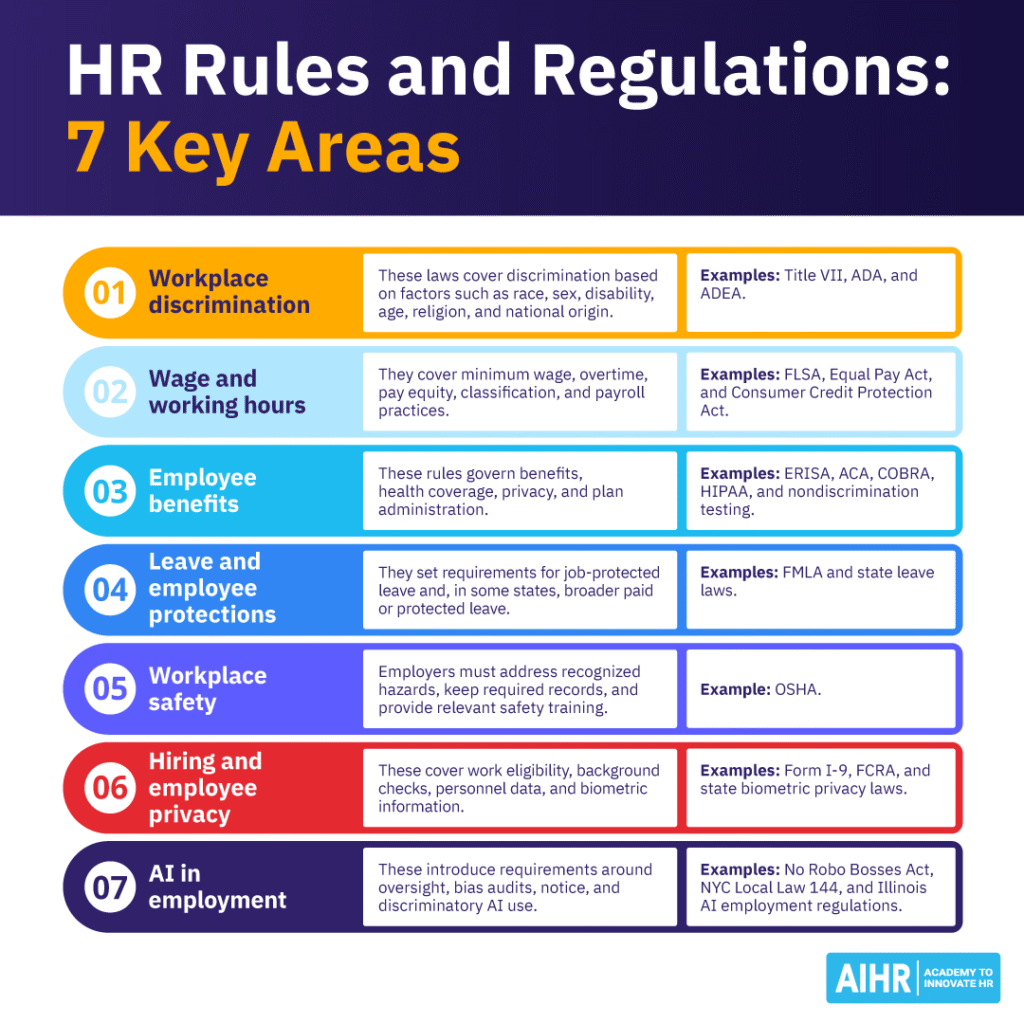
Let’s explore some of the HR rules and regulations HR teams need to follow, divided into various categories.
The rules below apply to employers in the United States. Requirements can also vary by state and city, so check local laws where your employees work.
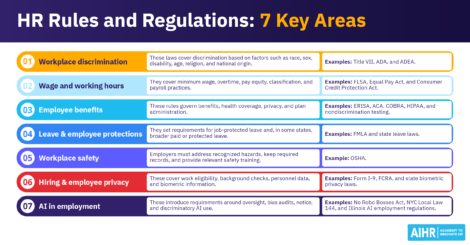
Workplace discrimination laws
Federal anti-discrimination laws prohibit unfair treatment of employees based on protected characteristics throughout every stage of employment. Examples of laws HR teams should be aware of include:
- Title VII of the Civil Rights Act: This federal employment law prohibits employment discrimination based on race, color, religion, sex (including pregnancy), and national origin.
- The ADA: The Americans with Disabilities Act (ADA) is a federal civil rights law that forbids discrimination against people with disabilities in everyday activities. It requires employers to provide reasonable accommodations for qualified employees and job applicants with disabilities.
- The ADEA: The Age Discrimination in Employment Act of 1967 is a federal labor law that protects employees and job applicants of 40 years and older from workplace discrimination based on age.
In the U.S., the Equal Employment Opportunity Commission (EEOC) enforces these laws and investigates employee complaints. Organizations must document their Equal Employment Opportunity policies and apply them consistently.
In 2015, the Supreme Court ruled that an employer’s obligation to accommodate an employee’s religious practices exists, even if the employee did not explicitly request that accommodation.
In the case of the EEOC vs. Abercrombie & Fitch Stores, Samantha Elauf, a Muslim woman, wasn’t hired at Abercrombie & Fitch because of her hijab. The company argued that the headscarf violated its dress code policy.
The Court disagreed, emphasizing in its ruling that employers need to proactively ensure that their workplace policies do not accidentally discriminate against (potential) employees’ religious practices.
Wage and hour laws
The most important wage and hour law in the United States is the Fair Labor Standards Act (FLSA). It sets binding federal rules for minimum wage, overtime pay, and child labor that affect nearly every U.S. employer.
- Elements from the FLSA to consider include:
- The federal minimum wage is $7.25 per hour (but many states set higher rates).
- Non-exempt employees must receive 1.5x their regular rate for hours over 40 per week (overtime pay).
- Misclassifying employees as exempt is one of the most common and costly HR violations.
- Employers must keep basic timekeeping records, such as time cards and work schedules, for at least 2 years and general payroll records for at least 3 years.
- The Equal Pay Act of 1963: This is a federal law that forbids sex-based wage discrimination between men and women who perform jobs that require substantially equal skill, effort, and responsibility under similar working conditions in the same workplace.
- The Consumer Credit Protection Act (Title III). Title III of this federal law limits the possibilities creditors have to collect an outstanding debt from an employee’s earnings.
The Wage and Hour Division (WHD) of the U.S. Department of Labor (DOL) enforces the Fair Labor Standards Act, and the EEOC enforces the Equal Pay Act. The Consumer Credit Protection Act is enforced by both the Consumer Financial Protection Bureau and the Federal Trade Commission.
In 2023, the Wage and Hour Division recovered $399,851 in back wages and liquidated damages for 49 workers at Supermercado Carrera, a family-owned supermarket.
The investigation by the WHD found that the grocery store paid several employees their regular rate for hours over 40 in a workweek, instead of the required 1.5 times their regular rate. This violated the FLSA. The WHD also found that the organization had misclassified some of its employees as independent contractors, thus denying those people overtime pay.
Employee benefits regulations
Several federal laws govern the design, administration, and disclosure of employer-sponsored benefit plans. HR teams should consider the following ones:
- The ERISA: The Employee Retirement Income Security Act sets minimum standards for most voluntarily established retirement and health benefits plans in the private sector to protect the individuals in these plans.
- The ACA: The Patient Protection and Affordable Care Act, commonly referred to as ACA, requires Applicable Large Employers (ALEs) to offer affordable, minimum-value health coverage to their full-time employees and their dependents.
- The COBRA: The Consolidated Omnibus Budget Reconciliation Act gives workers and their families who lost their health benefits the right to choose to continue group health benefits provided by their group health plan for limited periods of time after qualifying life events such as involuntary job loss, death, and divorce.
- The HIPAA: The Health Insurance Portability and Accountability Act establishes federal standards to protect sensitive health information from disclosure without a patient’s consent. This includes the privacy of employee health information held by plan administrators.
- NDT: Non-Discrimination Testing is a set of tests created by the IRS (the Internal Revenue Service) to assess whether or not an organization’s benefits plans are fair for all eligible employees and not just for the business owners, key personnel, or highly compensated employees. It’s a mandatory practice for U.S. companies that sponsor tax-advantaged employee benefits or retirement plans.
In the case of Disberry vs. the Employee Relations Committee of the Colgate-Palmolive Co. et. al., the U.S. District Court for the Southern District of New York ruled that both Colgate and Alight breached their duty under ERISA when they allowed a thief to empty a former employee’s retirement account.
Retired Colgate-Palmolive marketing executive Paula Disberry alleged that her former employer and the companies that provided services to its employee retirement plan were liable for her losses when a thief took control of and drained her retirement account of more than $750.000. The case also raises a question for employers: under ERISA, how far does their legal duty to protect retirement plan participants extend to cybersecurity?
Leave laws and employee protections
Federal and state leave laws give employees the right to take job-protected time off for medical and family reasons.
- The FMLA: The Family and Medical Leave Act entitles eligible employees at covered employers to take up to 12 weeks of unpaid, protected leave annually for specified family and medical reasons.
- State leave laws: State leave laws often provide broader protections and paid leave benefits beyond FMLA minimums. For example, the Oregon Family Leave Act (OFLA) applies to employers with 25 or more employees (compared to 50 under FMLA) and includes separate allowances for bereavement, pregnancy disability, military family leave, and sick child leave.
HR pro tip: When it comes to leave laws and employee protections, HR teams need to track intermittent leave carefully to avoid interference or retaliation claims. Clear, written leave policies reduce disputes and ensure consistent, compliant administration.
The U.S. Department of Labor’s case against Wicked Cantina, a Florida restaurant, shows how quickly FMLA violations can happen at the manager level. After a short hospital stay, an employee gave the restaurant’s general manager a doctor’s note saying they shouldn’t work for three days. The manager told them to work anyway.
At no point did the employer mention that the employee might qualify for FMLA leave or provide the required notices. Five days after the hospital discharge, the manager fired the employee for alleged tardiness and spreading rumors.
The Wage and Hour Division (WHD) investigated and took the case to federal court. In 2023, a consent judgment ordered the restaurant to pay $60,065 in back wages and damages and barred it from future FMLA violations. The employee never had to explicitly ask for FMLA leave. A doctor’s note was enough to put the employer on notice.
Workplace safety laws and OSHA compliance
The Occupational Safety and Health Administration, part of the U.S. Department of Labor, sets and enforces workplace safety and health standards.
- The Occupational Safety and Health Act (OSHA) requires employers to provide a work environment free from recognized hazards. Some elements that are especially relevant for HR teams are:
- Employers must comply with OSHA standards specific to their industry and operations.
- Workplace injury and illness records need to be kept on OSHA Forms 300 (the Log of Work-Related Injuries and Illnesses), 300A (the Summary of Work-Related Injuries and Illnesses), and 301 (the Injury and Illness Incident Report).
- Employees have the right to report hazards without fear of retaliation or punishment.
- Regular safety training and hazard assessments are required, not optional, compliance activities.
In a recent case, the U.S. Department of Labor proposed $3.5 million in fines for dangerous health and safety violations by three employers during a huge chemical spill in Texas.
OSHA investigators found that one of the companies sent in workers to clean up the chemical spill without adequate training, respirator fit tests, or safety measures. Violations of the other two companies included a lack of training, deficiencies in the use of respirators, and exposing workers to chemical burns.
Hiring, onboarding, and employee privacy requirements
Compliant hiring practices and proper handling of employee data are foundational HR obligations with significant legal consequences. Some employment rules and regulations to keep in mind are:
- Form I-9: The Employment Eligibility Verification form is mandatory for all U.S. employers and must be completed for every new hire to verify employment eligibility.
- Background check procedures: These checks must comply with the Fair Credit Reporting Act (FCRA), meaning they typically require disclosure and explicit written consent from job applicants. Familiarize yourself with relevant local (state) requirements to avoid non-compliance issues.
- Employee personnel files: These files should be stored securely and accessed only on a need-to-know basis.
- State biometric privacy laws: These laws now regulate how HR can collect and store fingerprint and facial data. For example, the Illinois Biometric Information Privacy Act (BIPA) states, among other things, that:
- Employers need to inform their employees in writing about the purpose and length for which the data is collected, and get a signed release before collecting biometric data such as fingerprints or facial scans.
- Employers can not lease, sell, or profit from their employees’ biometric data.
- Companies need to publish a written schedule and guidelines stating when they will permanently delete their employees’ biometric data.
HR pro tip: Review job postings and interview guides for wording that could screen out protected groups. Phrases like “digital native” or “recent graduate” can signal age bias, and questions about family plans or religion can expose you to discrimination claims. Asking every candidate the same job-related questions in a structured interview can help reduce bias in the hiring process.
Under the Americans with Disabilities Act (ADA), employers can’t ask job applicants disability-related questions or require medical exams before making a job offer. That includes indirect questions, which can be just as risky as direct ones. You can, however, ask whether a candidate can perform the job’s essential functions.
Questions to avoid include:
- What happened to your ?
- Do you have a disability?
- Have you ever been treated for a mental health condition?
- How many sick days a year did you take in your previous job?
Instead, focus on the requirements of the role:
- The role requires ; are you able to perform this task with or without accommodation?
- Are you able to meet the attendance requirements for this position?
AI in employment laws
AI now shapes how many HR teams screen candidates, assess performance, and make workforce decisions. As more states and cities regulate these uses, keeping up with new and changing AI laws has become part of HR compliance. Examples include:
- No Robo Bosses Act: The aim of this 2026 California legislation is to ensure human oversight of artificial intelligence systems in the workplace to prevent abuses. The bill requires employers, among other things, to:
- Ensure human oversight and verification when an automated decision-making system (ADS) is involved in disciplinary or firing decisions.
- Inform workers if they have used an ADS in termination or disciplinary decisions.
- Not solely rely on an ADS for termination or disciplinary decisions.
- NYC AEDT Regulation: NYC Local Law 144 of 2021 forbids employers and employment agencies from using Automated Employment Decision Tools (AEDTs) for hiring or promotions, unless specific bias auditing, public reporting, and candidate notification rules are met. These requirements include:
- An annual bias audit.
- A summary of the bias audit results publicly posted on the employer or employment agency’s website.
- Giving a candidate or employee at least 10 business days’ notice before using the AEDT, including information about what qualifications or job characteristics will be assessed.
- Illinois AI in employment regulations: From January 1, 2026, amendments to Article 5, Section 2 of the Illinois Human Rights Act (the IHRA) prohibit employers from using AI that subjects employees to discrimination on the basis of a protected class. The Act, among other things:
- Covers the use of AI in recruitment, hiring, promotion, renewal of employment, discharge, discipline, tenure, selection for training or apprenticeship, and the terms, privileges, or conditions of employment.
- Requires employers to notify employees of the use of AI for specified purposes (without elaborating on the scope or details of this notice requirement).
- Bans employers from using zip codes as a proxy for protected classes.
- Is subject to the enforcement and remedies provisions of the IHRA.
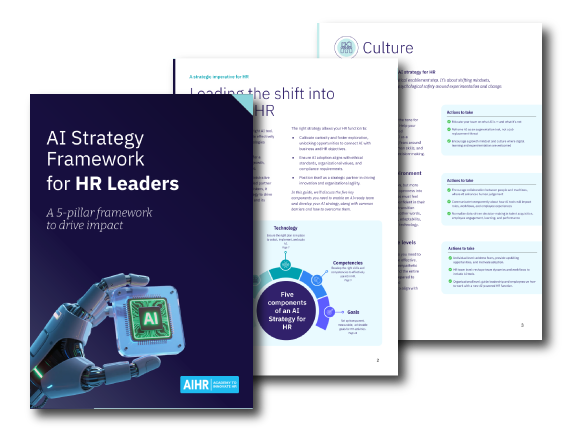
To comply with emerging AI laws, HR teams need to understand where and how AI is being used across the employee life cycle. AIHR’s AI Strategy Framework for HR Leaders guide helps you assess those use cases and align AI adoption with ethical and compliance requirements.
Under the Americans with Disabilities Act (ADA), employers can’t ask job applicants disability-related questions or require medical exams before making a job offer. That includes indirect questions, which can be just as risky as direct ones. You can, however, ask whether a candidate can perform the job’s essential functions.
Questions to avoid include:
- What happened to your ?
- Do you have a disability?
- Have you ever been treated for a mental health condition?
- How many sick days a year did you take in your previous job?
Instead, focus on the requirements of the role:
- The role requires ; are you able to perform this task with or without accommodation?
- Are you able to meet the attendance requirements for this position?
How to make sure your HR policies follow applicable laws
Knowing what HR rules and regulations are applicable is one thing; ensuring your HR team stays compliant is another. Here are some practices to consider:
- Identify governing laws: Start by making an inventory of all the HR laws and regulations that apply to your organization. Take into account your company size, industry, and location, and include federal laws, as well as state and local mandates. Track legislative changes to, among other things, minimum wage, paid leave laws, and pay transparency to ensure you stay current.
- Conduct an annual HR compliance audit: Make sure your audit covers all federal, state, and local obligations from your inventory, including the latest updates and (legal) changes. Check each internal rule and policy against the current statutory requirements to spot and address gaps.
- Consult with an expert: Consider bringing in an employment lawyer or HR compliance specialist to review your inventory and audit results, along with your key policies and employee handbook. Their input is especially valuable when you run your first audit, expand into new states, roll out new HR technology such as AI hiring tools, or respond to major legal changes.
- Update employee handbooks: Create a process that allows you to (if possible, automatically) update the company’s employee handbook and all the policies within it whenever laws or regulations change, and document distribution to all employees.
- Create clear ownership: Your inventory will provide you with a comprehensive overview of all the HR laws and regulations the organization must comply with. You can use this overview to assign clear ownership of each compliance area to a specific HR team member or a legal partner. Doing so makes it easier to stay on top of the various statutory requirements and legislative changes. It also creates clarity for people outside the HR team about who to turn to with queries about a particular compliance or legal area.
- Train managers regularly: Managers are usually actively involved in the organization’s day-to-day activities. As such, they are often also the first point of legal exposure, making solid, regular compliance training indispensable. Focus training on the situations managers handle most, such as interview questions, leave and accommodation requests, overtime approvals, and disciplinary conversations, so they know when to pause and bring in HR.
Over to you
HR rules and regulations form the backbone of an organization’s HR practices and, by extension, its success. Compliance starts with knowing what statutory requirements apply to your company and ensuring your rules and policies align with them.