


“We’ll know the right candidate when we see them”. – Hiring manager
“There must be candidates out there – we just need to search harder”. – Hiring manager and TA team
“We’ve been trying to fill this role for months”. TA team
You’ve likely heard similar words conveyed by your Talent Acquisition team. TA is facing a much tougher hiring process; roles stay open longer, and candidate pools are smaller than expected. The business response is often to add more channels, agencies, or requirements.
Yet these actions rarely address the real source of the problem because many hiring challenges are shaped before the search even begins.
Talent scarcity is becoming more structural in many markets, while skills are changing faster than role profiles and hiring processes can keep pace. At the same time, traditional filters such as degrees, years of experience, and narrow industry backgrounds are limiting access to talent, just as organizations need to widen it.
This creates a clear opportunity for Talent Acquisition to contribute earlier. By bringing market insights into the hiring conversation before expectations are set, TA can help shape the role, test assumptions, and improve decisions about where, when, and how to hire. That earlier involvement can prevent unrealistic searches from being launched and increase the likelihood of finding the capability the business needs.
This article explores the talent-market realities reshaping Talent Acquisition, the shifts these create for the practice, and the next practices HR can adopt to improve access to talent and the quality of the search.
The talent realities reshaping Talent Acquisition
The conditions under which organizations hire are changing. While economic cycles will continue to influence demand, several of the pressures now affecting recruitment are more persistent.
They are also connected. A smaller talent pool becomes more difficult to manage when employers define roles narrowly. Quickly changing skills makes long lists of experience requirements less reliable. Vacancy-led hiring creates further pressure because organizations begin building talent access only when the need becomes urgent.
These all change the response required from your Talent Acquisition team.
Reality 1: Talent scarcity is becoming structural
In several markets, talent shortages are no longer only the result of periods of strong economic growth or unusually high demand. Population demographics are changing the available labor supply.
Working-age populations are shrinking or growing more slowly across several major economies. More people are leaving the workforce, while fewer are entering it. In some regions, immigration is also becoming a less predictable means of offsetting domestic talent shortages.
Past hiring success can therefore create false confidence. The fact that an organization previously recruited a particular profile does not mean it can continue doing so at the same speed, cost, and scale.
This changes the role of market insight in recruitment. Rather than using talent availability data only after a search has stalled, TA needs to bring that information into the conversation before the role opens. This allows the organization to understand whether the profile is realistic and what trade-offs may be required.
Reality 2: Skills are changing faster than hiring processes
The challenge Talent Acquisition teams face lies in both the number of available people and the speed at which the skills required for work are changing.
Our research shows that roughly a third of the skills in the average job changed over a three-year period, with even faster movement in areas such as technology and marketing.
Most hiring processes are not designed for this pace of change. Role profiles are often based on previous job descriptions, familiar career paths, or the experience of the person leaving the role. By the time the requisition is approved, benchmarked, advertised, and taken through the selection process, the business need may already have shifted.
The organization can end up recruiting against the last version of the job rather than the work that needs to be done now. And the more narrowly a role is defined around current tools, experience, and responsibilities, the harder it becomes to find candidates who meet every requirement. It can also result in selecting someone for what they already know rather than for their ability to adapt as the work changes.
Talent Acquisition, therefore, needs a clearer view of which capabilities are stable, which technical skills are likely to change, and where learning ability matters as much as previous experience.
Reality 3: Traditional filters are reducing access to talent
Organizations respond to uncertainty by adding more requirements. Degrees, years of experience, previous job titles, sector background, and specific credentials are used to signal quality and reduce perceived hiring risk.
Some of these requirements may be necessary. Many, however, have been carried forward without being tested against performance. The effect is a self-imposed reduction in the talent pool. Employers may believe that suitable candidates are unavailable when, in reality, they have defined suitability too narrowly.
This is particularly visible in hard-to-fill roles. A search may combine technical expertise, leadership experience, sector knowledge, a specific qualification, and a minimum number of years in a similar position. Each requirement appears reasonable in isolation, but together they produce a candidate profile that very few people meet.
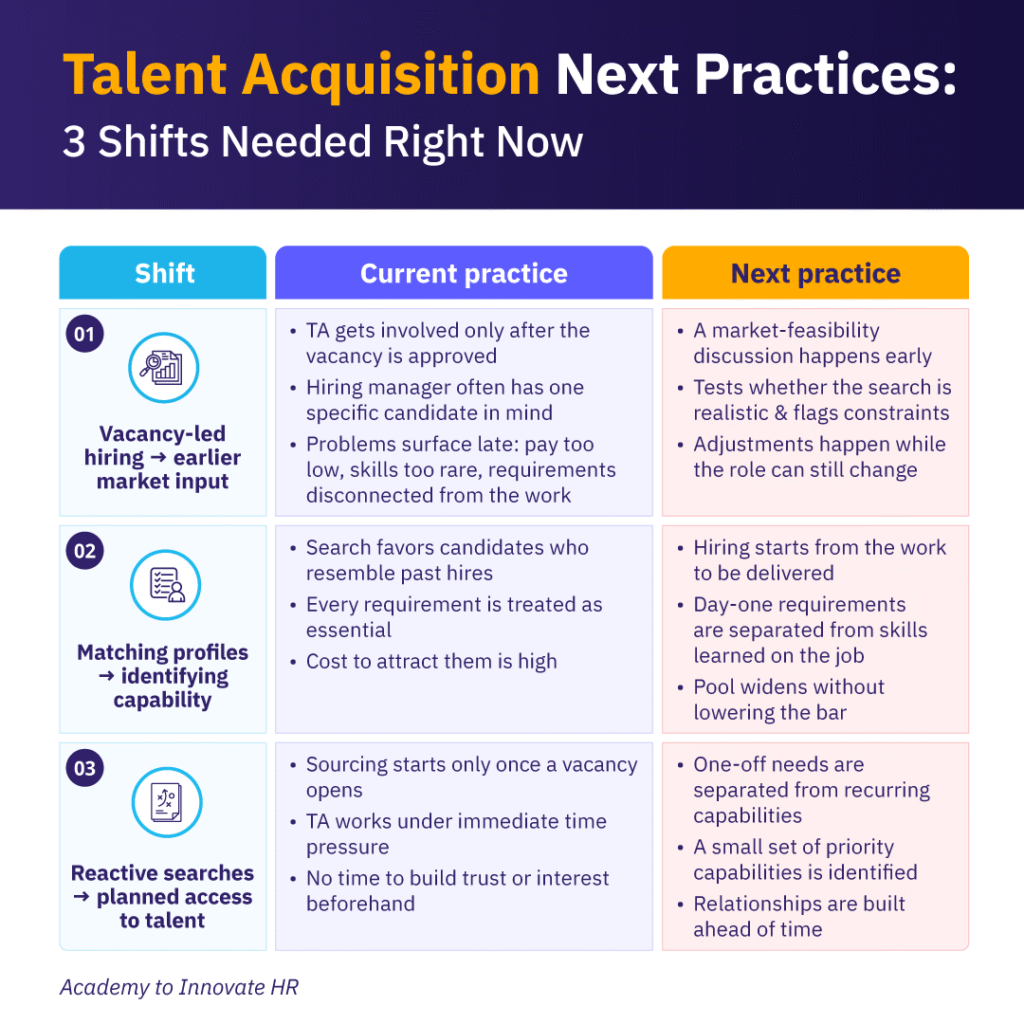
3 shifts required in Talent Acquisition
These realities do not call for a larger volume of recruitment activity. They require changes in when Talent Acquisition contributes, how roles are defined, and how access to talent is built.
Three shifts are particularly important:
The shift | Current practice | Next practice |
Vacancy-led hiring → earlier market input |
|
|
Matching profiles → identifying capability |
|
|
Reactive searches → planned access to talent |
|
|
1. From vacancy-led hiring to earlier market input
Talent Acquisition is often only meaningfully involved after the vacancy has been approved. By this point, the salary, location, reporting line, level, and role requirements may already be fixed. The hiring manager may also have a clear picture of the person they expect to find, often based on the previous employee or an ideal candidate from a competitor.
TA is then expected to deliver within conditions it had a limited opportunity to shape. This is why many searches begin with assumptions that only become visible once the market fails to respond. The salary is below the candidate’s expectations, the location excludes most of the available pool, the required combination of skills is rare, or several listed requirements have little connection to the work.
Earlier market input allows these issues to be addressed before time and credibility are lost. This does not require a lengthy new approval process. A simple market-feasibility discussion can provide enough information to determine whether the search is realistic, identify constraints, and determine which requirements are most likely to limit supply.
The shift is from bringing evidence into the conversation after the search struggles to using it while the role and hiring approach can still be adjusted.
2. From matching profiles to identifying capability
Hiring processes often begin with a title and a list of requirements. This encourages the search for candidates who resemble previous hires or who have followed a familiar career path.
A capability-based approach begins with the work the person needs to deliver. This makes it possible to distinguish among the required outcomes, the skills needed to achieve them, and the background traditionally associated with the role. This, in turn, expands the available pool without lowering standards.
For example, a role may initially require ten years of experience in the same industry, a specific degree, and previous experience in an identical position. Once the discussion shifts to the work itself, the real need may be experience leading complex projects, influencing senior stakeholders, and applying a particular technical skill. Those capabilities may exist in candidates from a wider range of sectors and career paths.
This shift also helps separate day-one requirements from skills that can be developed after appointment. When every requirement is treated as essential, the organization is effectively searching for someone already performing the same role in the same environment. That candidate may exist, but the pool will be small, and the cost of attracting them will be high.
Defining capability more clearly creates room to consider adjacent experience, transferable skills, and potential.
3. From reactive searches to planned access to talent
Even where talent needs are predictable, sourcing often begins only when a vacancy is approved.
This places the Talent Acquisition team under immediate time pressure and leaves little opportunity to build familiarity, trust, or interest among prospective candidates. Every new requisition starts a new search, even when the organization has repeatedly hired similar profiles. A more sustainable approach is to distinguish between one-off needs and capabilities that the organization will require regularly.
Past finalists, strong candidates who withdrew, former employees, referrals, and candidates from adjacent backgrounds can all become part of a more active talent pool. The shift is from beginning each search from zero to creating informed access to talent, where future demand is reasonably predictable.
5 next practices for Talent Acquisition to succeed
Now that we understand what needs to change, let’s address how your Talent Acquisition team can put this into action in their day-to-day work.
1. Introduce market feasibility before the search
A search is difficult to correct once expectations have been set and the role has been open for several weeks. By that point, the hiring manager may have communicated timelines to the business, internal stakeholders may expect progress, and TA may already have approached much of the available market. Changes to salary, location, or requirements can then feel like a reversal rather than an informed adjustment.
A market-feasibility check brings these choices to the fore. Before the search begins, your TA team should provide a basic view of the likely candidate pool, salary expectations, common locations for the required skills, competitor demand, and the requirements most likely to limit supply.
This doesn’t require a sophisticated talent intelligence function. In many organizations, a useful view can be built using the ATS, LinkedIn, labor-market data, previous searches, and recent candidate conversations.
The aim is not to predict the exact outcome of the search. It is to make the main constraints visible and provide options. Where the pool is limited, the organization may decide to adjust the salary, broaden the location, reduce non-essential requirements, consider remote work, include adjacent candidates, or allow more time. These are easier choices to make before the search starts than after it has failed to produce a shortlist.

Select one hard-to-fill role and assess the size and shape of the realistic candidate pool before approving the search.

Track the percentage of roles assessed for market feasibility before sourcing begins.
2. Define performance-critical skills
Job descriptions often combine what is essential, what is preferred, and what has simply been inherited.
Over time, requirements accumulate. A qualification is added because a previous employee held it. A specific number of years is included because it appears to indicate seniority. Sector experience becomes essential because it feels safer than considering candidates from unfamiliar backgrounds.
The result is a role profile that is difficult to use and even harder to recruit against. A stronger approach is to define a small number of skills and capabilities directly connected to performance in the role. For many positions, five to seven performance-critical capabilities create a clearer basis for sourcing and assessment than a long list of responsibilities and credentials.
This requires your TA and the hiring manager to connect each requirement to the work. The aim is to understand what the person must be able to do, why it matters, and how that capability will be assessed. Requirements that cannot be linked to performance should be removed or treated as preferences.
The same discussion should identify which capabilities must be present on day one and which can be developed within the first six to twelve months. This prevents the organization from treating a learnable gap as a reason to exclude an otherwise strong candidate.
Review the next role profile and require a clear performance rationale for every essential requirement.
Track the percentage of role requirements that have been validated as performance-critical.
3. Assess skills, potential, and adjacent experience
Changing the job description is not enough to change the hiring outcome.
An organization may remove degree requirements or reduce the emphasis on years of experience, but still favor candidates with familiar titles, recognizable employers, and industry experience in the selection process. Skills-based hiring only becomes meaningful when assessment changes, too.
Structured interviews, work samples, realistic scenarios, and job-relevant tasks allow the organization to assess capability more directly. They reduce reliance on proxies and make it easier to compare candidates from different backgrounds against the same criteria.
Potential also needs to be assessed more deliberately, particularly where the work is changing quickly. This does not mean relying on vague judgments about attitude, energy, or cultural fit. Learning ability and adaptability can be assessed through evidence. Candidates can be asked to describe how they learned a new skill, how they responded when their expertise became outdated, or how they applied existing capabilities in an unfamiliar setting.
Adjacent candidates should also become a planned part of the search. These candidates may not have held the same title or worked in the same sector, but they bring relevant skills that can transfer into the role. The key is to identify the specific remaining gaps and determine whether they can be closed through onboarding, targeted development, or on-the-job experience.
This is where closer coordination among TA, L&D, Talent Management, and the hiring manager is especially valuable. TA identifies transferable capability, while the wider HR system helps assess whether the development required is realistic.
Include at least one candidate from an adjacent background in the shortlist for a hard-to-fill role and assess them against the same performance-critical criteria.
Track the percentage of shortlists that include candidates with relevant adjacent experience.
4. Build pipelines around recurring capability needs
Talent pipelines often exist as static lists of people who once expressed interest in the organization. That is not the same as maintaining access to talent.
A useful pipeline is built around a defined capability need, contains people who are relevant to that need, and is supported by ongoing engagement. It should help TA respond faster and with greater confidence when demand arises.
The first step is to identify three to five capability areas where hiring demand is recurring, the external pool is limited, or the organization has repeatedly struggled to recruit. TA can then build a focused pool of prospective candidates by drawing on previous finalists, silver medalists, former employees, referrals, event attendees, and targeted sourcing.
The aim is not to create the largest possible database. It is to maintain a smaller group of relevant people who understand the organization and may be open to a future conversation.
Engagement also needs to continue between vacancies. This may involve sharing relevant content, providing updates on the organization, inviting people to events, or simply reconnecting periodically. The strength of the pipeline should be judged by whether it improves hiring outcomes, not by the number of names it contains.
Build an active pool of 20 to 30 people around one priority capability, using existing ATS and sourcing tools.
Track the percentage of hires coming from candidates who were previously known or engaged.
5. Use AI to widen access and improve consistency
AI is becoming part of sourcing, screening, candidate communication, interview support, and talent-pool management. The value of AI in TA lies in applying it to defined problems rather than adding it across every stage of the process.
AI can help identify relevant candidates already in the ATS, improve sourcing reach, support high-volume screening, maintain contact with talent pools, and flag restrictive language in role profiles. It can also help recruiters organize market information and identify patterns across previous searches.
Used well, these applications can improve efficiency and widen access to talent. Used without clear oversight, AI can scale weak assumptions.
If a role is defined too narrowly, an AI sourcing tool may simply find more people who resemble previous hires. If historical data reflects biased selection patterns, automated recommendations may reinforce them. If candidates do not understand where AI is used, trust in the process can decline.
This means that AI needs to sit within a clear decision framework. Each use case should be linked to a specific problem, supported by human oversight, and communicated transparently to candidates. The organization should be able to explain where AI is used, what it contributes, and where human judgment remains responsible for the outcome.
Document the current use of AI across the recruitment process and identify the decision or activity each application supports.
Track the percentage of AI-supported hiring processes with clear human oversight and candidate communication.
Enabling the shift across HR and the business
TA cannot embed these next practices in isolation. Earlier market input, skills-based hiring, and planned access to talent depend on how the wider organization makes workforce and talent choices.
The following conditions support the shift.
Strategic alignment
TA needs visibility into the capabilities the organization expects to hire externally, develop internally, or access through mobility. Without that view, TA may build external pipelines for skills the organization intends to develop, or repeatedly search the market for capabilities that already exist internally. Alignment does not require perfect workforce plans. It requires a shared understanding of the most important capability needs and the preferred response to each.
Connected HR practices
TA, Talent Management, L&D, and internal mobility do not need to operate as one function, but they do need clear points of connection. When an adjacent candidate is identified, there should be a practical way to assess whether development can close the remaining gap. When an external search is unlikely to succeed, internal talent should be considered before the search has already stalled. Shared ownership of capability gaps is more useful than treating external recruitment as the first and only response.
Focused technology investment
Technology choices should be linked to specific problems in the hiring process. AI sourcing may add value where the organization has a large candidate database but struggles to rediscover relevant people. Automated screening may support consistency in high-volume hiring. Talent intelligence may improve feasibility discussions for hard-to-fill roles. The question is not where AI can be inserted, but which decision or activity it improves.
Shared expectations with hiring managers
Earlier TA involvement may introduce more challenges before a role opens. That challenge needs to be evidence-based and accompanied by options. Telling a hiring manager that a profile is unrealistic is unlikely to improve the conversation. Showing the likely pool, explaining which requirements limit supply, and setting out the available trade-offs creates a more constructive basis for action. TA’s contribution is strongest when it combines market evidence with practical alternatives.
To sum up
By bringing market evidence to the fore, defining roles around capabilities, assessing skills and potential directly, widening access to adjacent talent, and building relationships before demand arises, your Talent Acquisition team can help the organization respond more effectively to a tighter, faster-changing talent market.
AIHR’s Advisory services help you to evaluate your current talent acquisition practices against these next practices standards and provide advice on where to start, including building capabilities within your TA team to deliver successfully.


