
The best HR Business Partner (HRBP) training for HR teams should build consistent strategic skills across your whole HRBP function. It should also help HRBPs move from tactical support to business advisory roles by providing a shared standard leaders can trust.
You may have trained one HRBP before, but training a full HRBP team is another challenge altogether, as different people start from different skill levels. This article explains how to assess your team’s gaps, compare HRBP training formats, and choose a program that builds measurable business impact.
Contents
Why team-wide HRBP training needs a different approach
What to look for in strategic HRBP training for teams
Start with an HRBP skills assessment
Compare the main HRBP training formats for teams
The best HRBP training for teams
How to choose the best HRBP training for your team
How individual HRBP certifications fit into a team rollout
How to measure HRBP team training impact
Why team-wide HRBP training needs a different approach
An individual HRBP seeking to build strategic skills would likely choose an HRBP course or certificate program, work through it, and apply what they learn to their job. However, the same approach won’t work for a team of multiple HRBPs.
Content is usually not the issue, since many reputable HRBP training programs cover similar skills: business acumen, stakeholder management, consulting skills, data literacy, and workforce planning. Consistency, on the other hand, is usually harder to maintain when scaling up HRBP training to serve a team.
On an HRBP team, some may already feel comfortable challenging a profit-and-loss (P&L) assumption in a leadership meeting, while others still turn manager requests into HR tasks without asking what the business really needs. As such, having them both take the same course will produce uneven results (e.g., varying completion rates).
This inconsistency can lead to problematic gaps. For instance, one business unit may trust its HRBP as a strategic advisor, while another may still see HRBPs as a support function. This can affect manager trust, decision speed, workforce planning, and HRBP retention.
There’s also a visibility problem. When one HRBP invests in their own development, few people outside HR notice. But when you invest in training the whole HRBP function, leaders expect a return. Your Chief Human Resources Officer (CHRO), Chief Financial Officer (CFO), and business unit leaders want to see fewer escalations, faster decisions, and HRBPs who bring solid data to leadership conversations.
This forms the basis of what to look for when considering the best HRBP training for teams. Your assessment must go beyond questions like “Which course has the best reviews?”, so you can ensure your company’s HRBP training closes specific gaps and builds a shared standard.

What to look for in strategic HRBP training for teams
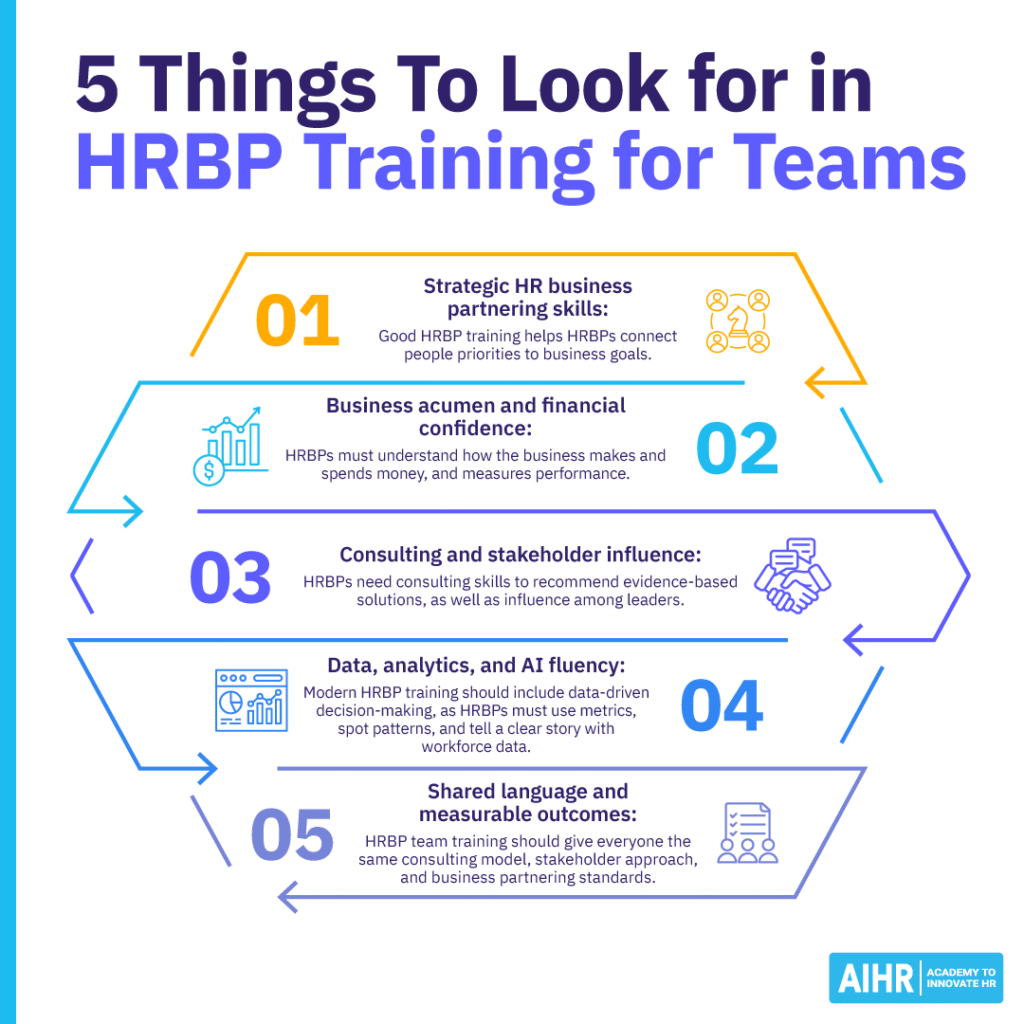
A program that works well for one person may not work for a team; team-wide HRBP training needs to build shared capability. The strongest programs usually cover five areas:
1. Strategic HR business partnering skills
Good HRBP training helps HRBPs connect people priorities to business goals, meaning they should be able to translate business strategy into workforce priorities. For example, a manager may ask for “more retention support”, but a strategic HRBP should be able to ask more pertinent questions, such as:
- “Which roles are at risk?”
- “What is turnover costing the business?”
- “What manager behaviors or workforce patterns are driving exits?”
2. Business acumen and financial confidence
HRBPs need to understand how the business makes money, spends money, and measures performance. Without that context, they may struggle to influence leaders. Business acumen includes understanding budgets, forecasts, margins, operating models, and P&L basics. It also means knowing how people decisions affect revenue, cost, risk, and productivity.
3. Consulting and stakeholder influence
Strategic HRBPs not only give advice but also diagnose problems, challenge assumptions, manage stakeholders, and guide leaders toward better decisions. This requires consulting skills that enable HRBPs to ask better questions, frame problems clearly, and recommend evidence-based solutions. They also need influence, as a strong HRBP can push back on a leader without damaging trust.
4. Data, analytics, and AI fluency
Modern HRBP training should include data-driven decision-making. HRBPs must use metrics, spot patterns, and tell a clear story with workforce data. While they don’t need to be people analytics specialists, they must be able to use data in leadership conversations.
AI has become part of this skill set. HRBPs may use it to summarize workforce insights, draft stakeholder communications, identify patterns, or speed up analysis. As such, training should teach safe and practical use, not vague AI awareness.
5. Shared language and measurable outcomes
Team-wide HRBP training should give everyone the same consulting model, stakeholder approach, and business partnering standards, to make collaboration easier and handoffs smoother.
For example, if one HRBP covers for a colleague on leave, they can pick up the stakeholder relationship without taking on a different way of working. The program should also give you something to report on, such as a skills baseline, completion rate, capstone project, manager feedback, or behavior change.
Start with an HRBP skills assessment
Before you shortlist a single HRBP course, certification, certificate program, or bootcamp, find out where your team stands. A structured assessment gives you a good starting point. AIHR’s HRBP Impact Assessment, for example, helps benchmark your HRBP function against its current required capabilities. These include stakeholder advisory, business acumen, data-driven decision-making, and HR consulting.
This baseline can help you determine the biggest gaps, which then allows you to select the right type of training for your HRBP team. For instance, a team that knows the fundamentals but struggles with stakeholder influence doesn’t need the same program as one new to business partnering.
Compare the main HRBP training formats for teams
Once you know the gap you’re closing, focus on the format of the training you’re considering. Team-wide HRBP training usually comes in three formats, each with trade-offs related to flexibility, speed, cost, and accountability.
HRBP training format | Best for | Main trade-off |
Self-paced team programs | Flexible learning across locations and skill levels | Less consistency without deadlines or manager support |
Cohort-based HRBP bootcamps | Fast upskilling, shared language, and team accountability | Requires more schedule coordination |
Blended enterprise academies | Large HR transformations and custom HRBP models | Takes more planning, budget, and stakeholder alignment |
Self-paced HRBP training and team licenses
A team license gives each HRBP access to a library of courses and certificate programs, allowing them to learn at their own pace and choose the topics most relevant to their role. AIHR’s Team License, for instance, gives teams access to certificate programs, including the HR Business Partner 2.0 Certificate Program. This format works well for teams spread across time zones, as well as for those with limited budgets or varied development needs.
The main trade-off is consistency. Self-paced training won’t guarantee that everyone completes the same content or reaches the same standard. Without deadlines, manager support, or shared milestones, training can slip when work gets busy. Two HRBPs on the same license can also end the year with different skill profiles, which supports general development but not one shared HRBP standard.
Cohort-based HRBP bootcamps
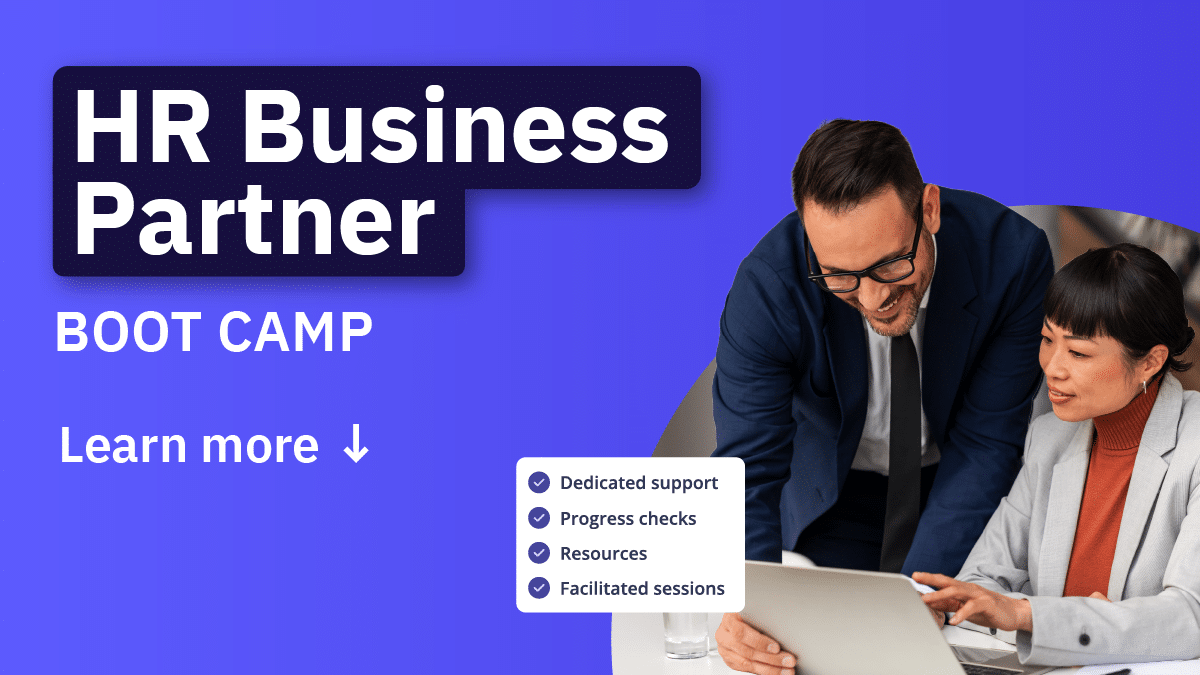
A cohort-based boot camp adds structure, as the team goes through a shared program with live sessions, learning milestones, and accountability. AIHR’s HRBP Boot Camp is built for this type of team rollout. It combines self-paced learning with live expert sessions, real-world use cases, and a capstone. Live sessions are available for teams of five or more.
This format helps solve the consistency problem, since everyone learns the same lessons, applies similar tools, and works toward a shared timeline. It also reduces the burden on HR leaders. A learning consultant or program lead can help keep learners engaged and on schedule, which in turn helps when HRBPs are balancing training with urgent business needs.
Cohorts work especially well when your team has wide skills gaps or a clear leadership mandate to improve fast. They also help when you need visible outputs, such as a capstone, implementation plan, or project showcase.
If your team needs AI fluency alongside business partnering skills, AIHR also offers an AIHR for HR Boot Camp that follows a similar cohort model and can pair well with HRBP-focused development.
Other providers also offer cohort-style HRBP programs that often focus on strategic influence, consulting skills, business acumen, and analytics. One example is HCI’s Strategic HR Business Partner (SHRBP) Certification, an intensive three-day program groups of HRBPs can attend together to obtain a shared, recognized credential and a common vocabulary in a short window.
Blended enterprise academies
For larger HR functions, a blended enterprise academy that combines self-paced learning, live cohorts, and custom curriculum design works best, especially if HRBP training is part of a broader HR transformation. It can support a new HR operating model, a change in HRBP role expectations, or a global capability-building plan.
SHRM’s enterprise and team training options, AIHR’s enterprise solutions, and CIPD’s group learning routes can all support this type of rollout. The best fit depends on your location, budget, and internal HR model.
It’s also important to remember that this is usually the heaviest lift. It takes more planning, more budget, and more stakeholder alignment, but can work well when a standard course or bootcamp doesn’t fit your organization’s needs.
None of these formats is universally the “best”. For instance, a team of four HRBPs across three countries has different needs from a headquarters team of 30 undergoing a one-quarter transformation. A team with strong baseline skills may need a license and shared learning plan, while one with wide skills gaps may need a cohort bootcamp.
Effective HRBP team training helps your team turn business priorities into people solutions, make evidence-based decisions, and influence stakeholders. The right development approach also creates an organization-wide standard for HRBP operations.
AIHR’s HRBP Boot Camp can teach your team how to:
✅ Execute business strategy by identifying value drivers, linking people priorities to strategic goals, and building actionable HR roadmaps.
✅ Diagnose business challenges with the CONSULT framework to uncover root causes and make evidence-based recommendations.
✅ Use HR metrics to demonstrate business impact via scorecards, KPIs, SMART metrics, and the HR Value Chain.
✅ Lead change better with stakeholder influence, strategic communication, and AI-supported workflows.
🚀 Equip your HRBP team to apply a consistent, business-focused approach to solving strategic challenges and delivering measurable impact.
The best HRBP training for teams
Consider the following options to help drive HRBP training for teams at your organization:
AIHR for HRBPs
- What it offers: A dedicated HRBP training solution built around three team-level options depending on size and timeline: a self-paced Team License, the cohort-based HRBP Boot Camp, or a fully customized HR Academy for larger HR functions.
- Format: Consultative. A learning specialist reviews your team’s goals and current skills gaps, then recommends one of AIHR’s HRBP-specific programs rather than pointing you to a single fixed course.
- Why it’s good for HRBP team training: It’s built around training an entire HRBP population from the start, and the recommendation process accounts for team size, experience spread, and timeline before you commit to a format.
- Cost: Custom, based on team size and the program selected. Requires a consultation to get a quote.
- Find out more: AIHR for HRBPs
AIHR’S HRBP Boot Camp
- What it offers: A cohort-based upskilling program that builds strategic business partnering capability across an entire HRBP team, covering business acumen, consulting skills, stakeholder influence, and data storytelling.
- Format: Blended over one to six months (depending on pace). Self-paced modules combined with instructor-led live sessions (available for teams of five or more), team-based projects, and a capstone project.
- Why it’s good for HRBP team training: The whole team goes through the same curriculum on the same timeline, with a dedicated learning consultant managing progress.
- Cost: Custom quote based on team size, program length, and whether live sessions are included. No self-serve pricing listed.
- Find out more: HRBP Boot Camp
AIHR’s AI for HR Boot Camp
- What it offers: A cohort program focused on AI fluency for HR teams, including HRBPs, covering prompt design, responsible AI use, and applying AI to workforce data and stakeholder communication.
- Format: The same blended model as the HRBP Boot Camp; self-paced modules, live expert sessions, an AI Fluency Scan baseline assessment, and a capstone project.
- Why it’s good for HRBP team training: It gives HRBP teams a shared AI skill baseline through the AI Fluency Scan, and a common set of AI practices to apply to HR work. This complements the strategic and consulting skills built in the HRBP Boot Camp.
- Cost: Custom quote, following the same structure as the HRBP Boot Camp.
- Find out more: AIHR for HR Boot Camp
AIHR’s HR Business Partner 2.0 Certificate Program
- What it offers: A skills-based certificate program covering business acumen, HR consulting, HR metrics, employee experience, and AI fluency for HR business partners.
- Format: Self-paced and online over approximately 33 hours of learning, with a capstone project required to earn the certificate.
- Why it’s good for HRBP team training: It’s available through AIHR’s Team License, so every HRBP on a team can work through the same certification on their own schedule, then bring a shared credential and skill set back to daily work.
- Cost: $1,125 for standalone course access, or included when a team enrolls through AIHR’s Team License, which starts at $2,990.
- Find out more: HR Business Partner 2.0 Certificate Program
SHRM Team Training & Development
- What it offers: Instructor-led seminars and specialty credentials covering HR strategy and business acumen, including a dedicated HRBP: Becoming a Strategic Influencer seminar built around SHRM’s competency model.
- Format: Custom learning journeys based on an organization’s goals, delivered through SHRM’s seminar catalog and specialty credentials.
- Why it’s good for HRBP team training: SHRM designs the program for your organization specifically, and many of its seminars carry SHRM recertification credit.
- Cost: Custom quote; SHRM requires a consultation through its program request form.
- Find out more: SHRM Team Training & Development
LinkedIn Learning for Business
- What it offers: A broad online learning platform spanning business, technology, and creative courses, including HR and business partnering content.
- Format: Self-paced video courses delivered through a licensed platform, with an admin center for assigning seats, tracking activation, and running completion reports across a team.
- Why it’s good for HRBP team training: The admin dashboard makes this workable at team scale. A People leader can assign licenses to every HRBP, see who has activated and completed which courses, and match HR business partnering content with broader skills training in one place.
- Cost: Custom, quote-based; LinkedIn requires a sales consultation for company-wide pricing.
- Find out more: LinkedIn Learning for Business
How to choose the best HRBP training for your team
Use your team’s starting point to guide the decision. The right format depends on the gaps you need to close, the time you have, and the level of proof leaders expect. Start with these questions:
- What business problem should stronger HRBP capability help solve?
- Which skills are weakest across the team?
- How different are skill levels between junior and senior HRBPs?
- Do leaders need visible progress within one quarter?
- Do HRBPs need a recognized individual credential?
- How much time can the team commit each week?
- What data will show that the training worked?
If your team needs flexibility, for example, a self-paced license may work. Set clear learning paths, deadlines, and manager check-ins so progress doesn’t stall. If your team needs consistency, choose a cohort-based bootcamp to give everyone the same standards, timeline, and practical application.
How individual HRBP certifications fit into a team rollout
While a team-wide program doesn’t replace individual credentialing, it gives that credential a stronger context. Even with a bootcamp or team license, each HRBP still benefits from earning a recognized certification, as it supports their own development and indicates they’ve built the skills expected of their role.
AIHR’s HR Business Partner 2.0 Certificate Program is an example of a single certificate program that can be part of a broader team strategy. It covers business acumen, HR consulting, stakeholder influence, HR metrics, and AI fluency, and is included in AIHR’s Team License.
Upon completion, each HRBP earns a digital certificate, as well as professional development credits (PDCs) for recertification with HR bodies like SHRM and HRCI. And while it’s an individual program, rolling it out team-wide means everyone can build skills based on one shared standard.
That encourages leadership trust, as the company is not just funding individual learning but also building consistent HRBP capability across the function.
How to measure HRBP team training impact
Team-wide HRBP training should lead to clearer, more consistent behavior across the function. Before the program starts, decide what you’ll measure and how often you’ll review progress. The best approach combines learning data, manager feedback, behavior change, and business outcomes.
Re-run your HRBP skills baseline
Start with the same skills baseline you used before training, and re-run it after the program ends to see how the team has improved and where gaps remain. For example, you can compare scores for business acumen, stakeholder influence, consulting skills, workforce planning, and data confidence. If the team’s lowest baseline area was financial literacy, improvement in that area should be one of your clearest success indicators.
Track completion and engagement
Completion data won’t prove impact on its own, but it shows whether the team engaged with the program. Track attendance, module completion, assessment results, participation in live sessions, and missed deadlines. Low completion may point to workload issues, weak manager support, or unclear expectations.
Strong engagement, on the other hand, shows that HRBPs had the time, structure, and accountability to complete their learning. This is especially useful when comparing a cohort-based program with past self-paced training efforts.
Review capstone or project quality
Applied work is one of the strongest ways to measure whether HRBPs can use what they’ve learned. If the program includes a capstone, project, or business case, review the quality of the output. Look at whether HRBPs used data, framed the business problem clearly, connected recommendations to business outcomes, and involved the right stakeholders.
Look for behavior change in daily HRBP work
The real test is whether HRBPs show up differently after training. Look for signs that they’re asking better questions, challenging assumptions, using data in leadership conversations, and moving beyond transactional support. For example, an HRBP who previously responded to every hiring request may now ask what capability gap the role solves.
These changes may show up before dashboards reflect progress, so collect examples from business reviews, workforce planning meetings, and stakeholder conversations.
Ask managers and business leaders for feedback
Manager and stakeholder feedback helps you see if the business notices a difference. Ask leaders whether HRBPs are giving more strategic advice, bringing better data, and helping them make faster workforce decisions.
Keep the questions specific; instead of asking if HR is “more strategic”, ask if HRBPs now help leaders diagnose workforce risks, prioritize talent actions, and connect people decisions to business goals. This ensures the practical feedback that’s easier to act on.
Connect training results to business outcomes
Finally, link HRBP training to outcomes leaders already care about. Depending on your goals, these may include retention, time to hire, fewer escalations, or faster decision-making. Don’t expect every metric to shift immediately; track progress over two or three quarters so HRBPs have time to apply their learning.
Next steps
If you’re still deciding on the best HRBP training for teams, start with a skills baseline, and be honest about the skills gaps. Your team may need stronger business acumen, better stakeholder influence, more data confidence, AI fluency, or a more consistent HRBP standard.
From there, match the training format to the gaps. If your team needs flexibility, use self-paced training, and if you need accountability and visible progress, choose a cohort model. For HR leaders training a full HRBP function, AIHR’s HRBP Boot Camp is a strong next step, as it combines expert-led sessions, applied learning, and team-wide skill building.