

A one on one meeting is an opportunity for managers to check in with their direct reports and for employees to have dedicated time with their managers to discuss opportunities, challenges, or daily workplace issues. A well-structured 1:1 meeting template can provide the framework for these discussions, ensuring they are productive and impactful.
Download our free one on one meeting templates, including a Word agenda template and 11 meeting templates in Excel, Google Docs, PDF, and Word formats.
Contents
What is a one on one meeting?
One on one meeting agenda (with a free template)
What is the purpose of a one on one meeting?
11 one on one meeting templates for managers and employees
One on one meeting questions to ask
How to prepare for a one on one meeting
How to run a one on one meeting
Best practices for effective one on one meetings
FAQ
Key takeaways
- One-on-one meetings give managers and employees dedicated time to discuss priorities, challenges, feedback, development, and support needs.
- HR can help managers run better one-on-ones by providing templates, agendas, sample questions, and guidance on follow-up.
- A strong one-on-one meeting template helps keep conversations focused while still leaving room for employee-led topics.
- Different meeting types, such as weekly, monthly, onboarding, career development, and wellbeing check-ins, require different questions and agendas.
- Consistent one-on-one meetings can support engagement, trust, performance, and manager-employee relationships.
What is a one on one meeting?
A one on one meeting, also known as a 1-on-1 meeting or 1:1 meeting, is a dedicated conversation between two people in the same organization, typically a manager and their direct report. It gives both parties regular time to discuss work priorities, challenges, feedback, development, and support needs outside of team meetings or formal performance reviews.
For HR professionals, these meetings are an important part of manager enablement. By giving managers a clear meeting structure, agenda, and set of questions, HR can help them have more consistent and productive conversations with employees.
These meetings can cover a range of topics, including project updates, roadblocks, workload, wellbeing, career development, employee feedback, and progress toward goals. A strong one-on-one meeting template helps managers keep the conversation focused while still leaving room for employees to raise what matters most to them.

One on one meeting agenda (with a free template)
To help managers and employees make the most of their meetings, we’ve created a customizable and free one on one meeting agenda template in Word. It includes key sections for performance discussion, goal setting, challenges, professional development, feedback, and next steps.
With this tool, both parties can come prepared and stay on track while still leaving room for organic conversation and immediate concerns. HR teams can customize the template with company branding and adjust the sections to fit different teams, roles, or meeting cadences.
Here is a sample one on one meeting agenda you can download and adapt for your team:

What is the purpose of a one on one meeting?
One on one meetings are a valuable tool for communication between employees and managers. Their purpose is to provide a scheduled time to discuss performance, address challenges, and explore professional development in a focused, supportive setting.
These meetings aren’t just about routine check-ins. They’re an opportunity to deepen working relationships, enhance engagement, and help team members feel recognized and supported in their roles.
Benefits of one on one meetings for employees
Regular 1 on 1 meetings give employees a reliable time to communicate directly with their manager. Here’s why they matter:
- Feedback and development: One on one meetings provide a space for constructive feedback, helping employees understand performance strengths and areas for improvement in real time.
- Goal alignment: Employees can discuss career goals, seek advice, and align their objectives with organizational needs, promoting growth.
- Career growth opportunities: These meetings enable discussions on learning paths and growth opportunities, key motivators especially for more junior employees seeking development. Gallup’s recent report, How Millennials Want to Work and Live, indicates that learning and growth opportunities are extremely important for 59% of millennials when applying for a job. An impressive 87% of millennials consider ‘opportunities for professional or career growth and development’ as a significant factor in a job.
- Engagement and retention: Having regular direct contact with a manager fosters a sense of value and recognition, which is directly linked to higher engagement and loyalty.
Learn the skills you need to ensure one-on-one meetings facilitate meaningful conversations that align managers and employees on goals, growth, and team priorities.
AIHR’s Talent Management & Succession Planning Certificate Program teaches you to:
✅ Use career management and talent mobility to keep your critical talent engaged
✅ Foster a positive experience throughout the employee life cycle
✅ Align leadership behaviors with the culture you have or aspire to build
Benefits of one on one meetings for managers
One on one meetings are equally beneficial for managers, offering them a unique chance to connect with team members and stay attuned to their needs:
- Deeper insight: Managers can better understand each team member’s strengths, weaknesses, and morale to make more effective decisions.
- Early intervention: Managers can address performance issues promptly, providing support or resources before problems escalate.
- Agility and adaptability: Teams have a moment to reassess objectives and adjust if priorities change, keeping goals relevant and the team flexible.
- Leadership development: Managers can strengthen their people management skills in communication, empathy, and problem-solving—essential qualities for effective leadership.
While these meetings bring many benefits, the challenge is often time. According to Reclaim’s State of Productivity Report, more than 40% of weekly one on one meetings are rescheduled, indicating that these meetings often take a back seat to more ‘urgent’ work. As an HR professional, you are ideally positioned to encourage these regular meetings to take place and even capture their frequency rates as a key performance indicator (KPI) for managers.
HR tip
Employees want feedback about their role, but they may not always ask for it directly. Regular 1:1 meetings can help managers proactively review performance, ask about development goals, and build mutual respect, trust, and understanding, particularly when managers listen well.
11 one on one meeting templates for managers and employees
Different meeting types call for different structures. A weekly check-in, first meeting, career development conversation, or employee wellbeing discussion will each require a slightly different agenda and set of questions.
In addition to the Word agenda template above, the collection includes 11 meeting templates for common manager and employee scenarios. Download them in Excel, Google Docs, PDF, and Word formats to access customizable agendas, questions, and printable options.
Here are the 11 meeting templates included in the collection:
1. Regular one on one meeting template
A regular check-in one on one meeting is a recurring scheduled meeting between a manager and an employee. Its primary aim is to facilitate communication, provide feedback, and address any concerns or questions the employee may have.

2. First one on one meeting template
The first one on one meeting between a manager and an employee is a crucial interaction that sets the tone for their working relationship. This meeting is an opportunity for both the employee and the manager to establish a connection, discuss expectations, and align on goals.
By using this meeting template tailored to the first catch-up with the new hire, managers can create a welcoming environment, build trust, and ensure clarity around roles, responsibilities, and team dynamics. This template helps guide the conversation, covering essential topics like onboarding, initial feedback, and long-term objectives.
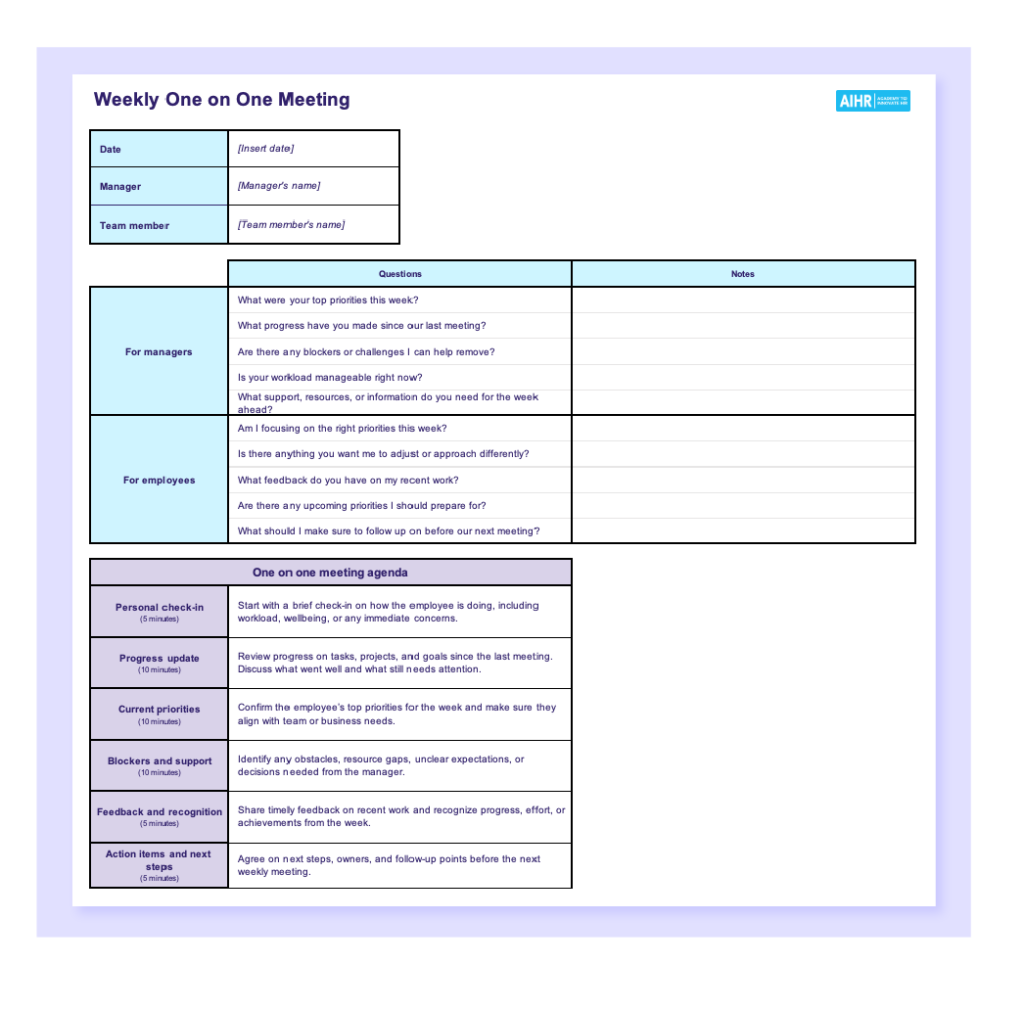
3. Weekly one on one meeting template
A weekly one on one meeting is a recurring check-in that helps managers and employees stay aligned on short-term priorities, progress, challenges, and next steps. This format works well for fast-moving teams, new employees, or roles where priorities change often.
4. Monthly one on one meeting template
A monthly one on one meeting gives managers and employees time to step back from day-to-day tasks and discuss broader progress, goals, challenges, and development needs. This format works well for longer-term planning, career development conversations, workload reviews, and teams that do not need weekly check-ins.
5. Onboarding and training meeting template
An onboarding and training one on one meeting is a launchpad to welcome and integrate new employees into the organization. This meeting is typically conducted between a new employee and a designated mentor, supervisor, or HR representative.
6. Skip-level meeting template
A skip-level one on one meeting involves a manager meeting with an employee who is not directly reporting to them but is part of their team or department. In a traditional organizational hierarchy, a skip-level meeting involves a manager interacting with a subordinate’s direct reports.
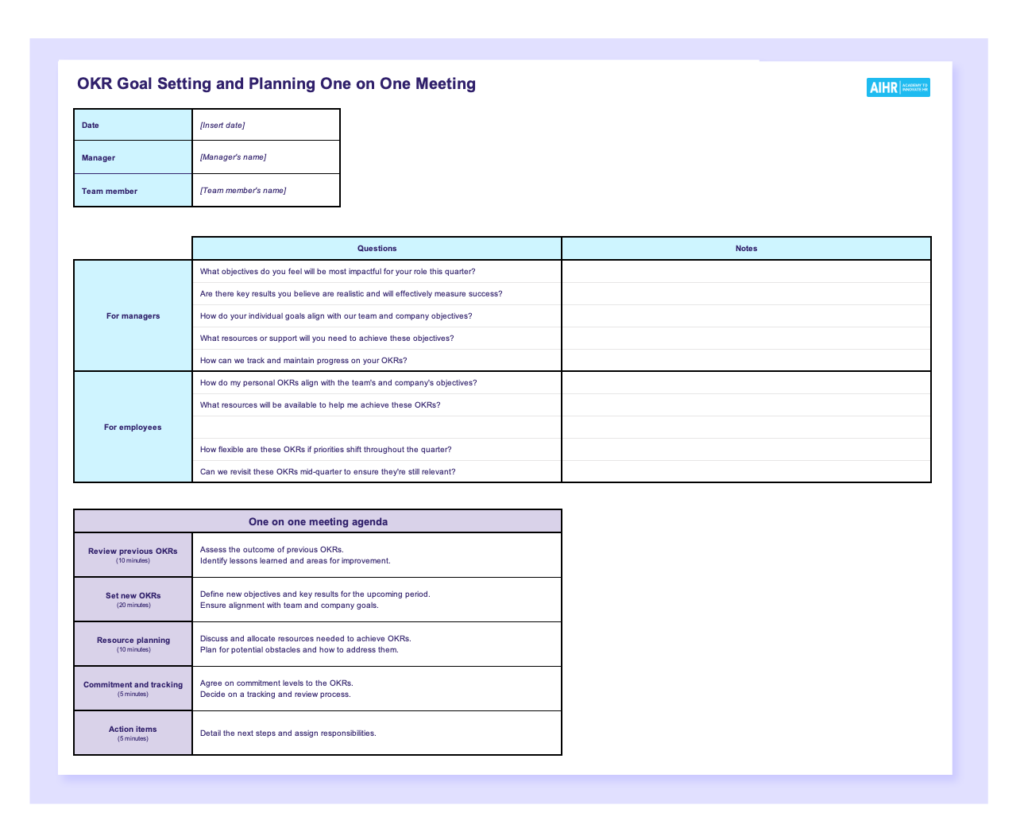
7. OKR goal setting and planning meeting template
An OKR (Objectives and Key Results) goal-setting one on one meeting is a strategic session between a manager and an employee aimed at aligning individual goals with broader organizational objectives using the OKR framework. OKRs are a goal-setting methodology that helps organizations define and track objectives and their corresponding key results.
8. Problem-solving meeting template
A problem-solving one on one meeting is a focused interaction between a manager and an employee with the primary goal of addressing and resolving specific challenges or issues. These meetings are designed to collaboratively identify problems, discuss potential solutions, and implement strategies to overcome obstacles.
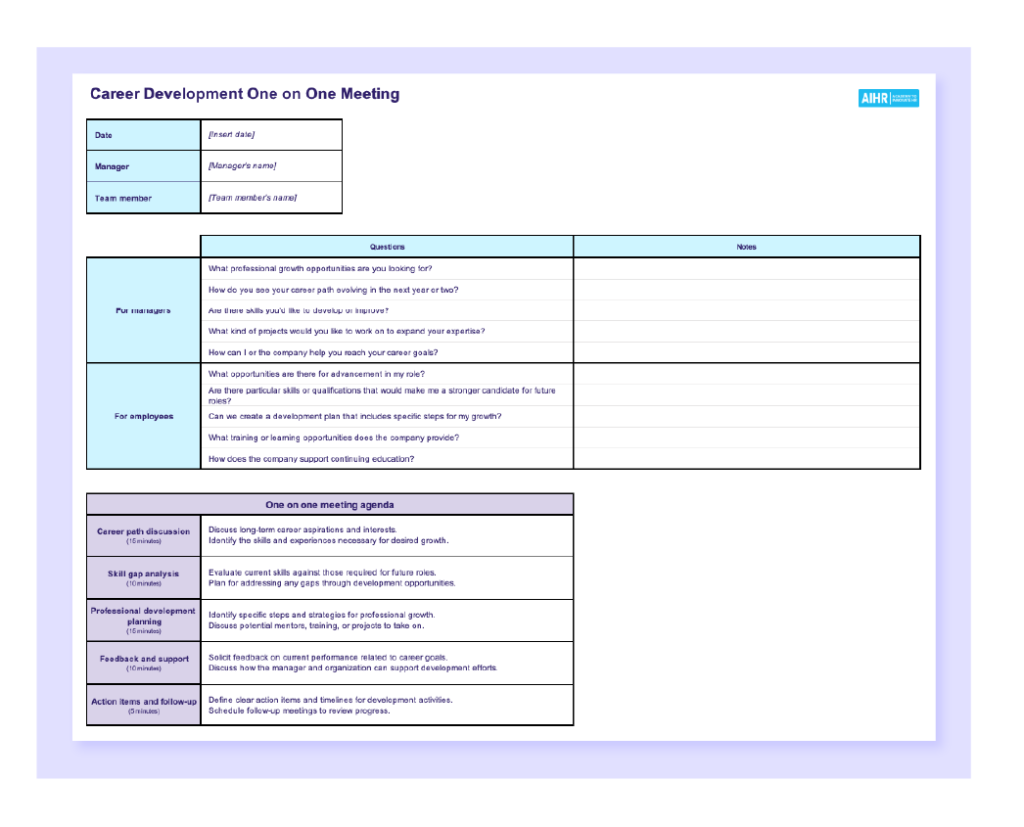
9. Career development meeting template
A career development one on one meeting is a dedicated session between an employee and their manager or mentor to discuss their professional growth, aspirations, and career goals. The primary focus is on mapping out a plan to help the employee progress in their career within the organization.
10. Brainstorming meeting template
A brainstorming one on one meeting is a collaborative and creative session between two individuals, typically a manager and an employee, where they generate ideas, solve problems, or explore new possibilities. The goal is to foster open dialogue and innovative thinking.
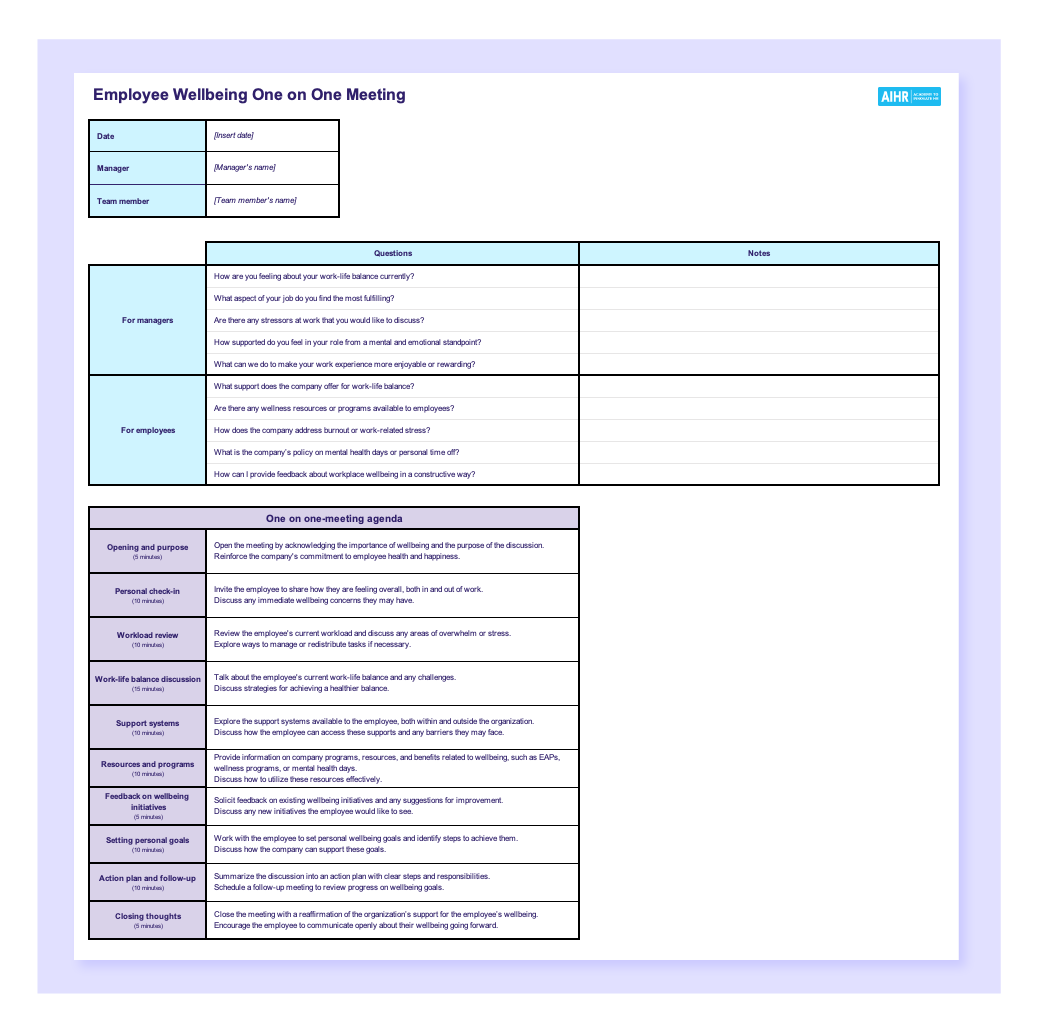
11. Employee wellbeing meeting template
An employee wellbeing one on one meeting is a session between a manager and an employee with the primary focus on the employee’s overall wellbeing and satisfaction in the workplace. The purpose of this meeting is to assess and support the employee’s mental, emotional, and physical health, as well as to discuss work-life balance and job satisfaction.
One on one meeting questions to ask
The right 1:1 questions can help managers move beyond status updates and have more meaningful conversations with employees. As an HR professional, you can share sample questions with managers to help them cover the right one on one meeting topics, including priorities, challenges, feedback, development, wellbeing, and support needs.
Managers don’t need to ask every question in every meeting. Instead, they can choose the questions that best fit the employee, the meeting purpose, and what has changed since the last conversation.
Questions managers can ask employees
| What are your top priorities right now? |
| How are you progressing with your current goals or projects? |
| What is going well for you at the moment? |
| Are there any blockers or challenges I can help with? |
| Is anything about your workload unclear or difficult to manage? |
| What support, resources, or information would help you do your best work? |
| Do you have any feedback for me or the team? |
| Is there anything we should discuss that we haven’t covered yet? |
Questions employees can ask managers
| Am I focusing on the right priorities? |
| How am I progressing toward my goals? |
| Is there anything you would like me to do differently? |
| What feedback do you have on my recent work? |
| Are there any skills I should develop for my current role? |
| What opportunities are available for me to grow? |
| What should I focus on before our next meeting? |
| Is there anything I can do to better support the team? |
Questions for career development
| What skills would help me grow in my current role? |
| What type of work should I get more exposure to? |
| Are there any career goals we should discuss? |
| What learning opportunities would support my development? |
| Are there responsibilities I could take on to build new skills? |
| How can you support my professional development? |
Questions about wellbeing and engagement
| How are you feeling about your current workload? |
| Is anything affecting your ability to do your best work? |
| Do you feel supported by me and the team? |
| What part of your work feels most motivating right now? |
| What part of your work feels most challenging? |
| Is there anything we could change to make your work more manageable? |
| Do you feel recognized for your contributions? |
First one on one meeting questions
| What would make these one on one meetings most useful for you? |
| How do you prefer to receive feedback? |
| What should I know about your working style? |
| What are your current priorities? |
| Are there any challenges I should be aware of? |
| What support do you need from me as your manager? |
| How often would you like to discuss goals and development? |
| What would help you feel successful in your role? |
How to prepare for a one on one meeting
One on one employee meetings benefit managers and employees only if they are valuable, and that takes preparation. Managers should know what they want to discuss and why, while employees should know what to expect and how they can contribute.
Both managers and employees should approach these meetings with a sense of purpose to ensure they are productive and meaningful. Here is some straightforward advice HR can offer managers and employees to prepare for their one on one meetings.
HR advice for managers:
- Examine the employee’s recent work, noting achievements and areas for improvement. Familiarize yourself with their projects and any challenges they’ve encountered since your last meeting.
- Draft a clear agenda that includes discussion points, goals, and any specific feedback you wish to provide. Ensure flexibility to include topics the employee may want to discuss.
- Be ready to deliver constructive feedback. This should be balanced; acknowledge what’s working well and what needs improvement.
- Think about the employee’s professional development. Identify potential opportunities for growth and be prepared to discuss them.
- Reflect on the interpersonal dynamics and the overall morale of your team. Be prepared to discuss any relevant issues that may affect the employee.
- Come to the meeting ready to listen actively. This means being fully present and not just responding, but also understanding.
HR tip
Establish separate meetings for formal performance evaluations, and use regular one on ones to focus on development.
HR advice for employees:
- Conduct a self-evaluation of your recent performance. Identify your successes, areas for improvement, and any help you might need from your manager.
- Prepare a summary of your work since the last meeting. Highlight completed tasks, ongoing projects, and any obstacles you’ve faced.
- Create a list of topics you wish to discuss, including any specific feedback you desire, questions about career development, or areas where you seek guidance.
- Have a set of questions or concerns ready that you want to address. This demonstrates engagement and a proactive attitude towards your professional growth.
- Be prepared to provide feedback to your manager if appropriate. One on one meetings are a two-way street, and constructive feedback can help improve team dynamics and management strategies.
- Review your personal and professional goals, ensuring they align with team and organizational objectives. Be prepared to discuss progress and set new objectives as needed.
HR tip
Both managers and employees should approach these meetings with a collaborative mindset. Preparation is more than having a list of talking points. It’s being ready to engage in a dialogue that promotes development, problem-solving, and mutual respect.

How to run a one on one meeting
According to The State of One-on-ones Report, 94% of managers surveyed have one on ones. However, a Harvard Business Review article revealed that nearly half of the 250 direct reports surveyed rated their 1:1 experiences as suboptimal. This means that despite the critical nature of these meetings, they aren’t necessarily having the desired effect.
The same article also found that many managers view regular one on ones as a burden, leading them to invest too little time and attention in these conversations. When poorly managed, these meetings can leave employees feeling functionally and emotionally disconnected, reducing their value for both managers and employees.
As an HR professional, you can add guidance and structure to these conversations. A clear process helps managers keep the conversation focused, employee-centered, and action-oriented. Here are the key steps managers can follow:
Step 1: Follow a clear one on one meeting format
A clear one on one meeting format helps managers structure the conversation while leaving room for employees to raise their own topics. The format should include:
- Preparation: Review previous discussions, recent work, and key points to cover
- Agenda setting: Set a flexible agenda that includes both manager and employee topics
- Private setting: Choose a comfortable space that supports confidentiality and minimizes interruptions
- Personal check-in: Start by asking how the employee is doing and recognizing recent progress
- Discussion flow: Cover priorities, progress, challenges, feedback, and development opportunities
- Action items: Agree on next steps, responsibilities, and deadlines
- Closing: Summarize key points and confirm what will be discussed or followed up on next
This gives managers a consistent flow to follow without making the meeting feel scripted.
Step 2: Start with a personal check-in
Begin with a personal check-in to establish rapport and understand how the employee is doing. Managers can ask about workload, wellbeing, or any immediate concerns before moving into work-related topics.
Starting on a positive note can also help. For example, managers can recognize recent achievements or progress since the last meeting.
Step 3: Review priorities and progress
Next, managers and employees should review current priorities, recent work, and progress on key tasks or goals. This helps both parties stay aligned on what matters most and where the employee should focus their time.
This is also a good moment to revisit action items from the previous meeting and check whether anything still needs follow-up.
Step 4: Discuss challenges and support needs
Managers should ask about any roadblocks, resource gaps, unclear expectations, or workload concerns. The goal is to understand what may be affecting the employee’s work and agree on practical ways to address it.
This step helps managers identify issues early and provide support before challenges escalate.
Step 5: Exchange feedback
One on one meetings should include two-way feedback. Managers can provide constructive feedback based on specific examples, while employees should also have space to share feedback, ask questions, or raise concerns.
This helps make the meeting a dialogue rather than a manager-led status update.
Step 6: Talk about development and future goals
Managers should use regular one on ones to discuss professional development, learning opportunities, career aspirations, and future responsibilities. These conversations help employees connect their current work to longer-term growth.
HR can encourage managers to separate these ongoing development conversations from formal performance evaluations, so employees have regular space to discuss growth without feeling like they are being reviewed.
Step 7: Agree on action items and next steps
End the meeting by summarizing the main discussion points, confirming action items, and assigning responsibilities. Managers and employees should be clear on what will happen next, who owns each action, and when they will follow up.
This helps turn the conversation into progress and keeps both parties accountable.
Step 8: Set the right meeting frequency
The frequency of one on one meetings can vary depending on the organization, the specific roles, and the nature of the work. However, they should be held regularly to ensure consistency and follow-up on action items. Managers can use the following guidelines:
- Weekly meetings: Best for new employees, fast-moving teams, roles with shifting priorities, or employees who need closer support.
- Biweekly meetings: Useful for maintaining regular alignment without overloading calendars, especially when employees work more independently.
- Monthly meetings: Suitable for broader progress updates, development conversations, workload reviews, or teams with more stable priorities.
Regardless of frequency, managers should schedule one on ones consistently to show that these conversations matter.
Best practices for effective one on one meetings
1:1 meetings work best when they are consistent, employee-centered, and focused on meaningful conversation rather than status updates alone. HR can help managers get more value from these meetings by providing guidance on structure, preparation, documentation, and follow-up.
Best practices for HR
Provide templates, sample questions, and agenda guidance managers can adapt.
Expect every manager to create their own process from scratch.
Train managers on active listening, feedback, coaching, and psychological safety.
Assume managers automatically know how to run effective one-on-ones.
Encourage a regular meeting cadence across teams.
Let one-on-ones become optional or easy to postpone.
Clarify what managers should document, such as key themes, action items, and follow-up points.
Turn one-on-ones into formal performance reviews or compliance exercises.
Look for broader themes, such as workload concerns, development needs, or manager capability gaps.
Ask managers to share private employee conversations unnecessarily.
Best practices for managers
Prepare by reviewing recent work, previous notes, and agreed action items.
Treat the meeting as a casual conversation with no structure or follow-up.
Let the employee contribute topics to the agenda.
Dominate the agenda or focus only on manager priorities.
Ask open-ended questions about progress, challenges, support needs, and development.
Turn the meeting into a one-way status update.
Give specific, timely feedback based on recent examples.
Save all feedback for the formal performance review.
Listen actively and leave space for the employee to share concerns or ideas.
Interrupt, multitask, or rush through sensitive topics.
Agree on clear action items, responsibilities, and next steps.
End the meeting without clarifying what will happen next.
Best practices for employees
Prepare updates, questions, challenges, and topics you want to discuss.
Arrive without thinking about what you want from the conversation.
Share progress, blockers, and areas where you need support.
Wait for your manager to guess what you need.
Ask for feedback on your work, priorities, and development.
Treat feedback as something that only happens during performance reviews.
Raise career goals, learning interests, and growth opportunities.
Focus only on short-term tasks if you have longer-term goals to discuss.
Be open to a two-way conversation and provide feedback when appropriate.
Avoid sharing useful feedback that could improve collaboration.
Follow through on agreed action items before the next meeting.
Let action items carry over without updates or accountability.
Getting started
One on one meetings can improve communication, strengthen manager-employee relationships, and support employee growth when managers run them consistently and with purpose.
HR can help by giving managers a clear template, training them to use it well, and encouraging regular follow-up. A structured approach keeps conversations focused while giving employees space to discuss priorities, challenges, feedback, and development goals.
These conversations also support stronger talent management by helping HR and managers spot development needs and retention risks earlier. To build these skills, explore AIHR’s Talent Management & Succession Planning Certificate Program.
FAQ
A one on one meeting is a regular private conversation between a manager and an employee. It gives both people time to discuss work priorities, challenges, feedback, development, and support needs outside of team meetings or formal performance reviews.
A 1-on-1 meeting should cover current priorities, progress, blockers, workload, feedback, career development, and support needs. Managers can also use the time to follow up on previous action items and ask employees what they need to do their best work.
A strong 1-on-1 meeting format includes a personal check-in, a review of priorities, a discussion of challenges, feedback, development topics, and agreed next steps. The format should be structured enough to guide the conversation but flexible enough for employees to raise what matters most.
The best one on one meeting agenda includes a check-in, progress review, current priorities, challenges, feedback, development discussion, and action items. This structure helps managers keep the conversation focused while making space for employee concerns, questions, and ideas.