Quick facts
- Name & Role: Shahma Zahid, Chief Human Resource Officer at Greenstar Social Marketing
- AIHR program: AI in HR Certificate Program.
- Time to complete: 3 months, self-paced alongside a full-time executive role.
- Key result: Cut business analysis work from three days to three hours and reduced external agency spend by producing presentations, communication materials, visual concepts, and executive-ready formats in-house.
Shahma Zahid began her HR career as an intern after completing her MBA in Marketing. Twenty-seven years later, with global HR leadership experience, she now serves as Chief Human Resources Officer at Greenstar Social Marketing in Pakistan.
She holds GPHR and SHRM certifications, volunteers with HRCI and SHRM, serves on the board of a non-profit education organization, and has spent ten years teaching MBA students as a visiting faculty member in Canada and Pakistan.
Having dedicated her career to strengthening HR capability from within organizations, continuous learning was never optional for Shahma. It’s central to her growth, credibility, and evolution into the HR leader she is today.
Getting ahead of the AI in HR shift
Shahma led HR through nearly three decades of transformation, from traditional personnel administration to strategic business partnering. But the shift toward AI felt different: it was faster, more disruptive, and the consequences of falling behind were far greater.
“AI was becoming too important to ignore,” she says. “I realized that many HR leaders were still trying to understand AI, data, and new digital ways of working. Without that understanding, HR risked becoming reactive rather than strategic.”
Shahma was determined not to be one of those leaders. She understood the strategic importance of AI, but needed a structured framework to engage with it meaningfully, build confidence, and stay ahead of the changes reshaping the HR profession.
The search for the right AI for HR program
Shahma was looking for something very specific: an AI program designed for HR professionals, not a general AI course that she would have to translate into an HR context herself.
She explored several programs, including Wharton and eCornell. However, the Academy to Innovate HR (AIHR) stood out because it was built specifically for HR professionals, focused on immediate real-world application, and offered professional development credits (PDCs) with both HRCI and SHRM.
She enrolled in the AI for HR Certificate Program and set a clear personal goal: to complete the full program, including the capstone, within three months.
Learning on her own terms
Shahma is clear about her preferred learning style. She values classroom interaction, live discussion, and structured accountability. Knowing this, she deliberately built similar elements into her AIHR study routine.
She blocked early morning sessions on weekends and used the platform’s progress tracking to stay focused and motivated. “The progress tracker kept me on my toes,” she explained.
The certificate program’s sequential structure also suited the way she learns. Each chapter had to be completed before moving to the next, and each module was followed by an assessment with explanations. This helped her check her understanding before progressing further.
“I want to know whether I have actually understood the concept,” she said. “Not just move past it.”
The Mastering Prompt Design module was one of the most immediately valuable parts of the AI for HR Certificate Program. Shahma worked with Claude, ChatGPT, and Copilot and learned how context, tone, framing, and clarity of purpose could produce more relevant prompts and sharper outputs. She began applying these new skills the same day.

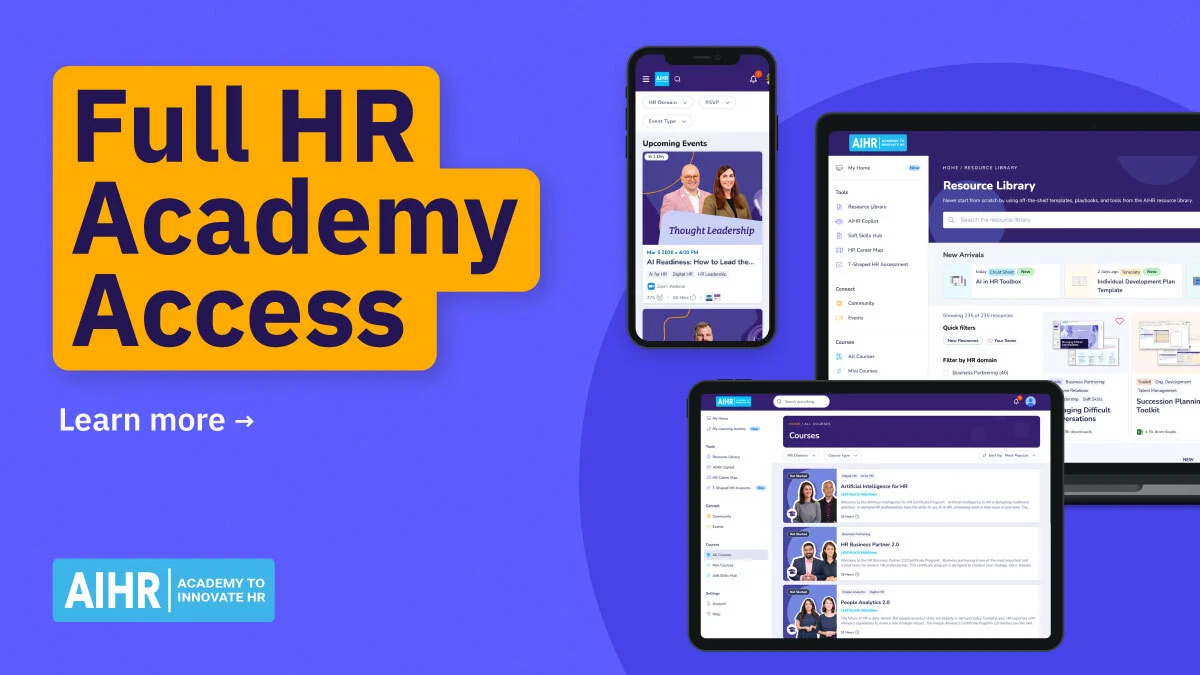
AIHR’s Resource Library also became a regular part of Shahma’s work, giving her access to templates, frameworks, and checklists she could apply immediately. Time she would previously have spent building materials from scratch could now be redirected toward more strategic work.
The mini courses served a different purpose, offering bite-sized lessons on active listening, leadership, and data analytics that she could weave into spare moments throughout her workday.
Shahma also joined AIHR’s community mentorship program as a mentor. She was paired with an early-career CHRO navigating organizational challenges.
“I like to give back to the HR community, but I ended up learning too,” she said. Coaching her mentee through challenges similar to those she had navigated in her own leadership journey sharpened Shahma’s own thinking in ways she had not anticipated. “Mentorship is always a two-way process,” she said.
See what the learning experience looks like for yourself.
The Demo Portal allows you to:
✅ Preview AIHR lessons before committing to a course or certificate program
✅ Explore guides, templates, and tools you can use in your day-to-day HR work
✅ Browse learning paths that match your role and goals
✅ Get a feel for AIHR’s learning experience and resources for ongoing development
Building influence & visibility with AI in HR
The impact showed up quickly in the way Shahma approached her HR leadership role.
She began by applying AI more intentionally to stakeholder communication, leadership preparation, policy review, and HR governance work. In a non-profit environment, where communication often involves donors, executives, Board members, and internal teams, tone and context matter deeply.
Using her prompt design skills, Shahma learned how to frame the background, audience, purpose, and sensitivity of each task more clearly.
For Shahma, AI did not replace judgment. It strengthened preparation. It helped her save time on first drafts, organize complex information, and think through issues more clearly before making recommendations. For example, a sales performance analysis she ran included creating a detailed prompt for Claude: organization background, workforce data, the specific question she needed answered. Three days of analysis became three hours and informed concrete hiring decisions.
“Detailed prompts improve the quality of the output,” she said. “But human judgment, context, and insight must always remain part of the process.”
The value of Shahma’s AI learning extended beyond individual productivity. It strengthened the way she approached business communication, leadership support, and organizational efficiency.
She began using AI-enabled tools to develop more structured presentations, communication materials, visual concepts, and executive-ready formats in-house. This allowed her to move faster, reduce dependency on external support, and respond more effectively to emerging business needs.
For a resource-conscious organization, this created business value: faster turnaround, better use of internal capability, and more time redirected toward strategic priorities.
More importantly, it reinforced Shahma’s belief that HR leaders cannot remain limited to traditional HR boundaries. By learning how to use AI responsibly and practically, she contributed to broader business effectiveness, decision-making, and organizational agility.
From personal learning to organizational AI strategy
Shahma’s AIHR learning did not remain limited to her own productivity. It strengthened the way she thinks about AI readiness, responsible adoption, and the role HR leaders must play in preparing organizations for the future of work.
Through the AI in HR Certificate Program, she gained a clearer understanding of how AI should be introduced with purpose, governance, risk awareness, and human oversight. This helped her move beyond individual tool usage and think more strategically about how organizations can build AI capability responsibly and practically.
She began applying these insights to broader conversations around AI awareness, digital capability, policy thinking, and workforce readiness. For Shahma, this was an important shift: AI was no longer just a learning priority, but a leadership priority.
What’s next for Shahma
Shahma plans to continue expanding her AIHR credential portfolio as part of her broader commitment to future-ready HR leadership.
“AIHR helped me connect emerging technologies such as AI with the practical realities of HR leadership,” she says. “It strengthened the way I think about workforce transformation, digital readiness, governance, and the future role of HR.”
For Shahma, the value of AIHR lies in its ability to help HR professionals move beyond traditional functional expertise and develop the strategic capability required for the future of work.
“If HR leaders want to remain relevant, they must understand how technology, data, and human judgment come together,” she says. “AIHR provides a practical and structured way to build that capability.”

Are you ready to transform your own career? Browse our extensive course catalog. You can also check out the AI for HR Certificate Program preview lessons or explore the AI for HR Certificate Program that Shahma chose to build future-ready skills and lead with greater confidence in a rapidly changing world of work.
Building your peer network? Connect with Shahma on LinkedIn to follow her journey in HR leadership, AI in HR, and future-ready workforce transformation.
FAQ
AIHR’s AI for HR Certificate Program is built for any HR professional who wants to add AI skills to their existing HR expertise. Rather than a general AI course learners have to translate into an HR context themselves, the certificate program applies AI directly to HR use cases from the start. Shahma chose it over general options like Wharton and eCornell for exactly this reason.
AIHR offers self-paced e-learning, which means learners set their own schedule working through chapters that unlock sequentially. Shahma gave herself a personal target of finishing the full certificate program, including the capstone, within three months alongside her full-time role. She built her schedule around early morning weekend sessions and used the program’s progress tracker to stay on target.
Yes, better prompts can meaningfully cut analysis time. Shahma built one such prompt for a sales performance analysis, reducing the workload by 96%. What used to take 3 days now takes her about three hours, creating significant time savings she then invests back into strategic work.