HR team development is essential for future-proofing your organization, and the data backs it up. While 95% of HR practitioners expect AI and HR tech use to grow, 87% of HR leaders are concerned their teams lack the skills to keep up with the function’s expanding responsibilities. That gap calls for intentional investment, equipping HR teams with the capabilities they need to navigate change, make informed decisions, and contribute meaningfully to business outcomes.
Contents
The importance of HR team development
Key competencies and skills of a successful HR team
12 best practices for HR team development

The importance of HR team development
An HR team can either function as a back-office support role or step up as a strategic partner to the business. The difference comes down to capability. When HR professionals build their skills and deepen their understanding of the business, they’re better equipped to design initiatives that move the company forward, whether that’s driving growth, managing change, or improving how work gets done.
A highly skilled HR team also lays the foundation for an effective talent strategy. By shaping how the organization attracts, develops, and retains top talent, HR plays a central role in elevating workforce quality and engagement. As the team’s expertise grows, so does its credibility and influence within the leadership circle. Well-developed HR professionals don’t just manage processes; they provide strategic counsel, interpret workforce data, and design people strategies that drive both performance and sustainable growth.
Beyond strategy, HR has a profound influence on the day-to-day employee experience. From onboarding to career development, the consistency and quality of HR practices can define an employee’s journey, shaping a workplace culture where individuals feel supported, engaged, and motivated to excel.
Ultimately, by committing to its own development, the HR team does more than improve its own capabilities. It leads by example, promoting a culture of continuous learning and adaptability across the entire organization. This strengthens HR’s ability to meet current challenges and prepares the wider business to thrive in a fast-paced, competitive world.
Key competencies and skills of a successful HR team
HR teams can’t rely on a fixed skill set anymore. Instead, they must continuously refine their skills and combine them in ways that reflect the complexity of modern organizations.
Today’s HR function operates at the intersection of people, data, and business strategy, requiring a unique blend of deep expertise and broad, adaptive capabilities. The most effective teams don’t just respond to workforce needs; they anticipate them, shape solutions that drive competitive advantage, and influence outcomes far beyond traditional HR boundaries.
Let’s take a look at the range of capabilities that together form the foundations of exceptional – and successful – HR teams:
T-shaped competencies
An effective HR team is made up of professionals who combine deep expertise in specific areas (such as recruitment, learning and development, employee relations, or compensation and benefits) with broad capabilities across the wider HR function.
T-shaped HR practitioners possess a solid foundation in the six core HR competencies:
This breadth allows them to understand the bigger picture, link their work to business outcomes, and stay flexible in addressing complex, interconnected challenges. In modern HR teams, where one initiative can affect multiple areas—from hiring to retention to culture—this mix of depth and range helps keep the function strategic and responsive.
Collaboration skills
HR professionals must act as both business partners and employee advocates, which requires strong collaboration skills, not just within HR, but across the organization. HR team members need to work effectively with senior leadership, line managers, and staff at all levels to design and deliver solutions for complex workforce challenges.
Strong collaboration also supports change management efforts and builds trust, supporting smoother implementation of initiatives and policies. HR cannot operate in isolation, and without this competency, even the most innovative ideas can stall due to poor stakeholder engagement.
Adaptability
An adaptable HR team can respond quickly to changes without losing momentum. Adaptability also reflects a mindset of openness and resilience, qualities that let HR professionals lead by example during uncertainty or transformation. This competency ensures HR remains proactive, able to pivot strategies, and keep the organization competitive and compliant despite dramatic external shifts.
Learn to develop your HR team to their fullest potential
Master HR team development to benefit your team and organization, and further your own HR career. With Full Academy Access, you and your team can:
✅ Discover HR-related strengths and see how they compare to those of peers in HR
✅ Obtain the skills necessary to excel in multiple aspects of Human Resources
✅ Gain the expertise to advance your career and make a lasting organizational impact
Continuous learning
Whether it’s understanding the latest employment law, mastering people analytics tools, or developing critical thinking skills, HR professionals must engage in continuous learning to remain effective. This commitment keeps the team’s knowledge up to date and signals to the organization that learning and growth are valued.
In a competitive talent market where employees seek development opportunities, HR teams that model continuous learning can better attract, retain, and inspire top talent.
Growth mindset
A growth mindset — the belief that skills and abilities can be developed through effort and learning — is especially important for HR teams navigating change and driving organizational improvement. HR professionals with a growth mindset embrace feedback, seek challenges, and view setbacks as learning opportunities, all of which position HR as a forward-thinking, solution-oriented function.
It also influences how HR designs learning and performance management systems, encouraging similar mindsets across the business.
Emotional intelligence (EQ)
At its core, HR is about people. EQ is the ability to understand and manage one’s emotions and empathize with others, which is the foundation for building relationships, resolving conflicts, and developing a positive workplace culture.
HR professionals with high EQ can navigate difficult conversations, support employees, and create environments where people feel heard and valued. In leadership roles, EQ helps HR to act as a trusted advisor to senior leaders and managers.
Strategic alignment
Finally, HR initiatives must align with the broader business strategy, from understanding the organization’s goals, market position, and operational challenges, to designing HR solutions that support those objectives. Strategic alignment ensures that HR efforts are seen as essential drivers of growth, efficiency, and competitive advantage.
HR professionals who master this competency can articulate how talent strategies contribute to financial performance, customer satisfaction, and long-term sustainability.
12 best practices for HR team development
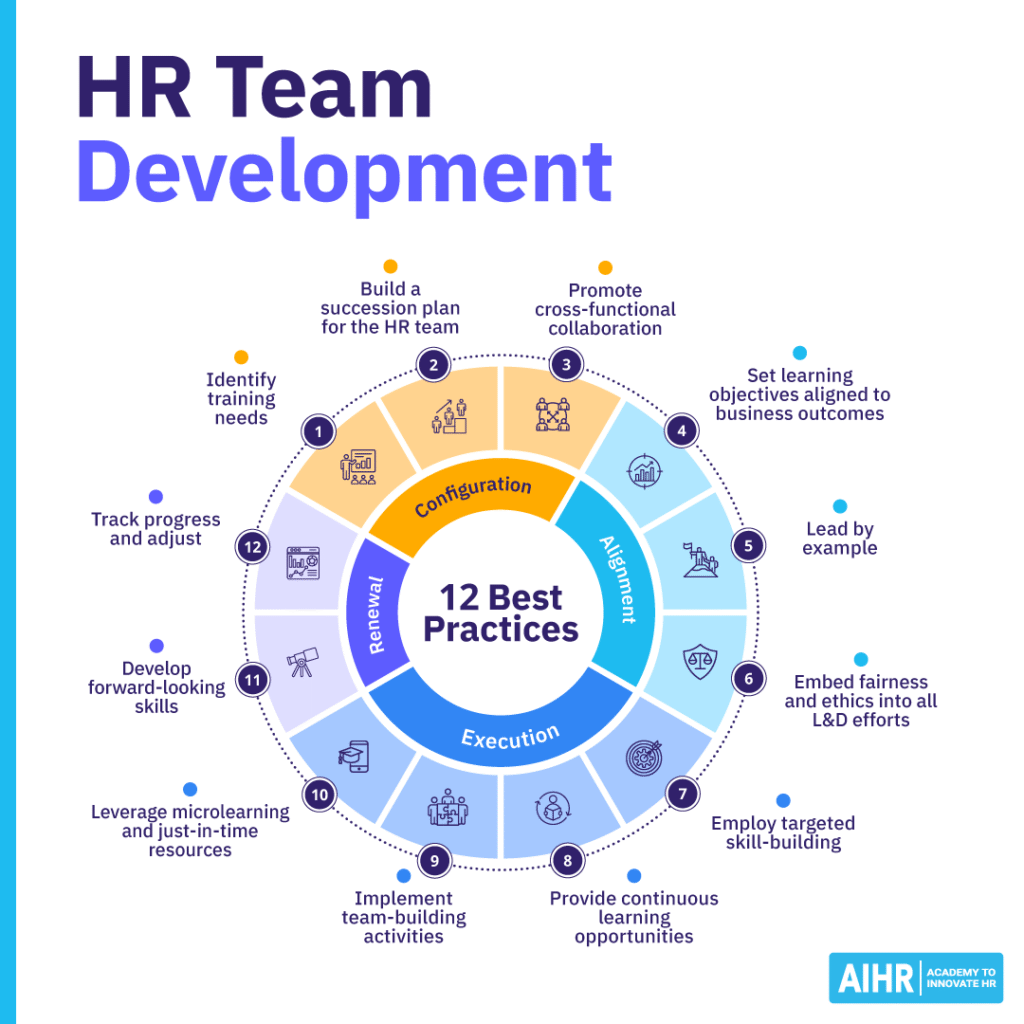
Building HR skills and competencies like business acumen, adaptability, and collaboration is essential. But skills alone don’t guarantee high performance. What matters just as much is how those capabilities show up in practice: how people work together, make decisions, solve problems, and adapt to change. That’s why strong teams focus on embedding these competencies into their day-to-day and strategic work.
McKinsey identifies four domains that drive team effectiveness:
- Configuration: Ensuring the right mix of roles, capabilities, and perspectives
- Alignment: Creating shared direction and connecting individual contributions to team goals
- Execution: Turning skills into consistent, high-quality outcomes
- Renewal: Building the capacity to evolve, learn, and stay ahead of change
Together, these conditions influence up to 76% of a team’s performance. Strategic HR team development combines upskilling with the intentional application of those skills through shared behaviors, clear systems, and team-wide practices.
The following 12 best practices across the four domains offer a practical roadmap for turning skill-building into real, sustainable performance.
Configuration: Strengthening core capabilities
1. Identify training needs
Start with a rigorous training needs analysis tailored to the realities of your HR team. Too often, development efforts rely on generic assumptions, like offering basic leadership courses to all HR staff, or off-the-shelf solutions that aren’t specific to HR’s challenges, such as generic Excel training or one-size-fits-all communication workshops. These approaches may check the box but rarely address the actual capability gaps holding your team back.
Instead, use a structured approach that combines performance data, employee feedback, business strategy, and workforce challenges. Assess the training needs of individual employees, as well as the broader team. For example, do your HRBPs struggle with data interpretation? Is your recruitment team aligned with the latest sourcing techniques?
This step ensures your development efforts focus where they’ll have the most impact: improving day-to-day execution and giving your team the tools to support broader business goals.
2. Build a succession plan for the HR team itself
HR often handles succession planning for the entire business, but many overlook their own team’s future leadership. To sustain performance and support the continued growth and success of your department and HR’s strategic role, identify high-potential HR professionals and give them stretch assignments, mentorship, and leadership development opportunities.
3. Promote cross-functional collaboration
Encourage the HR team to collaborate with Finance, IT, Marketing, and Operations to broaden their business understanding and drive innovative and integrated solutions to workforce challenges. Cross-functional projects also sharpen communication and project management skills critical for HR’s growing role as a strategic business partner.
Alignment: Connecting development to business and values
4. Set learning objectives aligned to business outcomes
Generic goals like “improve data literacy” won’t cut it. Effective objectives must be specific, actionable, and linked to organizational outcomes. Instead of “enhance HRBP effectiveness,” a better objective might be: “Equip HRBPs to lead workforce planning discussions using predictive analytics.”
Clear, measurable goals ensure learners and leaders can track progress and see how skill development contributes to the company’s success and justifies investment in HR development to other senior leaders.
5. Lead by example
If you want your HR team to take development seriously, they need to see that you do too. That means talking openly about what you’re working on, showing up for training, and carving out time for your own learning, not just encouraging others to do it.
Just as importantly, treat team development as a strategic imperative by building it into team goals, dedicating time for learning in regular workflows, and making it part of how you evaluate success, not just something to squeeze in when things are quiet. That sends a clear message: team development is something that directly supports your team’s ability to drive impact, not just a task to fit in when time allows.
6. Embed fairness and ethics into all learning and development efforts
Fairness and ethical judgment should be part of how HR builds skills and approaches decisions, not just mentioned in occasional workshops. Whether you’re covering hiring, performance, or leadership, it’s worth taking time to talk about how decisions are made and what “doing the right thing” looks like in practice. It helps the team stay grounded, consistent, and trusted across the organization.
Execution: Applying skills through everyday practice
7. Employ targeted skill-building
Once needs and objectives are clear, focus on targeted, high-impact skill building. Prioritize areas where upskilling will unlock immediate improvements or enable the team to meet strategic demands. For example, if HRBPs must contribute to workforce planning but lack confidence in analytics, design a hands-on learning track in HR data interpretation, dashboard use, and presenting insights to executives.
Targeted learning prevents effort dilution and ensures development investments deliver practical, job-ready skills that raise the team’s performance.
8. Provide continuous learning opportunities
Teams that learn continuously are more adaptable and resilient when facing new challenges, but one-off workshops or online courses won’t create lasting competence. Continuous learning must become embedded in the team’s culture. Offer a blend of formal training (certificate programs, instructor-led courses), informal learning (mentoring, peer knowledge-sharing, cross-functional projects), and self-paced opportunities (e-learning platforms, HR communities of practice) to accommodate different learning styles and career stages while making development a routine part of team life.
9. Implement team-building activities
Team cohesion and trust are essential for success, and regular HR team-building activities strengthen working relationships, improve communication across HR specializations, and clarify roles and responsibilities. In hybrid or multi-location teams, these activities are valuable for overcoming distance barriers and fostering unity and shared purpose.
10. Leverage microlearning and just-in-time resources
Short, targeted learning bursts help busy HR professionals acquire and apply skills immediately, enhancing retention and relevance. Just-in-time resources, such as quick-reference guides or knowledge-sharing platforms, can particularly support real-time problem-solving and knowledge application.
Renewal: Evolving with intent and staying future-focused
11. Develop forward-looking skills
HR cannot remain reactive in a fast-changing business environment; modern HR teams must develop future-focused competencies in AI and data. Understanding AI’s impact across HR functions such as recruitment, compliance, learning, and engagement is essential.
HR teams should engage in AI Boot Camps, tech literacy programs, and scenario-planning exercises to build comfort with emerging technologies and critical thinking, enabling them to assess and adopt new tools responsibly.
12. Track progress and adjust
You must monitor and refine your HR team development efforts to keep them effective over time. Use qualitative feedback and quantitative metrics to assess whether your development initiatives improve performance and confidence.
If some efforts aren’t delivering results, pivot. If certain skill gaps close while new ones emerge, reallocate resources. A continuous improvement mindset ensures HR development remains responsive, relevant, and aligned to the team’s growth and the organization’s changing needs.
To sum up
HR team development is a catalyst for organizational growth, innovation, and resilience. By cultivating diverse competencies, supporting collaboration, and embedding continuous learning, HR teams become not just operationally effective but strategically indispensable. Well-developed HR teams drive better talent outcomes, shape positive employee experiences, and provide the insights and leadership that help organisations thrive in an ever-evolving business landscape. Ultimately, when HR invests in its own growth, it sets the pace for the entire organization’s success.