An HR skills assessment is one of the most effective ways to understand whether your team is equipped to meet current demands and future challenges. Yet according to Gartner’s research, only 8% of HR leaders say they have reliable data on the skills in their organization, and just 23% of organizations effectively develop the capabilities they’ll need next.
That gap between what HR teams can do and what the business needs them to do is not just a resource issue – it’s a visibility issue. Without a clear view of what skills your team actually has, it’s nearly impossible to make strategic decisions about hiring, learning, or internal mobility. That gap between skills and business needs keeps HR reactive instead of proactive.
Gartner found that organizations that focus on skills visibility and talent fluidity see up to a 60% boost in talent readiness. In other words, a thorough HR skills assessment gives HR leaders a tangible way to future-proof their teams and increase strategic impact.
Contents
Why conduct an HR skills assessment
7 methods to conduct an HR skills assessment
10 next steps for HR leaders after a skills assessment
Key takeaways
- An HR skills assessment identifies gaps in team capabilities, helping organizations meet current and future challenges effectively.
- Using targeted assessments, HR leaders can enhance team performance and align skills with business strategies.
- Regular skills assessments improve visibility, support proactive decision-making, and future-proof the HR function.
- Implementing individualized development plans boosts employee growth and accountability, linking personal goals with organizational success.
- Making skills assessments a part of the annual HR rhythm instills a culture of continuous learning and strategic development.
Why conduct an HR skills assessment
HR leaders are under growing pressure to deliver strategic value, not just operational support. A targeted HR skills assessment offers a clear view of team strengths, gaps, and opportunities. By identifying what’s working and what’s missing, HR leaders can realign roles, prioritize training, and elevate their function’s impact across the business.
Whether you’re building a forward-looking team, responding to organizational change, or developing internal talent, regular assessments help you stay proactive and precise. Here’s how:
- Identify and bridge skills gaps: A structured skills assessment uncovers where capabilities fall short. Once identified, you can address these gaps through targeted upskilling, hiring, or outsourcing, reducing risk and improving HR’s ability to support the business.
- Hire the right talent: Understanding your team’s current strengths lets you hire with purpose. Instead of duplicating skills you already have, you can prioritize candidates who bring new capabilities, whether that’s deep systems knowledge, strategic thinking, or advanced people analytics.
- Future-proof the HR function: Future-ready capabilities like data literacy, change management, and digital agility are increasingly essential, but often lacking in organizations. Skills assessments give HR leaders the insight to invest in emerging competencies before they become urgent needs.
- Boost team performance: Assessments make performance conversations more concrete by linking strengths and gaps to job expectations. This increases clarity, sets realistic development targets, and helps team members understand where they can add the most value.
- Align HR with business strategy: HR doesn’t operate in a vacuum. A skills audit ensures your team is equipped to support business priorities, matching capability to strategy rather than function to role.
- Support targeted growth and development: Instead of generic training programs, a skills assessment enables tailored development plans for each team member, making learning more relevant, building confidence, and supporting succession planning.
- Encourage accountability and self-awareness: Skills assessments help team members reflect on their abilities and development needs, boosting ownership, improving goal setting, and encouraging proactive career planning.
- Reveal underutilized strengths: Sometimes the issue isn’t a lack of skills, but a lack of visibility. Assessments can surface hidden strengths or underleveraged expertise within the team, which team leaders can use to align the right people (and skills) with business-critical projects or mentoring roles.
- Support better workforce planning: Understanding your HR team’s capabilities helps you plan for restructuring, expansion, or leadership changes. You can anticipate talent gaps, build internal pipelines, and make more informed decisions about how to structure the function.
- Strengthen HR’s credibility: HR teams that actively evaluate and improve their capabilities demonstrate the same accountability they ask of the rest of the organization, building trust with stakeholders and reinforcing HR’s position as a strategic partner.
A stronger HR team streamlines HR and business operations, workforce planning, and EX and ER. To achieve this, you need to identify and close HR skills gaps accurately and promptly.
With AIHR for Business, you can equip your HR team to:
✅ Close critical HR skill gaps quickly, and align on shared frameworks
✅ Think and act more strategically to drive business impact at scale
✅ Adopt best practices and deliver measurable HR improvements
🎯 Close your HR team’s skills gaps promptly to drive business impact!
7 methods to conduct an HR skills assessment
Conducting an HR skills assessment is less about listing competencies and more about understanding how your team contributes to real business outcomes.
When approached strategically, these assessments offer a solid path to shaping a high-impact HR function – one that’s not just operationally sound, but aligned to what the business genuinely needs to thrive. Whether you’re upskilling, restructuring, or hiring, the following methods provide the right mix of insight and rigor to guide those decisions.
1. HR skills gap analysis
An HR skills gap analysis identifies the difference between the skills your team currently has and those required to deliver on the company’s short- and long-term priorities. It turns abstract capability conversations into a structured, actionable view of where to focus development, hiring, or even job redesign.
This approach works especially well when you’re trying to future-proof your team. If your business is heading into new markets, planning a major technology change, or facing an increase in compliance complexity, a skills gap analysis gives you a grounded baseline to work from so you’re not just reacting when a capability shortfall becomes a business risk.
Do this:
- Map business objectives and determine the core HR capabilities needed to support them
- List existing skills by team member, using job descriptions, self-assessments, or manager feedback
- Rate current proficiency levels and compare them with the required proficiency
- Identify gaps and prioritize based on strategic importance and urgency.
Use AIHR’s HR Skills Gap Analysis Template to get started.
Top tip
Aligns HR’s skill roadmap with actual organizational demand by bringing in leaders from other functions to validate what capabilities HR will need to support their departments.
2. T-shaped HR assessment
The T-Shaped HR Competency Model (developed by AIHR) is a powerful tool to understand how your team balances depth in one HR domain (e.g., L&D, recruitment, analytics) with broad knowledge across core HR competencies. It encourages specialists to develop strategic awareness and helps generalists identify where deeper expertise would increase their impact.
For HR leaders, it’s a strategic lens: Are you building a team of hyper-specialized experts who struggle to collaborate, or well-rounded professionals who can operate across silos and evolve with the business?
Do this:
- Share AIHR’s T-Shaped HR Assessment with your team
- Analyze individual results and aggregate data to see strengths and development needs at a team level
- Use this to guide development pathways and hiring decisions
- Revisit assessments annually to track growth and shape internal mobility.
Top tip
Use this tool to support career pathing by helping team members identify where they can broaden or deepen their skill sets to unlock new roles or responsibilities.
3. 360-degree feedback
360-degree feedback gives a multi-dimensional view of how HR professionals are perceived by peers, direct reports, and senior leaders. Beyond technical skills, it brings behavioral and interpersonal attributes into the spotlight, including how effectively someone collaborates, leads, communicates, and navigates complexity.
It’s particularly effective in identifying blind spots. High performers may be technically sound, but struggling with stakeholder influence. Others might be underestimated because their strengths are relational or strategic, not always visible in traditional metrics.
Do this:
- Select feedback providers from different levels and departments
- Use AIHR’s 360-Degree Feedback Template to create consistency and reduce bias
- Review feedback themes and discrepancies
- Use in performance reviews, development planning, and promotion discussions.
Top tip
Keep feedback focused on observable behaviors, not personality traits, to ensure the objectivity and actionability of the results.
4. Performance review analysis
Performance reviews, when analyzed with intent, reveal much more than past output. They show patterns in how individuals apply their skills over time and how that translates into business value. For HR teams, this can include metrics like time-to-hire, retention outcomes, employee satisfaction, and compliance rates.
Analyzing performance reviews as part of a broader skills assessment helps clarify who’s consistently delivering impact, who’s at risk of stagnation, and where support is needed to lift performance across the board.
Do this:
- Review several cycles of performance data to spot trends
- Cross-reference outcomes with business impact (e.g., project delivery, internal feedback, compliance results)
- Combine with skills self-assessments to surface misalignment between self-perception and performance
- Use insights to shape individual development plans and team-wide interventions.
Top tip
Focus on outcome-based indicators rather than activity-based measures. For example, “implemented a new onboarding process” is less straightforward than “reduced new hire turnover by 15%.”
5. Behavioral interviews for soft skills
Soft skills often differentiate good HR practitioners from great ones, but they’re harder to quantify. Behavioral interviews offer a structured way to assess qualities like judgment, empathy, influence, and agility, based on real past experiences. This is particularly valuable when hiring new HR professionals, but it can also be used internally to identify team members ready for more strategic or leadership roles.
Do this:
- Prepare questions that elicit real scenarios (e.g., “Tell me about a time you had to influence without authority.”)
- Use the STAR method (Situation, Task, Action, Result) to evaluate responses
- Look for clear decision-making, emotional intelligence, and accountability
- Compare outcomes across candidates or team members for consistency.
Top tip
Don’t just listen for “what” happened; pay attention to how they navigated context, competing interests, and follow-through.
6. Simulations and case study exercises
Real-world simulations test how HR professionals apply their knowledge in ambiguous, high-stakes scenarios, from navigating an ethics complaint or handling change resistance to resolving a data privacy breach.
These exercises often reveal capabilities that aren’t always evident in day-to-day work. They’re especially useful when evaluating readiness for leadership roles or special projects, where judgment and composure matter as much as knowledge.
Do this:
- Design or source role-relevant case studies tied to real business dynamics
- Ask individuals or teams to present their approach and rationale
- Evaluate critical thinking, problem-solving, and stakeholder awareness
- Use findings to inform promotions, training investments, or project assignments.
Top tip
Debrief after the exercise, covering what was missed, what was strong, and what could be improved to reinforce learning and promote shared standards.
7. Digital and data fluency assessments
HR is increasingly reliant on systems, analytics, and dashboards. Assessing your team’s ability to interpret data, work with HRIS tools, or run basic analytics has become core to the function. Whether it’s using Excel to model compensation changes or generating turnover insights, digital and data fluency directly affects how HR supports strategic decisions.
You can do this informally through task-based assessments or more formally through learning platforms and diagnostic tools.
Do this:
- Define what digital and analytical proficiency looks like for each role
- Assign scenario-based tasks (e.g., “Build a dashboard to track absenteeism by department”)
- Assess logic, accuracy, and interpretation beyond just technical skill
- Use results to inform upskilling, job design, or cross-functional training needs.
Top tip
Embed digital skills in real HR use cases to see how your team will actually apply them day to day.
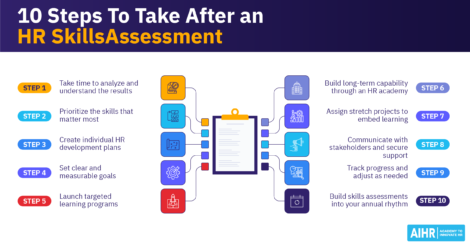
10 next steps for HR leaders after a skills assessment
A skills assessment is only as valuable as what you do next. Once you’ve gathered data on your HR team’s capabilities, the next step is to translate insight into action. This process is about more than closing gaps – it’s about aligning your people strategy with the future of your business. Here’s how to move from assessment to impact.
Step 1: Take time to analyze and understand the results
Jumping straight into development plans without interpreting the bigger picture can lead to misaligned priorities. Start by reviewing the data holistically, looking at trends across the team rather than just individual results. Are there consistent weaknesses in areas like data literacy, stakeholder influence, or strategic thinking? Are certain skill sets heavily concentrated in one area, while other functions are under-resourced?
Then layer in the business context: Which skills will matter most over the next 12–18 months? If your organization is scaling quickly, gaps in workforce planning or onboarding processes may be more urgent than gaps in employee relations. If you’re focusing on digital transformation, prioritize skills tied to HR tech fluency and change communication.
This is also a good moment to bring the team into the conversation. Organize a working session to explore the results together. You can discuss what surprised people, what confirms existing hunches, and where the group sees risks or opportunities. When skills insights are interpreted collectively, you’re more likely to land on development priorities that are both relevant and actionable.
Step 2: Prioritize the skills that matter most
Not every skill gap needs immediate intervention. The most effective HR leaders focus on the capabilities that have the greatest impact on business outcomes, such as workforce planning, leadership development, and diversity and inclusion. You may also need to prioritize skills that future-proof your function, such as analytics, agile HR, or systems thinking.
Ask yourself (and your team):
- Which capabilities are business-critical right now?
- Which skills support our ability to scale, innovate, or manage risk?
- What will happen if we don’t act?
Remember, development efforts should be practical, measurable, and aligned with strategic goals, so identify where you have strong capabilities that you can scale, share, or build into mentorship opportunities.
Step 3: Create individual HR development plans
Once you’ve prioritized key skill areas, map out targeted development plans for each team member. These should consider current strengths, career aspirations, business needs, and any stretch opportunities available.
Plans should answer:
- What skills need to be developed or deepened?
- How will the team member acquire them (courses, projects, coaching)?
- What timeline makes sense given business priorities?
You can use this structured HR Professional Development Plan Template from AIHR to guide the process. It offers ready-made frameworks for defining goals, learning actions, and evaluation checkpoints.
Step 4: Set clear and measurable goals
Development without accountability often stalls, so once you’ve identified skills to develop, translate them into outcomes using the SMART goal framework (specific, measurable, achievable, relevant, and time-bound).
For example:
- “Complete foundational people analytics training by Q3 and apply insights in our next engagement survey redesign.”
- “Co-lead the implementation of a new HRIS and deliver stakeholder training across three business units by year-end.”
It’s also important to involve team members in setting their own goals, as ownership improves motivation and strengthens the link between personal growth and team performance. Help them develop goals that link individual development to organizational value.
Step 5: Launch targeted learning programs
Short, intensive learning formats like boot camps can accelerate skill development in key areas such as digital HR, analytics, or business partnering. These programs offer immediate value by translating theory into real-world application and can be scheduled around operational demands.
The AIHR HR Boot Camp is ideal for teams needing to quickly build capability in a targeted way. Other options include microlearning, internal knowledge sharing, and cross-functional secondments to apply new skills in real time.
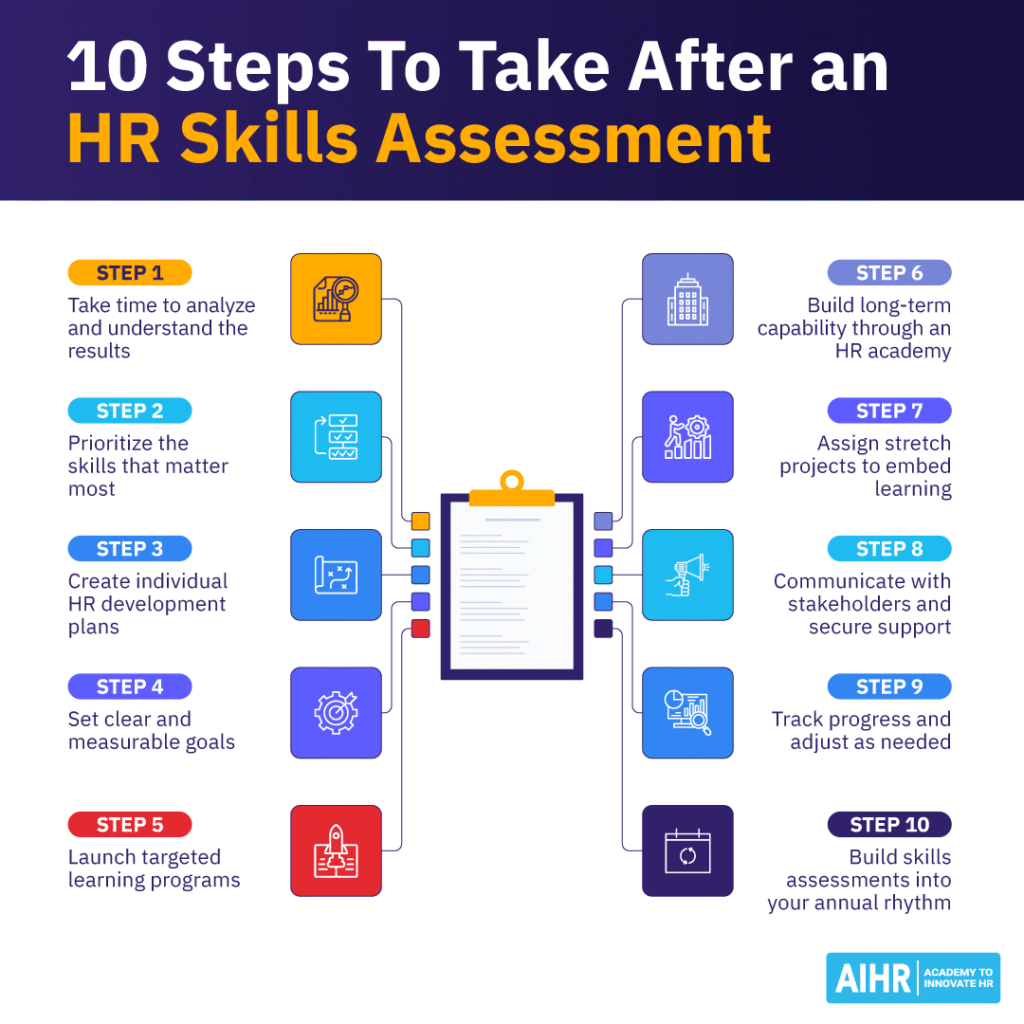
Step 6: Build long-term capability through an HR academy
While boot camps address urgent development needs, long-term capability building requires continuous learning, so give your team access to structured, on-demand programs that evolve with the profession.
The AIHR HR Academy offers a wide range of certifications and courses across HR domains, from talent management and analytics to leadership and transformation.
Embedding this kind of resource into your development ecosystem encourages self-directed learning, reduces over-reliance on managers for skill-building, and reinforces a growth mindset.
Step 7: Assign stretch projects to embed learning
One of the most effective ways to develop new skills is through applied experience. After formal learning, assign team members to real projects that let them practise what they’ve learned, whether it’s leading an employee experience initiative, revamping onboarding, or co-designing new HR dashboards. This also provides opportunities for visibility, influence, and leadership development, particularly for high-potential talent.
To build capability and strengthen internal collaboration, you can also pair newer HR professionals with more experienced team members on strategic projects.
Step 8: Communicate with stakeholders and secure support
Development plans and capability-building efforts are more effective when they’re supported by business leaders. Sharing key themes from your assessment with senior stakeholders builds credibility and may unlock budget, resources, or cross-functional support that accelerates progress.
These can include:
- What the team does well
- Where the gaps are
- How HR’s evolution supports broader business objectives.
Step 9: Track progress and adjust as needed
Create checkpoints to assess whether your plans are delivering the intended outcomes. This might include manager feedback, peer evaluations, business impact metrics (like reduced time-to-hire), or updated skills self-assessments. You can use this information to adjust development plans, celebrate wins, and course-correct where necessary.
It’s also a good idea to make this part of your quarterly team rhythm by reviewing development plans alongside performance discussions to keep growth and execution aligned.
Step 10: Build skills assessments into your annual rhythm
Finally, don’t let skills assessments become a one-time initiative. Integrate them into your annual HR planning cycle and use them to guide workforce planning, succession planning, and investment decisions.
The goal is to make capability-building part of your team culture and an expected, supported, and rewarded part of professional life. You can even combine skills assessments with team retrospectives or strategy off-sites to keep learning connected to performance, not siloed as a separate HR exercise.

Wrapping up
An HR skills assessment provides a clear, actionable snapshot of your team’s capabilities, showing where your strengths lie, where critical gaps exist, and how your team aligns with the business’s current and future needs.
With this insight, you can make confident decisions about hiring, training, and team design, ensuring that HR is equipped to lead, not just support, organizational growth.
The next step is to translate insight into action. Prioritize the capabilities with the greatest business impact, create tailored development plans for your team, and embed learning into real work. Make sure you build momentum through stretch opportunities, structured learning programs, and ongoing feedback. When assessments become part of your regular rhythm, capability-building becomes a culture that drives performance and prepares HR for whatever comes next.