High performing teams are one of the clearest predictors of business success, yet according to McKinsey, 75% of cross-functional teams underperform on key metrics. To fix this, you should first acknowledge that the gap between a team that delivers and one that regularly falls short isn’t a matter of talent. Instead, it depends on how team members work together.
HR plays a key role in this situation. You influence decisions on hiring, team structure, manager training, and how to drive performance. This article looks at what makes a high performing team, the 10 key characteristics that set them apart, and most importantly, five specific steps you can take to not only build such a team but also to maintain it.
Contents
What is a high performing team?
10 key characteristics of high performing teams
How to build a high performing team: 5 steps
How HR can help managers manage high performing teams
FAQ
Key takeaways
- High performing teams regularly outperform other teams in terms of profitability, retention, and innovation, not just because of the individual talent but also because of how they work together.
- Psychological safety is the single strongest predictor of team effectiveness. Teams that have it are more productive and innovative, and less likely to churn.
- HR’s most valuable contribution to team performance lies in equipping managers with the tools, data, and skills to create the right conditions for their teams to thrive.
- Building high performing teams is not a one-time initiative but a sustained effort across hiring, onboarding, performance management, and development.
What is a high performing team?
A high performing team is a group of people who consistently meet or exceed their goals, work well together, adapt promptly when priorities shift, and sustain strong results over time.
Performance alone doesn’t define a high performing team. For instance, team with a few exceptional contributors and several disengaged members wouldn’t make the grade. A true high performance team demonstrates collective strength in handling pressure, resolving conflict, sharing accountability, and improving together over time.
Employee engagement also plays a significant part in driving high performance. Among best-practice organizations, highly engaged teams see 51% lower turnover compared to disengaged ones. When teams trust each other and align on a clear mission, they don’t just perform better; they stay together.

10 key characteristics of high performing teams
Below are 10 characteristics most high performing teams have, what they look like in practice, and how you can build them:
1. Clearly aligned goals
High performing teams know exactly what they want to achieve and why it matters. Their goals are specific, relevant, and tied to business priorities, making it easier to stay aligned and spot gaps early.
- What this looks like in practice: Team members can clearly explain the team’s priorities, success measures, and deadlines. They’re not pulling in different directions, or working on tasks that don’t support the broader goal.
- How HR can help: You can support goal-setting frameworks, help managers translate business strategy into team objectives, and train leaders to set clear expectations and track progress consistently.
2. Defined roles and responsibilities
When people know what they own and how their work connects to others, teams operate with less confusion and duplication, as well as fewer dropped handoffs.
- What this looks like in practice: Team members know who’s responsible for what, where decisions sit, and when to involve others. On projects, ownership is clear and handovers run smoothly.
- How HR can help: Help teams clarify roles, improve job design, support workforce planning, and give managers tools to define responsibilities without making work overly rigid.
3. Trust and psychological safety
Psychological safety means people feel safe to speak up, ask questions, admit mistakes, and challenge ideas without fear of blame or embarrassment. Without it, problems stay hidden, causing teams to underperform.
- What this looks like in practice: People raise concerns early, ask for help when needed, and openly discuss mistakes or risks in meetings. They also entertain different views rather than shutting them down.
- How HR can help: Equip managers to build inclusive team environments, train leaders in feedback and listening skills, and use surveys or team diagnostics to identify where trust is weak.
4. Strong communication
High performing teams share the right information at the right time, meaning strong communication is not about having more meetings. Instead, it’s about making sure people have what they need to act.
- What this looks like in practice: Updates are clear, and team members flag blockers early. They also communicate decisions promptly, listen earnestly, and address misunderstandings quickly.
- How HR can help: Help set communication norms, support manager capability in team communication, and embed collaboration practices into onboarding, team development, and leadership training.
5. Mutual accountability
Strong teams share accountability, which means team members follow through on commitments. If something is off track, they say so early, and don’t rely on constant oversight to get results.
- What this looks like in practice: People meet deadlines, ownership is visible, and peers hold each other to agreed standards. When something slips, team members address it as early as possible.
- How HR can help: Build accountability into performance management, help managers set clear expectations, and encourage team-based ways of working that require visible, shared responsibility.
Master high performing team-building through deliberate talent decisions, from identifying critical roles and retaining top performers to creating the right culture, career paths, and succession plans.
AIHR’s Talent Management & Succession Planning Certificate Program, helps you to:
✅ Build a strategic talent management framework aligned with team performance goals
✅ Anticipate talent needs through demand and succession planning for critical roles
✅ Create stronger talent pipelines via talent mapping and leadership development
6. Complementary skills
High performing teams typically have a diverse make-up, bringing together different strengths, expertise, and ways of thinking that improve problem-solving and decision-making.
- What this looks like in practice: Team members rely on each other for different strengths, and balance gaps in one area with strengths in another. This broad range of perspectives strengthens the decision-making process by approaching problems from multiple angles.
- How HR can help: Improve hiring, internal mobility, and succession planning to build balanced teams. Skills mapping and talent assessments can also help identify where teams are strong and where they need support.
7. Adaptability
Strong teams can respond to change, setbacks, and shifting priorities without losing focus. They see disruption as something to work through together, not a reason to stall.
- What this looks like in practice: When priorities change, the team resets quickly, reallocates work, and keeps moving. This helps team members stay solution-focused under pressure.
- How HR can help: Develop change readiness through manager training, team coaching, and learning programs that build resilience, problem-solving, and agility.
8. Constructive conflict
High performing team members don’t avoid disagreement at all costs. Instead, they debate ideas, question assumptions, and challenge one another in ways that improve decisions without damaging relationships.
- What this looks like in practice: Team members can disagree openly, test ideas with evidence, and leave the discussion aligned even when views differ. This way, any conflict stays focused on the issue at hand, not any individual on the team.
- How HR can help: Train managers and teams in conflict resolution, feedback, and facilitation skills, and help create norms that make healthy debate part of team culture.
9. Consistent learning and feedback
Instead of allowing themselves to stagnate, high performing teams reflect on what’s working, address what’s not working, and use feedback to improve over time.
- What this looks like in practice: Feedback is regular, specific, and useful. Teams review outcomes, learn from mistakes, and actively help each other improve rather than waiting for formal review cycles.
- How HR can help: Build feedback into everyday performance practices, support coaching capability in managers, and create development systems that encourage reflection and skill growth.
10. Strong leadership support
Teams perform best when leaders provide direction, remove obstacles, and create the conditions necessary for good work. Essentially, they guide the team without micromanaging it.
- What this looks like in practice: Managers set priorities, unblock issues, support decision-making, and protect the team from unnecessary friction. At the same time, team members know where they’re heading, and feel supported in getting there.
- How HR can help: Strengthen manager effectiveness through leadership development, coaching, and practical tools that help leaders set direction, manage performance, and support team health.
How to build a high performing team: 5 steps
Here’s how you can build a high performing team in five practical steps:
Step 1: Hire for team fit and role clarity
Start before your first interview. Define the role’s requirements, how it fits within the team, and what collaboration looks like day-to-day. Without this clarity, you’ll be evaluating your candidates against undefined standards.
Use structured interviews to assess collaboration, adaptability, and accountability, not just technical competence. Ask candidates for examples of how they’ve handled conflict, navigated ambiguity, or supported teammates through difficult periods. Additionally, align your selection criteria with team goals, not only individual job descriptions.
Step 2: Build the conditions needed for strong team performance
Onboarding is where team norms are either reinforced or unintentionally undermined. Design your onboarding process to familiarize new hires with how the team actually operates. This includes communication rhythms, accountability standards, and decision-making patterns.
Support managers with goal-setting templates and team charters that make expectations explicit from day one. You can also help establish clear competency frameworks, so team members understand what strong performance looks like in their roles, and how their work connects to wider team and business goals.
Step 3: Strengthen trust, communication, and feedback
Train your managers to give team members consistent feedback and resolve conflicts promptly and effectively. A manager who can’t do this is a liability to their team’s performance, regardless of how technically capable they are.
Instead of waiting for annual engagement surveys to find out a team is struggling, use regular pulse surveys to spot friction early. Consider including focused questions like “Do you feel comfortable raising concerns in your team?” and “Is your workload manageable?” This helps HR and managers gauge psychological safety and workload pressure, allowing you to address issues before they escalate.
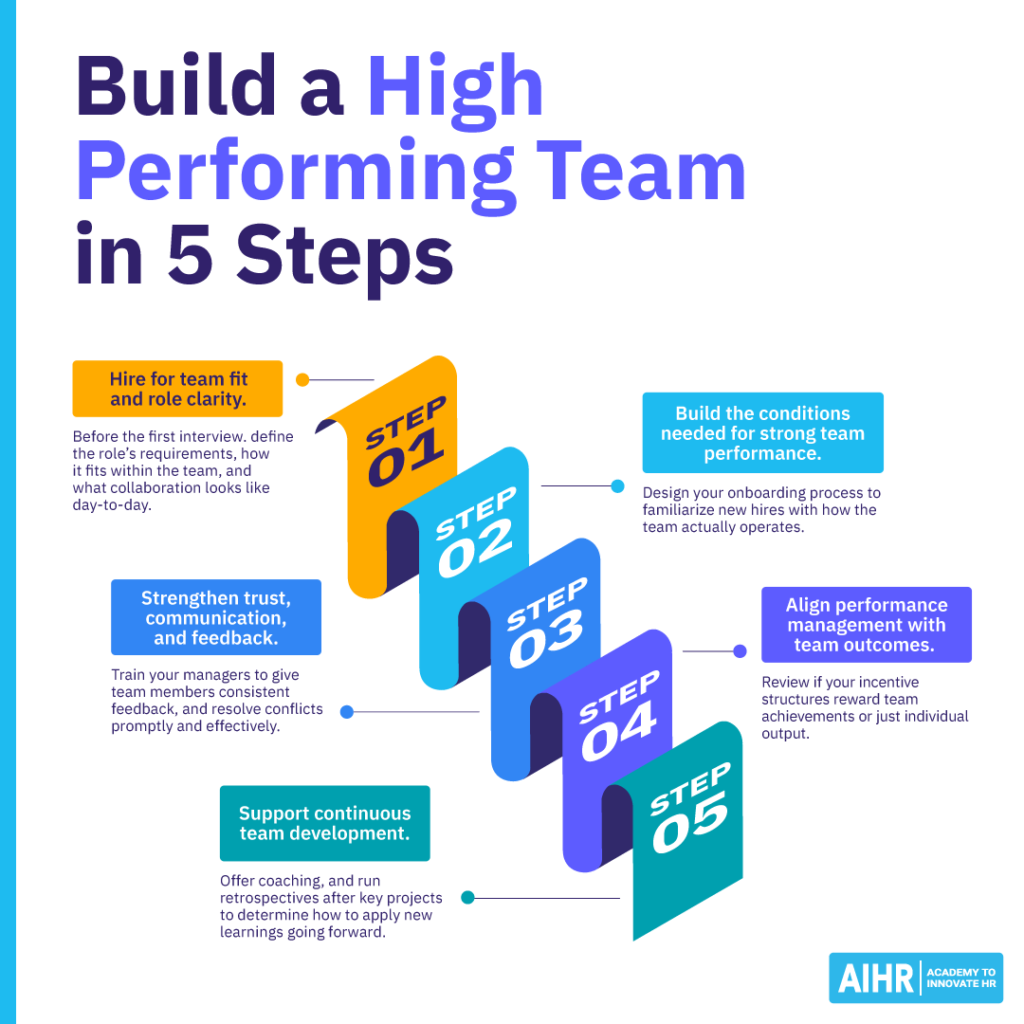
Step 4: Align performance management with team outcomes
Individual performance measures alone won’t build a collaborative team. Where appropriate, include team-based goals alongside individual ones, and review if your incentive structures reward team achievements or just individual output.
At the same time, track leading indicators (e.g., engagement scores, internal mobility rates, and voluntary turnover) alongside lagging ones, like goal attainment. A team that’s hitting its numbers but consistently losing people, for instance, clearly has a problem to address.
Step 5: Support continuous team development
Offer coaching and team effectiveness workshops, then run retrospectives after key projects to document what’s happened, and determine how to apply new learnings going forward.
You can also help managers identify and address skills gaps before they become blockers or lead to avoidable delays. Development isn’t just an individual activity; teams improve when they reflect and practice together, and have the space they need to grow collectively.
HR tip: Build a culture of apprenticeship to triple your team’s growth
A recent survey found that high performing team members were 2.3 times more likely to feel their team leaders trusted them and their colleagues respected them.
They also ranked emotional and social intelligence as their teams’ top success factor, above technical skills or strategic thinking. These teams were also nearly three times as likely to build a culture of apprenticeship, in which people learn from one another through daily work rather than through formal training alone.
How HR can help managers manage high performing teams
As HR, you need to make sure your managers have what they need to lead well, and to step in when they don’t. Here’s what this support looks like in practice:
Coach against micromanagement
Strong performers leave managers who try to exert excessive control. Guide managers to shift from task oversight to leading through trust, delegation, and empowerment, and help them see that giving talented people autonomy is a good way to retain them. This also means helping managers define where oversight is necessary and where they need to step back.
Keep goals and priorities clear
Managers need practical tools, such as goal-setting frameworks, planning templates, and regular alignment touchpoints. Without these, clarity erode, team performance drifts, and the tendency for micromanagement arises. You can reinforce this by making goal reviews and priority-setting a regular part of team management, not a one-off exercise.
Protect teams from unnecessary friction
Use employee pulse surveys, engagement data, and manager check-ins to identify problems before they snowball into something bigger. A team that’s struggling needs intervention, not a quarterly review. You should also help managers identify whether workload, unclear processes, poor collaboration, or weak leadership support is causing friction and inefficiencies.
Recognize contributions fairly and consistently
Failure to acknowledge strong performance dampens motivation and engagement quickly. Help managers build visible formal and informal recognition practices. Recognition doesn’t have to be expensive, but should be specific and timely. You can add structure by giving managers simple guidance on what good recognition looks like, and how to apply it fairly across their teams.
Address conflict early
Build managers’ confidence in having difficult conversations. Unaddressed conflict doesn’t disappear, but grows into more serious issues and damages trust among teams and managers. Train managers to address friction directly and constructively. You should also position conflict resolution as a core management skill, not something to avoid until it becomes a bigger problem.
Prevent burnout
High performing teams can experience burnout when their performance expectations become unsustainable. Monitor workload pressure and team health as standard practice. A team that regularly delivers beyond capacity may appear impressive but may be heading for a breakdown. Support them by helping managers distinguish between healthy stretch and chronic overload.
Keep development going
High performers tend to stay when they’re growing. Support managers in offering stretch assignments, coaching conversations, and regular meaningful career development discussions throughout the year, not just during performance reviews. At the same time, treat development as an ongoing part of performance, rather than a separate people process.
Revisit roles as the business evolves
As priorities shift, so should team structures. Support managers in periodically reviewing role clarity to keep teams aligned with business needs. HR shapes the conditions around team success, and managers lead their teams. When both work well together, high performance is both predictable and scalable. This is viral during growth, restructuring, or changing business priorities, when role confusion tends to increase.
Next steps
High performing teams require clear goals, trust, and managers who know how to create the right conditions for people to perform well together. For HR, this means treating team performance as a capability to build across hiring, onboarding, manager development, performance management, and workforce planning, not as a one-off initiative.
Sustaining these teams also depends on developing the human skills behind them. This is where focused learning can make a difference. If you want to build the capabilities that create the conditions for high performance, AIHR’s Soft Skills Hub is a practical starting point. It will help your workforce develop the skills they need to form high performing teams.
FAQ
High performing teams consistently meet or exceed goals, collaborate well, share accountability, and deliver strong results. They’re defined not by the talent of individual members, but how well they work together (through clear communication, mutual trust, defined roles, and strong leadership). The outcome is higher profitability, lower turnover, faster problem-solving, and greater innovation.
The 10 characteristics are: clearly aligned goals, defined roles and responsibilities, trust and psychological safety, strong communication, mutual accountability, complementary skills, adaptability, constructive conflict, consistent learning and feedback, and strong leadership support.