

The ADDIE model is a five-step instructional design framework used to create training and learning programs in a structured way. ADDIE stands for Analysis, Design, Development, Implementation, and Evaluation. L&D teams use it to identify learner needs, build training, roll it out, and improve it over time.
Because the ADDIE model of instructional design breaks learning design into clear phases, it is useful for workplace learning, onboarding, compliance, leadership development, and reskilling initiatives. In this guide, we explain what the ADDIE model is, how each phase works, when to use it, and how to apply it in practice.
Contents
What is the ADDIE model?
Purpose of the ADDIE model
Advantages and disadvantages of the ADDIE model
The 5 phases of the ADDIE model
ADDIE model examples
ADDIE vs other instructional design models
Free ADDIE model templates
FAQ
Key takeaways
- The ADDIE model gives L&D teams a simple five-step framework (Analyze, Design, Develop, Implement, and Evaluate) to build training that is aligned with business needs and learning goals.
- ADDIE starts with analysis, so teams must first define the business problem, audience needs, and desired outcomes before creating any training content.
- ADDIE is popular because it’s adaptable, consistent, and built for iteration, which helps organizations improve training quality over time.
- ADDIE can be slow and resource-heavy, so while it works well for structured learning design, it may be less suitable when teams need faster or more flexible development.
What is the ADDIE model?
The ADDIE model is a leading learning development model used for instructional design, which is the complete process of designing, developing, and serving learning content. Companies often use the model to design training and learning and development (L&D) programs in organizations.
It was developed by the Center for Educational Technology at Florida State University in 1975 to provide a structured framework for instructional systems development (ISD) for the U.S. Army. However, the model later saw wider adoption as an instructional design and workplace training standard.
The ADDIE acronym stands for:
- Analyze
- Design
- Develop
- Implement
- Evaluate.
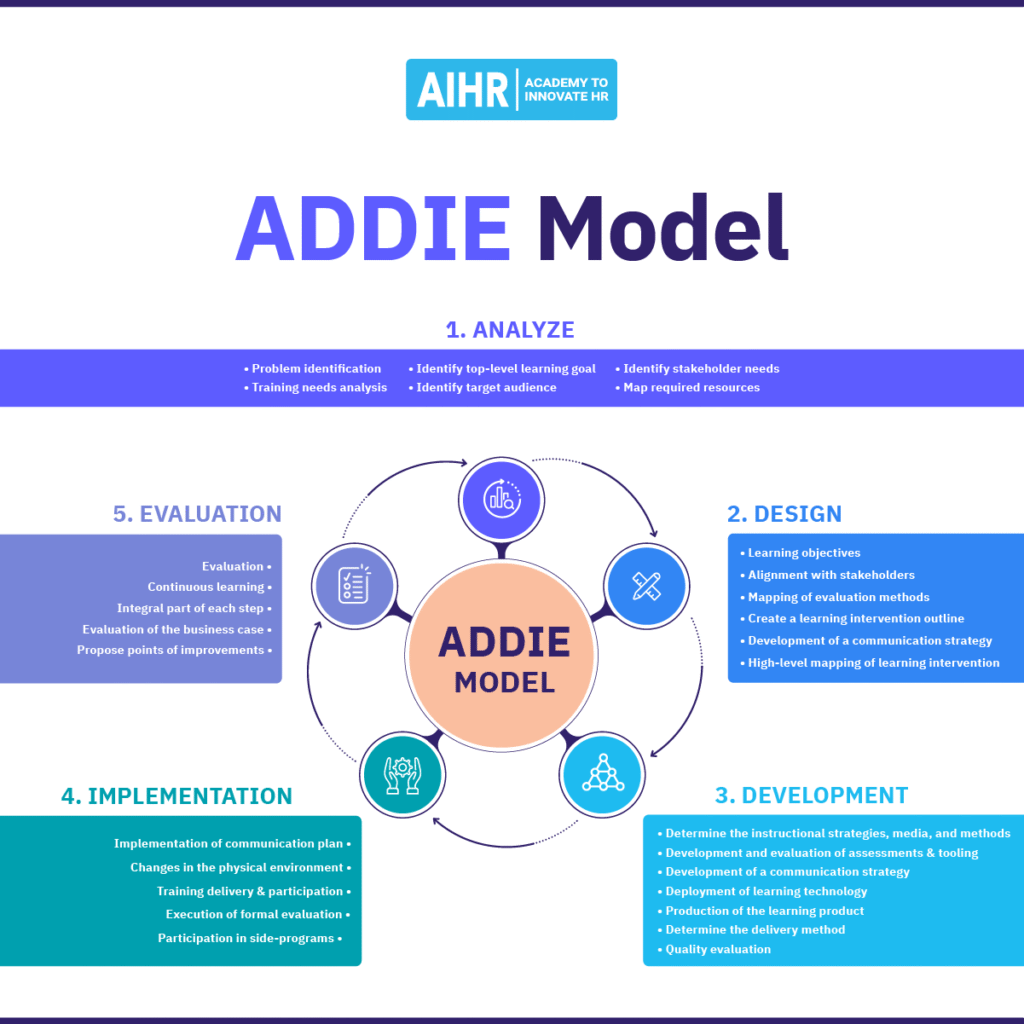
These are the five stages of the learning development process. ADDIE training model provides a streamlined, structured framework that helps you create an effective learning product, whether that’s delivered through an online or offline training program, a coaching session, a presentation, or an information booklet.
ADDIE helps identify the learning need in a structured way and ensures all learning activities serve that goal, which offers an integrated approach to learning. It also guides measuring learning effectiveness because job behaviors, knowledge, and skills are clearly defined within the framework.
In the ADDIE model, each stage must be carried out in order and carefully considered before moving on. Reflection and feedback at each stage ensure continuous improvement.

Purpose of the ADDIE model
The ADDIE model serves as a foundational framework for instructional design, offering a systematic process for creating effective and efficient training programs. There are multiple reasons why companies use the ADDIE model for instructional design:
- Creating a structured process for instructional design: The ADDIE model provides a clear, step-by-step framework that guides instructional designers through the creation of educational programs, ensuring they consider and address all critical aspects of instructional design.
- Aligning instructional activities with learning objectives: By starting with a thorough analysis phase of the ADDIE model, you can fully align all instructional materials and activities with the learning objectives, increasing the likelihood that the objectives will be met.
- Facilitating data-driven decision-making: By systematically collecting and analyzing data at each stage, the ADDIE model supports data-driven decision-making, allowing instructional designers to make informed adjustments that enhance the learning experience.
- Facilitating effective communication among stakeholders: By providing a common framework, the ADDIE model enables clear, effective communication among all stakeholders involved in the instructional design process, including educators, designers, and learners.
- Promoting continuous improvement: The evaluation phase of the ADDIE model enables the collection of feedback and data on the training program’s effectiveness, providing opportunities for continuous improvement and keeping the training program relevant and impactful over time.
- Enhancing instructional design expertise: The process of continuous evaluation and improvement helps instructional designers and educators to refine their skills and expertise over time, leading to higher-quality educational content and more effective teaching strategies.
Advantages and disadvantages of the ADDIE model
Although it is considered a leading learning development model, the ADDIE model has both advantages and disadvantages, as with all models.
Advantages of the ADDIE Model
- Adaptability: The ADDIE design model is highly adaptable and can be used across industries, disciplines, and learning environments. It can be tailored for projects of different scales as well as for individual or group learning.
- Consistency: The ADDIE model of training provides a structured and consistent approach to instructional design, which can boost efficiency and consistency in the quality of course development.
- Iteration opportunities: ADDIE is an iterative model, allowing feedback and changes at each stage of development to ensure the final product meets the desired learning objectives.
- Evaluation component: There is an evaluation component to the ADDIE model that allows businesses to measure the effectiveness of the instructional content. That is useful in identifying key areas of improvement for future iterations.
Disadvantages of the ADDIE Model
- Linear process: The ADDIE method can feel too linear when applied rigidly, and may not be flexible enough to address complex learning needs. In fast-moving environments, teams may need to iterate more quickly than a strict step-by-step approach allows.
- Being resource-intensive: Using the ADDIE model for instructional design can be a lengthy process that also requires significant resources. It may be challenging for smaller organizations with fewer resources to implement.
- Lack of emphasis on user experience: While organizations have been increasingly focusing on digital employee experience, including in training, the ADDIE model doesn’t have a strong focus on user experience. That can lead to unengaging instruction and poor learning outcomes for employees.
The ADDIE model provides a structured yet flexible approach to creating impactful learning experiences. Learn to use it to build programs aligned with organizational goals, and drive measurable results.
AIHR’s Learning & Development Certificate Program will help you:
✅ Master the ADDIE model to design, develop, and refine training that engages learners
✅ Gain hands-on skills in instructional design, evaluation, and continuous improvement
✅ Apply learning design principles to create effective employee training programs
🎓 Visit the AIHR Demo Portal to preview lessons that can help you design learning with more structure.
The 5 phases of the ADDIE model
Let’s take a closer look at the five phases of the ADDIE model for instructional design (Analyze, Design, Develop, Implement, and Evaluate), and how you can follow the key ADDIE model steps to implement it.
Analysis
Identify the business problem, learner needs, and performance gap.
What problem are we trying to solve?
Review performance data, interview managers, define learning goals.
Design
Plan the learning experience, structure, activities, and assessment approach.
What should the learning experience look like?
Create learning objectives, storyboards, assessment plans.
Development
Build the learning materials and resources.
What content and assets do we need?
Create slides, videos, facilitator guides, job aids.
Implementation
Deliver the training to the target audience.
How will we launch and support the program?
Roll out the course, brief managers, prepare facilitators.
Phase 1: Analyze
In the Analyze phase of the ADDIE framework, the first task is to identify the problem you’re trying to solve. It could be poor sales, a non-inclusive culture, or a lack of skills needed to move to a more digitized organization. From here, you can identify the core business problem and decide whether you can solve it through ADDIE model training, or if other organizational development interventions will be more effective. Instructional designers also need to determine and manage stakeholders’ needs.
Some helpful questions to ask are:
- What is the purpose of the training?
- Why should we do it?
- What is the desired change?
- Will the training be effective in creating this change?
For HR and L&D teams, the analysis phase often includes a training needs analysis (TNA), stakeholder interviews, learner research, and a review of existing performance data. The TNA process helps identify the gap between the actual and desired skills, knowledge, and abilities, and a strong analysis phase reduces the risk of building training that looks good but does not solve the right problem.

During this phase, it’s crucial to determine a target audience. You can create one or more trainee “personas” who display the general characteristics, knowledge, and experience of your target audience. Recognizing their needs and expectations will enable you to actively manage these, tailor your training to your audience and make it more relatable.
To ensure a successful ADDIE training model, you need a clear understanding of your target audience, and should focus on setting clear and measurable learning objectives. This will guide the content development process and help learners achieve their desired learning outcomes. Based on all the information gathered in the Analyze phase, you can also map out the resources required for the training. This includes the number of training hours, duration, required budget, facilities, and additional information.
Once you’ve collated all of this information, you can create a full ADDIE training process, which will include the who, what, when, where, why, and how of the training.
Phase 2: Design
In the design phase, the team translates analysis findings into a structured learning solution with clear learning objectives, activities, assessments, and delivery options. This phase creates the blueprint for development and helps keep the learning experience aligned with the original business need. In this phase, you also select an appropriate evaluation method from a learning design standpoint. Based on Kirkpatrick’s model, you can measure effectiveness on different levels.

Not every training program justifies measurements on all levels. Measuring reactions to the training may suffice for simpler training. As a rule of thumb, a full impact analysis, or training Return-on-Investment (ROI) calculation, is only justified in 5% of all training, specifically for training with a high investment that tackles a critical business issue.
The next step is to create a storyboard and/or prototype, so you can easily communicate the value of the training, particularly to stakeholders. It’s important to brief stakeholders and update them on the learning goals and learning design choices made in this phase. Make sure to align with them before you move on to the next phase.
Phase 3: Develop
The development phase of the ADDIE learning model is where you build the learning solution, including e-learning modules, facilitator guides, job aids, assessments, videos, and practice activities. At this point, the focus shifts from planning to production while staying aligned with the objectives set during the design phase. You can use your storyboards and/or prototypes as a guide to creating your courses.
Consider how you’ll deliver the ADDIE model training: in-person, online, or a mix of the two (a blended approach)? What will be the instructional strategies, media, and methods? Learning interventions often use multiple methods to deliver the content. Once you’ve decided, you can then think about whether you want to build this in-house or with an external provider. It’s equally important to decide where you’ll host it and what software and tools you’ll need (e.g., video conferencing software like Zoom, vendor’s platform, or an LMS).
Building the learning product in line with the design represents the bulk of the work in this phase. You may outsource this part to a trainer who’s a subject matter expert, or a training organization with relevant knowledge. It’s the role of the instructional designer to align the learning product with the design specifications and findings in the TNA.
Once you’ve created your course, test for errors like grammar and spelling, and ease of navigation. This isn’t a simple case of clicking through the course, but more about content accuracy and the utility of navigation. Is your learner able to progress through the course in the way you designed? Is it engaging? What is the duration like?
Conduct pilots and product reviews where different people (including you) test the learning product and training materials. You may want to use web-based tools like Survey Monkey or Qualtrics for users to evaluate the training.
The final step of the ADDIE model design phase is to develop a communication strategy to reinforce the importance of learning to your audience. How can you encourage them to devote time and attention to learning? How can you help them prioritize this at work while managing their main job responsibilities? Creating a clear communication strategy will keep learning top-of-mind and increase impact. Once you’ve completed the development stage, it’s time to implement, which means the training can commence.
Phase 4: Implement
The implementation stage of the ADDIE model focuses on training delivery and project management. This includes communicating with learners, handling logistics, collecting data, and training trainers for global rollouts of the learning program. The training delivery is the key element in this phase. Do learners need any extra guides or manuals? How about FAQs that may come up along the way? What’s the protocol if users experience technical difficulties during the training? It’s sensible to have additional IT support on hand, and let learners know whom to contact.
It’s important to remember that a strong implementation phase extends beyond delivery. It also includes stakeholder communication, facilitator readiness, learner support, technical setup, and manager involvement. Many training programs underperform not because the content is poor, but because their rollout plans are weak.
When it comes to sharing your training with learners, you’d typically upload the content to an LMS, with pre-set delivery options (who’s enrolled, pass rates, feedback collection, delivery, tracking, and reporting). But this depends on what you decided in the design phase. Think about how you can create a buzz around the new learning program and shine a spotlight on desired behaviors. Give learners ample notice of the program’s start and completion dates.
While evaluation is the final stage of ADDIE, you can already start gathering data in the implementation phase. Depending on the choices made in the analysis phase, you can use different training evaluation methods (e.g., training evaluation forms and pre-and post-training assessments, potentially with a control group). Questionnaires, interviews, observations, knowledge assessments, work assessments, 360-degree feedback, and work output data are common methods, though some fall under the next phase (evaluation).
Phase 5: Evaluation
Evaluation should not happen only at the end of the ADDIE process. It should also inform decisions throughout the design and delivery of the training program. A complete evaluation approach looks beyond satisfaction and considers what learners have retained, if behavior has changed, and if the program has improved business outcomes.
It’s important to evaluate at the design, development, and delivery stages of the ADDIE model, and continuously evaluate all elements of the program. As soon as you deliver the first course or workshop, you want immediate (and continuous) feedback to inform improvements. You can formally evaluate the learning program using post-assessments, observations, or productivity data to highlight what people have learned, how they’ve applied it, and the results achieved.
The instructional design team should evaluate what went well and what they can improve. Make a list of improvements the training program needs, and implement these before the next training. If the program is going to be shelved, you can still record these improvements, so when the same (or a similar) program is used in the future, you have these learnings to refer to.
Using your formal evaluation of the ADDIE framework, decide to what degree your initial training met the objectives and goals from the analysis phase. Feed these results back to your stakeholders, and ask about their satisfaction with the training program, as this will provide valuable input for future programs.
Below is a summary of the five stages of the ADDIE methodology:
| Phase | Key activities |
| 1. Analyze | Problem identification Training needs analysis Identify top-level learning goal Determine target audience Identify stakeholder needs Map required resources |
| 2. Design | Create a learning intervention outline High-level mapping of learning intervention Mapping of evaluation methods Development of a communication strategy Alignment with stakeholders |
| 3. Develop | Determine the delivery method Production of the learning product Determine the instructional strategies, media, and methods Quality evaluation Development and evaluation of assessments & tooling Deployment of learning technology Development of a communication strategy |
| 4. Implement | Participation in side programs Training delivery & participation Changes in the physical environment Implementation of communication plan Execution of formal evaluation |
| 5. Evaluate | Integral part of each step Evaluation Continuous learning Propose points of improvements Evaluation of the business case |
ADDIE model examples
Below are some examples of practical applications of the ADDIE model in different types of professional training:
Training for sales representatives
This ADDIE model training plan example for sales representatives focuses on improving sales skills like rapport-building, prospecting, presenting, and negotiating. Training methods such as role-playing reinforce these skills, while visual aids like infographics keep trainees engaged.
| Analysis phase | Identify the need for training specifically for sales representatives (based on low sales numbers or other issues that have arisen) Determine the learning objectives for the training, such as improving communication skills, negotiation, emotional intelligence, or product knowledgeIdentify the target audience for the training as the sales staff Evaluate the existing sales resources and identify any gaps in knowledge or skills |
| Design phase | Develop a training plan that outlines the instructional methods and materials to be used to address the learning objectives Create the instructional content such as training manuals, presentations, and other instructional materials to support the learning objectives Define the assessment methods and develop any necessary evaluation tools to measure the success of the training program Establish the training schedule and logistics, including the number of sessions and their duration, and the timing of each session |
| Development phase | Create any necessary visuals, videos, or multimedia material for the training content Develop role-playing exercises and other interactive elements to be used in the training program Review and refine the instructional content based on feedback from stakeholders Conduct a pilot test of the training content, and make any necessary revisions |
| Implementation phase | Deliver the training sessions to the sales representatives Provide any necessary support or feedback to the learners during the sales training Monitor the learners’ progress and address any issues as they arise |
| Evaluation phase | Gather feedback from the sales representatives about the effectiveness of the training Analyze the assessment results to identify any gaps in knowledge or skills Compare the sales numbers of the reps before and after the training to evaluate the effectiveness of the training Make any necessary modifications to the training based on the evaluation results |
Training for public speaking and presentations
This sample employee training plan will focus on improving public speaking skills including, communication, clarity, connecting with the audience, projecting the voice, tone of voice, creating note cards, designing an engaging slideshow presentation, and body language. Trainees will build these skills through training methods such as in-person practice sessions, and will also receive theory instruction to gain knowledge of what makes a great presentation.
| Analysis phase | Identify the need for training specifically for anyone who will need to give presentations to large groups as they progress in their career, or anyone who has struggled in the past to deliver compelling presentations or battles with nerves (managers can advise on their teams) Determine the learning objectives for the training, such as improving communication skills, body language, projecting the voice, and connecting with any audience Identify the target audience for the training as anyone who will need to regularly give presentations to large audiences. Evaluate the existing public speaking resources and identify any gaps in knowledge or skills |
| Design phase | Develop a training plan that outlines the instructional methods and materials to be used to address the learning objectives Create the instructional content such as training manuals, presentations, and other instructional materials to support the learning objectives Define the assessment methods and develop any necessary evaluation tools to measure the success of the training program Establish the training schedule and logistics, including the number of sessions and their duration, and the timing of each session |
| Development phase | Create any necessary visuals, videos, or multimedia material for the training content Develop in-person exercises and other interactive elements to be used in the training program Review and refine the instructional content based on feedback from stakeholders Conduct a pilot test of the training content, and make any necessary revisions |
| Implementation phase | Deliver the training sessions to the employees Provide any necessary support or feedback to the learners during the public speaking training Monitor the learners’ progress and address any issues as they arise |
| Evaluation phase | Gather feedback from the employees about the effectiveness of the training Analyze the assessment results to identify any gaps in knowledge or skills Compare the confidence of the employees when giving presentations before and after the training to evaluate its effectiveness Make any necessary modifications to the training based on the evaluation results |
Is the ADDIE model still relevant today?
Yes, the ADDIE model is still relevant, especially for learning programs that need clear planning, stakeholder input, and measurable outcomes. What’s changed is how teams use it.
Many L&D teams now apply ADDIE more flexibly by testing ideas earlier, gathering feedback throughout the process, and iterating before full rollout. Rather than seeing ADDIE as outdated, it’s more useful to see it as a strong foundation you can adapt to modern workplace learning.
ADDIE vs other instructional design models
The ADDIE model is one of the best-known instructional design frameworks, but it’s not the only one. Some teams compare ADDIE with models such as SAM when they need faster prototyping and shorter feedback loops. The biggest drawback of the ADDIE model is its lack of speed. The output of the previous step serves as the input for the next step, similar to the traditional ‘waterfall’ method.

This approach takes a long time, during which the learning and content needs may change. This can lead to a misfit between the end product and the reason why the process was started in the first place. Rapid instructional design offers a potential solution, as it’s a more agile approach. It’s based on rapid development techniques that originate in software development and apply to instructional design. It’s a continuing process, with new aspects being added and evaluated until the program is completed.
The aim is to create a proof of concept (POC), have learners and/or stakeholders interact with it continuously, and receive feedback that then incorporates into the next POC until the product is finished. Rapid instructional design comprises five steps:
- Definition: Initial definition of learning goals and requirements.
- Prototyping: Rapidly prototyping a proof of concept.
- Evaluation: Evaluating the prototype with stakeholders, followed by iterative improvements and adjustments of goals and requirements based on the POC.
- Implementation: Implementing the adjusted goals and requirements in an upgraded version of the POC.
- Repeat: Repeat steps 2 to 4 until learners achieve the learning goals.
This is an iterative approach built on the principles of build–measure–learn, which is commonly practiced in the lean methodology. The figure below shows this iterative process. Prototypes are developed rapidly and continuously aligned with the project planning and project goals. It’s not uncommon to have multiple iterations within a specific phase. For example, if the outline doesn’t fit user needs, you must iterate the outline before moving to the design prototype.

An example of this is one of AIHR’s HR upskilling projects. The training has a blended approach: mostly online learning combined with monthly sessions based on learners’ needs. These sessions aim to motivate learners to complete the e-learning while also providing them with assignments and challenges to solve. They’re always related to organizational issues and change over time based on current needs.
This creates a program in which employees upskill while also contributing to solving organizational issues in these offline workshops, which helps them apply what they’ve learned and, ultimately, create business impact.
Remember, however, that the best model depends on the learning need, the business’s pace, and the required level of stakeholder alignment. ADDIE remains a strong choice when a program needs clear planning, structure, and evaluation.
Free ADDIE model templates
A template can help teams apply the ADDIE framework more consistently by capturing the business problem, learner audience, objectives, content structure, rollout plan, and evaluation measures in one place. It can also facilitate communication and collaboration within the team, providing a shared reference point for the project’s status and next steps. Download AIHR’s ADDIE model template collection for free to help you streamline task allocation and monitor progress across the ADDIE phases.
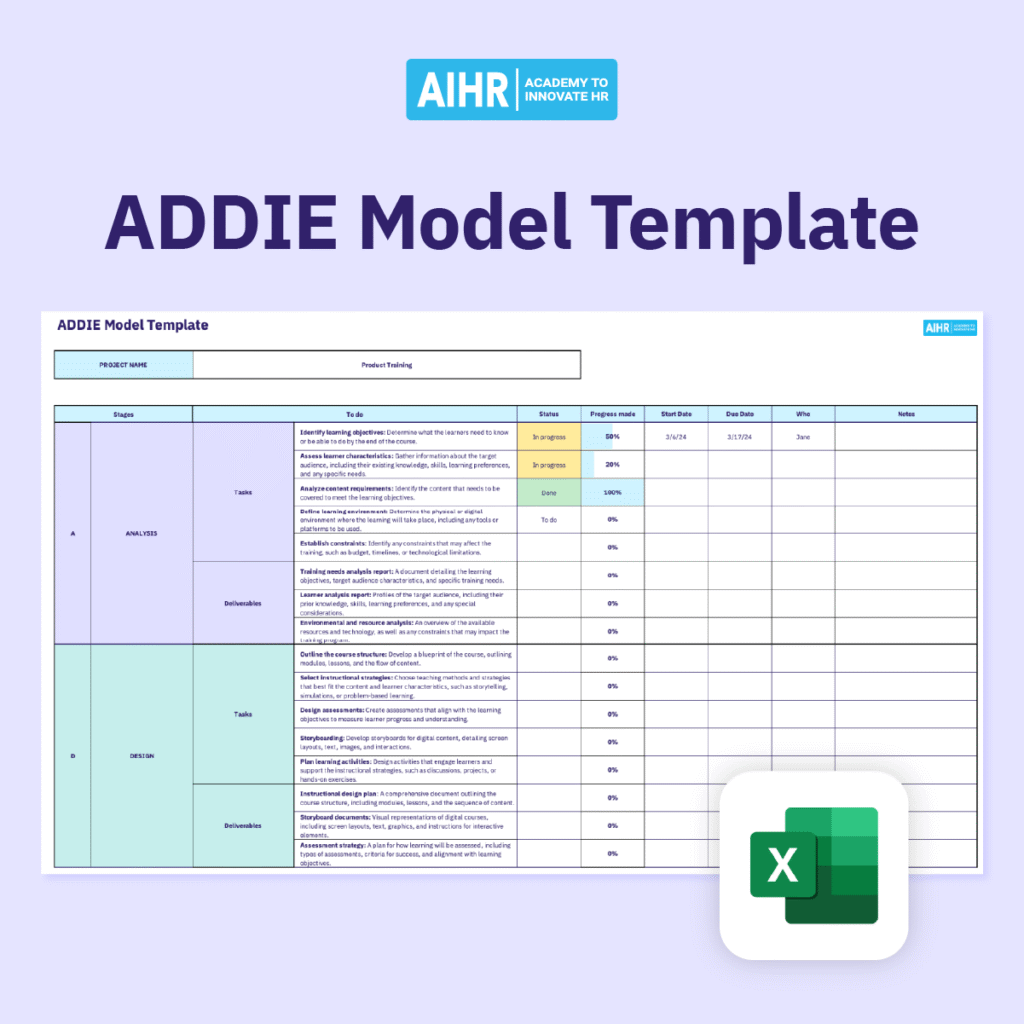
ADDIE model template: Excel
With this Excel template, you can easily break down the different phases of the ADDIE model process into tasks and track your progress across the project.
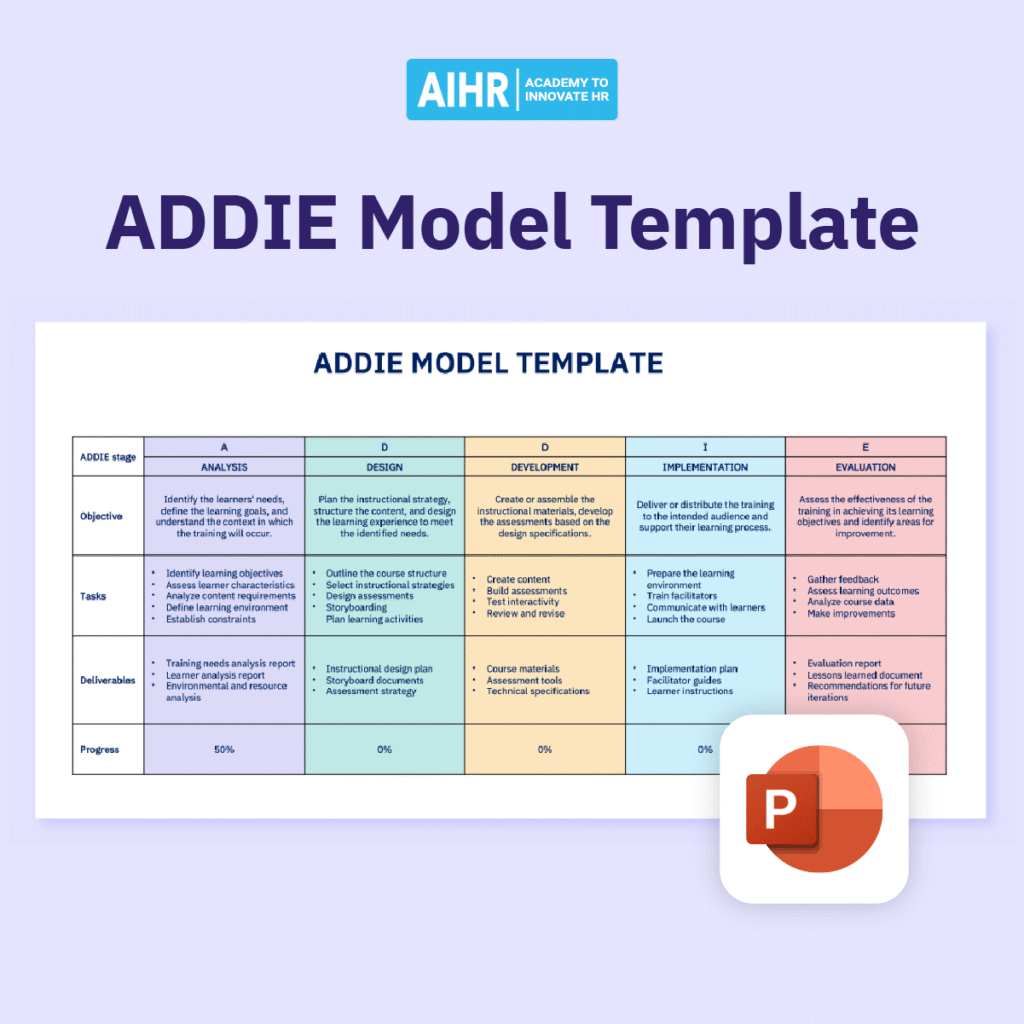
ADDIE model template: Powerpoint
This free Powerpoint ADDIE model template allows you to share your project progress with the wider organization in an easy to understand way.
Before you go
When applied correctly, the ADDIE model can be used in learning and development initiatives across industries and disciplines to improve individual and group learning and meet learning objectives. Its iterative approach allows for vital feedback at each stage of development, which ensures the final product meets your original instructional goals while helping you identify key areas for improvement in the future.
FAQ
The ADDIE model is a five-phase instructional design framework used to plan, create, deliver, and evaluate training programs. The phases are Analysis, Design, Development, Implementation, and Evaluation.
ADDIE stands for Analysis, Design, Development, Implementation, and Evaluation.
The ADDIE model is used as a systematic framework for instructional design, guiding the process of creating effective learning and development programs. It encompasses five phases—Analyze, Design, Develop, Implement, and Evaluate—to ensure that educational content is aligned with learner needs and achieves desired learning outcomes.
The five phases are Analysis, Design, Development, Implementation, and Evaluation. Together, they guide the learning design process from needs analysis to measurement and improvement.
Yes. The model is still widely used because it provides structure and supports alignment between learning design and business goals. Many teams now use it more flexibly than in the past.
A common example is using ADDIE to design a new manager onboarding program. The team identifies the capability gaps, designs the learning experience, builds the materials, launches the program, and measures whether managers improve on the job.
The ADDIE learning development model is commonly used because it’s highly adaptable and suitable for different industries, disciplines, and learning environments, as well for different scale projects. Its structured approach can boost efficiency and consistency in the quality of course development. Plus, ADDIE is an iterative model which allows for feedback, evaluation, and changes at every stage to ensure learning objectives are met.
The ADDIE model was developed by the Center for Educational Technology at Florida State University for the U.S. Army in the 1970s. Their goal was to standardize the process of creating instructional materials and training programs for military personnel, and enable a systematic and effective approach to education and training within the military.