
HR governance is becoming increasingly important as organizations manage more complex workforce structures, larger volumes of employee data, and growing use of AI across HR systems and decision-making processes. In the past, business units often made people-related decisions independently, using their own processes, documentation standards, and decision criteria.
Today, those decisions are more connected, data-driven, and visible across the organization. That makes consistency harder, and the risks of misalignment higher. Increasing use of AI adds another layer because it can influence who gets hired, promoted, developed, or supported at work. McKinsey’s Superagency in the Workplace report found that 92% of companies plan to increase AI investments over the next three years, yet only 1% say they have reached maturity.
For HR, this makes governance essential: Leaders need clear ownership, review processes, and escalation points for workforce technology, employee data, and people decisions.
Contents
What is HR governance?
Why your business needs robust HR governance
HR governance framework to implement
Best practices for effective HR governance design
What governance is needed when using AI in HR?
Key takeaways
- HR governance creates clear accountability for workforce decisions, policies, employee data, compliance, and AI-enabled HR processes.
- Strong governance improves consistency across hiring, workforce planning, compensation, performance management, and broader people operations.
- Workforce data quality, approval structures, escalation pathways, and policy oversight all play a central role in effective HR governance.
- As AI adoption in HR accelerates, governance frameworks are becoming essential for managing transparency, oversight, privacy, and decision quality.
What is HR governance?
HR governance is the framework of policies, decision rights, accountability structures, controls, and review processes that determine how an organization manages its people, workforce data, and HR-related risk. It defines who has authority to make decisions, how those decisions are evaluated, and what standards guide execution across the business.
This structure matters because HR decisions no longer stay within one team or process. A hiring, pay, performance, or workforce planning decision can affect budgets, compliance, employee trust, workforce data, and business planning across the organization. As HR teams, managers, and business leaders rely more on shared HR systems, analytics, and AI-enabled tools, organizations need consistent governance to keep decisions fair, accountable, and aligned.

Why your business needs robust HR governance
As organizations grow, people decisions become harder to manage through local practices alone. HR governance gives leaders the shared rules, ownership, controls, and review processes needed to make those decisions consistently across the business.
Effective HR governance helps organizations:
- Standardize decisions as complexity increases: A fast-growing company, for example, expanding from 500 to 2,000 employees, needs consistent rules for hiring approvals, pay decisions, workforce data access, and planning assumptions.
- Reduce hiring inefficiencies: Weak shared hiring standards can lead business units to use different approval processes, evaluation criteria, and staffing priorities. That can contribute to low offer acceptance, early turnover, and uneven candidate experiences. Recent McKinsey’s HR Monitor found that only 56% of job offers in Europe are accepted, and 18% of new hires leave during probation. This means organizations may waste time and recruitment resources on hiring processes that don’t convert candidates or retain new hires. HR governance helps by clarifying decision ownership, standardizing hiring criteria, and aligning workforce planning across teams.
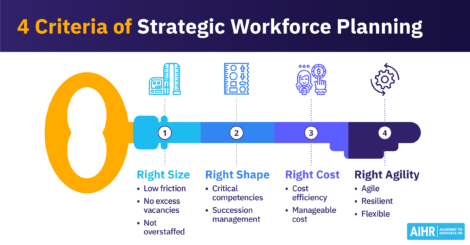
- Improve workforce planning discipline: BCG found that stronger strategic workforce planning capability helps organizations fill critical roles around 17 days faster. HR governance supports this by defining who owns workforce planning, how often leaders review talent needs, which roles are critical, and how to prioritize hiring, reskilling, and succession decisions.
- Guide work and AI-related changes: When leaders redesign roles or add AI to HR workflows, HR governance defines who approves the change, how HR assesses employee impact, and how the organization manages risk. Deloitte found that organizations redesigning work, roles, and human-AI collaboration are nearly 2.5 times more likely to report better financial results. HR governance helps leaders align role redesign and AI adoption with business goals while protecting fairness, compliance, and employee trust.
- Control legal, ethical, and reputational risk: Governance sets approval paths and controls for compliance, privacy, bias management, vendor oversight, and AI-supported decisions.
- Support responsible AI adoption: SHRM found that AI use in HR tasks rose from 26% to 43% in just one year. Governance helps ensure AI-enabled HR decisions include human oversight, transparency, and clear accountability.
HR governance framework to implement
When HR and business leaders use different rules for hiring, pay, skills, data, and workforce planning, decisions become harder to compare, explain, and improve. HR governance solves this by giving leaders one shared way to make and review workforce decisions.
Workforce planning is an example of why this matters. McKinsey’s HR Monitor found that only 12% of U.S. organizations plan their workforce over a three- to five-year horizon, while 32% of employees already lack the skills needed for their roles. Without clear governance, leaders can’t reliably connect today’s skills gaps with future hiring, reskilling, or succession decisions.
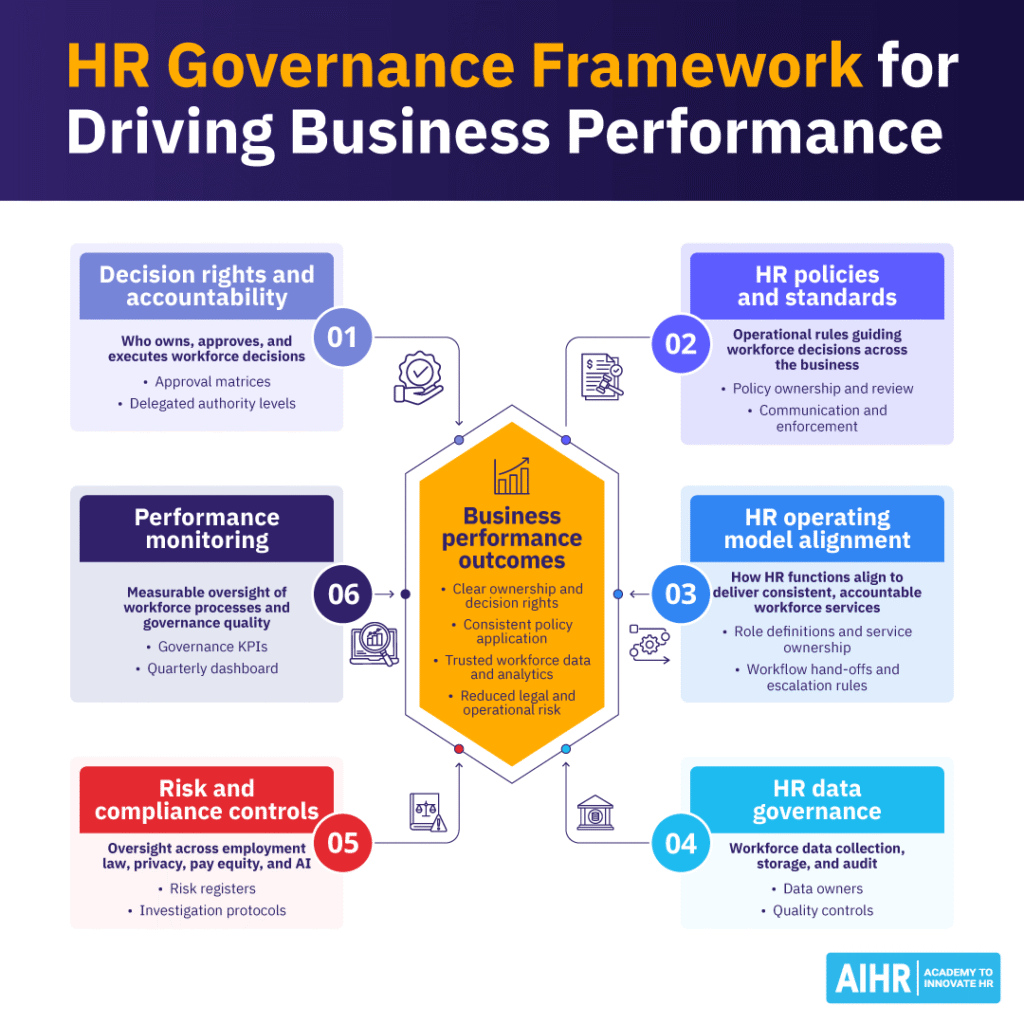
A practical HR governance framework defines who decides, what standards apply, what data leaders use, and when decisions need review or escalation. Here are the core elements to include:
Decision rights and accountability
Clear decision rights define who can make, approve, review, and challenge workforce decisions across the organization. They create consistency in areas such as hiring, pay, promotions, restructures, workforce planning, employee relations, and policy exceptions.
Strong accountability structures help organizations avoid duplicate approvals, inconsistent manager decisions, delayed escalation, and unclear ownership when issues arise.
Your framework should define:
- How the organization documents and reviews high-risk workforce decisions
- Who makes the final decision
- Which decisions require cross-functional review
- When leaders must escalate risks or exceptions
- Which teams oversee compliance, workforce data, and policy application.
Do this
Choose one high-risk workforce decision, such as a compensation exception, promotion, restructure, or employee relations case.
Map how the decision currently gets made, then simplify the process. Clarify:
- What information the manager or business leader must provide
- Who HR must consult before the decision moves forward
- Who gives final approval
- Which situations require review from Legal, Finance, or executive leadership
- How HR records the final decision and rationale.
Then test the process on the next similar decision and adjust any steps that create delays or confusion.
HR policies and standards
HR policies provide the operational rules that guide workforce decisions across the business. Governance ensures policies are consistently written, reviewed, approved, communicated, and applied across locations, workforce types, and business units.
An effective HR governance framework defines policy ownership, review schedules, version control, approval workflows, communication standards, and enforcement mechanisms. HR also helps managers and business leaders apply policies consistently in day-to-day workforce decisions. This makes it easier to identify where teams interpret policies differently or apply standards inconsistently.
Do this
Establish an annual policy review calendar with assigned owners, executive sign-off requirements, and documented communication plans for policy updates.
HR operating model alignment
A strong governance framework defines how the HR function works together to support consistent workforce decisions. It clarifies which teams or roles within the HR department own strategy, policy, service delivery, workforce data, compliance, and employee support.
Clear role boundaries help HR avoid duplicated work, missed handoffs, slow decisions, and inconsistent advice to the business.
Your framework should include role definitions, service ownership, workflow handoffs, escalation rules, and regular cross-functional reviews for workforce decisions and HR priorities.
Do this
Document end-to-end ownership for key HR processes such as recruitment, onboarding, performance management, employee relations, and workforce planning.
HR data governance
Workforce decisions rely on accurate, secure, and trusted HR data. Governance defines how workforce data is collected, stored, accessed, maintained, integrated, and audited across systems and teams.
Determine data owners, workforce definitions, access permissions, data retention schedules, quality controls, integration standards, audit trails, and reporting accountability. Strong HR data governance improves confidence in workforce analytics, succession planning, skills forecasting, and executive reporting.
Do this
Assign accountable owners for critical workforce datasets and establish quarterly data quality reviews across HR systems and reporting dashboards.
Risk and compliance controls
HR governance helps organizations manage workforce risk more consistently across hiring, pay, employee relations, workplace conduct, privacy, compliance, and AI-supported decisions. Clear controls help HR reduce legal exposure, improve documentation quality, and apply policies more consistently across teams and business units.
Your framework should define:
- How HR reviews high-risk workforce decisions
- Which issues require Legal, Compliance, or executive review
- What documentation managers and HR must maintain
- How HR handles investigations and policy violations
- Who can access workforce and employee data
- How the organization reviews AI-supported HR tools and external vendors.
Do this
Create a workforce risk register that tracks recurring HR risks such as pay equity issues, privacy breaches, policy violations, inconsistent hiring decisions, employee relations escalations, and AI-supported workforce decisions. For each risk, document the business impact, who monitors it, which controls already exist, when HR must escalate the issue, and how often the organization reviews the mitigation plan.
Performance monitoring
Governance frameworks require measurable oversight to ensure workforce processes operate consistently and effectively over time. Performance monitoring gives HR and business leaders visibility into operational quality, policy adherence, workforce risk, and service performance.
Include governance KPIs such as policy exceptions, audit findings, workforce data quality scores, HR service level agreements (SLAs), recruitment cycle times, approval turnaround times, compliance breaches, and employee case resolution metrics.
Do this
Create a quarterly HR governance dashboard reviewed jointly by HR leadership, risk teams, and business leaders.
Best practices for effective HR governance design
Effective HR governance is designed around how workforce decisions actually happen inside the organization. Many governance frameworks fail because they exist as policy documents rather than operational systems. Strong governance works inside everyday hiring decisions, workforce planning discussions, compensation reviews, performance conversations, employee data access requests, and AI-enabled workflows.
For HR, governance design is about creating decision-making structures that leaders can apply consistently under operational pressure. The goal is disciplined execution, reliable workforce data, clear accountability, and faster decision-making supported by defined controls.
Design governance around operational workflows
Governance becomes difficult to apply when approval processes, escalation rules, and decision ownership do not reflect how work actually moves through the business. Recruitment, workforce planning, promotions, restructures, and employee relations processes often involve multiple teams operating across disconnected systems and informal approval pathways.
Mapping operational workflows creates visibility into where decisions slow down, where accountability becomes unclear, and where workforce data moves between systems without oversight.
In practice
Many organizations discover that managers, HR, Finance, and Talent Acquisition use different hiring criteria, approval processes, and role definitions during recruitment decisions. Mapping the end-to-end workflow often exposes duplicated approvals, inconsistent role grading, and fragmented workforce reporting.
Assign single-point accountability for workforce decisions and data
Shared responsibility without defined accountability weakens governance quickly. Every workforce process, policy area, dataset, reporting process, and AI-enabled workflow requires a clearly accountable owner responsible for oversight, quality, risk management, and review.
This becomes increasingly important as organizations expand their use of workforce analytics and AI-powered HR technologies.
In practice
Separate who supports the process from who owns the standard. For example, HR may help business leaders plan headcount, but a designated HR leader should own the workforce planning process, data definitions, review cadence, and reporting quality. The same applies to compensation frameworks, employee data standards, and AI-enabled HR tools.
Standardize workforce data before scaling analytics and AI
AI-enabled HR systems amplify existing workforce data quality problems. Inconsistent job titles, incomplete employee records, duplicated workforce data, and weak reporting standards reduce the reliability of workforce analytics and AI-supported decision-making.
Governance frameworks should establish common workforce definitions, validation rules, reporting standards, retention schedules, and access controls across HR systems.
In practice
Many organizations invest heavily in data analysis tools and dashboards before resolving basic workforce data inconsistencies between payroll, recruitment, learning, and HRIS platforms. Governance works more effectively when data definitions and ownership rules are standardized before advanced analytics projects begin.
Introduce formal controls for HR technology and AI adoption
HR technology decisions increasingly carry legal, operational, ethical, and reputational risk. AI-enabled recruitment tools, workforce analytics platforms, employee monitoring technologies, and performance management systems all influence workforce decisions directly.
Governance frameworks should define how these technologies are reviewed, approved, monitored, audited, and escalated when issues emerge.
In practice
Leading organizations now involve HR, Legal, IT, Security, Procurement, and Risk teams before approving AI-enabled HR technologies. This creates stronger oversight around privacy obligations, discrimination risk, vendor accountability, workforce transparency, and human review requirements.
Build governance into cross-functional leadership routines
Workforce governance operates across multiple functions, including HR, Finance, IT, Legal, Operations, Risk, and executive leadership. Effective governance frameworks create recurring decision-making structures that support coordinated oversight rather than isolated functional reviews.
Cross-functional governance also improves the quality of workforce planning, skills forecasting, restructuring decisions, and enterprise transformation initiatives.
In practice
Organizations with mature HR governance often review workforce risks, workforce metrics, policy exceptions, and workforce capability trends through recurring governance forums rather than relying on ad hoc escalations after issues occur.
Measure governance effectiveness through operational outcomes
HR governance only works if leaders can see whether decisions happen consistently, risks get addressed, and processes run as intended. That requires a small set of practical metrics tied to speed, quality, consistency, and risk.
Track metrics such as:
- AI and technology oversight: How often HR reviews AI-supported decisions, data access, vendor performance, and bias risk.
- Decision cycle time: How long it takes to approve hiring, pay, promotion, restructure, and policy exception decisions.
- Policy exception rate: How often managers request exceptions, and which business units or regions request them most often.
- Escalation trends: Which issues HR escalates to Legal, Finance, Compliance, or executive leadership.
- Workforce data quality: How often key fields, such as job level, department, manager, location, and employment status, are complete and accurate.
- Audit and compliance findings: The number, severity, and repeat nature of issues found in HR audits or compliance reviews.
- Employee relations resolution time: How long HR takes to resolve cases, especially high-risk or repeated issues
- Compensation and pay equity indicators: Salary band exceptions, unexplained pay gaps, and out-of-cycle pay changes
In practice
Review these metrics quarterly with HR, Legal, Finance, and relevant business leaders. Focus on patterns that show where governance needs improvement, such as repeated policy exceptions, slow approvals, poor data quality, or recurring compliance issues.
Use the findings to update approval rules, clarify ownership, improve manager guidance, or add stronger controls where risk is increasing.
What governance is needed when using AI in HR?
Artificial intelligence is increasingly embedded across workplace systems, workflows, and workforce decision-making processes, including many functions traditionally managed by HR teams. For HR leaders and HRBPs, this creates an urgent governance challenge. AI is now influencing hiring, candidate screening, workforce planning, learning systems, employee engagement, promotion decisions, performance management, and employee support functions.
AI governance in HR is the set of rules, controls, accountability structures, and review processes that guide how these technologies are selected, implemented, monitored, and used within workforce decision-making. Strong governance creates transparency, protects employee trust, improves oversight, and reduces legal and operational risk.
AI in HR governance checklist
Effective AI governance in HR should include:
- Maintain a complete inventory of all AI tools and AI-enabled HR features used across recruitment, performance management, workforce planning, learning, engagement, employee support, and analytics systems
- Record the owner, vendor, business purpose, workforce data used, affected employee groups, and decision impact for every AI use case
- Conduct formal risk assessments before deployment involving HR, Legal, IT, Security, Data Privacy, Procurement, and operational business leaders
- Assess potential bias, discrimination risk, inaccurate outputs, workforce impact, employee trust implications, privacy exposure, and overreliance on automated recommendations before approving AI-enabled systems
- Require human oversight for all high-impact workforce decisions involving hiring, termination, promotion, compensation, disciplinary action, succession planning, and performance ratings
- Define exactly what human reviewers must evaluate before accepting or overriding AI-generated recommendations
- Establish clear escalation procedures when AI outputs appear inconsistent, discriminatory, inaccurate, or unsupported by workforce evidence
- Perform vendor due diligence before purchase and during contract renewals, including reviews of training data quality, bias testing, validation methods, explainability standards, privacy controls, cybersecurity protections, audit rights, and model update processes
- Inform employees and candidates when AI is used in workforce processes, including what decisions it influences, what workforce data it uses, and how individuals can request clarification or human review.
- Apply strict workforce data governance controls covering data minimization, access permissions, retention schedules, consent requirements where applicable, and restrictions on the use of sensitive employee information
- Connect AI governance directly to broader HR data governance frameworks so workforce data standards, reporting controls, audit trails, and privacy requirements remain consistent across systems
- Maintain detailed documentation showing why an AI tool was approved, what risks were identified, what controls were implemented, who reviewed outputs, and when the system was last assessed
- Conduct recurring audits to test AI outputs for bias, decision consistency, workforce impact, privacy compliance, and operational reliability over time
- Create governance review forums where HR, Legal, IT, Risk, and executive leadership regularly evaluate AI-related workforce risks, system performance, employee concerns, and regulatory developments
- Train HR teams, managers, and business leaders on how AI-supported workforce decisions should be interpreted, reviewed, challenged, and escalated within the organization’s governance framework
Wrapping it up
HR governance gives organizations the structure needed to manage workforce decisions consistently as operational complexity increases. It strengthens accountability, improves visibility across workforce processes, and creates clearer oversight across people, data, technology, and risk.
As organizations continue integrating AI into workforce systems and decision-making, governance is also becoming a critical part of how organizations maintain trust, transparency, and operational discipline across the employee lifecycle.