

HR costs can add up quickly through new tools, vendor contracts, hiring needs, and investments in employee development. A clear budget planning process supports HR cost optimization by showing where money goes, what creates value, and where you can make smarter spending decisions.
Contents
What is HR cost optimization?
How HR budget planning helps optimize costs
How to reduce HR costs without cutting value
How to use AIHR’s budget planning PDF for HR cost optimization
FAQ
What is HR cost optimization?
HR cost optimization is the process of reviewing HR spending and making sure each cost supports business needs, employee experience, compliance, or workforce performance.
It is not the same as cutting costs across the board. Cost-cutting often focuses on spending less. Cost optimization focuses on spending better.
For HR leaders, this means analyzing how the HR budget is used, what outcomes each cost supports, and whether there are better ways to achieve the same or better results.
For example, reducing HR costs could mean canceling an underused tool, combining vendor contracts, improving workforce planning to avoid urgent hiring costs, or automating repetitive admin work. It could also mean moving budget from low-impact programs to areas that better support retention, manager capability, or employee productivity.
Simply put, effective HR cost optimization helps you focus spending on the tools, programs, and services that have the clearest value for employees, managers, and the business.

How HR budget planning helps optimize costs
HR budget planning gives you the structure to understand, review, and manage HR costs before they become a problem.
Without a clear plan, HR spending can become reactive. Teams may approve new tools, training programs, or hiring support without checking whether they overlap with existing resources. Over time, this can create unnecessary costs and make it harder to explain HR’s budget needs.
A strong HR budget planning process helps you:
- See the full picture of HR costs: Break down spending across areas like recruitment, learning and development, HR technology, benefits, payroll, compliance, and employee engagement.
- Connect spending to business goals: Review whether each cost supports a clear workforce need, such as filling critical roles, improving retention, developing managers, or meeting compliance requirements.
- Plan ahead instead of reacting: Forecast future HR needs, such as hiring volume, training demand, or technology changes, so you can avoid rushed and expensive decisions.
- Compare cost and value: Look beyond the price of a program or tool. Ask what problem it solves, how often it is used, and whether it improves efficiency or outcomes.
- Make trade-offs more clearly: If your budget is limited, planning helps HR decide what to keep, pause, reduce, or redesign.
This is where HR budget planning connects directly to HR cost optimization. Budget planning shows where the money goes. Cost optimization helps you decide whether that spending still makes sense.
How to reduce HR costs without cutting value
Reducing HR costs does not have to mean reducing the quality of HR support. The best opportunities often come from improving processes, removing duplication, and focusing the budget on what works.
Here are practical areas to review:
- Audit your HR technology stack: Check which tools are used, which features overlap, and which platforms no longer meet your needs. If two systems solve the same problem, you may be able to consolidate.
- Review vendor contracts: Look at external providers for recruitment, training, payroll, benefits, employee surveys, and compliance support. Check renewal dates, usage levels, and whether each vendor still delivers value.
- Improve workforce planning: Better planning can reduce urgent hiring, reliance on recruitment agencies, and overstaffing. It also helps HR align hiring plans with real business demand.
- Reduce turnover-related costs: Replacing employees can be expensive. Review exit interview data, retention risks, manager capability, and internal mobility options to reduce avoidable turnover.
- Prioritize high-impact learning: Training budgets are easier to defend when programs support clear skills gaps or business needs. Pause or redesign learning programs with low attendance, unclear goals, or weak follow-up.
- Automate repetitive HR tasks: Use automation carefully for routine work, such as reminders, document collection, basic reporting, and onboarding workflows. This can free up HR time for more valuable work.
- Standardize recurring processes: Inconsistent processes can create hidden costs. Standard templates, workflows, and approval steps can reduce errors, delays, and rework.
The key is to avoid short-term decisions that create bigger problems later. For example, cutting manager training may reduce costs now, but it could lead to weaker performance conversations, lower engagement, or higher turnover.
A better approach is to ask: What can we stop, simplify, combine, or improve without reducing how we support employees?
How to use AIHR’s budget planning PDF for HR cost optimization
Use this PDF document as a practical tool to connect HR budget planning with cost optimization.
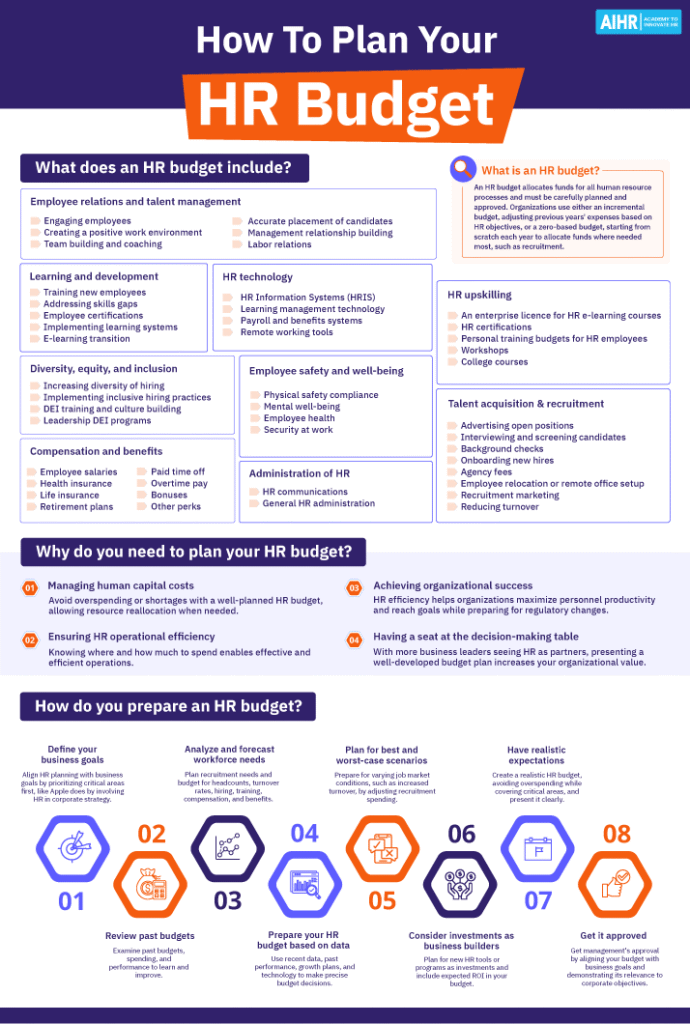
Start by mapping your main HR cost areas. These may include recruitment, learning and development, HR technology, compensation and benefits, employee relations, compliance, and HR administration, and other areas, depending on the type and size of your organization.
Then, review each cost area against the budget planning steps in the document. Look at past spending, current needs, future priorities, and expected outcomes. This will help you move from a general budget review to a more focused cost optimization process.
You can use AIHR’s budget planning PDF to:
- Structure your budget planning process: Follow the steps to review past spending, define priorities, estimate future costs, and prepare your budget request.
- Check whether key HR cost areas are covered: Use it to make sure you’ve considered areas like recruitment, learning and development, HR technology, compensation, benefits, and compliance.
- Prepare for budget conversations: The HR budget overview helps you explain what HR needs funding for and how those costs support workforce priorities.
- Create a more consistent planning approach: Use the steps in the PDF as a repeatable guide when preparing annual budgets, revising quarterly plans, or reviewing HR spend with stakeholders.
HR cost optimization helps HR leaders make stronger budget decisions, show the value of HR investments, and align spending with workforce and business priorities. By reviewing costs, planning ahead, and connecting HR spend to outcomes, you can build a more efficient HR function that stays focused on the programs, tools, and services that create measurable value.
FAQ
A typical HR budget varies by company size, industry, headcount, location, and HR operating model. HR can benchmark it year over year, per employee, as a percentage of operating costs, and by category, then use those comparisons to identify gaps, justify budget decisions, and adjust spending priorities.
The best ways to optimize HR costs include reviewing underused HR tools, consolidating vendors, improving workforce planning, reducing avoidable turnover, automating repetitive admin, and prioritizing learning programs that support clear business or workforce needs.
HR cost per employee varies by company size, industry, location, and HR service model. Recent SHRM data report a median HR-expense-to-FTE ratio of $2,479 per FTE. Use this as a comparison point, not a fixed target, and assess whether your HR costs match your workforce needs and service levels.