
Skills-based hiring is becoming important as job titles, career paths, and credentials no longer reliably predict performance. Traditional recruitment, which is often built around degrees, years of experience, and past job titles, is struggling to keep pace with the rapid evolution of skills and business models.
Many companies reported significant benefits from this shift: clearer hiring decisions, reaching more candidates, and stronger alignment between people’s capabilities and business outcomes. In practice, organizations apply skills-based hiring techniques across the entire employee selection process, most often during interviewing (87%) and screening (65%). They also create competency-based job descriptions (81%) and interview rubrics (58%).
This article explores why skills-based hiring matters now and provides a practical guide for HR and talent acquisition leaders to implement it responsibly and at scale.
Contents
What is skills-based hiring?
Why skills-based hiring matters now
Benefits of skills-based hiring
8-step skills-based hiring guide
Skills-based hiring best practices
Key takeaways
- Skills-based hiring works best when it’s treated as a system, not a single change. Clear skill definitions, structured evaluation, and shared standards matter more than any one tool or assessment.
- Focusing on evidence—not proxies—leads to better hiring decisions. Work samples, skills signals, and outcome-based criteria help teams assess what candidates can actually do, not just what’s on their résumé.
- Limiting must-have skills widens talent pools without lowering the bar. Separating essential skills from learnable ones helps recruiters move faster and access a more diverse, capable pool of candidates.
- The biggest payoff comes when hiring connects to internal mobility and development. Using the same skills language across recruiting, learning, and workforce planning makes skills data useful long after a role is filled.
What is skills-based hiring?
Skills-based hiring is a hiring approach that evaluates candidates based on demonstrated skills and competencies required for the job, rather than on proxies such as degrees, pedigree, prior titles, or years of experience. Put simply, organizations design the hiring process around the skills needed to deliver business outcomes.
This approach to hiring is defined by:
- Specific skill requirements (what someone must be able to do)
- Skill proficiency levels (how well they must do it)
- Measurable outputs or outcomes (what success looks like in practice).
Instead of relying on vague traits commonly listed on résumés (good communication skills, problem-solving, team player), recruiters use skills assessment tools to surface observable abilities such as “build an SQL query,” “run a structured interview,” or “manage a vendor budget.”
Skills-based hiring does not mean:
- Degree-free for all roles
- Ignoring experience but verifying capability
- Applying only to entry-level, it works for professional roles, too.
Many organizations face unprecedented skills shortages due to automation, digital transformation, and ever-changing business needs. To address this, they have adopted a skills-based mindset to compete, adapt, and innovate.
Defining work in terms of tasks and associated skills gives them a more flexible and accurate way to match people to outcomes. It also allows them to redeploy employees internally based on where their skills are most needed.
In such skills-based organizations, workforce planning becomes more data-driven, performance and rewards center on demonstrated skills and outcomes, and learning & development is geared towards building strategic competencies, not just training for roles.

Why skills-based hiring matters now
Skills-based hiring contributes to organizational goals by removing traditional educational requirements to hire people who can do the ‘actual’ work. As shifting labor markets, business needs, and candidate expectations converge, this approach helps organizations build workforces that are more adaptable, inclusive, and aligned with real performance requirements.
Here’s why businesses are adopting skills-based hiring practices:
- Labor-market reality: Job titles and career paths are less linear. Transferable skills matter more especially during a prolonged skills shortage. The World Economic Forum’s Future of Jobs identifies skills gaps as a top transformation barrier, alongside massive job creation (170 million new jobs by 2030), job displacements (92 million jobs), and rising demand for skills such as AI proficiency and creative thinking.
- Business impact: Clear definitions of required skills improve hiring accuracy by linking selection decisions directly to the work that needs to be done. When people are hired based on their ability to perform critical tasks, teams ramp up faster, performance becomes easier to assess, and workforce capability is better aligned with business priorities, strengthening the organization’s ability to compete.
- Candidate expectations: More people build skills through boot camps, certificates, apprenticeships, projects, or military experience. That contributes to why recruiters are omitting degree requirements from job postings. Indeed reported that a majority (52%) of U.S. job postings did not mention any formal education requirement. Similarly, recruiters on LinkedIn are 5x more likely to search by skills than by degrees.
- Workforce planning: Skills give a clearer view of gaps and future capability. WEF analysis shows that employers expect 39% of the core skills required in the workforce to change by 2030, reinforcing the long-term imperative for skills-centric hiring and development.
Skills-based hiring can unlock broader talent pools and better hiring outcomes. But to make it work in practice, your TA team needs the skills to redefine requirements, assess capabilities fairly, and align hiring decisions with business needs.
AIHR’s Talent Acquisition Boot Camp prepares your TA team to:
✅ Translate business needs into effective talent acquisition strategies
✅ Apply structured, skills-focused sourcing and selection methods
✅ Act as true talent advisors to hiring managers
✅ Use hiring data to improve quality-of-hire, equity, and long-term performance.
🎯 Develop your TA team for long-term hiring impact!
Benefits of skills-based hiring
Skills-based hiring offers a broader range of benefits beyond recruitment, shaping future business decisions:
Better quality of hire
In a skills-based hiring process, candidates prove their capability with work samples, assessments, and structured interviews. That way, new hires meet the job’s demands from the get-go. It cuts performance risk and ramp-up time. Kelly reported that companies using skills-based hiring cut mis-hires by 88% by evaluating what candidates can actually do, not just what’s on their résumé.
Wider talent pools
Skills-based hiring applies fewer unnecessary degree filters, resulting in better access to non-traditional candidates. By removing educational barriers, you can build a more diverse pool of candidates who may be just as capable as degree-qualified peers.
Faster hiring over time
Clearer job requirements reduce back-and-forth and late-stage misalignment. Once skill criteria are standardized, recruiters and hiring managers spend less time debating fit and more time evaluating the skills required to perform the role. Kelly also found that skills-based approaches save employers $7,800-$22,500 per role by catching mismatches early and shortening recruitment cycles.
More consistent decisions
Structured, skills-led criteria reduce “gut feel” bias. Using structured interviews and skill assessment tools creates a shared standard for evaluating candidates across roles and teams.
Improved internal mobility
Employees can move within the organization based on skill match, not job title history. Clear skills visibility makes it easier to identify internal talent for new roles, projects, or stretch assignments. This makes promotion decisions more objective by focusing on performance rather than tenure or visibility.
Stronger workforce planning
Skills data helps forecast gaps and training needs. By aggregating skills data across roles and teams, HR can anticipate scarce capabilities and align hiring and L&D investments with future demand.
Higher retention
Better role fit reduces early turnover. When you know what to expect from new hires, you are more likely to decrease employee dissatisfaction and turnover rate. According to TestGorilla, 65% of employers found that candidates hired through talent assessment stay longer in the role.
8-step skills-based hiring guide
Implementing skills-based hiring requires a shift in how organizations think about talent, performance, and potential. Prioritizing demonstrated capability over job titles and credentials changes how teams scope roles, evaluate skills, and connect hiring decisions to real business needs.
This eight-step skills-based hiring guide translates that shift into practical actions HR and talent acquisition teams can apply across the hiring process.
1. Choose roles to pilot
Piloting a skills-based recruiting program allows you to identify bottlenecks without overloading the hiring teams or disrupting the entire organization.
Start where success is measurable, and requirements are skill-heavy (e.g., customer support, sales development, analysts, IT support). At the beginning, avoid roles with less well-defined outputs and complex success criteria unless there’s urgency. Establish KPIs to track, such as quality of hire, time to hire, and new hire turnover rates.
Once you have the pilot results, compare them with traditional hiring methods to assess the effectiveness of the skills-focused approach.
2. Standardize skills, language, and definitions
Within the organization, align on a shared skills taxonomy so the same skill means the same thing across roles and teams. Define skill categories, names, descriptions, proficiency levels, and observable indicators in plain language. Document them in a central reference so everyone can access them.
This prevents duplication, reduces confusion during hiring, and ensures skills data can be reused for assessments, learning pathways, and internal mobility, not just recruitment.
3. Define the skills for each role (the minimum viable skill set)
Separate must-haves from nice-to-haves. Must-haves are the essential competencies a candidate should possess to do the job effectively. Nice-to-haves are valuable additions that enhance a candidate but aren’t considered deal-breakers.
Skills should include technical skills, soft skills (behavior-based), and role-specific knowledge. You should also define required proficiency levels. The skills you define should be observable, or the candidate must display behaviors that validate the respective skill level.
For example, for a data analyst role, the must-have skills are SQL (working level), data interpretation, and stakeholder communication, while treating tools like Python or Tableau as learnable, not gatekeeping requirements.
4. Rewrite job descriptions around skills and outcomes
When writing job descriptions and job posts, replace degree or years of experience with skill requirements and measurable outcomes. Add a ‘how you’ll be evaluated’ section, explaining that candidates will do assessments, structured interviews, or be asked to provide work samples.
Connecting skills to outcomes enables HR and talent acquisition teams to confidently prioritize candidates who will help the company achieve its objectives.
Instead of listing “problem-solving” on the job description, write down “resolve customer issues accurately within SLA while maintaining high customer satisfaction”.
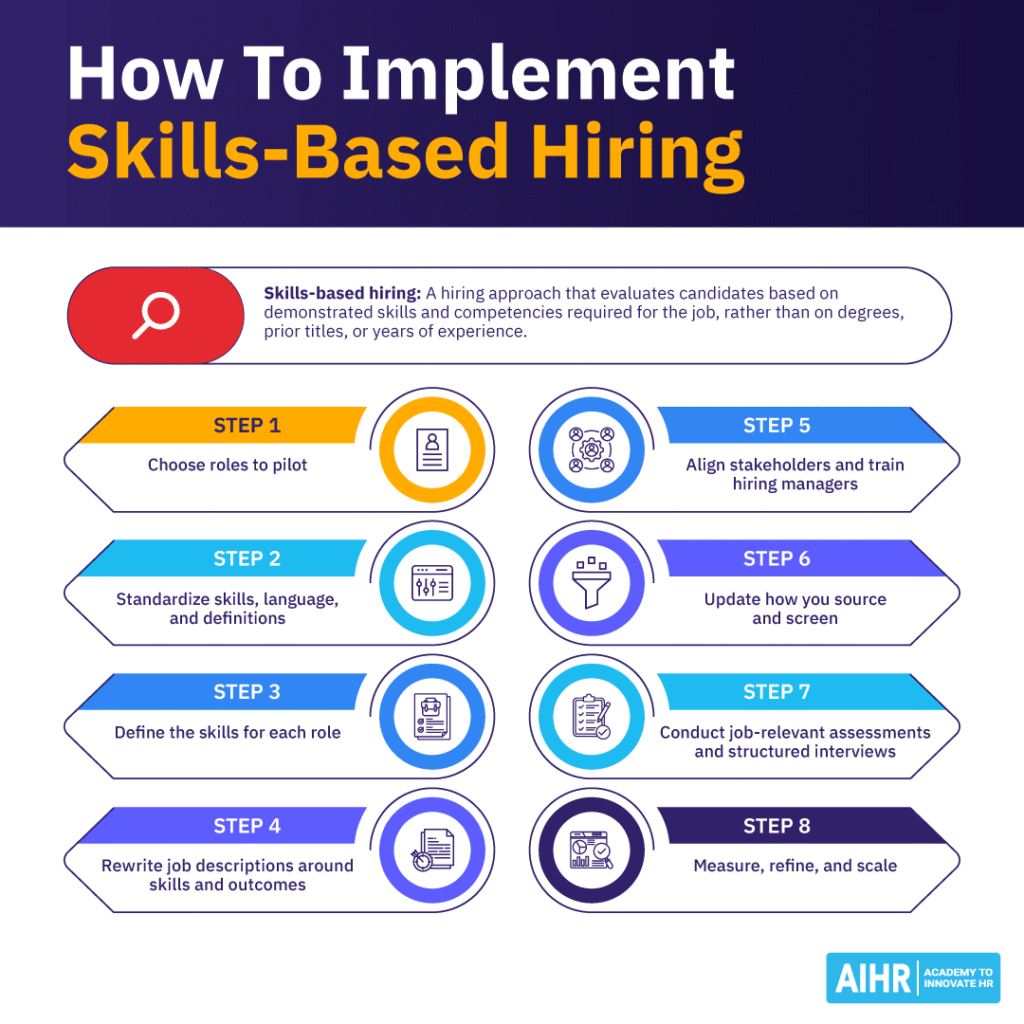
5. Align stakeholders and train hiring managers
Train the recruiting team and hiring managers to assess skills using evidence (work samples, assessments, and structured interviews), rather than relying on résumés, credentials, or past job titles.
For example, you can run a short calibration workshop within the hiring team. In this workshop:
- Define what counts as evidence
- Plan the type of questions to ask: behavioral or scenario-based
- Choose the right assessment tool that accurately measures the skills needed for the position.
Continue by creating a scoring process before sourcing begins. Before opening a role, HR/Talent Acquisition and the hiring manager should agree on what will be evaluated and how it will be scored before any résumés are reviewed.
Design a skills-based hiring guide on avoiding bias during the selection process, focusing on how decisions are made and interview guidance. Document final decisions, including which skills influenced the outcome.
6. Update how you source and screen
Screen for evidence of skills: portfolios, projects, certifications, quantified results, case narratives. Evidence shows that a candidate not only listed skills but also actively applied them to produce results. It’s also effective in predicting their future performance based on their past accomplishments.
For example, when screening for an entry-level UX role, recruiters may agree to treat portfolio work, community projects, or documented design challenges as valid signals of skill. Candidates who demonstrate these signals progress in the process, regardless of where the experience was gained.
You can also use knock-out questions based on true must-have skills (sparingly). These types of questions focus on whether the applicant has the necessary license, technical proficiency, or legal requirements for employment.
7. Conduct job-relevant assessments and structured interviews
Use work samples, case tasks, simulations, or skills tests that match the role. These assessments allow candidates to demonstrate their actual ability to perform job-specific tasks in a real-world or simulated environment.
Use structured interviews with consistent questions and scoring rubrics. Ask scenario-based questions to assess problem-solving skills. To evaluate communication and collaboration skills, ask behavioral questions. Each skill should be scored on a pre-defined scale.
For example, when hiring for a business development position, every candidate answers the same 6 questions (objection handling, call structure, prioritization). Interviewers score each answer on a 1–5 rubric tied to outcomes (e.g., “can progress a skeptical prospect to the next step”). This ensures candidates are evaluated against the same criteria from the start, rather than being compared subjectively.
8. Measure, refine, and scale
Track quality of hire signals (new hire performance, ramp time, retention), pass-through rates, and candidate experience. These metrics define whether the recruitment process is successful or needs improvement.
Improve the skill definitions, assessments, and scorecards before expanding to more roles. This helps ensure candidates are accurately assessed for roles critical to achieving business goals.
Skills-based hiring best practices
Skills-based hiring works best when organizations apply it consistently and with clear intent. The following best practices highlight how HR and talent acquisition teams can design skills-based hiring approaches that are practical, fair, and aligned with real business needs.
Choose realistic work samples over brain teasers
Work samples simulate real job tasks and give proof of how candidates perform under realistic conditions.
For instance, for a customer success specialist role, candidates complete a 30-minute ticket-resolution simulation. Recruiter scores them with a rubric tied to SLA adherence and empathy indicators.
Reduce bias with ‘evidence rules’
Evidence rules explicitly define what counts as valid proof of skill or capability in the hiring process, such as work samples, structured interview responses, or task-based assessments.
Without these rules in place, hiring decisions often default to familiarity or intuition. Interviewers may unconsciously favor candidates who share the same background or attended the same school rather than their work samples or interview responses.
Connect hiring to internal mobility
When hiring is based on explicitly defined skills, organizations gain a clearer view of the capabilities they already have. This makes it easier to identify internal employees whose skills match open roles, reducing unnecessary external hiring and shortening time to fill.
Using the same skills framework for both hiring and internal movement helps create consistency across talent decisions.
To sum up
Skills-based hiring shifts the recruitment process from titles, degrees, and tenure to evidence of actual capabilities tied to results. Clear skill definitions, structured evaluation, and documented evidence make hiring fair, repeatable, and defensible. It should be built systematically so it doesn’t collapse back into subjective judgment.
Skills-based hiring becomes valuable when it connects to internal mobility, learning, and workforce planning. It’s important to start small, standardize early, and refine continuously to build momentum without overwhelming teams. Skills-based hiring sets clearer expectations and supports more confident, evidence-based business decisions.