Annual Human Resources salaries can vary greatly, from entry-level roles earning under $50,000 to executive HR leaders earning well into six figures. In fact, depending on specialization and seniority, yearly HR salaries can differ by over $200,000 across the profession.
What’s driving this gap? The HR function has expanded beyond administrative support and into business partnering. HR professionals now influence workforce strategy, digital transformation, culture, compliance, and business performance. As companies rely more on people data, AI-driven tools, and strategic workforce planning, compensation has had to keep up.
This article combines trusted compensation benchmarks with Revelio Labs’ labor market insights to show how much HR roles pay this year, what drives pay differences and trends, and how to maximize your earning potential using a clear, skills-based HR career path.
Key takeaways
- HR pay in 2026 can vary by more than $200,000 a year, largely based on specialization, seniority, and how directly the role drives business results.
- Don’t compare ‘HR salary’ as one number — separate base pay from total compensation, and check what each data source includes and how it estimates pay.
- Use salary ranges as guidance, not guarantees, and weigh role progression, domain choice, and market demand (some mid-level specialist roles out-earn broader senior roles).
- To increase your pay, pick a target next role, build the three skills that role requires through applied projects, and negotiate using measurable impact, not job titles
Contents
What’s a Human Resources salary (and why do you see different numbers)?
Human Resources salary by role and seniority
HR salary by specialization
How to increase your Human Resources salary

What’s a Human Resources salary (and why do you see different numbers)?
An HR salary isn’t a standalone number, and misunderstanding this can cause confusion when researching HR pay. An HR salary typically includes two main components — base pay (the salary you receive from your employer) and total compensation (your base pay plus bonus, benefits, equity, and other incentives your company may offer).
In senior or more specialized HR roles, total compensation can exceed base pay by 20% to 40%, particularly if bonuses, long-term incentives, or equity are involved. When researching salary data, you’ll often see different numbers depending on where you look. That’s because each data source measures salary differently. Some of these sources include:
- Bureau of Labor Statistics (BLS): Reports occupational wage stats (e.g., HR Specialists) from survey data across employers nationwide.
- Glassdoor and Salary.com: These sites model compensation using user-submitted data, often reporting typical ranges (25th to 75th percentile).
- Revelio Labs: Uses AI-powered modeling over large datasets to estimate salaries at scale.
The salary figures you’ll see in this article are based on AIHR’s HR Career Map insights, which are powered by Revelio Labs’ labor market data.
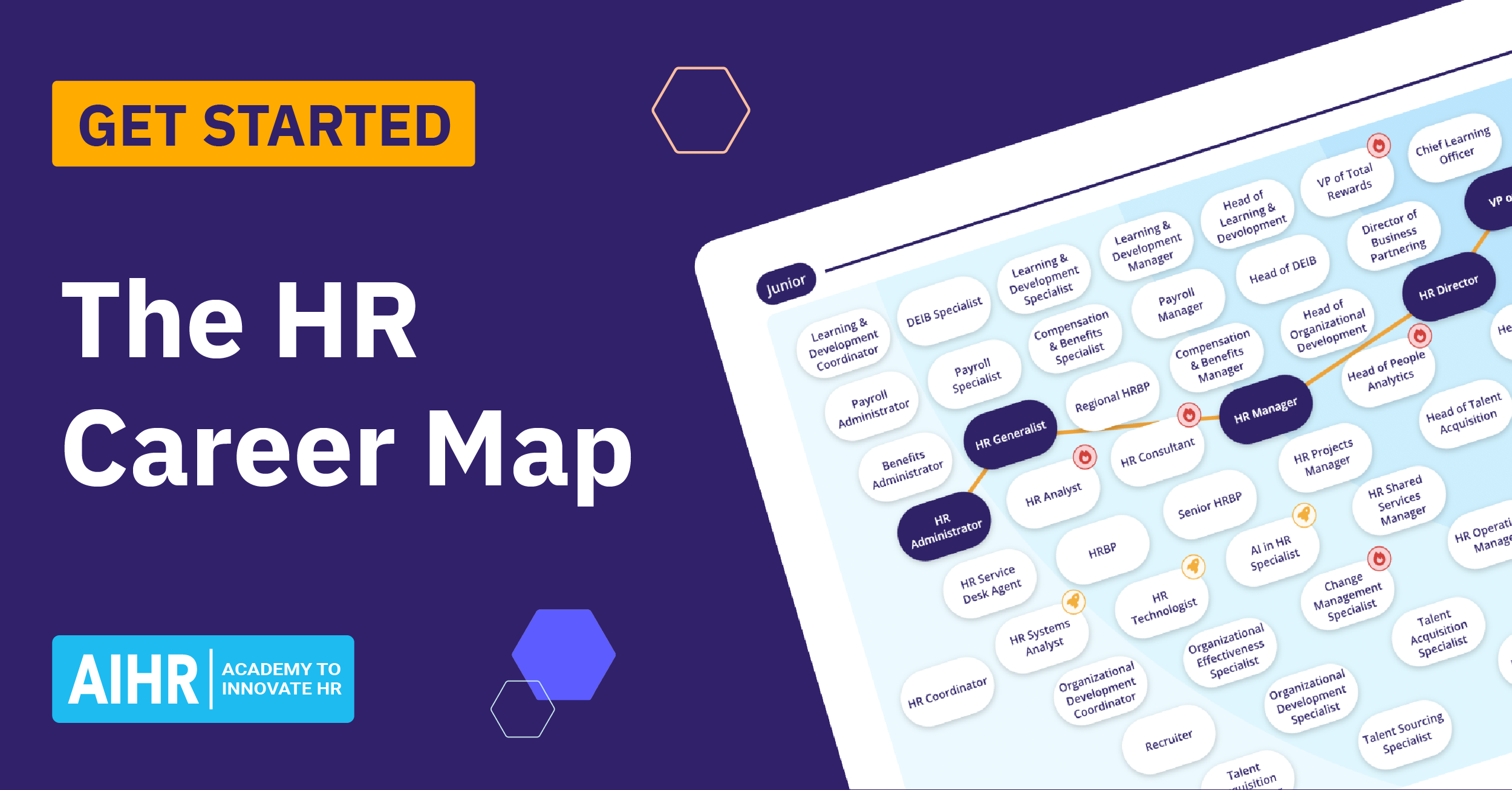
Map out your HR career path with AIHR
A higher salary is a great reason to further your HR career, but that’s just one of the advantages to plan ahead. With AIHR’s HR Career Map, you can:
✅ Explore possible HR career paths and get accurate salary insights
✅ Identify HR roles that best match your interests and ambitions
✅ Understand which skills and qualifications you need for your next move
✅ Plan practical next steps to progress further in your HR career path
Human Resources salary by role and seniority
One mistake HR professionals sometimes make is treating salary tables as promises rather than general information. These ranges represent typical earning potential across industries, but individual salaries vary based on location, company size, and business complexity. Treat them as decision-making tools, rather than guarantees of salary scope.
Here’s how to use this information effectively:
- Look at role progression, not just pay jumps. Moving from HR Generalist to HRBP, for instance, would likely lead to higher compensation and visibility.
- Compare domains at the same seniority level. A mid-level People Analytics role may out-earn a senior HR Operations role.
- Track demand signals. Roles with high or growing demand tend to see faster salary growth over time.
HR salary ranges by role and seniority (USD)
The table below shows HR salary ranges by role and seniority, alongside the level of demand and required education and experience per role. Salary ranges reflect 25th to 75th percentile estimates, which helps reduce confusion around averages and outliers.
| Role | Seniority | Salary range | Level of demand | Required education / qualifications |
| HR Administrator | Entry-level | $47,000 to $61,000 | Medium | Bachelor’s degree in HR, Business, or related field |
| HR Coordinator | Entry-level | $48,000 to $60,000 | Medium | Bachelor’s degree in HR, Business Administration, or related field |
| HR Assistant | Entry-level | $40,000 to $55,000 | Medium | Bachelor’s degree or HR certification |
| Benefits Administrator | Entry-level | $64,000 to $85,000 | High | Bachelor’s degree in HR, Finance, or Business |
| HR Generalist | Mid-level | $60,000 to $75,000 | Medium | Bachelor’s degree; HR certification preferred |
| HR Analyst | Mid-level | $96,000 to $128,000 | Very high | Bachelor’s degree in HR, Analytics, or Business |
| Talent Acquisition Specialist | Mid-level | $67,000 to $89,000 | Medium | Bachelor’s degree, with recruiting experience |
| HR Business Partner | Mid- to senior level | $81,000 to $95,000 | Medium | Bachelor’s degree, with business-facing HR experience |
| HR Consultant | Mid- to senior level | $123,000 to $158,000 | Very high | Bachelor’s degree, with consulting or advisory experience |
| HR Manager | Mid- to senior level | $97,000 to $131,000 | Low | Bachelor’s degree, with people leadership experience |
| People Analytics Manager | Mid- to senior level | $95,000 to $135,000 | High | Bachelor’s degree, with analytics expertise |
| Compensation & Benefits Manager | Mid- to senior level | $120,000 to $211,000 | Very high | Bachelor’s degree, with compensation specialization |
| HR Technology Manager | Mid- to senior level | $85,000 to $125,000 | High | Bachelor’s degree, with HRIS expertise |
| Change Management Specialist | Mid-career | $134,000 to $207,000 | Very high | Bachelor’s degree with change or OD background |
| AI in HR Specialist | Mid-career | $92,000 to $115,000 | High | Bachelor’s degree, with AI/data skills |
| HR Director | Senior | $100,000 to $170,000 | High | Bachelor’s degree, with senior leadership experience |
| People Analytics Director | Senior | $120,000 to $160,000 | Growing | Bachelor’s or Master’s degree |
| Chief Learning Officer (CLO) | Executive | $103,000 to $192,000 | Lower | Bachelor’s or Master’s degree |
| VP of Human Resources | Executive | $150,000 to $260,000 | High | Bachelor’s degree, with executive HR experience |
| CHRO | Executive | $233,000 to $269,000 | Lower | Bachelor’s or Master’s degree |
* Education and experience requirements are indicative. Refer to AIHR’s guide to Human Resources roles for detailed pathways.
HR salary by specialization
Specialization often drives pay. HR professionals at the same seniority level can earn very different salaries, depending on their HR focus. For example, a mid-level HR Analyst or AI in HR Specialist may out-earn an HR Manager with broader but less specialized responsibilities.
HR salary ranges by specialization (ranked by earning potential)
The table below ranks HR domains by earning potential.
| HR domain | Role examples | Level of demand | Salary range | Why it pays | Skills needed to increase pay |
| Executive HR leadership | CHRO, VP of HR | High | $233,000 to $269,000 | Strategic influence on enterprise outcomes | Strategy co-creation, analytics translation, executive presence |
| Talent management and org development | CLO, Change Management Specialist | High | $103,000 to $206,000 | Drives performance, transformation, and capability | Change navigation, culture, digital adoption |
| HR strategy and business partnering | HRBP, HR Consultant | Mid to high | $80,000 to $120,000 | Aligns people strategy to business goals | Business acumen, workforce planning |
| People analytics and digital HR | HR Analyst, AI in HR Specialist | Growing | $92,000 to $135,000 | Data-driven decisions increase impact | Analytics, digital aptitude, problem solving |
| Compensation and benefits | Benefits Admin, C&B Manager | High | $64,000 to $140,000 | Direct impact on retention and cost control | Analytics, risk mitigation |
| Talent acquisition | Recruiter, TA Specialist | High | $65,000 to $110,000 | Revenue impact through hiring | Sourcing, candidate experience |
| HR operations | HR Generalist, HR Coordinator | Medium | $45,000 to $82,000 | Broad operational support | HRIS, compliance, communication |
The bottom line? HR pay typically increases the fastest when you move across domains, instead of job titles.
Why certain HR specializations pay more
Not all HR work is valued equally by organizations, and compensation reflects this reality. Higher-paying HR domains tend to share the following three characteristics:
- Direct impact on revenue, cost, or risk: For instance, compensation and benefits (C&B) influence cost control and retention, while talent acquisition (TA) affects time to hire and revenue speed.
- Scarcity of skills: People analytics, AI in HR, and change management require hybrid skill sets that are harder to find and hire for.
- Strategic decision-making authority: HRBPs, HR Directors, and executives influence leadership decisions, not just execution.
Understanding these drivers helps you reverse-engineer your career toward advanced or higher-value work.
How to increase your Human Resources salary
How can you increase your HR salary? The answer lies in intentional career progression. Here are some relevant steps and actions you can take:
Pick a target role
Select your current role and intended next role using the AIHR’s HR Career Map. Focus on:
- Salary ranges (25th to 75th percentile)
- Required skills
- Typical career paths.
Doing so clarifies what you’re working toward and what’s preventing you from reaching your career goals.
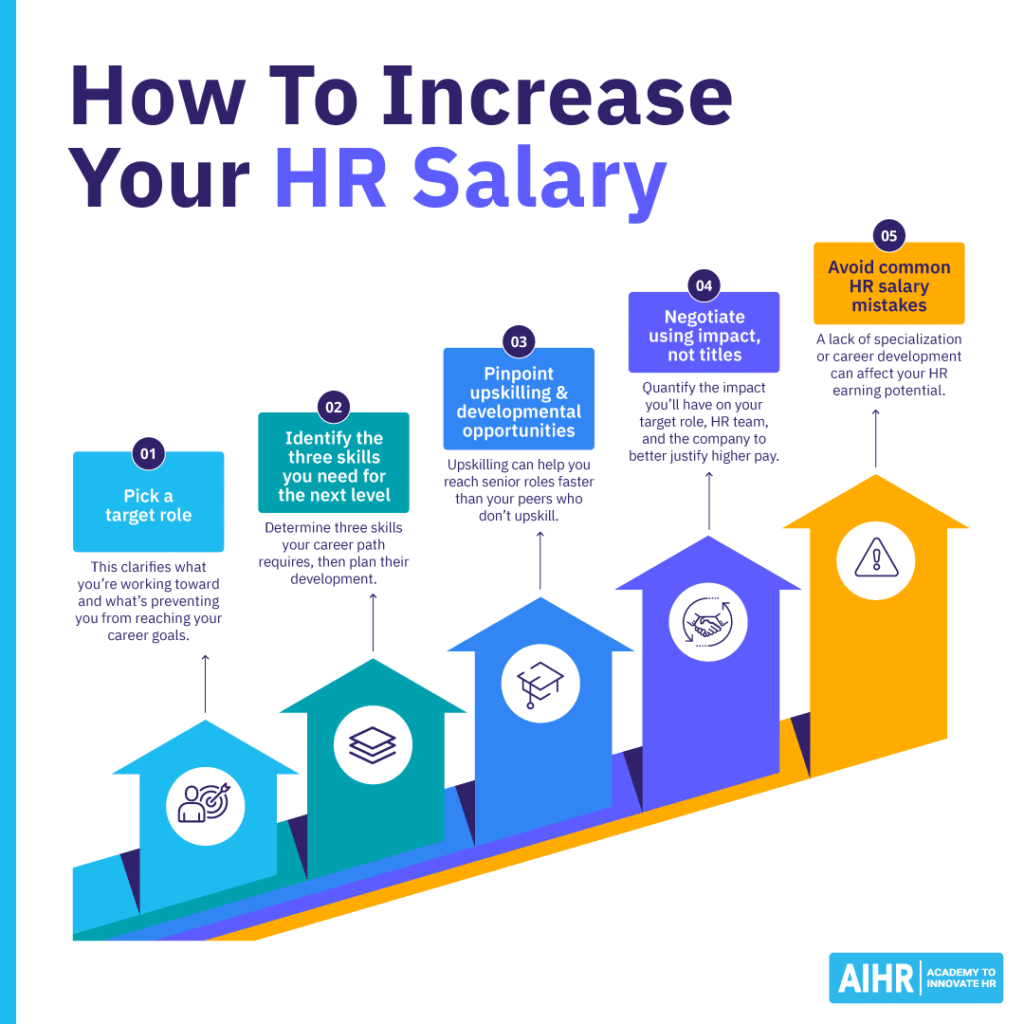
Identify the three skills you need to unlock the next level
You’ll need certain skills to advance to the next stage of your HR career; these will differ according to your specific career path. Below are some examples of the required skills for different HR career paths:
- HR Generalist → HRBP: Business acumen, workforce planning, and change leadership.
- HR Manager → HR Director: Strategic thinking, analytics fluency, and executive communication.
- HR Analyst → People Analytics Manager: Data analysis and storytelling, stakeholder influence, and tool proficiency.
Once you’ve identified the skills you need to progress, you can plan their development. For instance, if you plan to move from an HR Analyst to a People Analytics Manager role, you can start by strengthening your data analysis and storytelling by building a quarterly insights report.
Then, you can sharpen stakeholder influence by presenting recommendations to HR and business leaders. Finally, improve tool proficiency by getting hands-on with your core analytics platforms and automating a recurring dashboard.
HR tip
If your company pays any salaries above or below the market rate, or makes any other exceptions to its compensation philosophy, be sure to document it. Making a record of business decisions regarding pay, including any compensation outliers, will help your case if you ever want to ask for a raise or challenge a pay decision.
Pinpoint upskilling and developmental opportunities
Structured learning helps you focus better and move faster without random skill-building. To achieve this, you must:
- Choose learning aligned to your target role or domain
- Prioritize applied projects over theory
- Seek mentors already working one level above you.
HR professionals who intentionally upskill can often reach senior roles faster than those who don’t. Explore learning paths in AIHR’s HR Career Hub and AIHR courses to build sustainable HR and business skills.
Negotiate using impact, not titles
When negotiating compensation, use the following actions to increase your chances of success:
- Use market data as context
- Highlight business outcomes (retention, cost savings, efficiency, engagement)
- Negotiate total compensation and not just base pay.
If you can use your existing expertise and experience to quantify the impact you’ll likely have on your target role, HR team, and the company on the whole, you can better justify earning higher pay.
Avoid common HR salary mistakes
Many HR professionals unintentionally cap their earning potential. To prevent this, avoid these common mistakes:
- Staying too long in generalist roles without specialization
- Avoiding analytical or technological skills development
- Assuming loyalty automatically leads to raises
- Waiting for promotions instead of positioning for them.
These factors can affect your long-term earning power. While experience can help you draw a higher salary, enriching yourself with new skills and building on existing skills will increase your chances of earning more.
In summary
A Human Resources salary this year reflects both the complexity and strategic importance of the HR profession. While entry-level roles generally pay $40,000 to $60,000 a year, specialized and leadership roles can pay over $200,000 a year, especially in analytics, digital HR, and executive leadership.
By using AIHR’s HR Career Map insights, powered by Revelio Labs, you can move beyond averages, identify high-impact career paths, and focus on the skills that can help unlock higher pay. With the right strategy, HR can be a purpose-driven and highly lucrative career. Explore AIHR’s HR Career Hub to map your next role, skills, and salary potential.