
HRCI (HR Certification Institute) has been the standard-bearer for HR credentialing for over 50 years. With eight globally recognized certifications, NCCA accreditation for most of those credentials, and over 500,000 professionals certified throughout its history, HRCI has earned its reputation as the premier organization for validating HR expertise. Whether you’re an entry-level professional or a senior HR leader, HRCI offers a credential designed to formalize your knowledge and boost your career.
Based on a thorough review of everything HRCI offers, it’s the right fit if:
- You want a globally recognized credential to validate your HR knowledge
- You work in a compliance-heavy or regulation-focused HR role
- You need a tiered certification that matches your career stage
- You value NCCA-accredited credentialing with a 50-year track record
- You want a certification held by HR leaders in over 95% of Fortune 500 companies.
HRCI certifications are designed to validate existing knowledge. In other words, they test what you already know and credential you accordingly. While HRCI has expanded its learning offerings in recent years, its core strength remains credentialing. For deeper, continuous skill-building and practical application across modern HR competencies, a dedicated learning platform can round out your professional development.
This is where AIHR (the Academy to Innovate HR) comes in. As an approved provider with HRCI, AIHR offers 16 certificate programs and 85+ courses covering modern HR competencies like people analytics, business partnering, and AI in HR. The skills you build through AIHR can help you prepare for HRCI certification, and once certified, AIHR courses earn you the recertification credits you need to maintain your HRCI credentials.
Contents
What is HRCI?
HRCI pros & cons
HRCI review: How it offers & key features
What HRCI covers and what it doesn’t
Building on your HRCI credentials with AIHR
HRCI and AIHR: An overview
What is HRCI?
HRCI is an independent credentialing organization with over 50 years of history, offering eight globally recognized HR certifications that validate technical HR knowledge, laws, regulations, and compliance. The acronym also represents the organization’s core values: Human-centered, Responsibility, Collaboration, and Innovation.
HRCI was founded in 1973 through a collaborative effort by leaders within the American Society for Personnel Administration (now SHRM). The motivation was clear: as the HR profession grew in complexity, there was a need for a formal way to validate the skills and knowledge of practitioners. The first HR certification exams were administered in 1976. HRCI and SHRM operated as close partners for nearly four decades before parting ways in 2014, when SHRM launched its own certifications.
Today, HRCI operates as a non-profit organization based in Alexandria, Virginia, with over 126,000 active certification holders across more than 100 countries. The organization offers eight certifications spanning entry-level to senior executive roles, including specialized credentials for international HR and California-specific regulations. Most certifications are accredited by the National Commission for Certifying Agencies (NCCA), and according to HRCI, they’re the only HR certification body that seeks and maintains this third-party quality assurance.
HRCI’s core focus is on the technical and operational aspects of HR: laws, regulations, compliance, and policy implementation. The typical HRCI candidate is an HR professional at any career stage who wants to validate their expertise, gain credibility with employers, and demonstrate a commitment to the profession’s standards.
HRCI pros & cons
Pros | Cons |
✅ Eight certifications covering diverse career paths | ❌ Exam fees range from $400 to $595, , with prep materials representing a significant additional cost on top |
✅ 50+ year track record with global recognition | ❌ Certification exams test knowledge rather than build hands-on skills |
✅ NCCA-accredited certifications (seven of eight credentials) | ❌ Heavily U.S.-focused content for some certifications, which may be less relevant for HR professionals in other countries |
✅ No annual membership fee required to access the community | ❌ Recertification every 3 years adds ongoing costs |
✅ Professionals in 95%+ of Fortune 500 companies hold HRCI credentials | ❌ Limited free preparation materials compared to some competitors |
✅ Salary data suggests a premium for certified professionals | ❌ Some exam takers report a disconnect between official study materials and exam content |
HRCI review: How it offers & key features
Broad certification portfolio covering different career stages
HRCI’s certification suite is structured to align with different experience levels and professional focuses.
At the entry level, the Associate Professional in Human Resources (aPHR) requires no prior HR experience, making it accessible to career changers and recent graduates. The Professional in Human Resources (PHR) targets operational HR professionals focused on program implementation and U.S. laws, requiring one to four years of experience, depending on education level.
For senior professionals, the Senior Professional in Human Resources (SPHR) is designed for those involved in strategic planning and policy-making, with experience requirements ranging from four to seven years based on the role. The Global Professional in Human Resources (GPHR) serves professionals managing HR operations across multiple countries.
HRCI also offers international versions: the aPHRi, PHRi, and SPHRi for professionals practicing outside the United States, and the Professional in Human Resources, California (PHRca) for those navigating the state’s complex labor regulations. This breadth of options is broader than SHRM’s two-certification model (SHRM-CP and SHRM-SCP), providing more targeted credentialing paths.
The exams are competency-based, featuring scenario-driven questions that assess both knowledge and decision-making ability. Content is developed from HRCI’s Body of Knowledge (BoK) with input from hundreds of HR volunteers worldwide. Exams are administered through Pearson VUE testing centers or online proctoring.
Learning Center with on-demand HR courses
The HRCI Learning Center serves as a centralized hub for continuing education, offering more than 220 courses across topics like talent acquisition, compensation, leadership, diversity and inclusion, and ethics.
The platform is designed primarily to support recertification, with courses qualifying for HRCI recertification credits.
Courses are self-paced and accessible on computers, tablets, and smartphones, with 180-day access windows after purchase. The catalog includes individual courses, Pro Series courses for deeper expertise in specific areas, and recertification bundles for convenience. Topics range from core HR functions to emerging areas like cybersecurity and AI. The platform also includes features like a keyword search, filtering by topic, and certificates of completion upon finishing a course.
To claim credits for Learning Center courses, certificants need to record the Activity ID from each completed course in their HRCI online profile as part of the recertification submission process.
It’s worth noting that while the Learning Center has expanded to include advanced offerings like the Pro Series (covering topics such as AI for HR and people analytics), the majority of courses are oriented toward recertification support and foundational knowledge updates rather than deep, hands-on skill-building.
HRCI ENGAGE & Community provide free global platform for connection and knowledge sharing
Launched in early 2025, HRCI ENGAGE is a free online community for HR professionals worldwide.
The platform includes Community Spaces organized by geography and business vertical, an HR job board, and video events featuring webinars and live chats with industry experts. While HRCI describes it as open to the broader HR community, access for non-certified professionals may be subject to HRCI authorization.
HRCI also hosts webinar series covering topics like remote work, talent development, and workplace culture. The community has attracted members from all over the world. Additionally, HRCI recently launched HRCI CHAT, an AI-powered assistant designed to support HR workflows, and has formed strategic partnerships with organizations like Deloitte and WorldatWork to expand its educational offerings.
Recertification management
All HRCI certifications are valid for three years, after which professionals must recertify.
The primary method involves earning recertification credits through professional development activities. The PHR, SPHR, and GPHR require 60 credits, while the aPHR and aPHRi require 45. Since January 2021, all certificants must also complete at least one ethics-focused credit.
HRCI provides an online profile where certificants can record their activities and track progress toward recertification. Credits can be earned through various activities: attending conferences, completing approved courses like the ones from AIHR, on-the-job achievements, and professional memberships. HRCI maintains a searchable directory of pre-approved providers, and courses from these providers come with Activity ID numbers that simplify the submission process.
A useful feature is the surplus credit carry-over policy, which allows up to 15 excess credits earned in the last 12 months of a cycle to carry forward to the next one. Alternatively, professionals can recertify by retaking the certification exam instead of accumulating credits.
What HRCI covers and what it doesn’t
HRCI excels at credentialing and professional validation.
As with any organization focused on certification, there are areas that naturally fall outside its primary scope. Understanding these boundaries helps you plan a well-rounded professional development strategy.
Credentialing as a core mission: HRCI’s certifications are designed to validate existing expertise.
The exams test and credential what you already know rather than building new competencies from scratch. While HRCI has expanded into skill-building through its Learning Center, the certification exams themselves focus on established HR knowledge; compliance, regulations, and operational best practices, rather than emerging disciplines like people analytics, AI in HR, or digital transformation.
Learning center scope: The HRCI Learning Center offers 220+ courses, with the majority oriented toward fulfilling recertification requirements and providing foundational knowledge updates.
The newer Pro Series courses tackle more advanced topics, but professionals looking for structured learning paths with hands-on projects, case studies, and capstone assessments in modern HR domains may want to supplement with additional resources.
Cost considerations: The total investment in an HRCI certification journey adds up. Between exam fees ($400–$595), preparation materials, and recertification costs every three years, the financial commitment is significant. Study materials and preparation resources beyond the basics often require additional spending.
Evolving practical tools: HRCI has made strides in offering practical resources, including the AI-powered HRCI CHAT for drafting job descriptions and HR documents, and paid HRCI Handbook Builder for generating compliant employee handbooks. These tools are relatively new and more narrowly focused; professionals seeking broad template libraries and resource collections for day-to-day HR tasks may want to explore additional platforms.
These boundaries reflect the natural focus of an organization whose primary mission is credentialing excellence. For HR professionals who want to pair their credentials with continuous, practical skill-building, a dedicated learning platform can serve as a strong complement. And for those whose priority is developing modern HR capabilities rather than earning a formal credential, a purpose-built HR learning platform may be the more direct path altogether.
Building on your HRCI credentials with AIHR
AIHR (Academy to Innovate HR) is an online learning platform built to help HR professionals develop practical, future-ready skills through accessible online education. Founded in 2016 by Erik van Vulpen and Nando Steenhuis in Rotterdam, the Netherlands, AIHR has grown to serve over 85,000 HR professionals across 180+ countries.
For those who also hold or are pursuing HRCI credentials, AIHR fits naturally alongside them. Where HRCI validates compliance and regulatory expertise, AIHR focuses on building strategic capability, helping HR professionals connect their work to business outcomes, adopt data-driven decision-making, and develop the future-focused skills that complement a strong credentialing foundation. As an approved provider with HRCI, AIHR courses earn the recertification credits professionals need to maintain their credentials. AIHR is also recognized by SHRM, HRPA, and CPHR.
Comprehensive certificate programs across the full spectrum of modern HR competencies
AIHR’s curriculum spans 16 certificate programs and 85+ courses across areas including people analytics, HR business partnering, learning and development, talent acquisition, organizational development, and compensation and benefits.
Each certificate program requires approximately 30–40 hours of study time and is accessible for 12 months, allowing learners to progress at their own pace. The programs provide a structured learning journey designed to build deep expertise in a specific area. The People Analytics Certificate Program, for example, teaches professionals how to collect, analyze, and apply HR data to drive business decisions. The AI for HR Certificate Program builds fluency in applying artificial intelligence across HR functions.
Completing AIHR certificate programs earns recertification credits that count directly toward maintaining PHR, SPHR, GPHR, and other HRCI credentials. This creates a practical workflow: build skills through AIHR, and those same learning hours maintain your HRCI certification.
For professionals who want focused upskilling on specific topics, AIHR also offers mini courses on subjects like Generative AI Prompt Design for HR that can be completed in a few hours.
Practical, hands-on learning approach
AIHR’s programs are built on the T-Shaped HR Competency Model, developing both the broad core competencies every modern HR professional needs and deep expertise in specific HR domains.
To put those competencies into practice, AIHR structures its courses around a Tell-Show-Do-Apply methodology. Video lessons introduce concepts. Case studies and practical examples demonstrate real-world application. Hands-on labs let learners apply concepts in simulated scenarios, such as building HR dashboards in Excel or drafting AI policies. Capstone projects require learners to solve a business problem using the full scope of a program’s content.
Successfully completing the capstone project is compulsory to earn the digital certificate and associated recertification credits. Members who do not pass on their first attempt may retake the capstone.
This approach differs from exam-preparation study. Instead of memorizing concepts for a test, AIHR learners create deliverables they can use in their actual jobs. A talent management program might involve building a leadership succession plan. A compensation and benefits program might require designing a total rewards framework.
All courses are developed in-house by AIHR’s internal HR subject matter experts in collaboration with external practitioners, and content is regularly updated to reflect the latest developments in HR. Learning is self-paced and 100% online, accessible through desktop and a mobile app.
Practical tools for on-the-job support beyond the course content
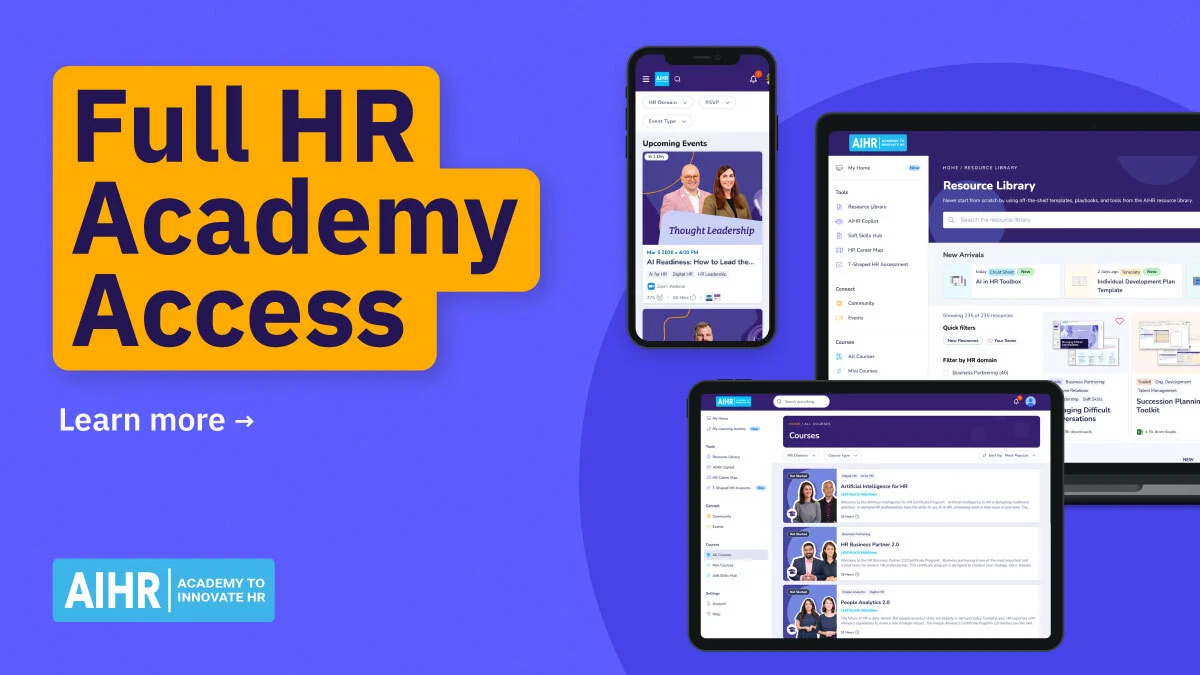
AIHR’s Resource Library gives members instant access to hundreds of downloadable templates, playbooks, cheat sheets, guides, and toolkits covering areas from sourcing and recruitment to strategic HR planning. In-house HR subject matter experts develop and regularly update every resource, so members always have a practical starting point for whatever they’re working on. Examples include offer letter templates, performance review frameworks, HR strategy presentation guides, and compensation analysis tools.
The AIHR Copilot is an AI-powered assistant trained on AIHR’s proprietary content library of over 1,000 articles, 500+ hours of video lessons, and 300+ resources. Built specifically for HR work rather than general use, it gives you instant, sourced answers to specific HR questions and surfaces relevant how-to guides and templates when you need them, so you spend less time searching and more time doing.
AIHR also includes a dedicated Soft Skills Hub for developing essential durable skills like communication, conflict resolution, influencing, negotiation, and coaching. These areas support HR professionals in becoming effective people advocates within their organizations.
Community, personalized learning and career planning
The AIHR community connects over 25,000 HR professionals from more than 180 countries. Members can engage in discussions, share best practices, and access weekly live events with HR experts on trending topics like AI in HR and annual HR trends. Many of these live events earn recertification credits applicable to HRCI and SHRM credentials.
AIHR also features several tools to shape your learning around your specific goals, skill gaps, and career aspirations.
With AI-powered Personalized Learning Journeys, members answer goal-oriented questions about their objectives, whether closing a specific skill gap, moving into a new HR domain, or preparing for a career leap, and receive a curated journey of courses and content mapped to their personal goals.
The T-Shaped HR Competency Assessment helps professionals evaluate their strengths across six core HR competencies (Business Acumen, Data Literacy, Digital Agility, AI Fluency, People Advocacy, and Execution Excellence) and identify areas for development. HR leaders can also use the assessment to benchmark their teams and identify skill gaps.
AIHR’s interactive Career Map allows HR professionals to explore roles, visualize career paths, compare salary ranges, and identify the specific skills needed for advancement.
Full Academy Access members also have access to a learning coach who provides accountability, helps create customized learning plans, and supports the achievement of career goals.
AIHR does not offer a free trial, but provides a freely accessible demo portal where prospective users can preview sample lessons and try key platform features, along with an extended money-back guarantee.
HRCI and AIHR: An overview
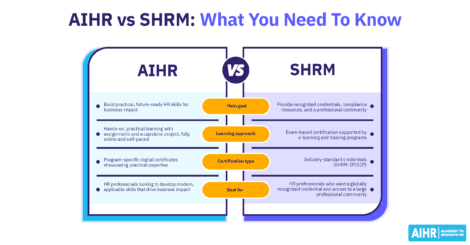
Aspect | HRCI | AIHR |
Primary purpose | Credential validation and certification | Skill-building and continuous learning |
Core offering | 8 certification exams | 16 certificate programs, 85+ courses |
Learning approach | Exam-based knowledge testing | Hands-on, project-based learning with capstones |
Content focus | HR compliance, regulations, and operational knowledge | Future-ready HR skills (analytics, business partnering) |
Practical resources | Webinars through HRCI Resource Network, paid Learning Center, and HRCI Handbook Builder | Resource Library (hundreds of templates), Soft Skills Hub, weekly webinars with HR experts included in Full Academy Access |
AI tools | HRCI CHAT (workflow support) | AIHR Copilot (HR-trained assistant with source-linked answers) |
Competency framework | Body of Knowledge (BoK) | T-Shaped HR Competency Model with self-assessment |
Community | HRCI ENGAGE (free, global) | 25,000+ member community with weekly live events included in the subscription |
Pricing model | Per-exam fees ($400–$595) + certification prep fees | Subscription-based (annual access) |
Recertification | 45–60 credits every 3 years | AIHR digital certificates do not expire, courses earn HRCI recertification credits |
Career planning | Certification tiers aligned to career stages | Interactive HR Career Map, Personalized Learning Journeys |
Best for | Validating and credentialing HR expertise | Building practical, future-ready HR capabilities |
Next step
HRCI and AIHR serve different but deeply connected purposes in an HR professional’s career. They aren’t necessarily alternatives to each other, as they address two complementary needs in professional development.
Choose HRCI if you want a globally recognized credential that validates your HR expertise and signals your commitment to professional standards.
Its certifications carry weight with employers, with professionals in over 95% of Fortune 500 companies holding HRCI credentials. The tiered certification structure ensures there’s a credential that matches your career stage, whether you’re just entering HR or leading strategy at the executive level. HRCI provides the validation that opens doors and builds professional credibility.
Explore HRCI certifications here.
Choose AIHR if you want to build the practical, future-ready skills that make you effective in your role, prepare you for what’s next in HR, and position you for the next step in your career.
Its specialized programs in people analytics, AI, business partnering, and more provide depth of learning that goes beyond what certification exam preparation covers. AIHR’s focus on strategic HR capability, connecting HR activities to business outcomes, data-driven decision-making, and employee-centric approaches, equips professionals with skills that complement a strong HR credential. And since AIHR is an approved provider with HRCI, the skills you build through AIHR directly earn the recertification credits needed to maintain your HRCI credentials.
For HR professionals looking to stay both credentialed and capable, the two platforms work well together: build and sharpen your skills through AIHR’s practical programs, validate your expertise with HRCI’s respected certifications, and maintain those credentials through the same AIHR courses that keep you learning.