
According to AIHR’s State of HR research, only 18% of HR professionals start in HR as their first or second role. Most people move into HR after working in other disciplines.
If you’re trying to get into HR without a degree, experience, or formal qualifications, the goal is simple: Build credibility fast by showing proof, not just interest.
In this article, you’ll learn how to get into HR through a clear plan, what to learn first, how to get “HR experience” before you have the job title, and which entry-level roles to target.
Contents
What is Human Resources?
What qualifications do you need to get into HR?
– How to get into HR without a degree
– How to get into HR with no experience
– How to get into HR with a psychology degree
9 tips for how to get into Human Resources
Entry-level HR jobs to consider
FAQ

What is Human Resources?
Human Resources refers to both a function and a department within an organization. Depending on the company, HR can be a single person or a team with multiple subfunctions.
As a department, HR manages the people-related work across the employee life cycle. This includes recruitment and onboarding, employee relations, performance management, learning and development, compensation and benefits, and offboarding, including separation and retirement. What HR looks like day to day will still vary by company size, industry, and available resources.
When it comes to getting into HR, there’s no single “right” route. In fact, 92% of HR professionals moved into HR from a different field as their second, third, or even fourth job. Career paths vary greatly, too, with people starting in HR operations, recruiting, L&D, or employee relations roles and then evolving further.
What qualifications do you need to get into HR?
Requirements vary by company and role, but most entry-level HR postings look for a mix of the following:
- Education (helpful, not always required): Employers often prefer an associate’s or bachelor’s degree (HR, business, psychology, communications). For roles like HR Assistant, HR Coordinator, and Recruiting Coordinator, employers may accept equivalent experience.
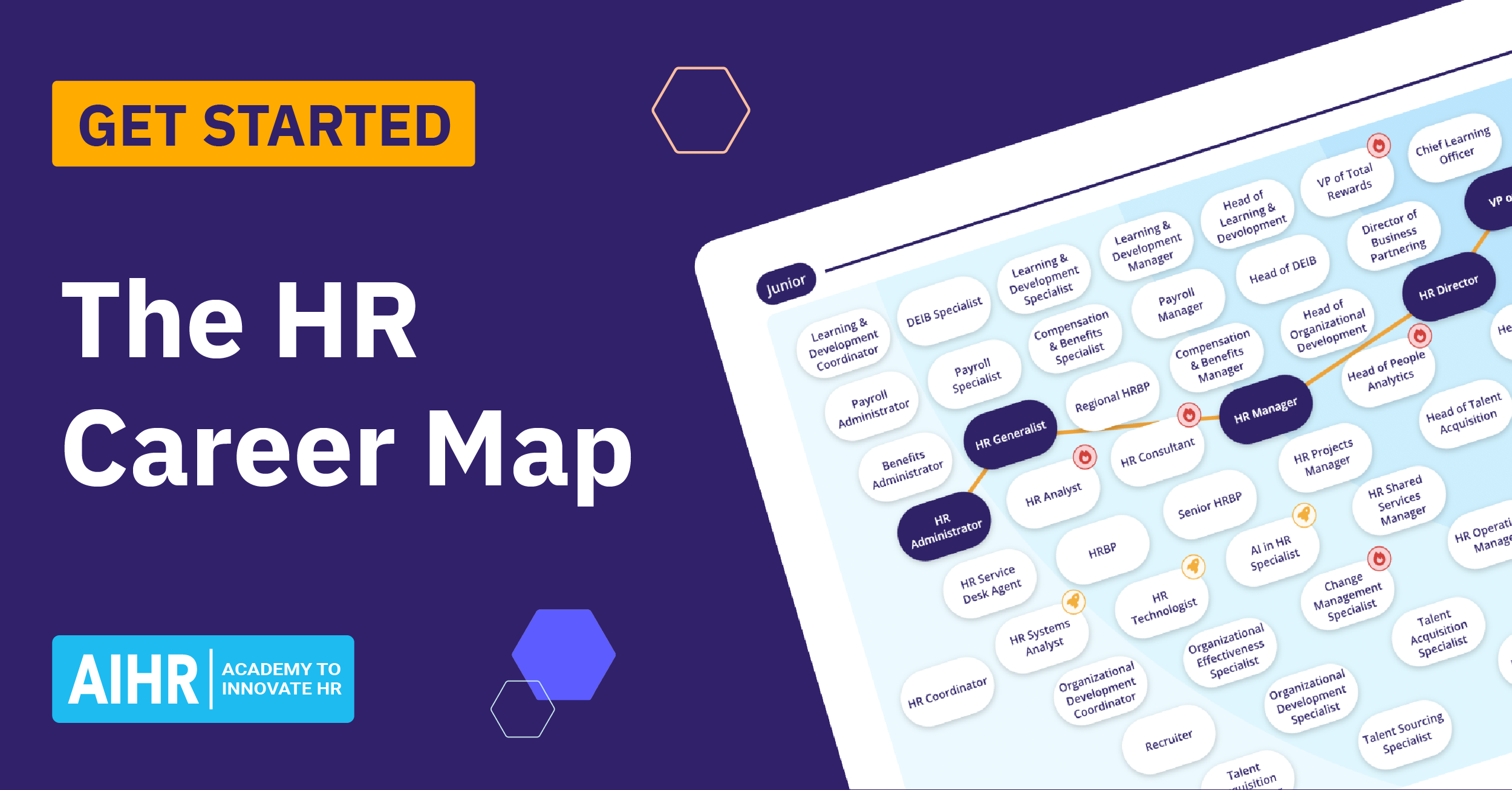
- Core skills: For entry-level roles, common expectations include strong interpersonal skills, action orientation, digital agility, and problem-solving. For a role-by-role breakdown of core skills, refer to our HR Career Map.
- Tools and working knowledge: Excel/Sheets, calendar management, ATS basics, and comfort with HR systems (HRIS). Increasingly, employers are also looking for AI fluency.
- Proof of relevant experience: Internships, volunteering, admin work that includes people processes, or projects that show coordination, documentation, and stakeholder management.
How to get into HR without a degree
Getting an HR degree isn’t the only way to build a career in this field. Some HR job postings do ask for a degree, but there are still plenty of practical ways to break in. Here are a few options to consider:
Build hands-on experience quickly
Look for opportunities to take on HR-adjacent tasks where you already work:
- Help coordinate interviews or scheduling
- Improve onboarding checklists or new-hire communications
- Track training completion or create simple learning materials
- Assist with employee events or recognition programs
- Document standard operating procedures (SOPs)
If you need a first step into an office environment, administrative roles, customer support, or operations coordination often build the same “HR core” skills (organization, people communication, process reliability).
Complete a practical HR certificate
A certificate can help you learn HR fundamentals and signal commitment, especially when paired with a small portfolio of work.
Explore AIHR’s HR courses based on your target entry role:
- HR Generalist track: HR Generalist Certificate Program
- Recruiting track: Talent Acquisition Certificate Program
- Data track: People Analytics Certificate Program
- Rewards track: Compensation & Benefits Certificate Program
HR career tip: Pick one track to start. “A little of everything” reads unfocused at entry level.
Translate your previous experience into HR outcomes
Instead of listing responsibilities, show outcomes that map to HR work:
- If you managed high-volume customer inquiries: You already have experience in service delivery, such as triaging requests, resolving issues, escalating complex cases, and documenting outcomes. That directly aligns with HR operations and employee support work (think HR inbox or ticketing systems).
- If you built a tracker or improved turnaround time: You’ve demonstrated process improvement and basic data skills, organizing information, spotting bottlenecks, and reporting progress. That’s valuable in HR coordination, onboarding, and recruiting administration.
- If you trained or coached teammates: You have experience supporting learning, explaining processes, creating simple job aids, and helping people ramp up faster. That aligns with onboarding and learning support roles.
- If you handled escalations or complaints: You’ve practiced de-escalation, fair problem-solving, and applied guidelines consistently. Those are core skills for employee relations support and HR service delivery.
Get HR-ready and break into HR with AIHR
Start your HR career with practical, job-ready skills. Explore AIHR’s Demo Portal to preview our certificate programs, courses, and resource library, built to help you confidently step into your first HR role.
✅ HR templates, guides, and essential resources when you sign up
✅ Playbooks and tools from the AIHR Resource Library
✅ Course + certificate previews to help you pick the right learning path
Curious what learning at AIHR looks like? Visit the AIHR Demo Portal and Resource Library to explore your options.
How to get into HR with no experience
If you don’t have HR on your resumé yet, you can still create HR-relevant experience in weeks, not years.
Audit your current experience for HR proof
Go through your job history: Look for transferable experience, such as:
- Handling sensitive information
- Process improvement
- Scheduling
- Customer service
- Solving people issues
- Volunteer work
Build a mini “HR portfolio”
Even if you don’t have much direct HR experience, you likely have more relevant skills, competencies, and work examples than you think.
Create simple, realistic artifacts you can show (or talk through) in interviews:
- Onboarding checklist for a 30-day ramp-up (role-based)
- Interview scorecard for a common role (criteria + rating scale)
- Basic HR tracker in Excel (e.g., applicant pipeline, training completion, or onboarding status)
Our article, “How to Create an Entry-Level Human Resources Resumé,” includes a step-by-step overview and practical examples to help you create your HR resumé.
Target roles that generate experience
Focus on gaining experience. There are plenty of ways to build relevant experience that helps you move into HR:
- Look for temp or contract HR admin roles
- Consider an HR internship
- See if there are cross-functional internal HR projects you can take part in
- Offer to volunteer where the HR team needs help from other employees (for example, when welcoming or training new hires)
You can also apply for entry roles where learning is built into the work. Search for job titles such as HR Coordinator, Benefits Administrator, or Talent Acquisition Coordinator to increase your chances of getting into HR.
How to get into HR with a psychology degree
A psychology degree can be a strong foundation for HR, especially in recruiting, L&D, performance coaching support, and employee relations.
Where psychology overlaps with HR:
- Interviewing and assessment (structured questioning, bias awareness)
- Learning design and behavior change
- Coaching and feedback conversations
- Conflict navigation and communication
- Workplace well-being support (within scope and policy)
Entry-level roles that often fit well: Recruiting Coordinator, HR Coordinator, L&D Coordinator.
HR career tip
Rewrite your psych experience in workplace language:
- Instead of: “Conducted a survey on stress among students”
- Use: “Designed and ran a survey, analyzed results, and turned findings into recommendations to support wellbeing initiatives.”
9 tips for how to get into Human Resources
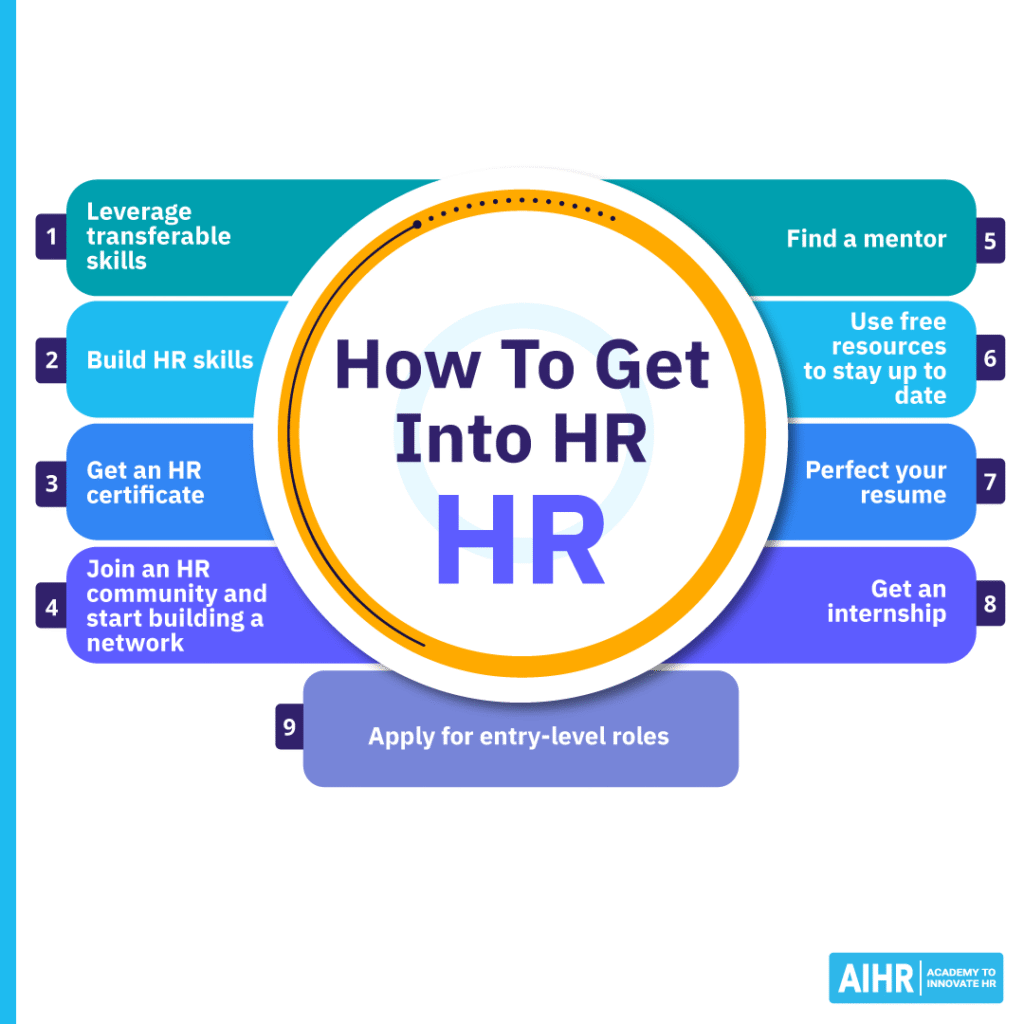
1. Leverage transferable skills
Even if you don’t have HR-specific experience yet, you almost certainly have skills that translate well into HR work. Think about tasks that require coordination, discretion, clear communication, and problem-solving, as these are common across almost every HR role. The key is to label your experience in a way that matches HR outcomes, such as supporting stakeholders, managing processes, handling sensitive information, and resolving issues consistently.
To make this land on a resumé or in an interview, don’t stop at listing the skill. Add proof in the form of a short example and a result. For instance, instead of saying you have strong communication skills, describe a situation where you handled a high volume of requests, organized competing priorities, or resolved a difficult issue calmly and fairly.
2. Build HR skills
Once you can articulate what you already bring, start building the HR skills that will make you effective on day one in an entry-level role. This includes a mix of fundamentals (like understanding the employee life cycle, onboarding basics, and HR operations) and modern expectations like digital agility, basic data handling, and comfort with learning new tools. If you want a competitive edge, pick one growth area that’s increasingly relevant (such as people analytics fundamentals, AI fluency, or change management) and commit to learning it consistently.
What matters most is applying what you learn. Look for small, realistic ways to practice in your current environment, like improving a simple process, creating a tracker in Excel, supporting interview scheduling, or helping organize onboarding tasks. Hiring managers respond well to candidates who can show they’ve already started doing “entry-level HR work,” even informally.
3. Get an HR certificate
An online HR certificate can be a practical option if you want structured learning without committing to a full degree. It helps you build job-ready knowledge and signals intent, especially when you’re transitioning from another field. The strongest approach is to choose a certificate that matches the type of entry-level role you’re applying for, so your learning supports your immediate job search rather than feeling broad and unfocused.
When you talk about a certificate on your resume or in interviews, make it concrete. Mention the skills you built, what you can now do, and how you’ve applied them, such as drafting job descriptions, building an onboarding checklist, or learning how an ATS supports the hiring process. A certificate becomes much more credible when it’s paired with examples.
There is a wide range of HR certificates to choose from, depending on whether you’re interested in becoming an HR Generalist or specializing in People Analytics, Talent Acquisition, or Compensation and Benefits. Look out for certificate programs suitable for beginners and relevant to the area(s) you want to focus on.
Many programs are fully online and self-paced, so you can learn alongside your current responsibilities, avoid travel costs, and keep working while you prepare for your next role.
4. Join an HR community and start building a network
HR communities can help you learn faster because you’ll see real questions, real scenarios, and how practitioners think through problems. They also expose you to job opportunities, career paths, and hiring expectations that aren’t obvious from job descriptions. For someone trying to break into HR, communities are a low-cost way to start building relationships and learning the language of the profession.
The most important thing is participation. Instead of joining multiple groups and staying silent, pick one or two where you can show up consistently. Comment on posts, ask thoughtful questions, and share what you’re learning. Over time, you become familiar with others in the community, which is often how referrals and mentoring relationships happen organically.
Here are a few well-established HR communities to get you started:
- AIHR Learners Community: Anyone who enrolls in one of our online HR programs gets access to the Practitioners Community in our portal.
- Improve Your HR Facebook Group: This community of almost 34,000 members (formerly The Evil HR Lady FB Group) is very active and a great place to seek advice, network, and celebrate successes.
- HR Professionals | Powered by HRCI and HRPA: A network of over 600,000 HR professionals on LinkedIn where people ask questions, share job openings, experiences, and more.
- Hacking HR: A global learning community (with 1 million followers on LinkedIn) of HR practitioners, HR and business leaders, consultants, vendors, and everyone else interested in learning, sharing, collaborating, and advancing the HR profession.
- Recruitment Consultants and Staffing Professionals: A very large (almost 900,000 people) and active community on LinkedIn dedicated to recruitment professionals.
5. Find a mentor
A mentor can help you understand how HR works in practice, not just in theory. They can give context on what entry-level HR work actually looks like, what skills matter most, and how to avoid common mistakes when you’re new. Mentors also help you build confidence because you get feedback from someone who’s been where you want to go.
To make mentoring more likely, keep your initial ask simple and specific. Instead of asking, “Will you be my mentor?” ask for a short conversation to learn about their path and advice for breaking in. If the conversation goes well, you can suggest a monthly check-in. Many mentoring relationships start informally and become more structured over time.
6. Use free resources to stay up to date
If you want to work in HR, it helps to stay current with what’s changing. Free resources like newsletters, podcasts, webinars, and blogs are an easy way to build that awareness. They also give you stronger talking points in interviews because you can reference trends and show you’re actively learning.
The trick is not to consume content endlessly. Pick one or two formats you’ll actually stick to and set a simple routine, like reading one article a week or listening to one podcast episode on your commute. When you learn something useful, write down how it relates to the role you want. That turns content into confidence and interview-ready insight.
Some resources to explore:
- Listen to HR podcasts: 21 HR podcasts to Subscribe to Right Away
- Read HR blogs and newsletters: 33 HR Blogs to Follow in 2026
7. Perfect your resumé
Your resumé is often the biggest barrier when you’re trying to break into HR, because it can unintentionally emphasize the wrong experience. A strong entry-level HR resume makes it easy for a recruiter to see why your background fits the role, even if your titles were different. That means leading with a clear summary, highlighting HR-relevant tasks, and using language that reflects HR responsibilities, for example, coordination, communication, documentation, and stakeholder support.
Avoid generic claims and focus on evidence. If you supported onboarding informally, describe what you did. If you built a tracker, explain what improved. If you handled sensitive information, mention the context. The goal is to help the reader conclude, “This person can handle the operational reality of entry-level HR work.”
8. Get an internship
Internships can be one of the fastest ways to gain credible HR experience because they put you inside the function, even for a short period. You learn the rhythm of HR work, the systems used, and how processes like recruitment and onboarding actually run. Internships can also expand your network quickly, which matters when you’re trying to land a first role.
If a formal internship isn’t realistic, look for alternatives that create similar proof, like contract HR admin work, temporary roles, or internal project support. What you’re looking for is exposure to real HR workflows and a manager or stakeholder who can speak to your performance in that context
9. Apply for entry-level roles
Once you’ve built a foundation of skills and can show proof through examples, start applying for entry-level HR roles that match your target path. Your first HR job may not be your long-term destination, but it’s a valuable stepping stone that builds experience, confidence, and clarity about what you want to specialize in later. Entry-level roles also make it easier to develop credibility inside HR systems and processes.
Apply with a process rather than relying on volume alone. Tailor your resume to the role family, prepare a few strong stories that demonstrate HR-relevant skills, and track what’s working. Explore an internal move as well if you’re already employed at a company with an HR team. Internal transitions can be a practical way to get into HR because you already understand the business and have existing relationships.
Entry-level HR jobs to consider
Here are some entry-level HR jobs to consider if you want to work in HR:
- Supports recruitment and onboarding.
- General HR admin and coordination.
- Assists with performance management.
$48,000 to $60,000
- Manages the benefits enrollment process
- Addresses employee issues
- Serves as a liaison between the organization and insurance providers
$64,000 to $85,000
- Candidate scheduling and recruitment process coordination.
- Candidate communication and experience.
- Cross-functional collaboration and pre-onboarding support.
$56,000 to $75,000
- Assists in executing organizational development (OD) programs
- Conducts development needs assessments
- Coordinates OD projects
$59,000 to $77,000
- Processes payroll runs
- Ensures compliance
- Resolves employee queries
$47,000 to $58,000
This is just a small sample of the jobs available to you if you want to start working in HR. For a more extensive overview, check out our article 14 Entry-Level HR Positions to Know.
HR career tip
If you want to explore possible HR career paths, see the latest salary insights, and pinpoint the skills that will help you land the role you want, check out our HR Career Map.
Next steps
If you want to get into HR, there’s almost always a way in. Whether you already have an HR degree and experience or you’re coming from a different background, there are plenty of routes that can lead to the role you’re aiming for.
Start building relevant skills and experience now, or consider an HR certificate program to strengthen your profile and improve your long-term career prospects and earning potential.
FAQ
If you want to get into HR, start by building relevant transferable experience and HR skills. You can do this by taking on HR-related tasks in your current role, joining cross-department HR projects, applying for an internship, or going straight for entry-level HR positions.
It depends on the company and the role. Some employers still ask for an HR degree, especially for more specialized positions. But it’s also very possible to start an HR career or switch into HR without a degree, particularly through entry-level roles and by showing relevant skills and experience.
Whether a career in HR is right for you depends entirely on your career ambitions and preferences. If you like working with people, solving problems, and improving how organizations run, HR can be a strong fit. It’s also a good path if you want varied responsibilities and the chance to influence culture and employee experience.