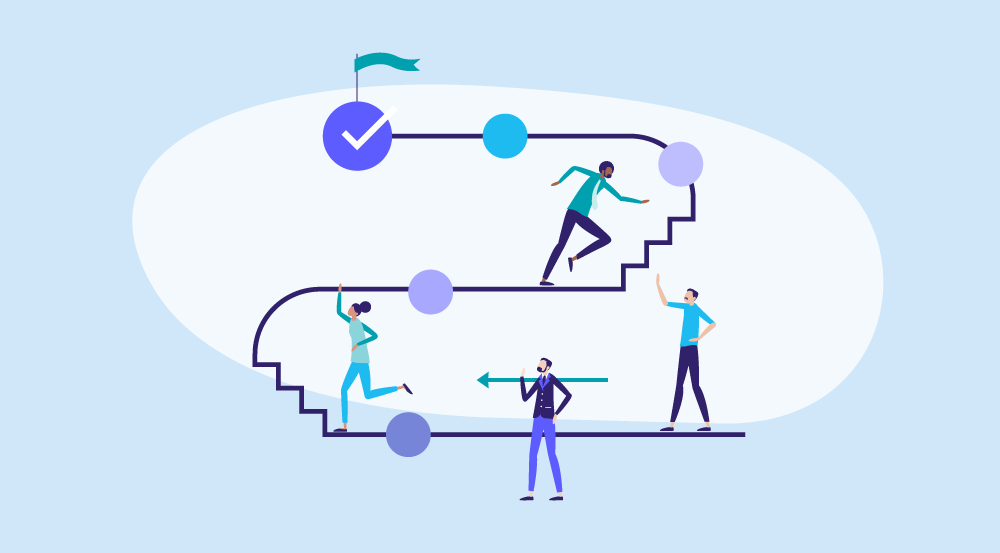
The employee journey begins before candidates even apply for a role in your organization. For instance, your company’s employer brand impacts candidates’ impression of it, influencing how likely they are to apply for jobs there. Next, your interview process affects how likely candidates are to accept job offers from your organization.
Once hired, the journey continues through onboarding, daily work, offboarding upon resignation, and even for alumni after they leave. This article examines the key stages of the employee journey, the role HR plays in shaping it, and how to create a positive employee journey within your organization.
Key takeaways
- The employee journey covers every stage of an employee’s relationship with an organization, from attraction and recruitment to offboarding and alumni engagement.
- Each stage includes key touchpoints that influence employee engagement, satisfaction, and retention.
- HR must design the employee journey framework, set standards for each touchpoint, coordinate with departments, ensure data quality and compliance, and collect employee feedback to drive continuous improvement.
- Building a positive employee journey involves mapping and standardizing key stages, training managers, improving team handoffs, tracking KPIs, and closing the feedback loop with employees.
Contents
What is the employee journey?
HR’s role in the employee journey
7 employee journey stages and their key touchpoints
How to build a positive employee journey

What is the employee journey?
The employee journey, also known as the employee experience journey, encompasses the entire experience an employee has with an organization, from awareness and recruitment to offboarding and alumni engagement. Although it shares the same stages as the traditional employee life cycle, the main difference is that the journey centers on lived experiences and notable touchpoints.
These employee journey touchpoints (e.g., the first job interview, first day at work, and first performance review) all impact retention, engagement, and productivity. A positive employee journey makes it easier to achieve business outcomes, such as reduced turnover, increased employee engagement, and a higher employee Net Promoter Score (eNPS).
Employee journey mapping helps HR identify and chronologically order the most crucial points in the employee journey, and measure the employee experience (EX) at each of these moments. With this data, you can identify areas that need improvement and take steps to create a more effective employee journey.
HR’s role in the employee journey
As an HR professional, here’s what you must know about you and your team’s role in the employee journey:
Orchestration, not ownership
HR’s responsibility is to design the employee experience journey framework and set standards for each touchpoint, but managers and support teams (including IT, facilities, finance, and legal) should own specific touchpoints. For example, when introducing a new hire to their team, their direct manager should take responsibility for the experience at this touchpoint.
Defining the stages and key touchpoints
Set clear stages across the employee life cycle so that everyone knows when one stage ends and another begins. For each stage, name the critical transitions. These include the company’s job offer, the first 30 days of an employee’s tenure, their first performance review, any internal moves they make, and their resignation and exit.
Setting policies and guardrails
Ensure compliant and consistent practices across all locations and worker types. This includes both hourly and salaried employees, as well as onsite and remote staff. As hybrid work becomes more common, it’s essential to properly welcome and support new hires during onboarding and provide them with the necessary tools and workspace to perform effectively.
Build the talent management skills every HR team needs
Move beyond daily operations and start contributing to long-term talent strategy with confidence.
🎓 The Talent Management & Succession Planning Certificate Program helps you:
✅ Support succession planning through talent reviews and mapping
✅ Apply a structured approach to workforce and demand planning
✅ Use talent mobility strategies to engage and retain key employees
✅ Design experiences that align with culture and drive performance
Manager enablement
You should provide scripts, checklists, and templates for recurring moments across all stages of the employee journey. These include, for example, offer calls, an employee’s first day, 30-60-90 day check-ins, performance reviews, and stay interviews. This provides managers with the necessary support, ensuring consistency across all teams and departments.
Data and governance
Your team should own the employee journey analytics model, definitions, and cadence by conducting monthly reviews and a quarterly refresh of the map. You are also responsible for maintaining data quality by confirming that employee data is accurate and adhering to privacy standards when handling all employee data.
Cross-functional coordination
One of the common causes of disruption in the employee journey is a lack of cross-functional communication and coordination. To avoid this, run a standing ‘journey council’ with representatives from recruiting, IT, payroll, facilities, and communications to address handoffs and establish service level agreements (SLAs).
This ensures that a new hire’s work devices and email account are set up, and provides them with access to all necessary network areas and programs on their first day of work.
Employees’ voice
You and your team are also responsible for collecting and synthesizing feedback from employees throughout the entire employee journey. This includes pulse surveys, one-on-one interviews, and helpdesk themes. Based on this information, you can add recurring issues to a list of necessary improvements and prioritize them according to their level of urgency.
Change management
Finally, HR has a duty to communicate all changes to the employee journey, train managers on how to better connect with and support their employees, and verify adoption through simple enablement plans and conducting spot checks. You should also track change management metrics to assess the effectiveness of change management initiatives.
7 employee journey stages and their key touchpoints
The employee life cycle model can help you map out the employee journey, including all the steps and support needed to deliver and maintain a positive employee experience. Let’s explore the seven employee journey stages and the touchpoints that matter at each stage:
Stage 1: Attraction
At this stage, your HR team’s goal is to attract suitable candidates to open positions. Prospective applicants’ knowledge and perception of the organization’s culture, purpose, mission, and employer brand affect how keen they are to join your workforce. As such, your language and communication skills can help highlight your company’s values and attract top candidates.
Key touchpoints: Potential candidates’ first encounter with your organization’s social media channels, careers page, or website.
Stage 2: Recruitment
At this stage, you need tailored job postings, a clear, straightforward application and selection process, and effective communication to attract the right candidates. Bear in mind that 60% of candidates don’t complete their applications if the process is too rigid or time-consuming. Make sure yours doesn’t involve too many clicks, take up too much time, or require candidates to create an account before applying.
Key touchpoints: Candidates’ first interaction with job postings, filling out applications, first interviews, and final hiring decisions.
Stage 3: Onboarding
Onboarding starts when the involved parties sign an employment contract and continues throughout the scheduled onboarding period. It includes a preboarding phase where new hires complete required paperwork, receive relevant information and materials, learn more about the company and their role, and get answers to their questions before their first day.
Communicate clearly with them and ensure IT sets up all their work devices before their first day. On their first day, give them an office tour (if not remote), introduce them to their team, and have their manager brief them on their initial tasks. With 69% of staff more likely to stay with a company after a good onboarding experience, this stage is crucial for driving retention.
Key touchpoints: New hires’ first interaction with their direct teams and/or managers, and their first day at work.

Stage 4: Retention
This stage involves the organization continually engaging and motivating employees to retain them in the long term. It involves three main environmental factors at work: technological, cultural, and physical.
The first requires employees to have the necessary tools and technology to excel in their roles. The second entails a workplace culture that makes all employees feel valued, respected, and a sense of belonging. Managers must also regularly communicate with staff to determine how well they’re handling their responsibilities, and provide additional support whenever necessary.
Finally, employees must have physical workspaces (both in the office and at home) that support their productivity and wellbeing. Your company can support this by investing in high-quality office furniture and allocating a budget to cover home office equipment for staff. Be sure also to collect employee feedback regularly to gauge sentiment and make improvements where needed.
Key touchpoints: Integrating into company culture, regular manager-employee check-ins, and providing employee feedback.
Stage 5: Development
This stage focuses on learning and development (L&D) initiatives that help employees build skills, knowledge, and competencies. A lack of career growth opportunities often leads to turnover; therefore, it’s essential to provide employees with ample learning and development opportunities.
These may include individual development plans, peer coaching and mentoring, training programs, and job rotation. A variety of training programs and coaching methods can help you cater to different development needs and learning styles, driving employee engagement and motivation.
Key touchpoints: First formal employee-manager sit-down, performance reviews, L&D opportunities, training program completion, and promotions.
Stage 6: Offboarding
The offboarding process begins when an employee officially resigns, and includes an exit interview that can provide valuable feedback on the employee journey. This interview is necessary to help you know what the company did right, what it could improve, and the impact and impression it has made on the employee.
Key touchpoints: Notice of resignation, conversation with manager, handover, exit interview, final day at work.
Stage 7: Happy leavers
This final stage of the employee journey encompasses the relationships between former employees and the organization after they have left. Make it easy for them to stay in touch through an alumni platform, which helps maintain positive relationships and updates alumni on exciting company events or news to keep their interest and retain a connection.
Key touchpoints: Invitation to join the alumni network of former employees, and interactions with former colleagues.
How to build a positive employee journey
Here’s how you can help build a positive employee journey across all stages to drive engagement, motivation, and retention throughout each employee’s tenure.
Start with clarity
Create and publish a one-page employee journey map with clearly defined stages, along with the relevant owners, SLAs, and key performance indicators (KPIs) for each stage. Make sure your map is visible to all relevant parties. Additionally, be sure to review and update it regularly to ensure it remains current at all times, particularly when a new hire needs it.
Standardize critical moments
During preboarding, automate paperwork, IT provisioning, the welcome email, and the first-week agenda. During onboarding, new hires should get a prepared 30-60-90 day plan, buddy assignment, and role training checklist.
At the development stage, use standardized templates and performance review methods for goal setting, monthly one-on-ones, and quarterly feedback. Standardizing these critical moments enables consistency across the organization, which positively impacts the employee experience and journey.
Equip managers
Deliver ready-to-use toolkits (e.g., email templates, meeting agendas, and sample feedback), as well as short training sessions, to ensure managers have the tools and support they need to deliver a positive employee experience journey. Regular one-on-one meetings between managers and a member of your HR team can help you measure adoption and act as a safe space to discuss any issues.
Use employee journey analytics
Select relevant KPIs to track and measure for each stage of the employee journey. For example, at the recruitment stage, metrics like source of hire, time to hire, and offer acceptance rate are useful.
During the retention stage, you may want to measure 90-day retention rates, turnover rates, and eNPS. Review trends each month and run targeted experiments so that you can compare before-and-after results.
Close the feedback loop with employees
It’s important not just to listen to employees but also to act on their feedback. Share updates with them on key improvements in the employee journey to demonstrate you’re taking their feedback seriously.
Continue to encourage regular feedback after key moments, such as after a candidate has accepted an offer, at the end of their first work week, or after their first review.
Design for inclusion
Design your employee journey mapping with fair, accessible practices (e.g., structured interviews, clear promotion criteria, flexible scheduling where possible, etc.). Monitor outcomes across different roles and locations to determine whether you need to make any adjustments to meet your company’s DEIB standards and requirements.
Automate the routine
Use your organization’s HRIS, ATS, and workflow tools for all reminders, approvals, and status tracking. This will reduce the need for manual follow-ups and human errors, and support greater consistency throughout the entire employee journey. This, in turn, builds trust and confidence in employees that the company prioritizes their convenience during the employee journey.
Prioritize by impact vs. effort
Each quarter, aim to tackle three to five ‘quick wins’, such as making sure all relevant documents, materials, information, and devices are ready for employees on their first day. At the same time, focus on one or two larger projects, such as developing a manager capability program or setting up a workshop to help employees upskill themselves.
Sustain progress with regular reviews
Set a recurring cadence (e.g., quarterly) to review employee journey KPIs, feedback, and process compliance with HR, managers, and key support teams. Use these sessions to update your journey map, remove outdated elements, refresh priorities, and agree on next steps. Share outcomes and owners, so everyone stays accountable and momentum doesn’t fade.
To sum up
Treat the employee journey as a strategic priority, not a side project. When you map key stages, assign clear ownership, and standardize critical moments, you reduce friction for employees. As a result, you make it easier for managers to consistently do the right things, support their employees’ growth, and increase engagement and performance.
The next step is to put this into practice with discipline. Start small by clarifying your journey map and tracking a focused set of KPIs. Then, use employee feedback and regular reviews to refine your approach. When done right, the employee journey becomes a competitive advantage that enhances retention, strengthens the employer brand, and helps deliver better business results.