An employee handbook template gives you a practical starting point for building an employee handbook without creating every section from scratch. It helps you organize policies, expectations, benefits, and workplace guidance in one place, while still leaving room to tailor the final document to your company, workforce, and legal context.
A strong template helps you work faster and more consistently. However, it only adds value if you adapt it carefully, review it thoroughly, and roll it out in a way employees will actually use.
This guide explains what an employee handbook is and why it matters, and shows you how to use the downloadable Word and PDF template to create a clear, practical handbook employees can understand and trust.
Contents
What is an employee handbook?
Why use an employee handbook template?
What does a good employee handbook template include?
Free employee handbook templates
Employee handbook example: Sample sections and wording
5 steps to create an employee handbook using a template
Employee handbook best practices
Common mistakes to avoid with employee handbook templates
Legal and compliance considerations for employee handbooks
FAQ
Key takeaways
- An employee handbook template helps you document policies, expectations, and employee information in a consistent format.
- Most handbooks should include company information, employment basics, workplace policies, benefits, conduct standards, reporting routes, and an acknowledgment form.
- A template is a starting point, not a finished handbook, so you should adapt it to your culture, workforce, and location.
- Review, communication, training, and employee acknowledgment are just as important as the content itself.
What is an employee handbook?
An employee handbook is a document that explains the key information employees need to understand how your organization works and what it expects from them. It usually outlines the company’s mission, vision, and values, along with workplace policies, procedures, benefits, and standards of conduct.
It acts as a central reference point for employees, helping them find clear guidance on everyday workplace expectations and company rules.
Employee handbook vs. HR policies
Your handbook is the umbrella document. It gives employees a clear overview of the rules, expectations, and resources that shape their experience at work.
Individual HR policies go into more detail. For example, your handbook may include a short anti-harassment section and direct employees to the full policy for definitions, reporting steps, and investigation procedures.
Who should use an employee handbook?
An employee handbook is useful for any organization that wants to clearly and consistently communicate workplace expectations. It can be especially helpful for businesses creating their first handbook, small businesses that want to formalize their employee guidance, and employers with outdated handbooks that no longer reflect current practices.
It is also useful for organizations that want to create a more consistent onboarding experience across teams, locations, or managers by giving employees one reliable source of information from day one.

Why use an employee handbook template?
A strong template does more than save time. It helps you create a handbook that employees can use in practice, and managers can apply consistently.
Time-saving and improved consistency
Templates speed up drafting because the structure is already in place. You can focus on tailoring the content instead of deciding what belongs in the handbook each time. They also improve consistency. When every section follows a clear format, employees are less likely to receive mixed messages.
Clear policy communication
Employees need simple, reliable guidance on what’s expected of them and what support is available. HR policies provide transparency, support consistent decisions, and reduce misunderstandings and conflict. That brings the handbook from an administrative document to an effective communication tool.
Onboarding support
A handbook is especially useful during onboarding because it provides new hires with a single source for essential workplace information. Onboarding best practices recommended by AIHR include providing access to the employee handbook and company policies to help new employees get oriented and find the right resources quickly.
Compliance and documentation support
A handbook can also support compliance by making policies easier to document, access, and explain. AIHR’s HR compliance checklist recommends documenting policies, making them easily available, and ensuring new hires acknowledge their understanding of policies, rights, responsibilities, and reporting routes.
However, do bear in mind that a handbook is not legal advice, and should not replace legal review where needed.
What does a good employee handbook template include?
A robust employee handbook template is built around the information employees actually need to do their jobs, understand expectations, and find support when questions come up. Here’s what a typical template would include:
- Company overview: Start with a short section that introduces the company and helps employees understand how people are expected to work together. This usually includes a welcome message, the organization’s mission, vision, and values, and a brief culture statement that sets the tone for the rest of the handbook.
- Employment basics: Keep this section clear and easy to scan. Employees should be able to read it quickly and understand how the work is structured. Include the core terms of employment, such as employment classifications, work schedules and hours, attendance expectations, payroll timing and pay basics, and any work location, remote work, or hybrid expectations that apply.
- Workplace policies: This is often the largest section of the handbook because it covers the policies employees are expected to follow. It should explain major employment topics clearly and support consistent decision-making across the organization. Common areas to cover include:
- Equal employment opportunity (EEO)
- Non-discrimination and anti-harassment policies
- PTO policy
- Performance and disciplinary processes
- Workplace health and safety
- Technology and data use
- Remote work where relevant.
- Benefits and employee support: Avoid turning the handbook into a full benefits guide. Instead, give employees a clear summary of the support available to them and direct them to the right systems or contacts for more detail. This section can cover benefits eligibility, health and retirement benefits at a high level, learning and development opportunities, and employee assistance resources, if available.
- Code of conduct and behavior expectations: Your code of conduct should be easy to find and easy to understand. It should clearly explain expectations around respect, professionalism, ethics, company property, confidentiality, and workplace behavior. This section of the employee handbook should be actionable, enforceable, accessible, and reinforced through communication and training.
- Reporting, complaints, and investigations: This is one of the most practical sections in the handbook because employees should never have to guess how to raise a concern. Explain what kinds of issues should be reported, who employees can contact, what alternative reporting routes are available, how the organization addresses retaliation, and what employees can expect after a concern is raised.
- Acknowledgment of receipt: Close the handbook with a short acknowledgment form for documentation.
Free employee handbook templates
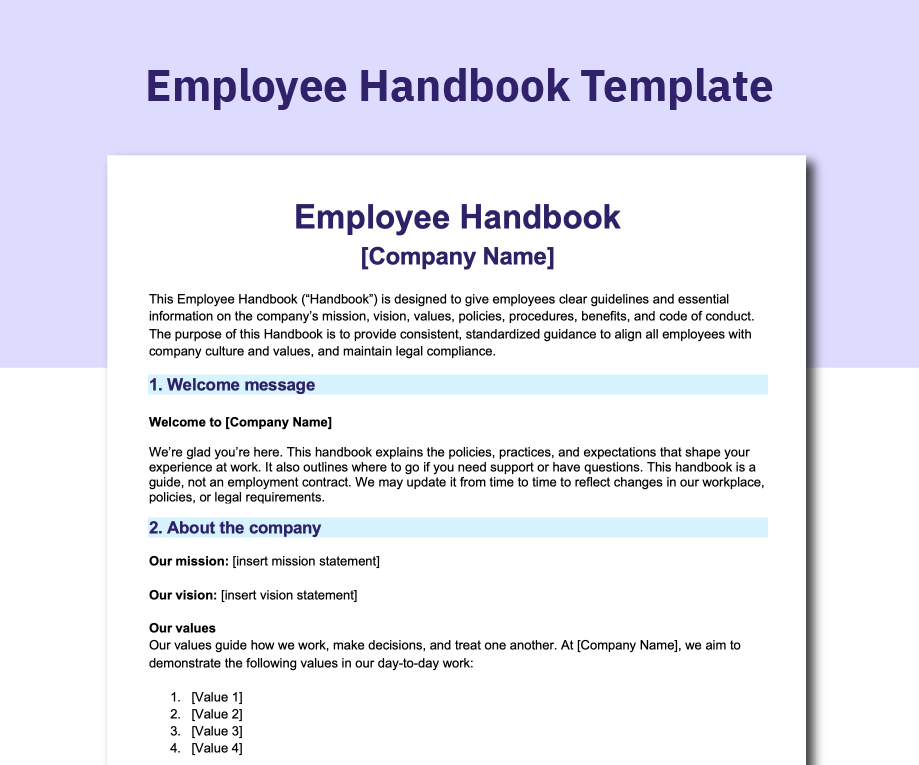
Using a template can save HR teams time by providing a clear starting point for building a handbook instead of creating one from scratch. This is especially helpful for smaller organizations, where a small business employee handbook template can make it easier to structure company policies, workplace expectations, benefits, reporting routes, and acknowledgment forms in a way that is practical, clear, and easy to roll out.
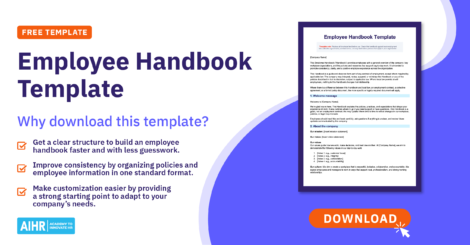
To make the process easier, we’ve created a sample employee handbook template in both Word and PDF format. Use the Word version to customize the content for your organization, and the PDF version as a clean, easy-to-share reference copy.
Employee handbook example: Sample sections and wording
The examples below show the kind of tone, structure, and level of detail that work well in an employee handbook. They are not a complete handbook, but short sample sections you can adapt to your organization.
Example opening section
Welcome to [Company Name]
We’re glad you’re here. This handbook explains the policies, practices, and expectations that shape your experience at work. It also outlines where to go if you need support or have questions.
This handbook is a guide, not an employment contract. We may update it from time to time to reflect changes in our workplace, policies, or legal requirements.
Why this works: It’s warm, clear, and realistic, and explains purpose, scope, and limits without sounding overly formal.
Example policy section
Attendance and punctuality
You’re expected to arrive on time and be ready to work at the start of your scheduled shift. If you will be late or absent, notify your manager as soon as possible and follow your team’s call-out process. Repeated attendance issues may lead to corrective action.
Why this works: It states the expectation, employee action, and consequence in plain language.
Example acknowledgment section
I confirm that I received the Employee Handbook and understand that I should review its contents and follow the policies outlined in it.
Why this works: It’s short, direct, and easy to sign and store.
5 steps to create an employee handbook using a template
Here are the steps to take when creating an employee handbook using a template:
Step 1: Gather existing policies and procedures
Pull together your current policies, onboarding materials, reporting processes, and benefits summaries. Your template should organize real source material, not replace it. It should also help you to structure the material in a way that’s easy to digest and flows well. This makes it easier for employees to adhere to company standards and policies.
Step 2: Customize the template to your organization
This is where the real work happens. Adapt the template to your tone of voice, values, workforce model, policy reality, and local requirements.
For example, if your company has a hybrid work arrangement, include clear guidance on office days, equipment use, availability, and meeting norms. If you operate in multiple jurisdictions, avoid using one blanket rule where local laws differ.
Step 3: Review with legal and key stakeholders
Ask your HR teammates, leadership, managers, and legal counsel to review the draft where appropriate, drawing on their respective areas of expertise to refine the document and ensure policy and legal compliance. Policy requirements vary by law, state, and company size, so having these different parties review the handbook is crucial.
Step 4: Roll it out and train employees
Don’t just upload the handbook and hope employees read it. You need to communicate policies clearly, include them in onboarding, make them easy to access, and train employees and managers on what they mean in practice. A practical rollout could include:
- A launch email from HR
- A short manager briefing pack
- A 20-minute onboarding walkthrough video
- A signed acknowledgment process.
Step 5: Update it regularly
Handbooks should not sit unchanged for years. Schedule regular reviews and updates for both policies and codes of conduct to keep them relevant, effective, and aligned with evolving legal requirements. This helps keep the entire organization up to date and on the same page, as well as lowers legal exposure and risk for the business.
Employee handbook best practices
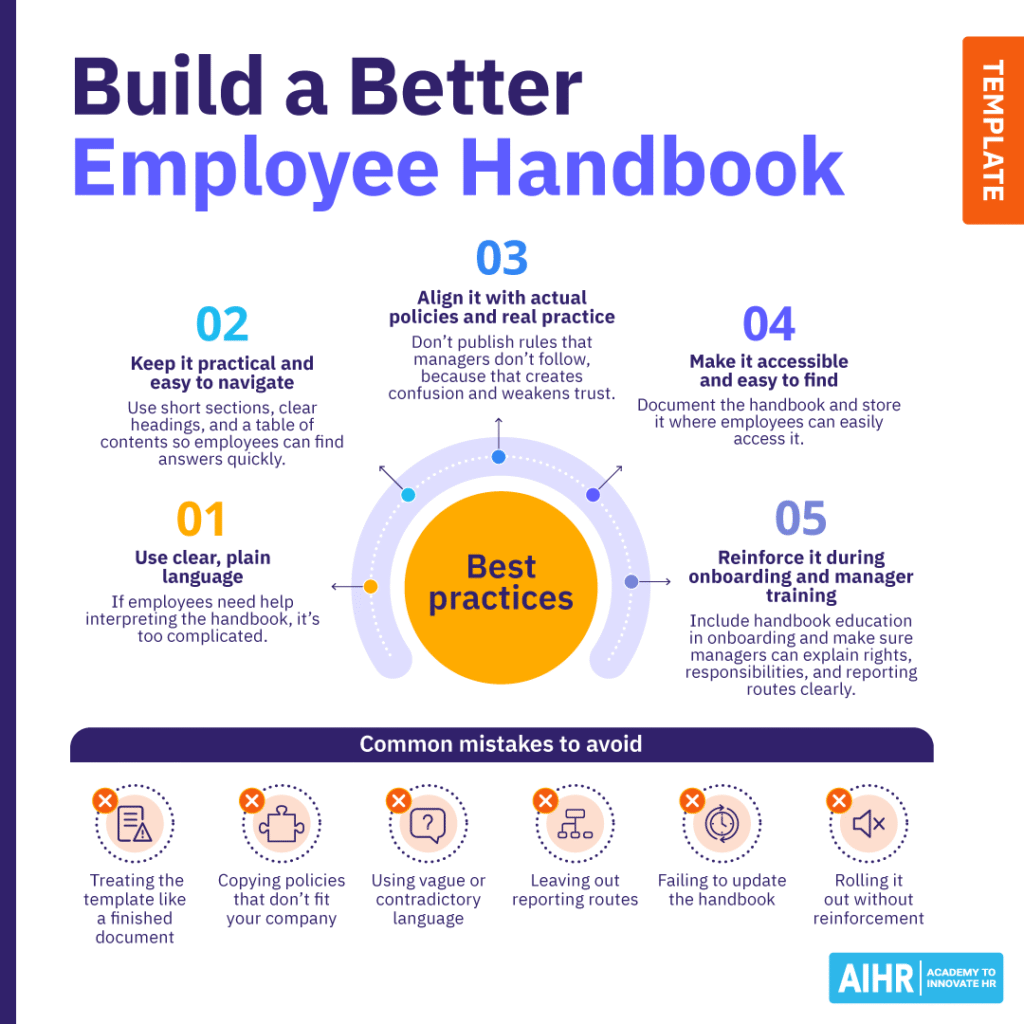
Here are five best practices to follow when developing your organization’s employee handbook:
- Use clear, plain language: If employees need a manager or lawyer to interpret the handbook, it’s too complicated. Use simple, straightforward policy language to reduce confusion and minimize inconsistent interpretation.
- Keep it practical and easy to navigate: Use short sections, descriptive headings, a detailed structure, and a table of contents. This will help new employees find answers quickly and easily, instead of spending unnecessary time searching for information.
- Align it with actual policies and real practice: Don’t publish idealized rules that managers themselves don’t follow, as this will eventually create confusion and weaken trust. Instead, make sure the handbook reflects how the organization actually operates so employees, managers, and leadership stay aligned.
- Make it accessible and easy to find: Store the handbook where employees can access it easily, for instance, on the company intranet.
- Reinforce it during onboarding and manager training: A handbook works best as part of how employees learn about the business. Include employee policy education in onboarding and ensure managers can clearly explain employees’ rights, responsibilities, and reporting routes.
Common mistakes to avoid with employee handbook templates
Below are six common mistakes you should avoid when using an employee handbook template:
- Treating the template as a finished legal document: A template is only a starting point, not a ready-to-use legal document. Every company has its own structure, working practices, local laws, and risk areas. Using a generic template without adapting it can create gaps, compliance issues, and poor employee guidance.
- Copying policies that do not fit your company: Copying policies directly from a template without checking if they reflect workplace reality can create confusion. If the handbook refers to procedures, benefits, or reporting lines that do not exist, employees will lose trust in HR and the organization.
- Using vague or contradictory language: A handbook should be clear and internally consistent. Vague wording or language that conflicts with other policies increases the risk of inconsistent interpretation and disputes.
- Leaving out reporting routes: A handbook shouldn’t just state rules but also explain what staff should do if there’s a problem. If reporting routes are missing, employees won’t know whom to contact about grievances, misconduct, or policy breaches.
- Failing to update the handbook when practices change: A handbook should reflect current workplace reality. When policies, benefits, tools, or ways of working change, so must the handbook. Outdated content creates confusion and can expose the organization to legal or employee relations risk.
- Rolling out the handbook without reinforcement: Publishing the handbook is not enough on its own. If employees don’t receive training, acknowledgment, or a clear explanation of where to find it, adoption will be weak. Reinforcement helps turn the handbook from a static document into a practical day-to-day guide.
Legal and compliance considerations for employee handbooks
An employee handbook can support consistency and risk reduction, but legal requirements vary. Consider the following when developing your organization’s handbook:
Required vs. recommended policies
Some policies are legally required, depending on your organization’s jurisdiction and company size. Others are strongly recommended because they support fair treatment, compliance, and consistent decision-making. Distinguishing between the two (required and recommended) will help your organization prioritize updates and avoid missing critical obligations.
Local law, state law, and global workforce variations
If you have employees in multiple states or countries, a single handbook may not cover every rule. In such a scenario, keep the core handbook broad and include jurisdiction-specific appendices in different versions made for employees in different jurisdictions. This supports consistency across the business, while still addressing local legal and operational differences.
Handbook disclaimers and acknowledgments
A disclaimer can clarify that the handbook is a guide and not a contract. An acknowledgment confirms receipt and supports recordkeeping. Both are practical tools, but they still need review if your legal context is complex. If you use them properly, these tools can strengthen clarity and documentation, though they should never replace sound legal review.
Review cadence and ownership
Assign clear ownership of the handbook. In many organizations, HR owns the document, legal reviews sensitive areas, and managers help identify sections that no longer reflect real practice. Without clear ownership and regular review, the handbook quickly loses value as its content becomes outdated and less reliable as a source of guidance.
Next steps
A simple employee handbook template helps you build faster, stay consistent, and turn scattered policies into one clear, practical resource for employees and managers. When it’s tailored to your organization, easy to navigate, and reinforced through onboarding and training, it becomes a foundation for better communication, stronger compliance, and more confident HR practice.
Creating a good handbook also builds core HR capabilities (e.g., policy development, employee communication). To strengthen such skills, consider AIHR’s HR Generalist Certificate Program. It covers policy frameworks, core HR processes, and practical tools for people practices, making it especially relevant if you’re developing an employee handbook or onboarding program.
FAQ
It should include company information, employment basics, workplace policies, benefits guidance, conduct expectations, reporting routes, and an acknowledgment form.
Not always. No general U.S. law requires every company to have an employee handbook, but some states require certain employment policies to be written down and accessible. Requirements vary by jurisdiction and company context.
Review it at least once annually, as well as any time major policies, laws, systems, or workforce models change. AIHR recommends regular updates to ensure policies remain relevant and legally compliant.
An employee handbook is an employee-facing guide that summarizes key workplace expectations, practices, and support in simple language. HR policies are the more detailed internal documents that set out the full rules, procedures, and standards behind those topics. In short, the former explains what staff must know, while the latter provides more detailed guidance.
Yes, this is good practice in most cases. AIHR advises obtaining and recording employee acknowledgment as part of onboarding and policy documentation.