
Attrition rate is an important HR metric that shows how stable your workforce is and where retention may be slipping. In the U.S., workers quit about 3.2 million jobs last December alone, with a 2.0% quits rate, which shows how much movement still exists in the labor market.
Attrition rate helps you quantify that movement inside your own organization. It can highlight whether your retention efforts work, where workforce planning needs attention, and which teams or roles might need a closer look.
In this article, you’ll learn what attrition rate means, how to calculate it, what influences it, and how to interpret your results so you can take practical steps to reduce unwanted attrition.
Want a broader view beyond attrition? Download our free 51 HR Metrics Cheat Sheet for a quick, practical reference to the most-used HR metrics and formulas you can plug into your reporting and dashboards.
Contents
What is attrition rate?
Attrition rate vs. turnover rate
Different types of employee attrition
How to calculate attrition rate
Attrition rate calculator
What is a good attrition rate?
What is a high attrition rate?
How to conduct an employee attrition analysis
How can HR reduce attrition rate
FAQ

What is attrition rate?
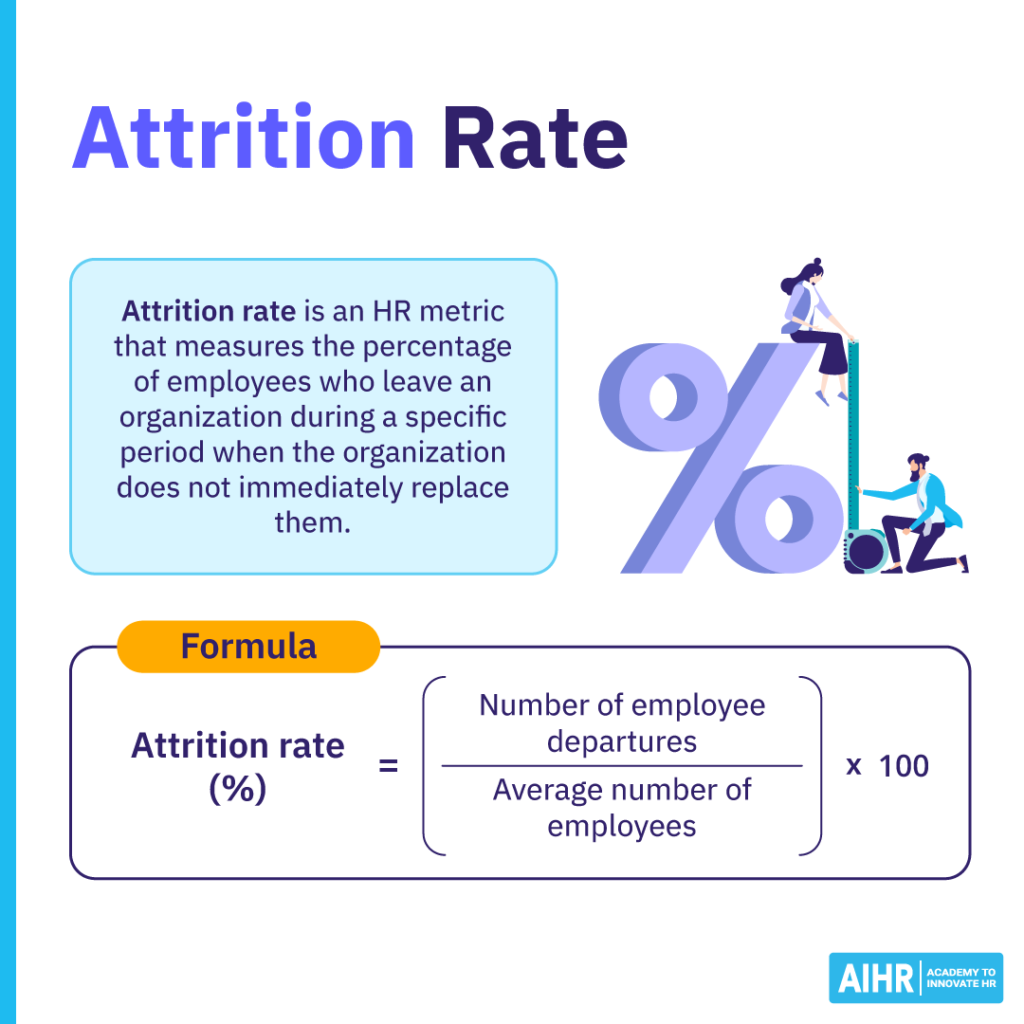
Attrition rate measures how quickly employees leave an organization during a specific period when the organization does not immediately replace them. Companies usually express it as a percentage of the workforce. Because attrition focuses on roles that remain open, it often signals more than employee movement. It also reflects how your headcount changes over time and how well your organization can maintain the capacity it needs to deliver work.
Attrition can affect productivity, continuity, customer service, and team morale, especially when key roles stay unfilled. When HR teams track attrition rate over time, they can spot whether exits rise or fall and adjust workforce planning, hiring targets, and manager support accordingly. A change in attrition rate can also point to underlying issues, such as workload, leadership gaps, pay concerns, limited growth opportunities, or team-level engagement problems.
Attrition rate vs. turnover rate
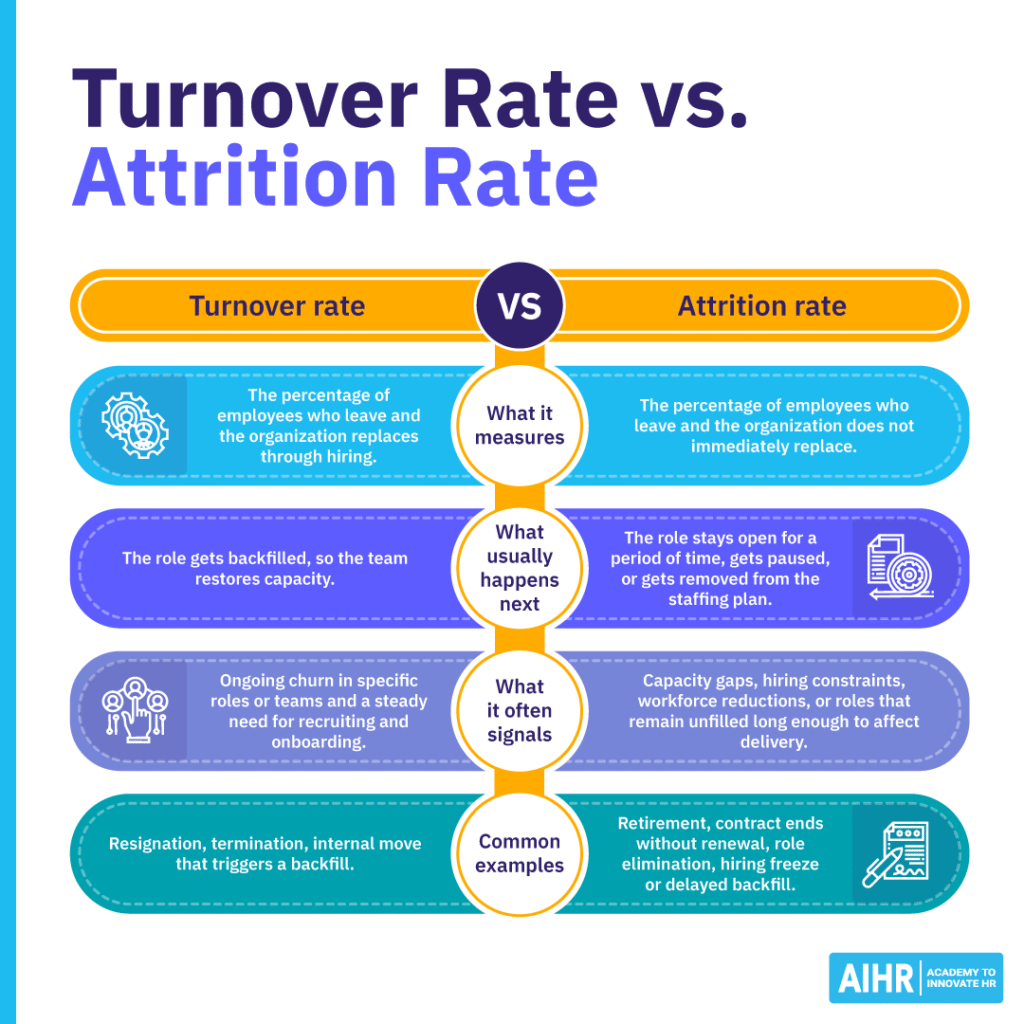
Attrition rate and employee turnover both track employees leaving, but they describe different workforce patterns. Attrition focuses on roles that stay open or get eliminated, while turnover focuses on exits the organization replaces through hiring. When you separate the two, you can diagnose the issue correctly and choose the right response, from workforce planning to retention.
What it measures
Employees leave and the organization replaces them with new hires
Employees leave and the organization does not replace them right away (or removes the role)
What it often signals
Churn in positions and ongoing replacement demand
Workforce reduction, hiring constraints, or persistent vacancies
Typical time horizon
Often shorter-term movement
Often longer-term impact on capacity and headcount
Cost and operational impact
Higher recruiting, onboarding, and ramp-up costs; knowledge loss risk during transitions
Capacity gaps, workload increases, delays, and potential capability loss if vacancies stay open
Common examples
Voluntary resignation, involuntary termination, internal transfer that triggers a backfill
Retirement, contract ends without renewal, role elimination, hiring freeze
Example
An employee resigns and the team hires a replacement
An employee retires and the organization leaves the position unfilled
Different types of employee attrition
HR teams often use “attrition” as an umbrella term, but employees leave for different reasons and under different circumstances. When you break attrition into types, you can interpret your numbers more accurately and choose the right response. Some forms of attrition reflect expected workforce movement, while others signal risks you should address quickly.
- Voluntary attrition happens when employees choose to leave, for example, to take another job, change careers, relocate, or step away for personal reasons. This type often links to the employee experience, manager effectiveness, workload, pay, flexibility, and growth opportunities.
- Involuntary attrition occurs when the organization initiates the exit. This includes dismissals for performance or conduct, as well as terminations tied to restructuring. Because the business drives these exits, involuntary attrition usually reflects decisions about performance standards, workforce strategy, or cost control.
- Retirement attrition describes employees leaving due to retirement. This type tends to affect long-tenured employees and critical knowledge holders, so it can create a capacity and capability gap if the organization does not plan for succession or knowledge transfer.
- Internal attrition refers to employees leaving a team, department, or location but staying with the same employer. Organizations often treat it separately because it still creates a vacancy and workload impact for the original team, even though the company retains the employee.
- Demographic or functional attrition focuses on attrition within a specific employee group, such as high performers, new hires, a job family, a location, or a critical skill area. This lens helps HR move from a company-wide average to targeted insights. For example, a stable overall attrition rate can still hide a sharp increase in attrition among early-tenure employees or hard-to-fill roles.
When you categorize attrition this way, you can connect exits to the right interventions. For example, rising voluntary attrition may call for manager coaching, clearer career paths, or pay reviews, while retirement attrition often increases the need for succession planning and knowledge sharing.
Turn attrition data into retention action
Develop the skills you need to calculate, track, and analyze attrition, so you can spot risk early, explain the “why,” and drive targeted retention improvements.
🎓 The People Analytics Certificate Program helps you:
✅ Build self-service dashboards and reports in Excel and Power BI to monitor attrition trends
✅ Run a structured attrition/turnover analysis to uncover patterns, hotspots, and key drivers
✅ Present clear, stakeholder-ready insights using data storytelling and a full people analytics cycle (from question → analysis → action)
How to calculate attrition rate
You can calculate attrition rate with a few inputs: the number of employees who left during a specific period and your average number of employees for that same period. Most organizations track attrition monthly, quarterly, or annually. Pick one timeframe and use it consistently so you can compare results over time and avoid overreacting to a one-off spike.
Step 1: Choose your time period
Decide whether you want to calculate attrition for a month, quarter, or year. Your choice depends on how often your workforce changes and how you plan to use the metric. If you want to spot changes quickly, a monthly or quarterly view usually helps. If you want a steadier view that smooths out seasonal hiring and one-off departures, an annual view can work better.
Step 2: Count the number of employees who left
Count how many employees left during the selected period. Use the same rules each time so your results stay comparable. For example, decide upfront whether you include fixed-term employees, and whether you treat internal moves as attrition or track them separately.
Step 3: Calculate the average number of employees
Calculate the average number of employees during the same period. This helps you account for changes in workforce size.
You can calculate the average like this:
Average number of employees = (Number of employees at the start of the period + Number of employees at the end of the period) ÷ 2
Step 4: Apply the attrition rate formula
Divide the number of employees who left by the average number of employees, then multiply by 100 to convert it into a percentage.
| Attrition rate = | Number of employee departures | x 100 | |
| Average number of employees | |||
Here are examples of calculating the attrition rate annually, quarterly, and monthly:
Example 1: Annual
An organization starts the year with 200 employees, and 30 employees leave during the year. The calculation looks like this:
- End of year employees: 200 − 30 = 170
- Average number of employees: (200 + 170) ÷ 2 = 185
- Attrition rate: (30 ÷ 185) × 100 = 16.2%
This means the organization saw 16.2% attrition over the year.
Example 2: Quarterly
A company begins the quarter with 150 employees and has 10 departures during the quarter. Here’s the math:
End of quarter employees: 150 − 10 = 140
Average number of employees: (150 + 140) ÷ 2 = 145
Attrition rate: (10 ÷ 145) × 100 = 6.89%
So, the company’s attrition rate for the quarter is 6.89%.
Example 3: Monthly
A team has 80 employees at the start of the month, and 3 employees leave that month. The calculation is:
End of month employees: 80 − 3 = 77
Average number of employees: (80 + 77) ÷ 2 = 78.5
Attrition rate: (3 ÷ 78.5) × 100 = 3.82%
That results in a monthly attrition rate of 3.82%.
Attrition rate calculator
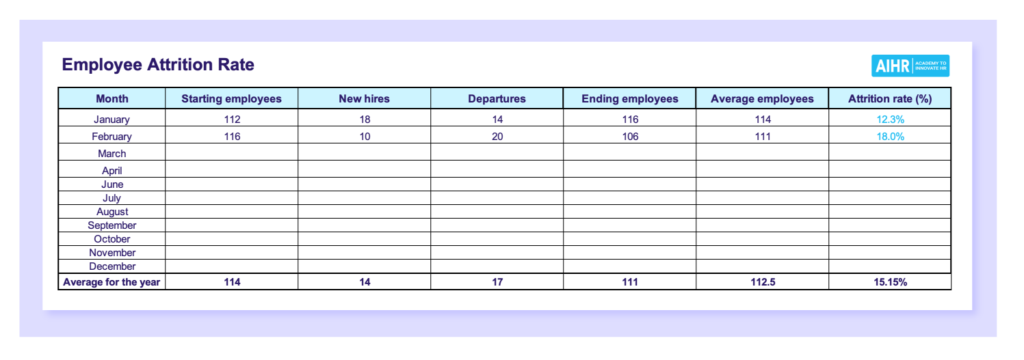
If you want to calculate attrition rate quickly and consistently, use our attrition rate calculator template. It helps you plug in the number of employees who left and your average number of employees for a chosen period (monthly, quarterly, or annually), then it calculates the attrition rate automatically. You can also track results over time, so it’s easier to spot trends and investigate changes early.
What is a good attrition rate?
A good attrition rate is one your organization can manage without creating ongoing capacity gaps or putting pressure on service levels, delivery timelines, or team wellbeing. Because attrition measures employees who leave without the organization immediately replacing them, there’s no single benchmark that fits every business.
Instead of aiming for a specific percentage, treat “good” as a rate that stays consistent over time and aligns with your workforce plan. Start by reviewing your trend over the last few periods and use that as your baseline. Then break the number down by department, role, location, and tenure group to see whether attrition concentrates in one part of the business.
It also helps to sense-check your results against broader industry patterns in employee movement. For example, BLS JOLTS data shows that monthly quits rates can differ widely by sector, with higher movement in accommodation and food services (4.9%) and retail trade (3.3%) than in professional and business services (1.6%). These quits rates do not equal attrition, but they help explain why organizations often set different expectations by industry and role type.
What is a high attrition rate?
A high attrition rate is less about a universal cutoff and more about a clear signal in your data. Attrition becomes “high” when it rises above what’s normal for your organization or clusters in roles you cannot afford to leave open.
HR teams often flag attrition as high when it spikes over a short period, stays elevated across multiple periods, or concentrates in one department, manager group, location, or tenure band (for example, early tenure). These patterns usually justify a closer look because they can lead to persistent vacancies and strain on delivery.
How to conduct an employee attrition analysis
Calculating attrition rate gives you the number. An attrition analysis helps you understand where attrition concentrates, what makes it risky, and what to tackle first.
Confirm your definitions and data
Start by aligning on what you include in the calculation. Use one timeframe (month, quarter, or year) and apply the same rules each time. For example, decide whether you include fixed-term employees and whether you track internal moves separately. Pull the number of employees who left, the number of employees at the start and end of the period, and any hiring data you need to validate the end-of-period count.
Break attrition down into segments
Overall attrition can hide hotspots. Cut the data by:
- Department and team
- Role group or job family, and job level
- Location or shift (if relevant)
- Manager group
- Tenure bands (for example, 0 to 3 months, 3 to 6 months, 6 to 12 months, 1+ years)
This step helps you see whether attrition is widespread or concentrated.
Look for patterns over time
Compare the current period to your baseline and check the trend over several periods. Focus on:
- Spikes compared to recent periods
- A steady upward pattern
- Repeat issues in the same team or role group
- Early-tenure exits that happen again and again
Add context with supporting signals
Attrition tells you what happened. Supporting data helps you narrow down why it happened. Pair attrition with:
- Exit interview and exit survey themes
- Engagement or pulse survey results by team
- Absenteeism and overtime patterns
- Time to fill and vacancy duration for key roles
- Internal mobility patterns (moves in and out of teams)
Summarize insights and prioritize actions
Wrap your findings into a short report that answers three questions: Where does attrition concentrate, which roles create the biggest risk when left open, and what likely explains the pattern. Then choose a small set of actions with clear owners and timelines. Recheck the same segments in the next few periods to see whether the trend improves.
How can HR reduce attrition rate
Reducing attrition rate starts with diagnosing where it happens and why roles remain unfilled. Focus on patterns first, then choose interventions that match the problem.
- Pinpoint where attrition concentrates: Break down attrition by team, role, location, manager, and tenure (especially early tenure). A steady company-wide rate can hide spikes in one department or job family. This view helps you prioritize where action will have the biggest impact.
- Separate “manageable” attrition from “unwanted” attrition: Not all attrition is negative. Some exits are expected (retirement, end of contract, planned restructuring). Prioritize unwanted attrition, especially in business-critical roles or hard-to-fill positions.
- Strengthen the manager experience: Managers influence workload, clarity, recognition, coaching, and fairness. Invest in practical manager support such as goal-setting and expectation clarity, regular 1:1s, feedback skills, and tools for handling performance and wellbeing conversations. When a specific team shows higher attrition, review how managers assign work, communicate priorities, and support growth.
- Make growth and internal mobility easier: Employees stay longer when they can see progress. Clarify promotion criteria, build visible career paths, and make internal moves easier to navigate. Pair this with skills development that connects to real roles and projects, not generic training.
- Address workload issues before they become burnout: If roles stay open for long periods, remaining employees often carry the load. Track workload signals (overtime, backlog, missed deadlines, repeated handoffs) and adjust resourcing, priorities, or timelines. Even small changes, like removing low-value work or improving team planning, can reduce pressure quickly.
- Review pay and total rewards for competitiveness and fairness: Pay often becomes a factor when it feels inconsistent or out of step with the market. Use salary ranges, internal equity checks, and progression guidelines to reduce surprises and frustration. If you cannot adjust pay immediately, improve transparency around how pay decisions work and what employees can do to progress.
- Improve onboarding and the early employee experience: Early exits drive attrition fast. Standardize the basics (tools, access, clear role expectations, training plan, and team connection) and build structured check-ins in the first 30, 60, and 90 days. Use these check-ins to catch misalignment early and fix it before it becomes an exit.
- Track progress and follow up consistently: Set a baseline, monitor attrition trends regularly, and evaluate results by segment, not only at the company level. Pair the metric with leading indicators like engagement, internal mobility, absenteeism, and manager quality signals so you can act before attrition rises.
A final word
Attrition rate helps you spot where staffing gaps may start to affect delivery. Track it over time, break it down by team and role, and use attrition analysis to focus on the areas that need attention. From there, HR can choose targeted actions that reduce unwanted attrition and protect capacity where it matters most.
FAQ
Attrition rate in HR is a metric that measures the percentage of employees who leave an organization during a specific period when the organization does not immediately replace them. It helps HR track workforce stability and spot roles or teams where staffing gaps may start to affect delivery.
An 80% attrition rate means departures during the period equal about 80% of your average number of employees. That’s extremely high in most settings, so it’s worth double-checking the timeframe and inputs. If the number is correct, it often points to a major disruption, large-scale restructuring, or severe retention issues.
Use the attrition rate formula: Attrition rate (%) = (Number of employees who left ÷ Average number of employees) × 100.
To calculate the average number of employees, use: (Employees at start of period + Employees at end of period) ÷ 2.