

HR leaders have fought hard for a seat at the board table. Today, nearly 70% of publicly traded companies have seen rising Chief Human Resources Officer (CHRO) engagement with their boards. In close to 60% of firms, the CHRO is a regular fixture at board meetings. The debate regarding the seat at the table has been won.
Yet, there is still a gap between having a seat and building credible influence. AIHR’s research found that 41% of CHROs advanced from the HRBP role, often entering the boardroom with skill sets and exposure that do not match the level of demand. HR leaders often admit they were unprepared for the board level, particularly for operating beyond the normal executive team scope.
This article explores how HR leaders can build executive presence intentionally and set themselves up for success in the boardroom.
Contents
Executive presence: What HR needs in the boardroom
Why HR’s boardroom impact often stalls
The 6 C’s that build boardroom credibility for HR leaders
How to build your boardroom presence as an HR leader
Executive presence: What HR needs in the boardroom
Why do some HR leaders immediately command a room, get the room to listen when they have a view or opinion, and are called upon when others don’t know the right way forward?
Much of this has to do with executive presence. Executive presence is often mistaken for charisma or simply speaking up to be heard. Contrary to popular belief, it is more about being “legible”; providing clear, consistent signals that you can operate at this level, belong in the room, and have a valuable perspective to contribute.
Research from Coqual (formerly the Center for Talent Innovation) found that executive presence accounts for 26% of what propels a leader to the next level. It’s built primarily through gravitas, communication, and how a leader performs under pressure. Critically, 98% of leaders must deliberately develop it, and it is a behavior that is learned over time.
The irony is hard to miss. HR leaders spend their careers building others’ capability, and often haven’t built their own. But the deeper problem isn’t neglect. It’s that the behaviors celebrated in HR on the way up actively work against executive presence in the boardroom.
Active listening, facilitating decision-making rather than making them, and bringing people’s voices into business conversations – these are the marks of a strong HR leader. The function rewards those who hold space for others, while the boardroom rewards those who hold a view.
Most HR leaders never get the chance to be an executive first, with a position, a perspective, and the willingness to defend it. They arrive at the board already shaped by a role that taught them to serve the room rather than lead it.
PwC’s Annual Corporate Directors Survey found that 64% of board members report talent management has featured in every board meeting over the past year. The topic is on the agenda. What’s far less certain is whether HR is shaping those conversations or just reporting into them. Those are very different contributions, and boards know the difference, even when they don’t say so.
We discussed HR in the boardroom with Candice Mitchell, talent development strategist, consultant, and founder of the Talent Development Academy. See the full interview below:

Why HR’s boardroom impact often stalls
Most HR leaders have learned to show up well in the ExCo. They know the room and the relationships. They’re detailed when detail is needed, consultative when the team is working through a problem, and people-centered in how they frame the agenda. However, the boardroom is a different room entirely.
While the ExCo is an operating forum, which collaboratively works through problems, values context, and moves at the pace of deliberation, the board is a governance forum.
It makes decisions under time pressure and with incomplete information, and expects you to arrive with a position, not a process. What reads as thorough or consultative in the ExCo is seen as unprepared and uncertain at the board.
For example, HR attends the board, presents the people dashboard, answers questions when called upon, and leaves. The Chairperson thanks them and no decision is made or frame changed.
The problem isn’t your presentation, it’s how it registers. The skills that built your ExCo credibility won’t automatically transfer to the boardroom, and assuming they will is the most common reason HR leaders stall at this level.
The mistakes tend to follow a predictable pattern:
- Too much data, too little insight: The people dashboard was presented as evidence of HR activity rather than as intelligence about organizational risk.
- Advocacy instead of advice: HR as the champion of people, rather than the shaper of decisions.
- Reporting the past instead of framing the future: No forward-looking perspective on where workforce risks are heading.
- Hedging instead of conviction: Every recommendation is qualified until it stops being one.
Each time HR shows up only to report, the positioning problem deepens, creating inconsistencies in the mandate HR brings to the boardroom.
Beyond presence, you need a clear HR mandate
You can’t build executive presence on an unclear mandate. And for most HR leaders, the mandate isn’t clear enough to anchor boardroom authority, because it was never designed for that level.
Since the industrial era, we have been the support function, the training people, the tick box people. And it’s like, we just can’t shake it.

HR functions still operate from a governance or service mandate. The function responds to requests, supports the business, protects against risk, and enables managers. These are useful at the operational level. At the board level, they’re limiting. A service mandate tells the room you’re there to support decisions, not shape them. This is a positioning problem, and no amount of personal authority will fix a mandate mismatch.
Here’s a simple litmus test. Ask your board members what they expect from the HR function. Then ask your ExCo the same question. Then ask your own HR leadership team. Don’t compare answers, instead compare the difference between them. In most organizations, those three groups correspond to three distinct functions.
The board wants a strategic risk and capability voice. The ExCo wants execution and people support. HR leadership is often somewhere between the two, trying to serve both. And the CHRO needs to know how to bring these closer together and flawlessly transition between them when the situation calls for it.
I was so learning-centric. I didn’t get to know them at all. I didn’t know their business at all — and yet I was coming up with a solution. You need to be business-aligned. You cannot lead with a solution.
HR’s mandate in the boardroom isn’t to report on engagement scores, headcount, or learning completion rates. It’s to shape decisions about your organization’s capacity to perform, now and in the future. The reframe should rather be:
- Workforce risk is business risk
- Culture is a performance variable
- Succession is a continuity question
- Capability gaps are a strategic constraint.
If you’re not framing your contribution in those terms, you’re giving the board no reason to treat you as a strategic voice.
The evidence makes the cost of this gap visible. McKinsey’s HR Monitor found that companies serious about people performance are 4.2 times more likely to outperform peers, realizing an average of 30% higher revenue growth. Yet only 12% of HR leaders report doing strategic workforce planning with a three-year or longer horizon. That’s the credibility problem, and no amount of personal authority will substitute for getting that foundation right.
You are the expert in leading people. And you need to own that. Pull up your own damn chair. No one’s going to make that space for you.
The 6 C’s that build boardroom credibility for HR leaders
Once your mandate is clear, focus on the behaviors that signal authority. These six areas are where you need to direct deliberate effort.
1. Clarity in strategic framing
- Don’t say: “We ran a leadership development program.”
- Rather say: “Here is the leadership risk to the strategy, and this is how we’re addressing it.”
Open with organizational consequence, not HR activity. Don’t say “we ran a leadership development program.” Instead, say “here is the leadership risk to the strategy, and this is how we’re addressing it.”
The former positions you as a reporter; the latter positions you as a strategist. Boards listen differently to each other.
2. Commercial fluency
- Don’t say: “Our learning outcomes improved.”
- Rather say: “Here’s the business value, risk reduction, and return this initiative supports.”
Speak the language of value, risk, and return; and not HR value, but business value. Board members think in terms of capital allocation and risk exposure. You need to be fluent in that register to be taken seriously in that conversation.
If you’re not confident reading a profit and loss (P&L) statement or translating people metrics into financial terms, that’s the gap to close first.
They don’t care about gamification. They don’t care about your learning outcomes. They actually don’t care. So how are you going to walk into that meeting knowing what they care about?
3. Concise authority
- Don’t say: “Let me give some background and context first.”
- Rather say: “Here’s the conclusion and what it means for the business.”
Say more with less. Know when to stop. HR’s instinct is to provide context and nuance while the board’s tolerance for it is shorter than most HR leaders assume. Lead with your conclusions. Offer details only if asked.
4. Constructive challenge
- Don’t say: “I agree with the room.”
- Rather say: “Here’s the risk or assumption we should challenge.”
Disagree without deferring. On people matters, HR often has the clearest view in the room. They are backed by data and shaped by experience. Be prepared to hold that position, even when the room pushes back.
The approval-seeking pull runs deep in HR. The function is trained to serve, and that instinct doesn’t disappear in the boardroom. If anything, it intensifies. The pull toward agreement becomes a pull toward silence. That’s the trap.
Boards don’t need another confirming voice. They need someone willing to challenge a framing, question an assumption, or name a risk no one else is raising.
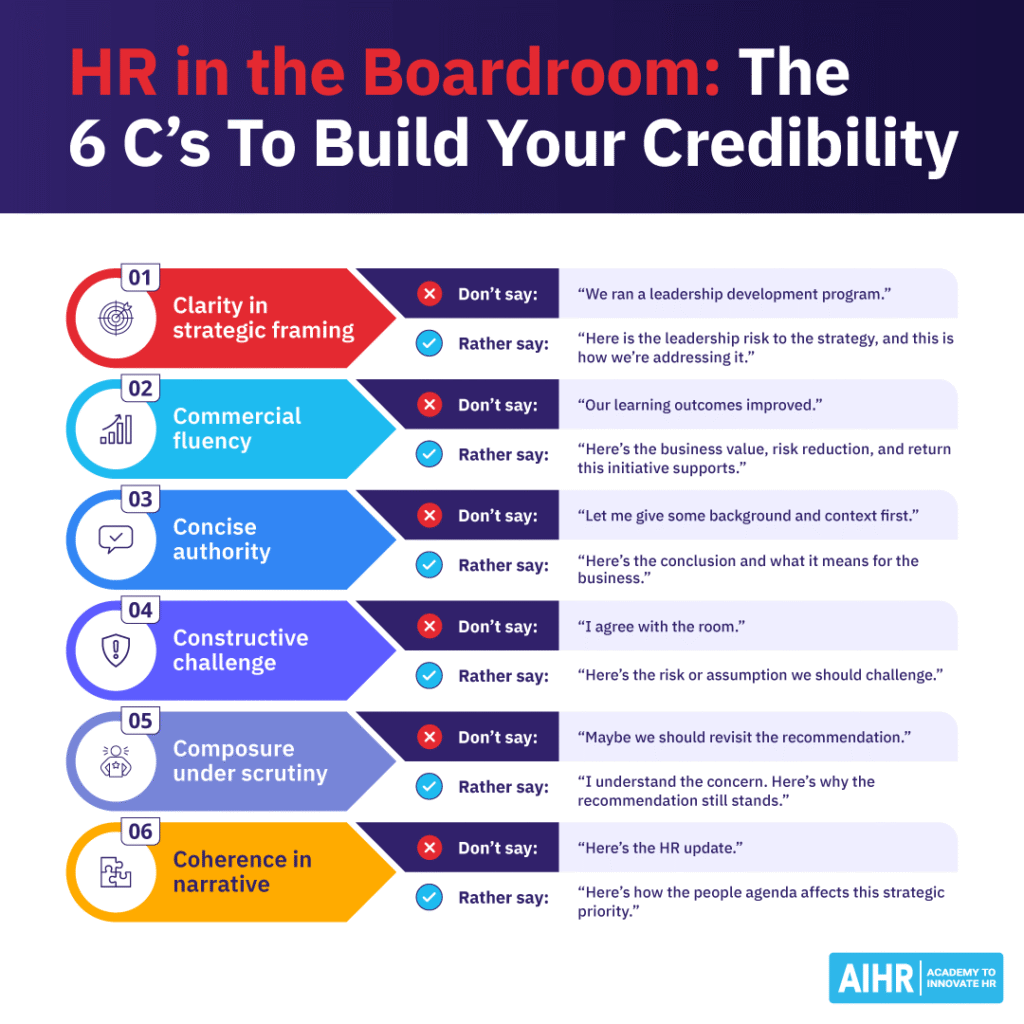
5. Composure under scrutiny
- Don’t say: “Maybe we should revisit the recommendation.”
- Rather say: “I understand the concern. Here’s why the recommendation still stands.”
When a non-executive challenges your data or your recommendation, don’t soften, qualify, or over-explain. Acknowledge the challenge. Listen to the concern and then stand on the substance.
Your ability to hold your position under pressure is one of the clearest signals of boardroom authority.
6. Coherence in narrative
- Don’t say: “Here’s the HR update.”
- Rather say: “Here’s how the people agenda affects this strategic priority.”
Connect the people agenda to the business story. You shouldn’t be a separate chapter in the board’s discussion; you should be a thread running through every strategic question on the table. If your contribution doesn’t connect to the issues the board is already holding, it’ll be heard as a sidebar.
This requires a different kind of preparation. You need to understand what the board cares about. The strategic priorities, the risks on the table, the decisions coming next quarter. Your job is to show how each person’s agenda connects to them, not as a parallel track but as a direct input.
If the board is discussing an acquisition, you’re there to name the capability gaps that will determine whether the deal delivers. If the board is reviewing a market expansion, your role is to assess whether the leadership pipeline can carry the growth. When the frame changes, your contribution changes with it.
Narrative coherence is also about conciseness. A long, detailed people update (even a well-structured one) loses the room if it doesn’t connect back to the central business question. Boards lose confidence not just when HR can’t answer questions, but when they can’t follow the argument.
Before every board appearance, ask yourself one question: What is the strategic issue this board is trying to resolve, and what does HR uniquely know about it? Start there. Build everything else around that answer.
How to build your boardroom presence as an HR leader
A single well-delivered boardroom performance doesn’t shift perception. Research from SAP and Oxford Economics found that 42% of C-suite executives still don’t view HR as an equal strategic partner, and 36% see HR as only slightly critical to business strategy. Perception moves through sustained, deliberate relationship work, long before any slide deck opens.
- Before the meeting: Pre-meeting conversations with individual board members matter more than your slide deck. Use them. Understand what each non-executive is worried about. Surface people risk in informal exchanges. By the time you walk into the room, the groundwork should already be laid.
- In the meeting: Know the one thing you need the room to leave believing — and build your entire contribution around that single idea. Practice positioning before preparation. Lead with consequence, not context.
- After the meeting: Treat every boardroom appearance as a data point. What landed? What didn’t? What would you do differently? Seek feedback from board members directly, not just from your CEO or your team. Build this into a deliberate improvement cycle.
- The longer game: Building boardroom presence isn’t only an individual responsibility. As AIHR’s research argues, it requires action at three levels: the individual HR leader developing the skills, the organization legitimizing the role and its mandate, and the profession collectively reframing what HR leadership means at the highest level.
In 2018, just 10% of independent directors in the Russell 3000 disclosed human capital qualifications on their boards. By 2024, that figure had risen to 25.5%, and to 38.3% in the S&P 500. Today’s board members care more about people matters than at any point in recent history.
But this also raises the bar. The boards you present to know considerably more about talent, workforce strategy, and people risk than the boards did five years ago. That means the expectations are higher, and the opportunity to make a real difference is greater than ever.
Waiting to be invited, waiting to have the title, waiting for that elusive chair — I can’t tell you how much the chair doesn’t matter. You’ve got to push yourself into that environment.
A call to action for HR leaders
The seat at the table has been won, but influence is earned. HR leaders, this is your moment to stop operating from a service mandate and start leading with strategic conviction. The board is ready for a voice that translates workforce risk into business risk and culture into a performance variable.
The path to real boardroom authority requires a deliberate shift:
- Own your mandate: Reframe your contribution from reporting on activity to shaping decisions about the organization’s capacity to perform.
- Embrace the 6C’s: Prioritize Clarity in strategic framing, Commercial fluency, Concise authority, and Constructive challenge. Your Composure under scrutiny and Coherence in narrative are the non-negotiable signals of your executive presence.
Your opportunity is greater than ever, but so are the expectations. Stop waiting for an invitation or a title. Push yourself into that environment, show up ready to define the organization’s future, and lead with the conviction of the expert you are.