

If you’re wondering which learning and development certifications are best, you’re likely deciding where to spend 30 to 60 hours of study, and anywhere from a few hundred to several thousand dollars to advance your career. The right L&D certification helps you build practical skills, shows employers what you can do, and matches your learning style.
There isn’t one best learning and development certification, because the best choice for you depends on your career stage, your job responsibilities, and how much time you can invest. This guide compares the top L&D credentials for 2026, and gives you a clear way to decide.
Contents
Why is learning and development important for HR?
The 9 best learning and development certifications in 2026
How to choose the best L&D certification for you
How L&D certifications connect to HR business partnering
Key takeaways
- When picking an L&D certification, consider your career stage, scope of work, and preferred learning format, instead of simply looking at their universal rankings.
- ATD’s CPTD and APTD are the most recognized credentials, while CIPD’s Level 5 Associate Diploma is the standard for L&D specialists in the U.K. and many other international markets.
- Academy-style L&D certificate programs like AIHR’s focus on applied capability, and offer recertification credits with SHRM, HRCI, HRPA, ATD, and CIPD.
Why is learning and development important for HR?
Learning and development (L&D) helps HR respond to changing skill needs across the business. Skills shortages, AI-related change, and retention concerns all create demand for better employee development.
For HR and L&D professionals, this means knowing how to spot skill gaps and translate them into learning priorities. You may need to review workforce data, speak with managers, or map skills to critical roles.
The need for capability development is also increasing. Employers expect 39% of workers’ core skills to change by 2030, according to the World Economic Forum. That gives L&D a clear role in workforce planning, not just training delivery. Learning opportunities can also support retention. When employees can build skills and explore internal growth paths, they have more reason to stay.
For HR professionals, this makes L&D a valuable area to develop. Skills in learning strategy, instructional design, analytics, and business partnering can help you support employees and strengthen your career.

The 9 best learning and development certifications in 2026
Instead of ranking programs against one another, we’ve ranked them by skills developmental goals to help you find the right program for you.
For HR professionals building strategic L&D capability
These programs are for HR and L&D professionals who want to build the end-to-end capability to run a learning function (strategy, design, analytics, and stakeholder partnering) in a single curriculum.
1. Level 5 Associate Diploma in Organizational Learning & Development (CIPD)
This CIPD Level 5 Associate Diploma is the gold-standard L&D qualification across the U.K. and many international markets, aimed at HR practitioners targeting mid-level L&D management roles.
- What you get: An undergraduate-level qualification (Level 5 RQF) built around three core units, three specialist units, and one optional unit, with written assignments of around 4,000 words each. On completion, you become an Associate Member of CIPD, and can use the post-nominals “Assoc CIPD”.
- Format and time commitment: Online or blended delivery through approved study centers over 12 to 18 months.
- Cost: U.K. fees typically range from £1,600 to £3,600, in addition to CIPD student membership (£57 for six months and £170 for 18 months).
- Best fit: L&D practitioners in the U.K., E.U., or markets where CIPD is the dominant HR body (especially those targeting mid-level L&D management roles).
2. Learning & Development Certificate Program (AIHR)
AIHR’s Learning & Development Certificate Program is for HR and L&D professionals who want to build practical skills to run a strong learning function (from strategy to measurement) without signing up for a multi-year diploma.
- What you get: A curriculum covering L&D strategy, designing digital learning experiences, skills gap analysis, and learning analytics, ending in a capstone project that walks you through a realistic organizational challenge.
- The program is recognized for 24 SHRM Professional Development Credits (PDCs), 24 HRCI (HR General) Credits, 30 HRPA Continuing Professional Development Credits (CPDs), and 24 ATD Continuing Education Units (CEUs).
- Format and time commitment: Fully online and self-paced, over approximately 36 hours of learning. Most participants complete the program in three to four months.
- Cost: $1,125 for standalone course enrollment, or $1,850 for Full Academy Access.
- Best fit: HR generalists, HRBPs, talent development (TD) specialists, and training managers who want to build practical L&D capability quickly without committing to a multi-year diploma.
For experienced talent development professionals
If you’ve already spent five or more years in talent development and want a senior-level credential that indicates your organizational impact to executive stakeholders, consider the following certification.
3. Certified Professional in Talent Development (ATD)
Issued by the ATD, the Certified Professional in Talent Development (CPTD) is the most recognized senior credential for talent development professionals in North America/ It’s grounded in ATD’s evidence-based capability standards.
- What you get: A credential built on ATD’s Talent Development Capability Model, which covers 23 capabilities across personal, professional, and organizational impact. Recertification is every three years through 60 CPDs.
- Format and time commitment: Proctored three-hour exam (no formal course needed). Eligibility requires at least five years of talent development experience and 60 hours of professional development in the previous five years. Most candidates study for 80 to 120 hours and have up to 18 months from their registration date to pass the exam.
- Cost: $1,099 for ATD members, $1,500 for non-members.
- Best fit: Senior TD practitioners and L&D leaders who have the experience to qualify and want a respected, exam-based credential focused on organizational impact.
Build the L&D skills to turn learning into measurable workforce impact.
AIHR’s Learning & Development Certificate Program helps you move from delivering training to designing learning initiatives that address real business and people challenges. You’ll build the practical skills to:
✅ Design an L&D strategy that aligns with business priorities
✅ Identify current and future skill gaps through structured analysis
✅ Create digital learning experiences that support learner needs
✅ Use learning analytics to measure the impact of interventions
For early-career L&D and TD practitioners
If you have around three years of hands-on training, instructional design, or learning coordination experience, this credential will give you formal recognition before you’re eligible for senior exams.
4. Associate Professional in Talent Development (ATD)
The Associate Professional in Talent Development (APTD) is ATD’s early-career counterpart to the CPTD, validating foundational talent development capability for HR practitioners with hands-on delivery experience.
- What you get: A credential grounded in the foundational areas of ATD’s capability model, which covers instructional design, training delivery, and learning technologies. Recertification is required every three years.
- Format and time commitment: Two-hour roctored exam. Eligibility requires three years of paid talent development experience and 28 hours of professional development in the previous three years.
- Cost: $525 for ATD members, $800 for non-members.
- Best fit: Training specialists, instructional designers, and L&D coordinators with three or more years in the field who want a recognized credential before they’re eligible for the CPTD.
For specialists in instructional design and delivery
These programs dive deeper into the craft of designing learning. They vary widely in terms of cost and length, so you can pick the level of financial investment and time commitment that best suits you.
5. Master Programs (ATD)
ATD’s Master Programs are intensive skill-builders in specific L&D capabilities. They’re useful for deepening expertise in different aspects of L&D, rather than earning a full professional credential.
- What you get: Master-level programs in instructional design, training delivery, talent strategy and management, performance consulting, and other relevant capabilities. Each focuses on specific capability areas, with a structured curriculum and applied exercises.
- Format and time commitment: Cohort or online delivery; typically five weeks of study per certificate, except the Master Trainer Program (eight weeks).
- Cost: $3,545 for members, $3,845 for non-members.
- Best fit: L&D professionals who already hold a broader credential and want to deepen specific capabilities, or practitioners moving into L&D from an adjacent role and requiring certain skills before tackling a full credential exam.
6. Introduction to Learning Experience Design (LXD) Specialization (University of Michigan)
Created by the University of Michigan and delivered through Coursera, this specialization focuses on the practice of designing engaging, evidence-based learning experiences. Its goal is to bridge instructional design with user-centered design principles for modern learners.
- What you get: A three-course series covering LXD and inclusive design principles, learning theories, and frameworks. An applied learning project walks you through building a professional design portfolio to showcase your skills, and you earn a shareable certificate from the university on completion.
- Format and time commitment: Fully online and self-paced through Coursera, with roughly 43 hours of content across three courses. Most learners complete it in four to 12 weeks, depending on their pace.
- Cost: Included in a Coursera Plus subscription for $59 per month or $399 per year. You can also enquire with Coursera regarding financial aid.
- Best fit: Aspiring or early-career LX and instructional designers, and L&D specialists who want a university-backed foundation in the science and practice of learning design.
7. MasterTrack Certificate in Instructional Design (University of Illinois)
Offered by the University of Illinois Urbana-Champaign College of Education in partnership with Coursera, this MasterTrack is a graduate-level certificate with credits that can be applied toward a full master’s degree in education.
- What you get: An eight-credit graduate certificate covering instructional system design, learning technologies, design models, and aligning technology choices with learning objectives.
- The certificate stacks into the University of Illinois Instructional Design, Technology & Organization Ed.M. program, and other College of Education degrees, making it a credible first step toward a master’s.
- Format and time commitment: 100% online, delivered in eight-week terms with multiple start dates per year in the fall, spring, and summer. Most learners complete the program across one to two semesters.
- Cost: Reduced tuition rate of $2,384; no GRE required for admission.
- Best fit: Aspiring and new learning and instructional design professionals who want a university-conferred graduate credential, particularly those considering a master’s degree in instructional design or educational technology.
For HR generalists and HR business partners who own parts of L&D
If your primary role is HR Generalist or HRBP, and L&D is one aspect of your work, these credentials signal full-professional HR competence, including L&D.
8. SHRM-CP and SHRM-SCP
While not specifically designated as L&D courses, these SHRM certifications cover the full HR body of knowledge, including employee learning, training, and development. This makes them a strong choice for HR generalists and HRBPs responsible for L&D.
- What you get: A credential grounded in the SHRM BASK (Body of Applied Skills and Knowledge), with employee development and learning culture sitting alongside broader HR functional areas. Recertification is on a three-year cycle through PDCs.
- Format and time commitment: Proctored, in-person exam at an authorized Prometric testing center. SHRM recommends at least 60 hours of preparation; most candidates study for three to four months prior to the exam.
- Cost: Each exam costs $399 for members and $499 for non-members, with early bird fees at $350 for members and $450 for non-members.
- Best fit: HR generalists and HRBPs who own parts of L&D and want a broad HR credential instead of an L&D-specific one.
9. PHR and SPHR (HRCI)
HRCI’s PHR and SPHR credentials cover the full HR profession, with a dedicated “Human Resource Development” functional area that offers an L&D-adjacent path for HR generalists and senior HR leaders.
- What you get: A credential covering the full HR body of knowledge, including a Human Resource Development functional area that overlaps directly with L&D content. Recertification is through CEUs on a three-year cycle.
- Format and time commitment: Proctored exam. Eligibility varies by credential; the PHR requires one to four years of HR experience (depending on education), and the SPHR requires four to seven years.
- Cost: The PHR costs $495, and the SPHR costs $595 (each includes a $100 application fee).
- Best fit: HR generalists and HRBPs who want their L&D scope recognized as part of a broader HR credential, especially in U.S.-anchored organizations.
How to choose the best L&D certification for you
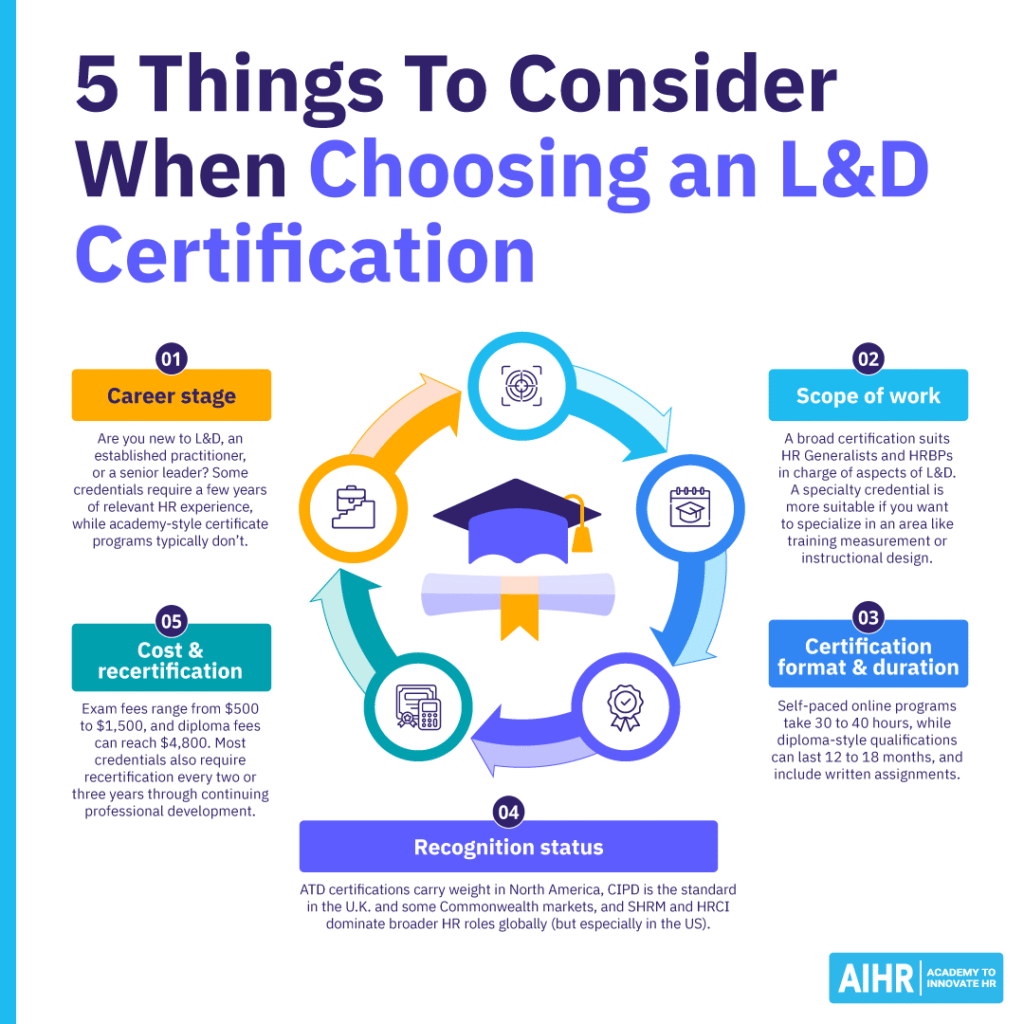
Before you compare L&D programs, consider the following factors:
Career stage
Are you new to learning and development, an established HR practitioner, or a senior HR leader responsible for shaping strategy? Some credentials require three or five years of relevant experience. Academy-style certificate programs typically don’t, which makes them more accessible if you’re moving into L&D from an adjacent Human Resources role.
Scope of work
Learning and development encompasses a wide range of areas, including strategy, instructional design, training delivery, learning technologies, coaching, and learning analytics. A broad certification is good for HR generalists and HRBPs who handle different parts of L&D. If you want to work in a specific area like instructional design, training measurement, or LX design, consider a specialty credential.
Format and time commitment
Self-paced online certificate programs like AIHR’s Learning & Development Certificate Program (typically lasting about 30 to 40 hours) suit busy professionals who want to apply practical skills to their jobs as they learn. Exam-based credentials, on the other hand, require dedicated study and proctored exams. Additionally, diploma-style qualifications can span 12 to 18 months, and include written assignments.
Recognition
Will employers in your market recognize your credential of choice? ATD certifications carry weight across North America, and CIPD is the standard in the U.K. and many Commonwealth markets. SHRM and HRCI dominate broader HR roles mainly in the U.S. At the same time, AIHR is recognized by SHRM, HRCI, HRPA, CPHR, ATD, and CIPD for recertification credits.
Cost and recertification
Exam fees alone range from roughly $500 to $1,500, while diploma fees can reach $5,000. Most credentials also require recertification every two to three years through continuing professional development. It’s important to assess all these different costs and factor them into your budget, not just look at the headline price.
How L&D certifications connect to HR business partnering
If you’ve worked in or around the modern HRBP role, you’ve probably seen how HRBPs are now expected to turn business strategy into people strategy. L&D is one of the main tools they use, either directly or by working with a center of excellence (CoE).
This is a useful way to think about choosing your certification. Not everyone in HR has the HRBP title, but every HR professional is expected to act as a business partner. This means understanding the business, asking better questions, and shaping practices that improve performance.
An L&D specialist who understands their company’s business needs can design more relevant learning programs. In the long run, the most valuable certifications help you connect learning design to business strategy, learning analytics to measurable results, and skills gap analysis to workforce planning.
If you work in a CoE L&D role, a more advanced L&D credential shows your expertise. If you’re in an embedded HRBP role with L&D responsibilities, you’ll benefit more from a strategic HR credential combined with focused L&D training. Your main stakeholders would be line managers who are highly focused on business results.
If your role is mainly HR business partnering, the fastest way to build credibility may be to complete a strategic HRBP program, along with shorter L&D training, instead of a 12-month diploma.
If your role is mainly L&D, a more advanced credential like CIPD Level 5, ATD’s CPTD, or AIHR’s Learning & Development Certificate Program is a better fit. You can also add a SHRM or HRCI credential later if you want to broaden your HR career options.
Next steps
Choose the certification that matches your current experience, not just your future goals. For instance, if you have a few years in L&D or a related HR role and want a recognized credential without a 12-month commitment, AIHR’s Learning & Development Certificate Program is a good option.
No matter which path you take, the main idea stays the same: the best learning and development certification is the one you will complete, use in your job, and keep renewing as you keep learning and growing.