
A capability assessment is an important tool to determine how prepared your workforce is for future business needs. With 44% of workers’ core skills expected to change by 2027, you should know not just what your workforce can already do, but also how capable they are of applying their expertise and adapting to changing roles.
When well-designed, they help identify strengths, uncover capability gaps, prioritize reskilling, and make better decisions about hiring, promotions, and workforce planning. This article details what capability assessments are, the benefits they can bring about, how you can use them effectively, and which tools can help you implement them in your organization.
Contents
What is a capability assessment?
6 types of capability assessments
How to conduct a capability assessment: 9 steps
Types of capability assessment tools to consider
Key takeaways
- Capability assessments measure whether employees can apply their knowledge, behaviors, and experience to deliver results in real work situations.
- HR plays a critical role in designing the framework, ensuring fair assessments, and translating results into practical workforce decisions.
- Different types of capability assessments serve different purposes, from hiring and promotions to succession planning and leadership development.
- Companies that turn assessment insights into learning, mobility, and hiring strategies see the greatest positive impact.
What is a capability assessment?
A capability assessment is a structured process you can use to evaluate whether individual employees or entire teams can perform the work a company needs, both today and in the future. It helps answer a critical question for HR and leadership: Do we have the capability to execute our strategy?
An employee capability assessment looks beyond simple skill checklists and evaluates a broader combination of factors. These include skills, knowledge, behaviors, experience, and the ability to apply these in real-world work situations.
There’s also a distinction between skills and capabilities. A skill is a specific ability, like using Excel or writing code. A capability, on the other hand, is broader. It indicates how skills, knowledge areas, and behaviors combine to drive effective performance.
For instance, data-informed decision-making is a capability that requires analytical, business understanding, critical thinking, and communication skills.
Capability assessments help you answer questions like:
- Which teams are ready to take on strategic initiatives?
- Where are the biggest capability gaps in our workforce?
- Which employees are ready for promotion or new roles?
- What skills should we prioritize in hiring or learning programs?
Having a data-driven understanding of workforce strengths and gaps allows you to make better learning investments and build suitable talent pipelines. In this way, capability assessments support internal mobility, succession planning, reskilling and upskilling, performance management, and strategic workforce planning.

HR’s role in capability assessments
When it comes to capability assessments, HR typically has to define capability standards, create structured assessment frameworks, and ensure the process minimizes bias. You may also need to set timelines, communicate expectations, and train managers on how to evaluate capability fairly.
Capability assessments can generate sensitive talent data. As such, you might need to help ensure proper data governance, access controls, and documentation practices to maintain compliance with privacy and employment regulations.
Finally, you might also have to translate insights. Assessment results only matter if they lead to action, so it’s crucial to be able to translate insights into concrete plans like learning initiatives, internal mobility opportunities, or succession pipelines.
6 types of capability assessments
In practice, companies use several approaches to capability assessments, depending on their goals and business needs. Here are the six most common types of capability assessments HR teams use:
1. Role-based assessment
A role-based capability assessment measures how well an employee’s capabilities align with the requirements of a specific role. For example, a company might define capabilities required for a Senior HRBP, then assess employees against these standards to determine their suitability for the role.
This approach works well for promotions and role progression, hiring alignment, and job- leveling parameters. Managers might rate employees on defined role capabilities using a scale (e.g., developing, proficient, or advanced). The key advantage is clarity, as employees know exactly what is required to move into a role.
2. Skills-based assessment
A skills-based capability assessment focuses on identifying and validating employee skills across the company. It usually involves two components: a skills inventory (where employees declare their skills) and validation (where the company verifies those skills through projects, certifications, tests, or work samples).
This is useful for companies building internal talent marketplaces or project-based staffing models. For instance, you may need to quickly identify staff with experience in data visualization or agile project management. The biggest risk here is relying too much on self-reporting. Without validation mechanisms, skills data may be unreliable.
3. Performance and potential
The well-known 9 box grid can act as a capability signal, even though it doesn’t measure capability directly. It evaluates employees based on both their current performance and future leadership potential. Together, these indicators help identify employees who may be ready for expanded responsibilities.
For example, an employee who’s demonstrated high performance and potential may be ready for leadership roles. An employee who’s demonstrated high performance but moderate potential, on the other hand, may be suitable for a strong specialist track.
For HR, the 9 box grid is most valuable in succession planning and leadership development discussions. However, you should combine it with other capability assessments to get a fuller picture.
4. Competency-based assessment
A competency-based capability assessment evaluates employees against a defined set of competencies, typically behavioral indicators that reflect how work gets done. Examples include customer focus, strategic thinking, collaboration, and problem-solving
Some organizations use competency assessments to help ensure consistent expectations. For HR teams, this type of assessment helps standardize performance conversations and development plans. The challenge is keeping competency frameworks relevant and simple enough for managers to use effectively.
5. 360 degree feedback
A 360 degree assessment gathers feedback from multiple individuals, including managers, peers, direct reports, and, where relevant, customers or stakeholders. This provides a more balanced view of employee soft skills, especially for leadership roles that prioritize collaboration and influence.
For example, a leader may rate themselves highly on communication, while peers or team members disagree. HR often uses 360-degree assessments for leadership development, coaching, and culture and collaboration initiatives. However, keep in mind that these assessments require careful facilitation to avoid bias or interpersonal tension.
6. Work sample or job simulation assessment
Work sample or simulation assessments are among the most predictive forms of capability assessment because they evaluate how someone performs realistic job tasks. Examples include asking candidates to analyze a dataset and present insights, simulating a difficult employee conversation, and running a strategy case exercise.
These assessments are particularly effective for hiring decisions, promotions into critical roles, and high-stakes internal mobility. While simulations require more effort to design, they offer a clearer picture of real capability than theoretical tests or interviews. These assessments and work samples are becoming more popular in use.
Learn to assess workforce capabilities fairly and accurately to support robust talent pipelines and effective succession planning.
AIHR’s Talent Management & Succession Planning Certificate Program will teach you to:
✅ Use the 9 box grid to create detailed, accurate talent maps for your company
✅ Employ effective methods to identify, develop, and engage tomorrow’s leaders
✅ Take advantage of capability and skills maps to determine talent demand
How to conduct a capability assessment: 9 steps
Running a successful capability assessment requires a structured process that promotes clarity, fairness, and actionable results. Here’s a practical step-by-step approach you can take:
Step 1: Start with the business goal
Begin by identifying the strategic questions the assessment should answer. For instance:
- Are we ready to scale our digital capabilities?
- Which employees are ready for leadership roles?
- What skills do we need to support AI initiatives?
Without a clear goal, assessments become data collection exercises with little business value.
Step 2: Pick the scope
Decide whether the assessment will focus on:
- A specific function (e.g., HR, sales, engineering)
- Leadership roles
- A strategic capability like data literacy.
Starting with a focused scope makes the process easier to manage and learn from.
Step 3: Define what “good” looks like
Next, establish clear capability definitions and rating criteria, such as beginner, developing, proficient, or expert. Then provide concrete behavioral examples that demonstrate employee capabilities. This allows managers to consistently and objectively evaluate these capabilities. It also shows employees interested in roles they aren’t yet qualified for what they must work towards.
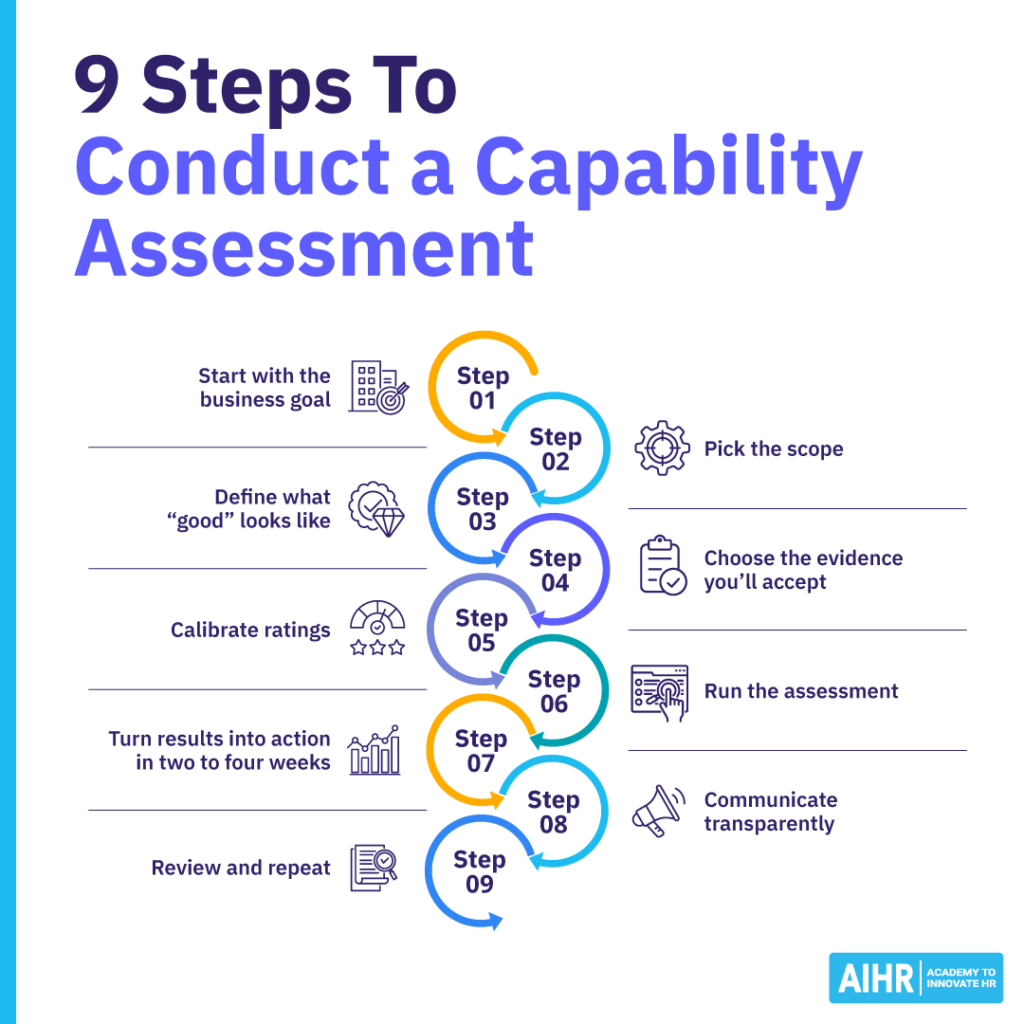
Step 4: Choose the evidence you’ll accept
Decide on what evidence you’ll use to prove capability. This may include work samples, manager assessments, certifications, peer feedback, or project outcomes. This step confirms that the assessment reflects real work and behaviors, rather than perception or hearsay alone. Doing so assures employees that the assessment is evidence-based and fair.
Step 5: Calibrate ratings
Before finalizing results, run calibration sessions, which require managers to review ratings together. Calibration helps reduce bias, provides a consistent interpretation of capability levels, and aligns leaders on talent standards. As part of the HR department, either you or a team member (or both of you at the same time) could facilitate these sessions.
Step 6: Run the assessment
At this point, the assessment process can begin. This can include manager evaluations, employee self-assessments, skills tests, and 360 degree feedback surveys. Using a structured capability assessment tool can make data collection and analysis easier. To get more reliable results, ensure everyone involved understands the assessment’s purpose and criteria.
Step 7: Turn results into action in two to four weeks
Speed matters. If insights sit unused for months, the assessment loses credibility. Within a few weeks, you should translate the findings into clear actions, such as learning programs, internal mobility opportunities, hiring priorities, and leadership development initiatives. Assigning clear owners to each action can help maintain momentum and ensure follow-through.
Step 8: Communicate transparently
Communicate transparently throughout the process. Employees should understand why the assessment happened, what the results mean, and how the organization will use them. Clear communication and transparency build trust and encourage engagement with development plans. This is also a good time to explain what support they can expect after the assessment.
Step 9: Review and repeat
Review and repeat the assessment regularly. Capabilities change and grow quickly, so your organization would benefit from running capability assessments annually or every two years. Treat it as an ongoing workforce intelligence system, not a one-time project. Regular reviews also make it easier to track progress and adjust workforce plans as business needs change.
Types of capability assessment tools to consider
Choosing the right capability assessment tool depends on your organization’s size and technology stack. Your company could benefit from a combination of tools, rather than relying on a single platform. Here are several common options.
HRIS talent modules
HRIS talent modules are often the starting point for organizations that want to track capabilities within existing HR systems. Many HR systems include basic capability tracking features.
Best for: Storing employee capability profiles and linking capabilities to job roles.
Watch out for: Limited analytics or skill validation features.
Ownership: HR and HRIS teams.
Skills intelligence platforms
These platforms help organizations build a broader and more dynamic view of workforce capabilities. Skills intelligence platforms use AI to infer and organize skills across the workforce.
Best for: Building dynamic skill taxonomies and identifying emerging capability gaps.
Watch out for: Over-reliance on inferred data without validation.
Ownership: HR, L&D, and sometimes, IT.
LMS and learning experience platforms
These tools are useful when the main goal is to connect assessment insights with employee development. They can help connect capability gaps with relevant development opportunities.
Best for: Personalized learning paths and reskilling initiatives.
Watch out for: Learning recommendations that don’t reflect real capability needs.
Ownership: L&D teams.
Performance management platforms
Performance management platforms can support capability assessments by adding structure to manager reviews and talent discussions. They often include manager rating systems and calibration workflows.
Best for: Structured performance and capability discussions, and talent reviews.
Watch out for: Managers who may conflate performance with capability.
Ownership: HR and people managers.
360 degree feedback tools
These tools collect feedback from multiple raters to provide deeper insight into leadership capability and provide a more rounded view of leadership and interpersonal strengths.
Best for: Leadership development and collaboration-focused roles.
Watch out for: Feedback overload (if overused).
Ownership: HR and leadership development teams.
Assessment platforms
Assessment platforms are best suited for situations where organizations need more direct evidence of skill or capability. They provide structured testing and simulation capabilities.
Best for: Hiring assessments, job simulations, and skills validation.
Watch out for: Poorly designed tests that don’t reflect real work.
Ownership: HR, talent acquisition, and L&D.
Internal talent marketplace platforms
Talent marketplaces help organizations put capability data into action by connecting people with opportunities inside the business. They match employee capabilities with internal projects and roles.
Best for: Internal mobility, project staffing, and career development.
Watch out for: Low adoption if managers resist sharing talent.
Ownership: HR and talent management teams.
A simple stack for smaller organizations
Smaller organizations don’t always need specialized platforms to run a useful capability assessment process. Small HR teams can still run effective capability assessments using:
- Structured spreadsheets
- Standardized assessment forms
- A simple analytics dashboard,
Ultimately, it comes down to having clear capability definitions and a consistent process.
To sum up
Capability assessments provide a clear, evidence-based understanding of workforce readiness, which is incredibly valuable for HR and the organization as a whole. Instead of relying on assumptions or perception, you can accurately identify strengths, close capability gaps, and align talent strategies with business goals.
Remember, however, that the real impact comes from what happens next. When you can translate capability insights into learning opportunities, internal mobility, and smarter hiring decisions, capability assessments become a reliable and powerful tool for building your future workforce.