
Organizations aren’t struggling to “get people to try AI” anymore. HR is dealing with a messier reality: AI use is already underway, unevenly and unofficially, while business expectations keep rising.
You’ll see pockets of quick wins, even in your HR teams (drafting job ads, summarizing policies, or crafting employee communication), but also familiar blockers. Employees may be uncertain about which data can be used, inconsistent access to tools, concerns from IT and Legal, and a growing gap between experimentation and workflows that are safe, repeatable, and measurable.
An AI hackathon helps solve some of this. It creates a short, focused window where teams can come together and build something tangible around real business workflows, demo it to stakeholders, and create momentum to continue building and experimenting. Done well, it’s also one of the fastest ways to go from experimentation to scalable AI solutions that people can actually use.
This article shows you how your HR team can run an AI hackathon that drives adoption, including a practical case study of how we structured our own AI Hackathon at AIHR.
Contents
What is an AI hackathon?
Should your AI hackathon be company-wide or function-led?
The AI hackathon format that worked well for AIHR
Free AI hackathon playbook
How your HR team can run a successful AI hackathon
AIHR case study: How we ran our AI hackathon
Key takeaways
- Use an AI hackathon to move from AI awareness to workflow change, with demos that stakeholders can sponsor and scale.
- Set guardrails before build day so teams can move fast without creating data, privacy, or compliance risk.
- Judge for usefulness and feasibility, not novelty, so “winning” projects are easy to operationalize.
- Plan capability building and follow-through upfront so hackathon prototypes turn into repeatable workflows.
What is an AI hackathon?
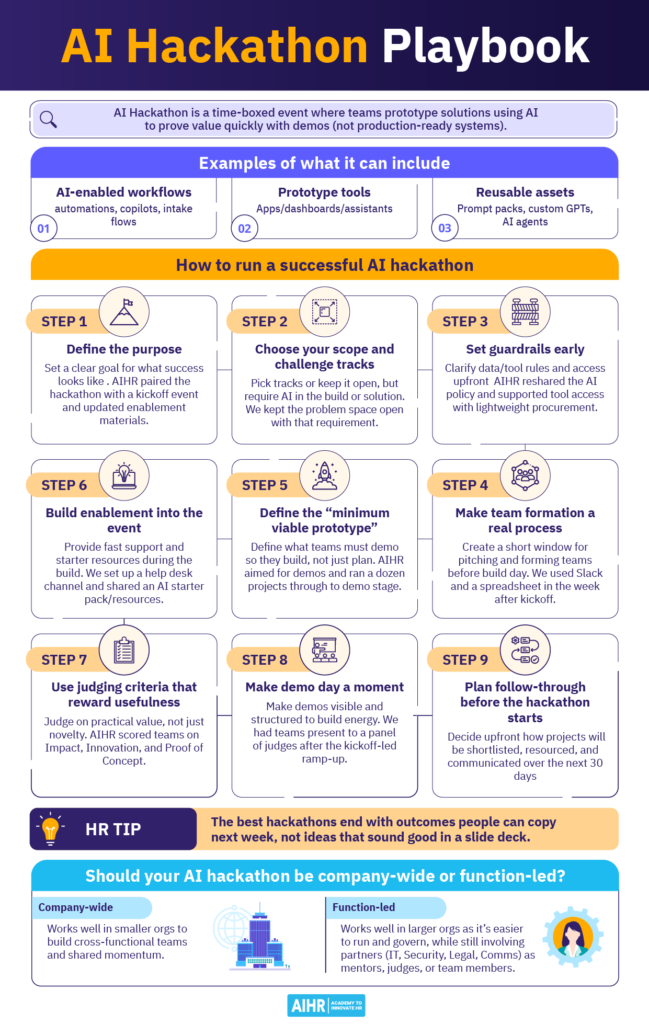
An AI hackathon is a time-boxed event where teams prototype solutions using AI. The goal is not to build perfect, production-ready systems in one or two days.
The goal is to build demos and prototypes that prove value quickly and give your organization concrete examples of what’s possible.
That can include:
- AI-enabled workflows (automations, copilots, intake flows)
- Prototype tools (internal apps, dashboards, assistants)
- Reusable assets (prompt packs, custom GPTs, AI agents).
The best hackathons end with outcomes people can copy next week, not ideas that sound good in a slide deck.

Should your AI hackathon be company-wide or function-led?
There’s no single best format. It depends on your organization’s size and how you want adoption to spread.
If you’re a smaller organization: Go company-wide
A company-wide AI hackathon can work well in smaller orgs because you can build cross-functional teams (HR, Ops, Product, Commercial, Marketing).
Your HR team will still need IT buy-in for tool access and integrations, and security and legal sign-off before your build day.
If you’re a larger organization: Run a function-led hackathon
A function-led AI hackathon is often easier to run and easier to govern in larger organizations.
For example, your HR team can run a focused hackathon to improve HR workflows and the employee experience, while still inviting cross-functional partners (IT, Security, Data, Legal, Comms) as mentors, judges, or team members.
Function-led doesn’t mean each team or department builds alone. It means the team owns the problem definition and adoption, while your partners make sure the solutions are feasible and compliant.
What we did at AIHR
As a mid-sized company, AIHR started with a company-wide hackathon to build a common vocabulary, shared momentum, and internal examples. From there, departments were encouraged to run their own versions later with a tighter scope.
An organization-wide AI hackathon can be a great catalyst. It helps employees experiment, build prototypes, and share what’s possible. But for the hackathon to translate into real, sustained business impact, HR has to be ready to lead.
AIHR’s AI for HR Boot Camp is built for HR teams and helps you:
✅ Build AI mindset, culture, and capability across the HR function
✅ Ensure safe and responsible AI usage
✅ Automate repetitive tasks and admin to boost efficiency
✅ Track progress, impact, and ROI with the AI Adoption Scan
Explore the AI for HR Boot Camp for teams.
The AI hackathon format that worked well for AIHR
We chose a simple format that worked well for our first AI hackathon.
In the week before the hackathon, HR scheduled a kickoff event to explain the hackathon format. Employees could then pitch ideas, and HR compiled them on a single sheet. Employees could then explore all of the ideas and join a team to participate in a specific build that would interest them
The following week, HR hosted the hackathon build day. The team presented the workflow they would be developing and split off across the company to explore together. AI Champions (employees with more advanced AI skills) circulated amongst the groups to lend support, answer security questions and risk concerns, or enable access to tools and APIs.
The team builds were followed by a demo-half day, where each team could present their workflows. Teams were encouraged to present even if the build was not successful, to showcase challenges and share learnings. The best builds were judged with a celebration afterward.
Free AI hackathon playbook
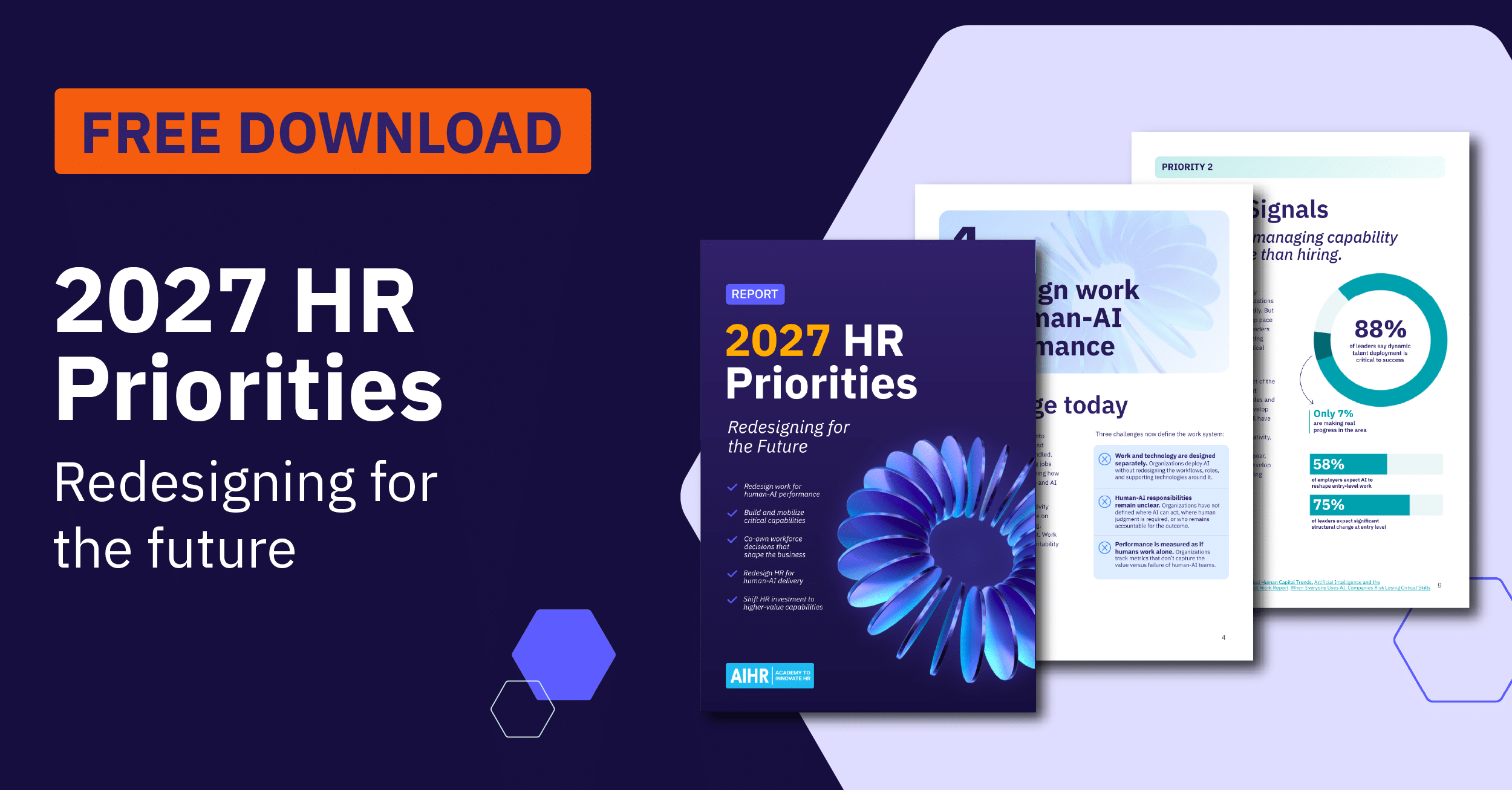
We’ve developed a quick reference AI hackathon playbook you can download to help guide your first AI hackathon:
How your HR team can run a successful AI hackathon
Step 1: Define the purpose
Be explicit about what you want out of the hackathon. Common goals could include:
- Increase practical AI usage in day-to-day work
- Generate prototypes worth scaling
- Create reusable assets (prompt packs, custom GPR, workflows)
- Identify champions who keep building after the event
- Build confidence, excitement, and momentum across teams.
The core purpose for AIHR’s hackathon was adoption: Get people using AI themselves, generating ideas, and seeing what’s possible.
Step 2: Choose your scope and challenge tracks
You can leave the problem space open, but teams do better when they have a few tracks to choose from.
Examples that work well across functions:
- Productivity: Reduce repetitive work and admin.
- Customer impact: improve customer experience and outcomes.
- Operations: Improve internal systems, handoffs, and clarity
- Learning and enablement: improve how people learn and apply skills.
- Insights: Turn messy information into decisions faster.
We intentionally allowed a broad problem space (workflow hacking, customer solutions, product features), with one simple rule: solutions must leverage AI in some way.
If you want HR-specific inspiration, AIHR’s overview of generative AI in HR use cases can help teams start with proven workflow categories
Step 3: Set guardrails early
This is where your AI hackathons could go wrong if due consideration hasn’t been given beforehand.
If teams don’t know what they can use, what data is allowed, and what tools are approved, they either:
- Take risks, you’ll have to shut down later, or
- Hold back and produce safe but shallow outputs.
Create a one-page “rules of the game” covering:
Data rules:
- What data is allowed (synthetic, anonymized, public)
- What data is not allowed (employee personal data, confidential customer data, proprietary docs unless approved)
- What redaction/anonymization is required.
Tool rules:
- Approved models and tools
- Whether external integrations are allowed
- How credentials and access will be handled.
AIHR’s hackathon prep included resharing our AI policy and setting up an AI support squad to help teams get unstuck.
Step 4: Make team formation a real process
Don’t leave team formation and ideation for the day of the hackathon. Give employees the opportunities to think about workflows they believe are worth experimenting with, and those that may not have a clear idea, the opportunity to join in on an idea that interests them.
A simple system can work well here:
- Share a spreadsheet or board for idea pitches
- Include clear roles: team captain, domain expert, contributor
- Set a deadline for teams to form (ideally 2–3 days before build day).
We ran a pre-hackathon week where people pitched ideas asynchronously using a shared spreadsheet, and cross-functional teams formed around these.
Practical tip:
- Keep teams cross-functional by default in smaller organizations
- In larger organizations, encourage cross-functional support even if the hackathon is function-led.
Step 5: Define the “minimum viable prototype”
If you don’t define what a prototype is, you’ll get two extremes: teams that overbuild and run out of time, or teams that deliver a concept slide.
Specify what the minimum viable output expectations are. For example:
- A short demo (3–6 minutes)
- A walkthrough of the workflow or user journey.
AIHR’s HR team communicated that the event would be followed by live demos presented to judges at the end of the build day.
Step 6: Build enablement into the event
Even if your hackathon is designed for advanced experimentation, teams still need fast support.
Provide:
- A starter pack with patterns (prompt pack examples, workflow examples, “how to prototype quickly”)
- A help desk (MS Teams/Slack channel) for blockers
- Office hours with a few AI-savvy mentors.
We created an “ask-ai-helpdesk” style channel and a designated support team to unblock participants quickly.
Step 7: Use judging criteria that reward usefulness
Judging criteria shape behavior. If you focus too much on novelty, teams build flashy demos instead of something that creates real value for the business.
Define a practical set of criteria, like:
- Impact: What business value does this create? How much time does it save, what risk does it reduce, what experience does it improve?
- Innovation: Is the approach meaningfully new or clever in how it applies AI?
- Proof of Concept: Does it work in practice? Can someone realistically build on it after the hackathon?
Also consider award categories that increase engagement, for example, judges’ choice, people’s choice, best workflow, most scalable, or best use despite constraints.
Step 8: Make demo day a moment
Treat the demo day like a mini launch.
- Invite leaders and stakeholders who can sponsor follow-through
- Keep demos short and structured
- Celebrate participation, not just winners.
We intentionally included celebration as part of the event, not as an afterthought, to help encourage AI adoption.
Step 9: Plan follow-through before the hackathon starts
One of the biggest challenges for HR and managers is continuing to drive adoption. While the hackathon is a great initiative to drive adoption on the day, continued use will taper post the hackathon if you don’t plan beforehand on how you will continue to encourage adoption across the organization.
Before the event begins, decide:
- Who will shortlist the projects to scale
- What the next 30 days look like
- Who can allocate time, budget, or engineering support if needed
- How you will communicate outcomes.
A simple follow-through model for HR and managers could include selecting one to three projects to be executed, assigning an owner per project, and. publishing a “what shipped” update at day 30.
This is also the point where organizations may realize they need team-wide capability building. Scaling will stall ff the same two or three people keep owning every AI workflow.
AIHR case study: How we ran our AI hackathon
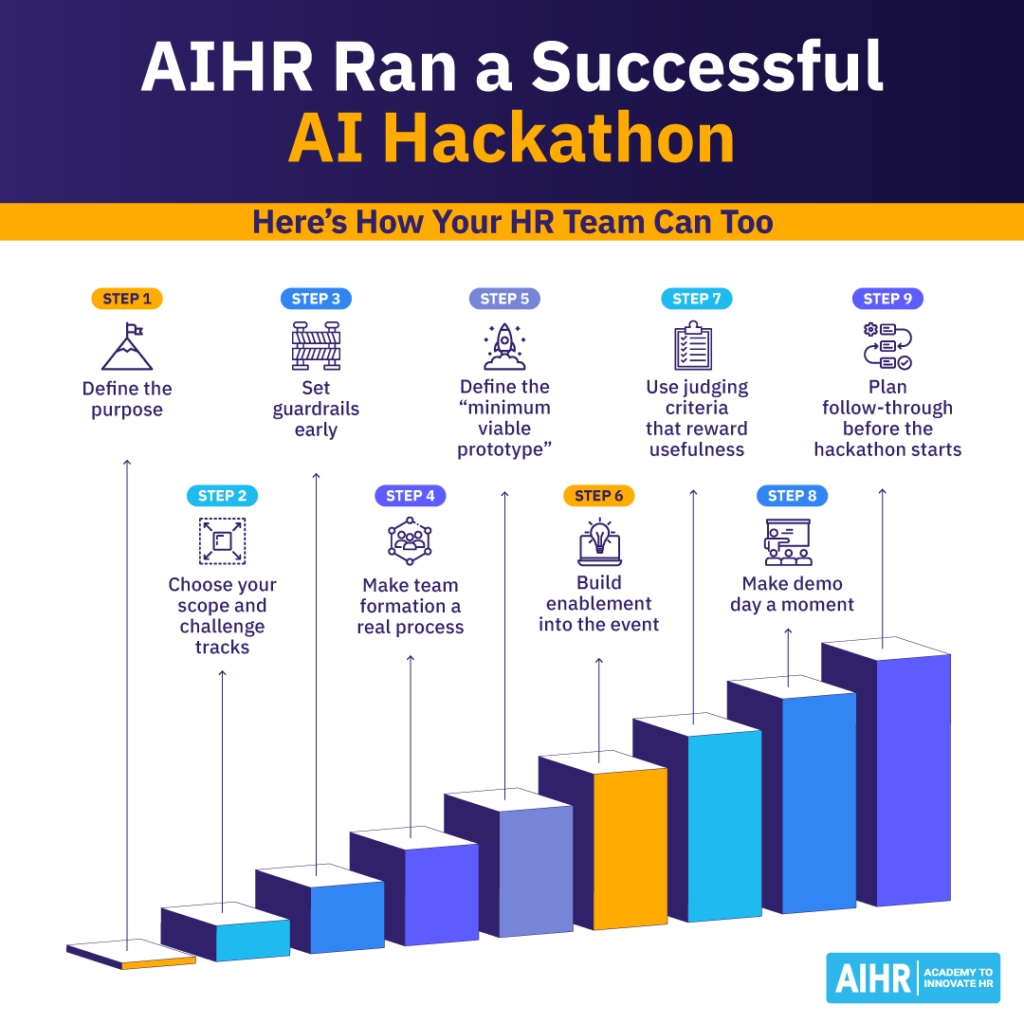
Here’s the structure we used at AIHR, based on our internal proposal and materials.
1. We paired a kickoff event with the hackathon
The hackathon wasn’t announced in isolation. We created the moment first.
Week 1: Kickoff event
- Recap key learnings from our AI transformation work to date
- Internal presentations showing how teams already use AI
- A panel component (internal or including external voices)
- Announcement of the hackathon and the start of team formation.
We aligned the kickoff with the release of updated AI resources and enablement materials.
2. We used a pre-hackathon team formation window
People pitched ideas asynchronously and teams formed around them using a shared system (Slack + spreadsheet) in the week between kickoff and build day.
We didn’t restrict the problem space, but we required that solutions leverage AI either in the build process or in the solution itself.
3. We put support structures in place
Our prep list included:
- team formation process and comms
- a help desk channel to unblock teams
- cancel all internal meetings
- resharing the AI policy
- an AI starter pack
- tool access and lightweight procurement support.
4. We used clear judging criteria
Teams presented to a panel of judges and were evaluated on:
- Impact
- Innovation
- Proof of Concept.
5. We generated breadth of ideas, then focused on demos
We generated over three dozen project ideas for people to join, and successfully ran around a dozen projects through to the demo stage.
That shape is common and healthy: lots of ideation up front, then a smaller set of executed demos at the end.
To sum up
An AI hackathon is a practical adoption accelerator. It moves AI from “interesting” to “useful” by forcing teams to build, test, and demo real workflows in a short time window.
If you want the hackathon to create a lasting impact, treat it as part of a bigger system. Set guardrails early so teams can move fast without risking privacy, data security, or compliance. Build a path to scale with owners, success metrics, and a 30-day plan before demo day happens. Invest in team-wide capability – including within your own HR team, and not just champions, so adoption doesn’t bottleneck.