

If you’ve ever been in charge of a small HR department, your team has probably spent excessive time on administrative work instead of strategic priorities like hiring, engagement, and retention. The good news is that there is an inexpensive yet effective way to change this — free HR templates for small businesses.
HR templates help save time, increase efficiency, standardize processes, and promote consistency and fairness. This article explores their specific benefits in different areas of HR, and best practices for using such templates. It also points you to 27 of AIHR’s free HR templates you can download for free and customize to fit your team’s and organization’s needs.
Contents
Why should you use HR templates?
27 free HR templates for small businesses
– Sourcing, recruitment, TA, and hiring
– Workforce information and administration
– PTO and vacation
– Performance and talent management
– Compensation and benefits
– Disciplinary process
– Exit and offboarding
12 best practices for using HR templates in small businesses

Why should you use HR templates?
HR templates can give your HR team and overall organization more structure and leverage. They allow you to deliver more consistent, professional HR support without reinventing the wheel every time a manager, employee, or department needs something. Here’s how free HR templates support you in a small business environment:
Immediate time-saving
Writing job postings, offer letters, or checklists from scratch is one of HR’s most time-consuming tasks. Templates give you a starting point that’s already structured, accurately worded, and ready for you to tailor to your specific business needs. This helps you save time and effort and reduces the stress on your team.
Consistency across managers
In small businesses, people management can vary greatly from one manager to the next. HR templates can help standardize how managers communicate across the board, evaluate employee performance, approve time off, and document issues and processes. This consistency supports fairness, clarity, and trust, and ultimately, minimizes compliance risks.
Reduced legal and compliance risk
HR issues often start with poor wording, incomplete, or missing documentation. Templates can help you structure conversations and make decisions more carefully, especially in sensitive areas like discipline, termination, and compensation. While templates don’t replace legal advice, they can reduce risk by guiding managers through processes to ensure compliance.
Facilitating HR self-service
Providing managers with ready-to-use HR forms and HR documents reduces dependence on HR for every little request. Instead of asking you for guidance whenever they have to do something for the first time, managers can have the information they need at their fingertips thanks to clear forms, checklists, or guides. This frees you up to focus on more strategic work.
Improved employee experience
Employees feel safer and more supported when processes at work are clear, consistent, and predictable. Templates help minimize ad hoc decisions by creating consistency throughout the entire employee life cycle — from hiring all the way to exit. This way, all staff will know what to expect in most circumstances, allowing them to feel more secure and assured at work.
More scalable HR
As your company grows, informal ways of working are likely to stop working. HR templates help turn “how we do things” into standardized, repeatable workflows that remove unnecessary pressure on your team. This means growth doesn’t automatically mean chaos, and new managers and employees don’t need to deal with the uncertainty of guessing how HR works.
Better documentation and data quality
Inconsistent or incomplete documentation prevents you from keeping detailed records or identifying trends in employee sentiment (among other issues). Structured templates make it easier to capture information accurately and consistently. This helps improve record-keeping and allows you to spot patterns, risks, and development needs over time.
HR can excel more easily
Well-developed HR templates make good HR practices accessible. They can help reduce the friction of “doing HR properly” by making it as simple as filling in a form, which is critical when time, expertise, or confidence is limited. Bear in mind, of course, that HR templates should also be updated in line with changing business needs and labor regulations to remain effective.
27 free HR templates for small businesses
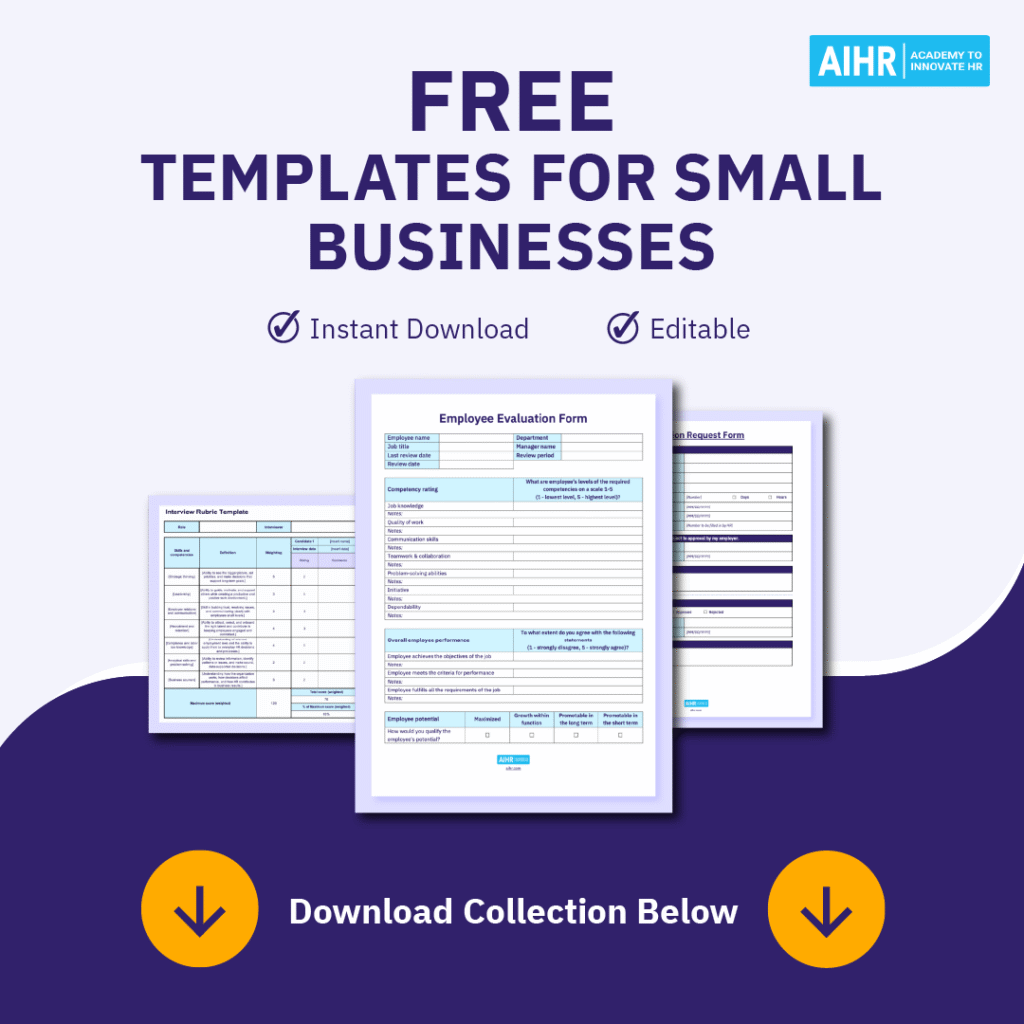
AIHR has designed a wide variety of free HR templates specifically for HR professionals working in small businesses and lean teams. These templates are practical, ready-to-use tools and resources built around real HR workflows.
They cover essential HR functions like recruitment, contracts, leave management, performance reviews, compensation, discipline, and offboarding. Instead of building everything from scratch, you start with proven structures that reflect best practices.
Additionally, every template is customizable, so you can adapt it to your company’s specific needs. This means you’ll spend less time formatting and more time focusing on what actually matters, such as hiring the best candidates, supporting managers, and retaining talent.
Below, you’ll find an overview of 27 of AIHR’s free HR templates, grouped by HR function, along with practical guidance on how each one helps you do your job better.
Sourcing, recruitment, TA, and hiring
These templates help you streamline sourcing, recruitment, talent acquisition, and hiring by standardizing how you attract, assess, hire, and onboard new employees.
1. External job posting template
You can use the external job posting template to create clear, compelling job ads that consistently reflect your employer brand. It helps you communicate job responsibilities, requirements, and benefits in a concise and structured manner, enabling your organization to compete for talent even without a big brand or recruitment budget.
2. Internal job posting template
AIHR’s internal job posting template provides a structured way to create job ads aimed at existing employees, and supports internal mobility and transparency. It can help your company offer employees a fair chance to apply for new open roles, which can encourage shorter time to productivity, long-term retention, and decreased turnover.
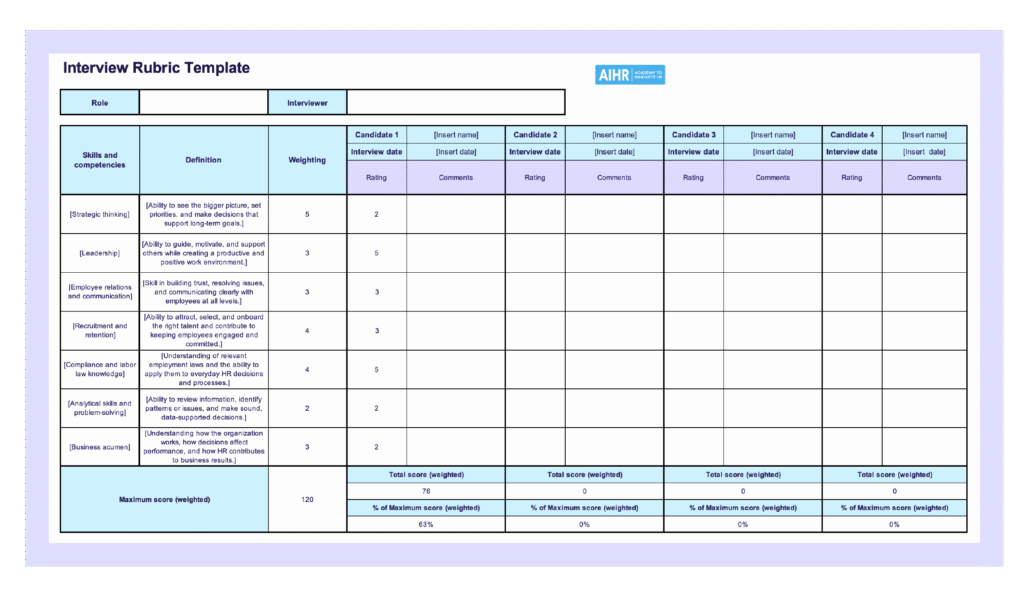
3. Interview rubric template
The interview rubric template facilitates objective, unbiased candidate interview evaluation, so using it can help you avoid having to rely on ‘gut’ feeling. The template helps interview panels score all candidates against identical criteria, making your hiring decisions more consistent and defensible by minimizing bias.
4. Offer letter template
AIHR’s offer letter template helps ensure every job offer your organization makes includes all the correct details the candidate needs — compensation, start date, conditions, and next steps. Using this template helps you avoid omissions and inconsistencies that could cause confusion or even legal risk.
5. New hire checklist
You can use the new hire checklist to coordinate tasks among HR, IT, and managers across different teams and departments. This checklist template helps ensure nothing slips through the cracks before day one, even when hiring happens quickly. This also leaves a positive first impression on new hires, who are then more likely to stay.
6. Employee onboarding checklist
AIHR’s employee onboarding checklist helps you structure employee onboarding beyond just the required paperwork. Using this template, you can better guide managers through the first weeks of each new hire’s tenure. This will help them feel welcomed, informed, and prepared, and as such, shorten their time to productivity as well.
7. New employee training plan template
You can use the new employee training plan template to outline role-specific training programs and details, expectations, and milestones for each new hire. This template — which comes in both Excel and Word — will help you plan training activities, track progress, and make employee onboarding more consistent and effective.
Free HR templates can take a lot of admin work off your plate. But to really save time and run HR smoothly as your business grows, your team also needs the right skills and practical know-how. If you’re thinking about where to focus your HR upskilling without stretching a small team too thin, AIHR’s HR Upskilling for Small Businesses shows which skills add the most value and how to get started in a realistic way.
Workforce information and administration
These HR templates are designed to help you collect, store, and manage essential employee information accurately, securely, and confidentially (where applicable).
8. Employee information form
AIHR’s employee information form template helps standardize how you collect each employee’s personal, contact, employment, compensation, educational, medical, and additional information. This makes your records more complete and accurate, as well as easier to maintain, helping you avoid costly payroll errors and compliance issues.
9. Employee emergency contact form
The employee emergency contact form typically contains information about whom you should contact in the event of an emergency involving an employee. It helps you make sure critical information is readily available when it’s needed most. This way, you can avoid having to scramble for it or rely on outdated, irrelevant data.
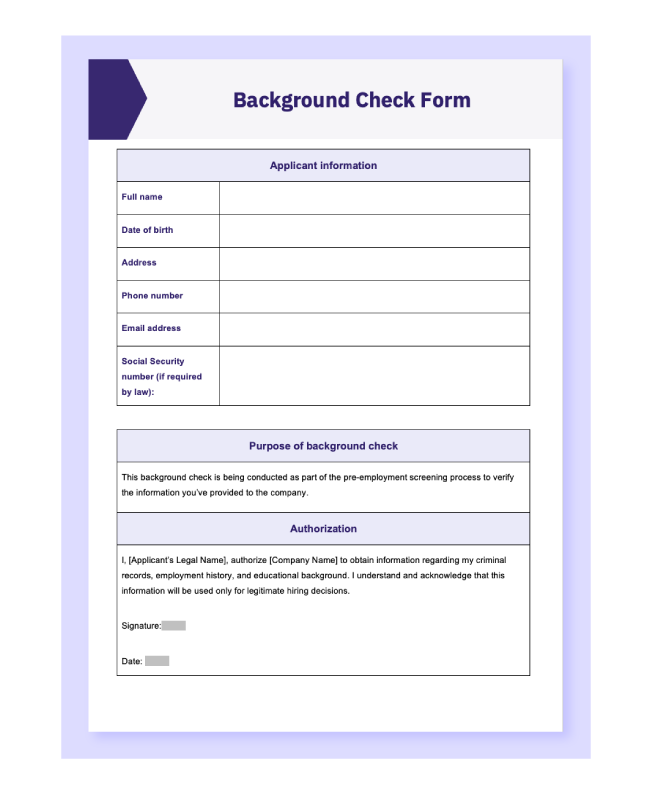
10. Background check form
The background check form template provides a clear, compliant way to request, conduct, and document background checks on job candidates. This way, you manage risk responsibly by ensuring they understand the purpose of such checks, what kind of information the company will review, and how it will use it.
11. Reference check form
AIHR’s reference check form can help you structure conversations with referees on job candidates and document information consistently for all candidates. This fully customizable template works whether you’re conducting a phone reference check, using a digital employment reference check form, or integrating it into your ATS or HRIS.
If you lead a small HR team, you understand the importance of streamlining daily tasks to prevent burnout and make time for strategic pursuits. With AIHR’s team-wide training and tools, you can strengthen HR’s impact on your SMB.
✅ Access to all 16 Certificate Programs + new releases
✅ Templates and playbooks to cut busywork
✅ AI Assistant for HR to streamline daily tasks
✅ Benchmark reporting & analytics to track ROI
Empower your team with practical skills and resources that save time today and create long-term value tomorrow.
PTO and vacation
These HR form templates provide a standardized way for your HR team to manage leave requests fairly, consistently, and transparently.
12. Vacation request form
This vacation request form helps you create an official record of all employees’ vacation requests, approvals, and denials. This allows you to track leave history and apply leave policies fairly and consistently. Management can also better plan coverage to ensure no disruptions to workflow or productivity in the absence of any employee.
13. Time off request form
You can use this time off request form for all non-vacation leave requests to help managers plan capacity and minimize scheduling conflicts. You can also customize the template for situations that may require a more extensive form, such as if an employee is responsible for finding someone to replace them during their absence.

Performance and talent management
AIHR developed these templates to help HR professionals support ongoing performance conversations and development at their organizations.
14. Employee task list template
You can use this employee task list template to clarify expectations by documenting responsibilities, priorities, and deliverables. This is especially useful for new roles, new hires, or changing teams. The template helps staff stay on top of their responsibilities by providing an efficient way to clearly outline their tasks, deadlines, and priorities.
15. Employee evaluation template
The employee evaluation template provides structure to performance evaluations, helping managers assess performance consistently and fairly. It can also be helpful when facilitating performance discussions. Additionally, this template comes in Word, Excel, and PDF formats to accommodate different approaches to employee evaluation.
16. Employee review template
You use AIHR’s employee review template to guide meaningful review conversations between managers and employees that balance feedback, recognition, and development planning. At the same time, the standardization it provides also supports fair, objective and unbiased reviews among the entire workforce.
Compensation and benefits
These templates are designed to help HR professionals design, implement, and document compensation and benefits policies and packages clearly and efficiently.
17. Compensation package template
The compensation package template can help you present total rewards transparently and enable employees to understand the full details and value of their compensation packages. These Excel and PDF templates highlight various components of compensation, providing a clear representation of what an ideal package might include.
18. Compensation plan template
The compensation plan template helps you document pay structures, increases, and incentives, which is critical to ensure and prove fairness and internal equity. It enables your company to detail its compensation plan in a structured way, leading to greater clarity and time-saving, and ensuring you don’t leave out any relevant details.

19. Expense reimbursement policy template
Use this expense reimbursement policy template to help you set clear rules around expenses. This includes what the company considers a reimbursable expense, and the specific rules on how employees should document and submit claims for reimbursement. This can reduce confusion and minimize disputes while protecting your company.
Disciplinary process
These templates will help you consistently and objectively handle sensitive situations involving disciplinary action. Additionally, they can make it easier to protect your company from legal risk.
20. Employee write-up form
AIHR’s employee write-up form helps you document issues clearly and objectively, creating factual records instead of relying on memory. It’s designed to ensure you capture all relevant information in a fair, unbiased manner, increasing your chances of resolving serious issues arising from negative employee behavior.
21. Disciplinary action form/action letter template
This template for a disciplinary action form or letter guides you through the formal steps to take to ensure clear, compliant, and fair employee discipline. It also simplifies the process of documenting the relevant incidents and actions taken, making it easier for you to handle employee misconduct and prevent accusations of unfairness.

22. Employee discipline form
The employee discipline form template allows you to standardize documentation across different incidents that warrant employee discipline, making patterns easier to identify. It can also help you explain disciplinary actions clearly, helping staff understand issues, expectations for improvement, and the consequences of not addressing the problem.
Exit and offboarding
These templates will help you handle employee resignations, offboarding, and exits professionally and sensitively, protecting your business’s reputation and preventing legal risk.
23. Employee exit checklist
AIHR’s employee exit checklist template helps you coordinate tasks across HR, IT, payroll, and finance to ensure everyone is on the same page and to avoid loose ends. It enables you to follow all the necessary steps to facilitate a smooth exit and protect your organization from potential legal risk from disgruntled former employees.
24. Offboarding checklist
This offboarding checklist template helps you ensure efficient, complete knowledge transfer, equipment return, and system access removal upon an employee’s official last day at the company. This minimizes any disruption to workflows and productivity, and ensures the employee’s expertise and experience become institutional knowledge.

25. Exit interview form template
Use AIHR’s exit interview form template to capture structured feedback and identify patterns, trends, and areas for improvement. Another benefit of this template is that the data you can get from an exit interview form tends to be more easily measurable and quantifiable than what exit interview questions typically provide.
26. Employee termination checklist
This employee termination checklist helps you manage both voluntary and involuntary terminations carefully and compliantly, reducing legal and operational risk. By using this template to document everything and follow all the necessary legal and internal steps, you can minimize the risk of your company attracting wrongful termination claims.
27. Termination letter template
AIHR’s termination letter template can help you communicate decisions clearly, respectfully, and consistently, even in sensitive situations, promoting fairness and objectivity. It also creates a formal record of each termination decision, ensuring legal compliance and protecting both parties in case of future questions or disputes.
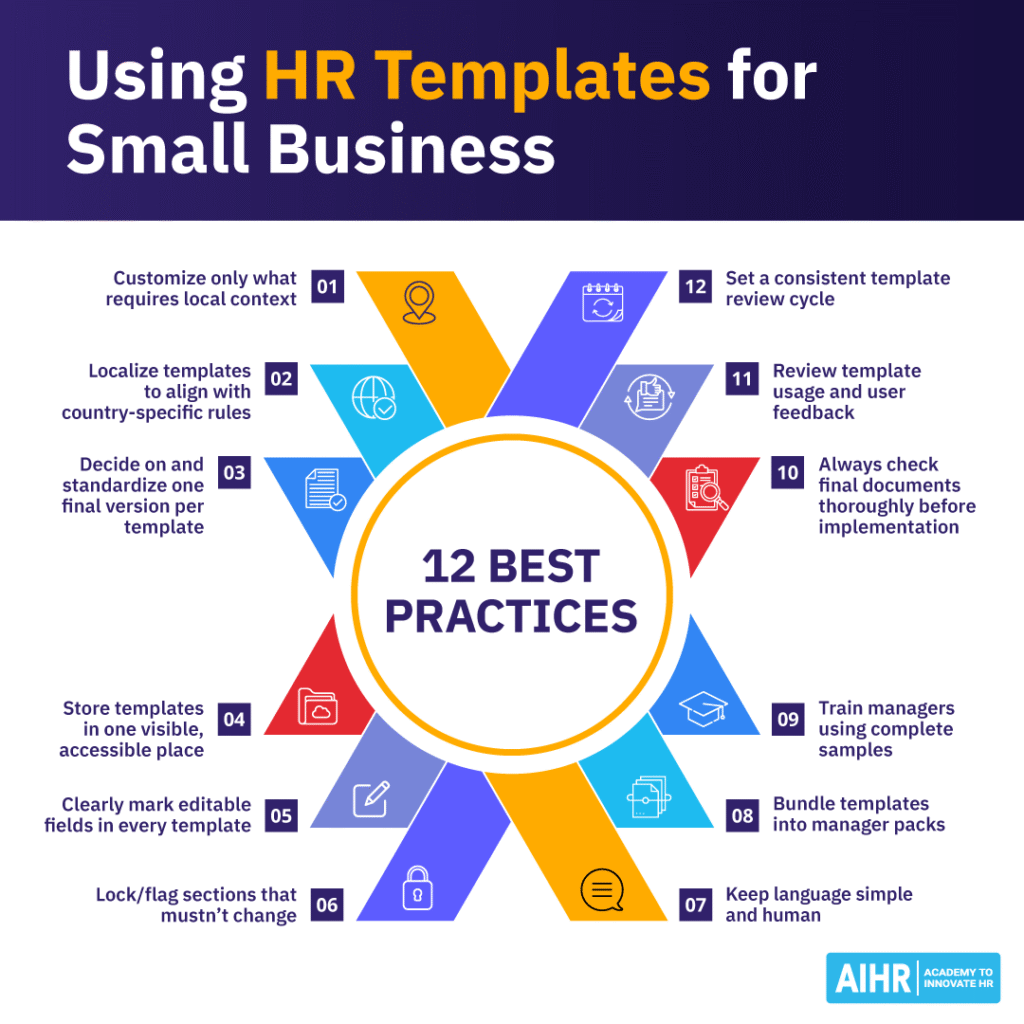
12 best practices for using HR templates in small businesses
Below are 12 best practices to follow to get the most value from free HR templates for small businesses:
- Customize only what needs local context: Edit company-specific details like names, roles, benefits, and processes, but don’t rewrite everything. This keeps the structure consistent across locations, while the document remains accurate for the local team.
- Localize templates to align with country-specific rules: Always adapt contracts, policies, and disciplinary documents to local labor laws. If you don’t, you risk using wording or steps that are invalid locally and could create compliance issues.
- Decide on and standardize one final version per template: Once customized, save one approved version and eliminate duplicates or side versions. This prevents managers from picking up outdated files and applying the wrong rules or wording.
- Store templates in one visible, accessible place: Use a shared drive or HR system, so managers know exactly where to find them. Set clear permissions and naming conventions, so people can find the right version fast without asking HR.
- Clearly mark editable fields in every template: Use placeholders like [Employee name] or [Date] so managers know what to complete. Make the editable fields obvious and consistent across templates to reduce mistakes and back-and-forth.
- Lock/flag sections that mustn’t change: Lock or clearly flag sections that must remain unchanged, especially legal language. This protects the parts approved by HR/legal and reduces the risk of someone ‘improving’ wording that shouldn’t be touched.
- Keep language simple and human: Avoid adding unnecessary slang or jargon; clear language builds trust and usability. Write like you’re speaking to a manager who needs to act quickly, not like you’re writing a legal essay.
- Bundle templates into manager packs: Group templates by use case (e.g., hiring, PTO, performance) to make them easier to use. Add a short “when to use this” note at the top of each pack to help managers choose the right document the first time.
- Train managers using complete samples: Show completed examples so managers have a baseline to work from.
- Always check final documents thoroughly before implementation: Review names, dates, salaries, and locations before sending anything out. Use a quick checklist for the most common error points to avoid embarrassing or costly mistakes.
- Review template usage and user feedback: Ask managers which templates they actually use and where they get stuck. Then, use that input to determine which templates to retire and which ones to improve.
- Set a consistent template review cycle: Consistently check that templates still match your processes and legal requirements, and update them as needed. Also, make sure your HR team and management know where to find the templates and how to use them.
Final thoughts
When you work in a small business, you need structure to perform more efficiently, especially when it comes to HR. Free HR templates for small businesses help you move faster, reduce risk, and deliver a consistent employee experience without increasing costs or becoming overwhelmed with work. This helps you focus more on the business and strategic initiatives.
By using AIHR’s free, customizable HR templates, you can turn best practices into everyday habits. You can stop reinventing, start standardizing, and create HR systems that actually support growth for your business, managers, workforce, and yourself.