
An employee wellness program is now a core part of organizations’ employee retention strategies. As more employees prioritize their own health at work, businesses are increasingly focusing on mental and preventive health, as well as holistic wellness solutions. This also means HR is getting more involved in designing programs that are relevant to employees’ health needs.
A thoughtful, structured program can reduce burnout, strengthen employee engagement strategies, and make work feel more sustainable in the long term. This article looks at what an employee wellness program is, its seven key pillars, real-life examples, and how you can develop your own program to benefit your workforce.
Key takeaways
- Organizations are focusing on holistic support that covers mental and physical, as these have a direct impact on engagement and performance.
- Well-designed wellness programs connect everyday habits with business outcomes, supporting employees with practical resources.
- The strongest programs are simple, accessible and inclusive, accommodating different schedules and roles (especially in hybrid or distributed teams).
- HR must assess needs, secure buy-in, design holistic initiatives, communicate clearly, measure impact, and share real stories to make wellness an ongoing effort.
Contents
What is an employee wellness program?
Employee wellness vs employee wellbeing
What makes an effective employee wellness program?
5 examples of successful employee wellness programs
6 steps to create and implement an employee wellness program

What is an employee wellness program?
Modern corporate employee wellness programs are designed to support employees’ physical and mental health. Aside from the usual fitness and nutrition initiatives, they also cover stress management, financial literacy, flexible work policies, and mental health support activities.
These wellness programs aim to address employees’ health issues to help them become more engaged and productive at work. For example, if a company notices a spike in tardiness, it might offer flexible work policies, burnout prevention training, and employee financial wellness sessions.
In this context, HR’s job is to align employee wellness with business goals, track staff participation in wellness programs, and monitor the impact of such programs on engagement, the employee retention rate, productivity metrics, and employee satisfaction metrics.
Employee wellness vs employee wellbeing
While people often use the terms ‘wellness’ and ‘wellbeing’ interchangeably, there are some key differences between the two:
Focus
Primarily on physical and mental health
Covers physical, mental, social, and financial health
Goal
Prevent illness and promote healthy habits
Better work-life balance and employee satisfaction
Approach
Program-based (e.g., health screenings or fitness perks)
Culture-based (e.g., inclusion, flexibility, purpose)
Measurement
Health outcomes and participation rates
Engagement, belonging, and fulfillment metrics
The 7 pillars of employee wellbeing
While multiple models of employee wellbeing exist, there are typically a few key pillars required for total wellbeing to work. These include:
The benefits of employee wellness programs
There are a few main benefits of employee wellness programs, including:
- Performance link: Stress, be it physical, mental, or emotional, can significantly impact productivity and work quality. Using wellness programs to equip employees to prevent and manage stress can help maintain their productivity levels and improve their output.
- Employer brand and EVP: Benefits related to wellness and flexibility are key differentiators in hiring. This means wellness programs can shape your employee value proposition (EVP) and influence your chances of attracting and retaining top talent.
- ROI and cost control: Investing in employee wellness can lead to better ROI and support your company’s budget. In fact, nearly two-thirds of organizations that track ROI from their wellness programs see at least $2 returned for every $1 spent.
- Impact on society: The impact of wellness programs extends beyond the individual and organization to broader society. Healthy individuals are more likely to contribute actively to their local communities, whether through volunteering or civic engagement with their government.
Master EX to ensure long-term employee wellness and wellbeing
Build the skills you need to create positive employee experiences to ensure wellness and wellbeing throughout the entire employee life cycle.
🎓 The Digital HR 2.0 Certificate Program will help you to:
✅ Use design thinking to create valuable experiences for employees
✅ Understand how employee experience influences business performance
✅ Create an effective EX strategy aligned with HR and organizational strategy
What makes an effective employee wellness program?
Wellness programs should align with employees’ actual needs. With the right resources and support, wellness programs can be a part of the company culture, rather than an isolated project. Here are some factors that contribute to an effective employee wellness program:
Practical health education
Practical health education is most effective when tailored to employees’ actual needs and delivered in small, manageable pieces. Instead of long guides, pick one topic each month (e.g., sleep, movement, or nutrition) and share a short message with one clear action people can try that week.
Keep it easy to read in two minutes, link to trusted resources, and time messages around real pressure points, such as quarter-end or major launches. It also helps give managers a simple “talk track” they can use in team meetings, so you can reinforce the message in day-to-day work, rather than treating it as a separate HR campaign.
Physical health support
Physical health support becomes actionable when you make it easy for employees to improve their setup and reduce strain. Start with a quick ergonomics check for both office and remote workers. Then, as part of your company’s work-from-home policy, offer a straightforward home office stipend with clear guidelines on what it covers and how to claim it.
Provide simple standards for a good workstation — monitor height, chair support, keyboard and mouse options — and give staff practical help through short “desk setup” office hours or quick coaching in the workplace. Training managers to recognize early signs of strain, such as recurring wrist pain or headaches, can also prevent minor issues from developing into major injuries.
Mental health resources
Mental health resources are most effective when access is simple, private, and normalized. Staff should be able to find support through one clear link and understand what will happen next without having to ask HR. Including employee assistance program (EAP) login details and counseling options during onboarding makes it more likely they’ll use the service early, rather than waiting until things are severe.
Offering different formats (e.g., one-on-one counseling, chat support, and self-guided tools) caters to a wider range of preferences and needs. Clear communication about confidentiality is also critical, as people must be able to trust that their employer cannot access their personal information.
Stress management and resilience
Stress management and resilience initiatives must target real-world work scenarios and align with practical work models. Instead of focusing on theory, teach skills employees can use immediately, such as prioritizing under pressure, setting boundaries, and short recovery routines during demanding periods.
Shorter sessions tend to have better uptake than longer workshops, especially when scheduled before known busy seasons. Be sure not to use resilience training to make staff “cope with” unrealistic demands. Teams need clear priorities, regular workload checks, and a simple plan for what to do when pressure spikes, such as reducing meetings and agreeing on what to deprioritize.
Financial wellness support
Financial wellness support should address common money stressors and remain confidential. Provide staff with access to financial coaching or practical workshops that cover everyday topics, such as budgeting, debt management, savings, and planning for major life expenses. The key is to help employees leave with a next step, such as a simple 30- or 90-day plan and a basic, practical budgeting tool.
Where feasible and compliant, options such as emergency savings support or early wage access can alleviate short-term financial pressure, especially for employees who live from month to month. Time support around performance bonus cycles, annual reviews, or cost-of-living changes to make financial wellness support more relevant to employees.
Social connection
Social connection matters as it supports morale and reduces isolation, especially in hybrid and remote teams. However, it needs to be inclusive rather than forced. Regular, low-effort rituals tend to be more effective than occasional, large-scale events, and small-group formats are often more comfortable than large social gatherings.
Simple structures, such as monthly cross-team coffee chats, can help people build rapport with colleagues they rarely meet, while buddy systems can support new hires during their first weeks. To drive remote employee engagement, asynchronous channels and lightweight recognition routines can support ongoing connection, as long as participation is optional and respectful of personal boundaries.
Flexible work environment
This requires clear definitions and consistent team habits. Set guardrails so people understand what flexibility means in practice, then manage performance based on outcomes, not hours logged. Focus time is especially important — approaches like “focus Fridays”, no-meeting blocks, or core collaboration hours can reduce interruptions and improve productivity.
A hybrid work schedule also requires fairness to be built in, ensuring remote employees have equal access to information, decision-making, and visibility. This is where manager training matters: leading hybrid teams requires strong planning, communication, and inclusion skills, not just good intentions.
Measurement and improvement
These make your program credible and sustainable. Start by defining success (e.g., lower stress-related absence or stronger engagement and retention), then track key metrics that cover awareness, usage, and value. Short employee pulse surveys, conducted every eight weeks, can highlight what is and isn’t working, while deeper surveys, conducted a couple of times a year, provide more context.
Segment results carefully to spot patterns across teams or locations while protecting anonymity. The most important step is closing the loop: share what you heard, what you’re changing, and when employees can expect the next update, so people see that feedback leads to action.
5 examples of successful employee wellness programs
Here are five real-life company examples of successful employee wellness programs to inspire your own approach to such programs:
Example 1: Amazon
Amazon launched its “Mo is Calling!” challenge to encourage employees to walk or run 60 miles in one month. The number represents the 60 men lost to suicide every hour worldwide. As employees hit different milestones, they unlocked short lessons on mental health, such as early warning signs, healthy habits, journaling tips, and simple breathwork.
What you can replicate
- Set up month-long challenges that support causes employees care about to make the activity meaningful, and not just another step challenge
- Use milestone unlocks to share small, easy-to-read lessons on mental health or stress management
- Keep the challenge open to everyone — walking should count just as much as running to make it more inclusive.
Example 2: EquipmentShare
EquipmentShare developed a mobile-first employee wellness program that made health resources accessible to its 5,500 employees nationwide. The program attracted a high rate of employee participation because it offered rewards, including PTO and gift cards.
What you can replicate
- Use a mobile-friendly wellness platform to reach employees across locations easily
- Offer meaningful and tangible rewards, such as PTO and gift cards, to incentivize participation
- Transition from periodic challenges to a continuous incentive program to support long-term healthy habits.
Example 3: White Hat Gaming
White Hat Gaming introduced a fun, gamified wellness program for its remote and distributed teams across Malta, Gibraltar, the UK, and South Africa. Staff could log different activities, such as movement, hydration, learning new skills, and sustainable living habits. The program was engaging, as it utilized points, challenges, and incentives that were effective regardless of location.
What you can replicate
- Include activities beyond fitness, such as mindfulness breaks, hydration goals, or quick learning challenges
- Use simple gamification, like points, levels, or team challenges, to keep employees motivated
- Offer flexible incentives, so employees can choose rewards that matter to them.
- Build steady engagement for remote teams through team-based challenges or by connecting the program with wearable devices.
Example 4: St Elizabeth Healthcare
St. Elizabeth Healthcare integrated its wellness program and HR systems, offering employees personalized health assessments that identified individual risks (e.g., high blood pressure and cholesterol). Staff can customize wellness paths, such as weight loss challenges and mental health resources. The program had a 60% participation rate, improving employee wellbeing metrics.
What you can replicate
- Integrate wellness platforms with existing HR systems for easy access and wider employee reach
- Use personalized health assessments to tailor wellness activities to individual needs
- Offer a mix of physical and mental wellness programs to cater to the diverse interests of employees.
Example 5: Agravis
With over 6,000 employees in 400 locations, Agravis needed a globally consistent wellness program. It built a central wellness system with access to simple challenges, personalized recommendations, and an online community. The program helped staff stay connected via ‘destination challenges’ and social features that encouraged teamwork across geographies.
What you can replicate
- Centralize your wellness efforts to ensure all employees receive the same level of support
- Offer personalized recommendations and simple challenges that match individual health goals
- Create social and interactive activities that help employees feel more connected, even in large or spread-out workplaces
- Include a mix of activities to make the program relevant for different roles, interests, and fitness levels.
6 steps to create and implement an employee wellness program
Launching an employee wellness program requires careful planning, alignment, and effective execution. Here are six steps you can take to develop and roll out your own wellness program successfully.
Step 1: Assess and align
Start by getting real insights into your workforce’s needs, such as the pressures they regularly face and the kind of support they may be lacking.
Example: Prepare and distribute a simple survey asking, “On a scale of 1–5, how well supported do you feel in terms of mental, financia,l and physical health?” Once completed, group results by job role.
Checklist
Step 2: Secure leadership and embed governance
Next, secure strong leadership and a clear governance structure, and assign champion networks and dedicated leads.
Example: Form a wellness steering committee consisting of the HR Lead, HR Operations Manager, and two wellness champions from different sites.
Checklist
Step 3: Design holistic initiatives
The program should cover different wellness pillars (physical, mental, social, and financial), with each pillar having an assigned owner.
Example: Launch Wellness Wednesday with mini-sessions, such as posture in week one, budgeting in week two, and team connection in week three.
Checklist
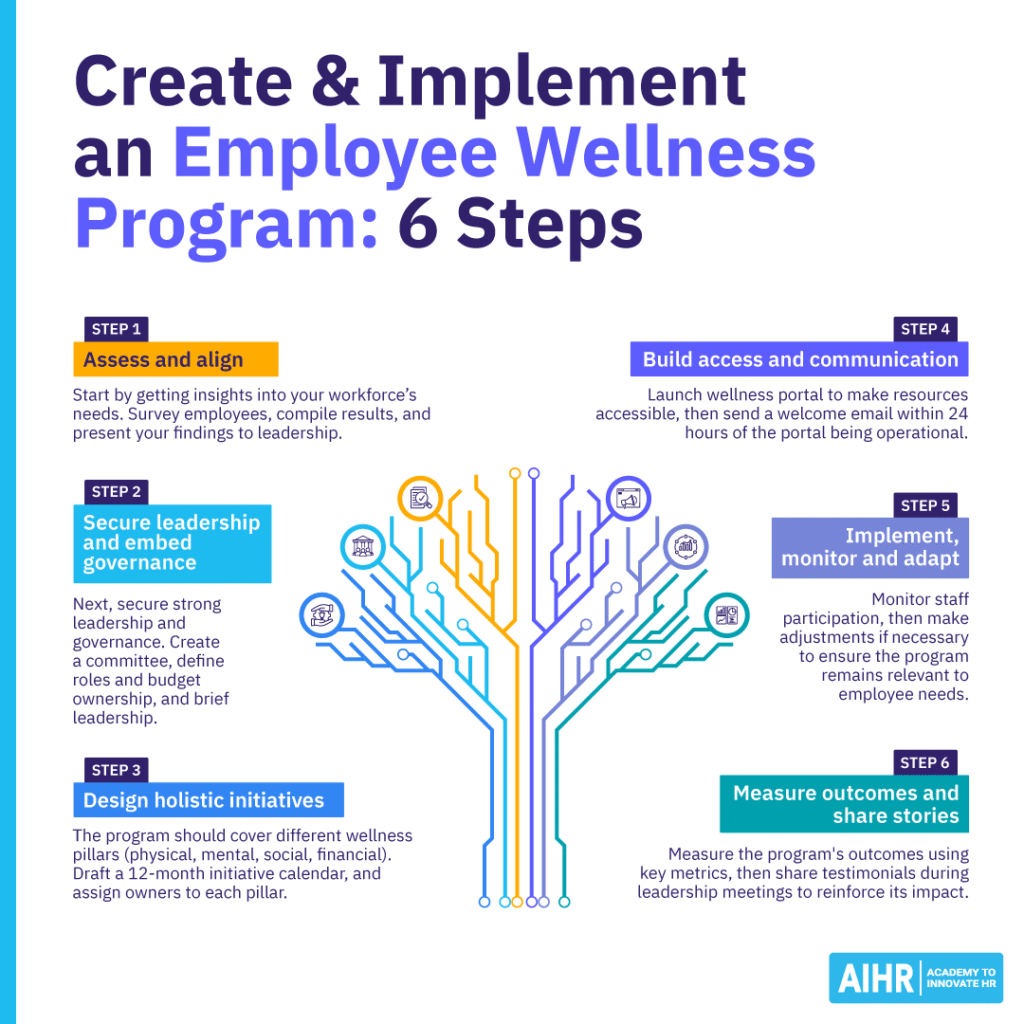
Step 4: Build access and communication
Make resources accessible to keep staff engaged, and use multiple channels to communicate your wellness initiative to the entire workforce.
Example: Create a dedicated wellness portal link and send a welcome email to all employees with a message directing them to your organization’s wellness resources.
Checklist
Step 5: Implement, monitor and adapt
IMonitor staff participation, then make adjustments if necessary to ensure the program remains relevant to employee needs.
Example: After three months, review participation rates — if a step challenge had low uptake among shift workers, for instance, try replacing it with walking rounds.
Checklist
Step 6: Measure outcomes and share stories
Measure the program’s outcomes using key metrics, then share testimonials during leadership meetings to reinforce its impact.
Example: Document a relevant case, e.g., “Warehouse team reduced absenteeism rate by 12% after hydration initiative.” Then, share this information during an all-staff meeting.
Checklist
To sum up
Wellness is no longer a nice-to-have benefit at work. When it meets real needs and is tied to clear business objectives, it supports retention, performance, and healthier work practices. The strongest programs are practical: easily accessible, simple, and providing support that covers physical, mental, financial, and social health without forcing participation or adding any burden.
To make wellness stick, treat it like an operating system, not a campaign. Start small, measure what matters, and improve based on what people actually use. Keep leaders visible, managers equipped, and communication clear. When you close the loop with data and real stories, you build trust, making wellness part of the culture instead of just another HR initiative.