
Challenges in digital HR transformation go well beyond ‘just’ software and implementation issues. Employee resistance, for instance, affects 39% of the workforce, and about 33% of failed transformations are directly linked to a lack of executive and management support.
In this article, we’ll discuss key HR digital transformation challenges and ways to address them. We’ll also share some steps to take when starting the transformation process.
Contents
What HR digital transformation really means today
Challenges of HR digital transformation
How to start HR digital transformation at your organization

What HR digital transformation really means today
For years, HR digital transformation mostly meant taking paper-based processes online. You’d replace spreadsheets with an HRIS, give employees a self-service portal, and move hiring into an applicant tracking system. Each project had a defined scope and a go-live date, and once the system went live, most teams treated the transformation as done.
Today, HR digital transformation is a continuous process of adopting new technologies, redesigning workflows, and embedding digital-first thinking into all aspects of workforce management. AI transformation in HR has sped up that shift and widened its scope, since AI changes how your team makes decisions, delivers services, and creates business impact.
While HR digital transformation has never been an easy process, it’s now even more layered than before. On top of adopting AI, many HR teams are still dealing with earlier transformations that failed or only partly delivered, and employees who lived through those projects often bring some distrust of leadership into the next one. So while technology sets the direction, your success depends just as much on how people respond and how well you redesign the processes around them. That’s also where most HR digital transformation challenges start.
Challenges of HR digital transformation
HR digital transformation challenges range from technical issues, like poor data quality and disconnected systems, to people issues, like low adoption and resistance to change. Some are new, such as deciding where AI fits into your HR processes and how to govern its use. Others have been around since the first HRIS rollouts. The difference today is that they tend to show up at the same time, and often within the same project.
Here are the most common challenges you and your HR team are likely to face.
Challenge 1: Resistance to change
Both HR teams and other employees may be reluctant to change. Perhaps there have been too many (poorly managed) workplace changes and too little time for people to recover, causing change fatigue. Or maybe some members of the HR team fear that automation will reduce their relevance or eliminate certain roles.
There are a few ways HR leaders can address this:
- Develop a solid (digital) change management plan. Change management is a structured process that helps people understand, accept, and adopt changes to how they work. It also has a measurable impact on results, since Prosci’s benchmarking data shows that initiatives with excellent change management are seven times more likely to meet objectives than those with poor change management.
- Appoint change champions within departments. These people are fully informed of the planned changes, the reasons behind them, and the various steps to get there. They are the go-to person for a department when individuals have questions or concerns and know who to refer people to if they can’t help them.
- Gather employee feedback at key milestones. Focus employee input on the moments where it can still change the outcome, such as before you select a tool, after a pilot, and a few weeks after go-live. Short pulse surveys work well here, since they’re quick for employees to complete and easy for you to repeat. For example, a month after launching a new leave request portal, you could ask employees how easy it is to submit a request and where they get stuck.
- Surface usability issues early on. The employee feedback mentioned in the previous point allows you to identify – and resolve – usability issues quickly. This shows people you take their input seriously and act upon it, increasing their engagement and reducing their resistance to change.
Challenge 2: New HR tech integration
When integrating new HR technology, HR teams often face the technical complexity of connecting modern HR platforms with existing legacy systems that are already in use. Other common data and tech challenges include data silos, incompatible formats, and limited APIs.
You can start by focusing on a few practical actions:
- Establish a single source of truth. Create a centralized data repository or system that is the trusted home for your organization’s people data, and make sure your other HR tools pull from it instead of storing their own versions. For example, if your HRIS is your single source of truth, your payroll, learning, and performance management systems all take core employee data, like job title, department, manager, and location, directly from it. So when an employee moves to a new team, you update their record once in the HRIS, and the change carries through to every connected system, instead of HR updating each tool by hand and ending up with three different headcount numbers.
- Develop a data governance policy. Think of this as the official rulebook or manual that comes with your centralized data repository. It defines clear rules about, among other things:
- Who owns specific data categories
- Who maintains and uses the data
- Who is allowed to edit, delete, or view the data.
- Build and maintain an effective HR tech stack. Having your data and its governance in order is one thing. Building a set of integrated software, platforms, and apps is another. A solid HR tech stack allows HR teams to work more efficiently and deliver a better (digital) employee experience, while also offering the flexibility to add – and integrate – new tools or technology seamlessly.
Challenge 3: A lack of digital skills in the HR team
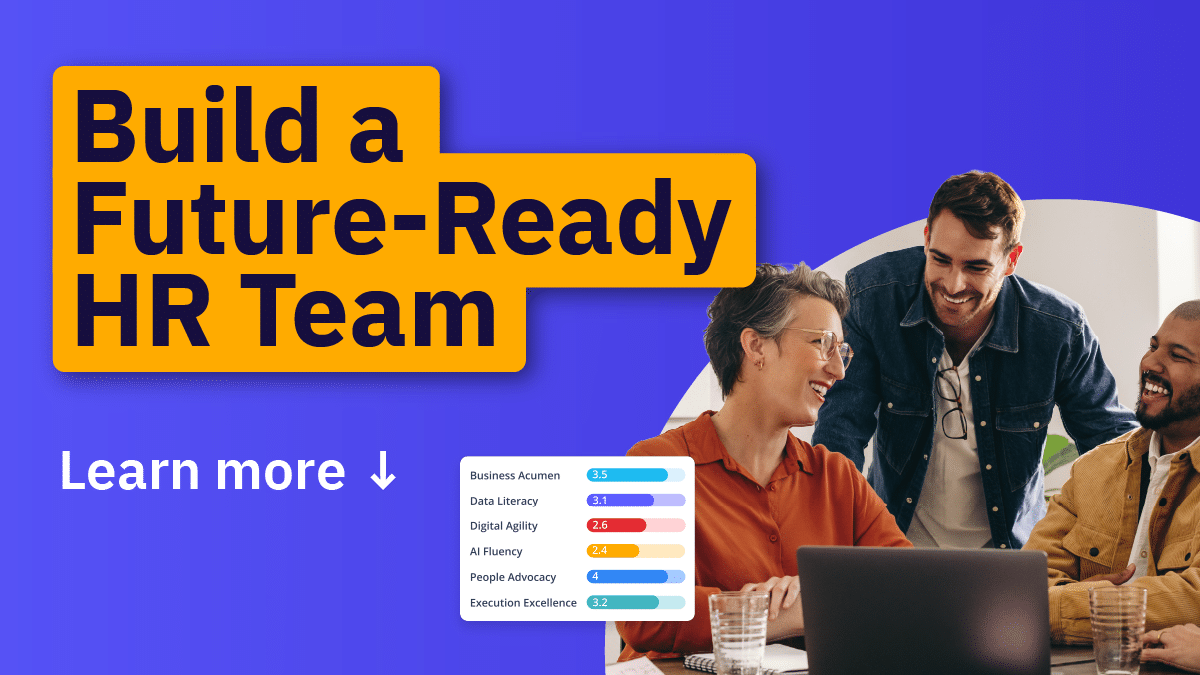
AIHR’s Future-Ready HR Skills Research found that only 50% of HR teams believe they have the right skills to deliver impact, with HR professionals often lacking the digital agility, data literacy, and AI fluency needed to configure, adopt, and champion new digital tools.
Upskilling your HR team in these areas is essential for success:
- Enroll your team in targeted, cohort-based training programs, such as AIHR’s AI for HR Boot Camp. Learning as a group helps your team move forward at the same pace, and the boot camp’s practical format lets people apply new skills to real HR work as they go.
- Ensure your team of HR professionals also has access to individual high-quality HR training, and make this training part of your team’s objectives to emphasize its importance and boost engagement. With AIHR, you can tailor the learning to what your team needs to achieve. For example, if your organization is redesigning its HR operating model so that AI handles most routine HR services, your HR operations team could follow courses on AI fluency and process automation.
- Introduce a buddy system. Pair up your team so that every team member has a buddy to support them during their upskilling. Not only is this a great way to create engagement and accountability, but it also makes learning and mastering new skills a team effort.
Challenge 4: AI in HR-related risks
The use of AI in HR processes inevitably brings potential ethical and compliance risks, from biased screening decisions to unclear use of employee data, which presents one of the newest challenges in digital HR transformation.
When these risks go unmanaged, employees start to question the decisions AI helps make. And as AI plays a bigger part in decisions about hiring, performance, and pay, employee trust in those decisions is becoming a key HR trend. That trust will depend on how fair, transparent, and accountable your AI systems are.
You can reduce these risks and build trust with a few deliberate steps:
- Apply the same standards of fairness, transparency, and accountability to your AI systems that you expect from your managers and HR processes.
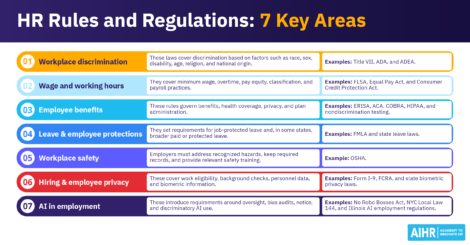
- Introduce mandatory human oversight. In the U.S., this is already required by law in various states. In California, for example, the No Robo Bosses Act forces employers to ensure human oversight when an automated decision-making system (ADS) is involved in disciplinary or firing decisions. Similar HR rules and regulations exist in New York City and Illinois.
- Provide a way to question or appeal AI-influenced decisions. The ability for employees to challenge an AI-driven or supported decision is just as important for the legitimacy of (and trust in) a system as its accuracy.
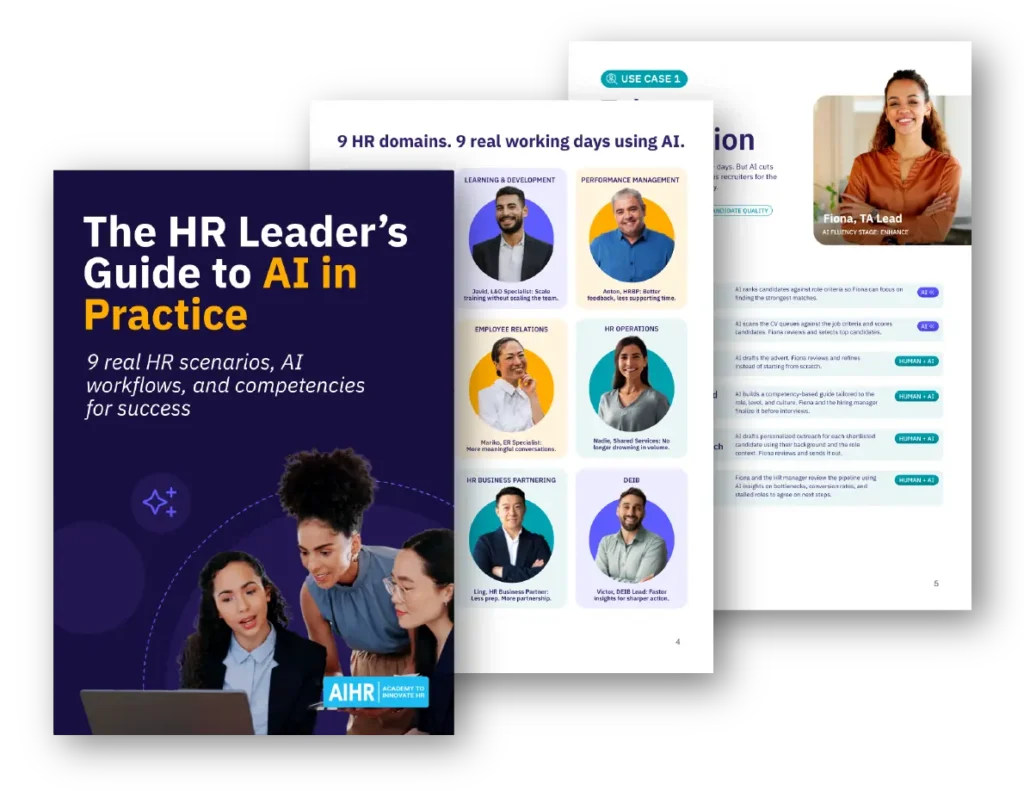
Putting AI into practice responsibly requires clear standards for how it should be used across HR. AIHR’s HR Leader’s Guide to AI in Practice can help you apply AI in a way that supports human judgment, fairness, and accountability.
Challenge 5: Cost and budget management
Juggling between a digital transformation budget and financial constraints on the one hand and different types of (unexpected) costs on the other is not easy. But having your financials in order is the first step toward successful digital transformation.
Here’s how you can plan your budget more realistically and avoid surprises:
- Consult with an expert. Especially if you’re just embarking on a digital HR transformation journey, you may want to talk with someone who has guided a similar process. That could be an external expert or a colleague who led a digital transformation in another department, such as finance or IT. They can tell you which costs to expect, how long the process is likely to take, and which people and teams need to be involved.
- Create a clear budget overview. Based on your discussion with the transformation expert – and perhaps even together with them – you can create a cost overview. Include the available budget, direct costs such as the price of new HR technology, but also indirect costs such as the time spent on the digital transformation process by various teams in the organization, and upskilling costs.
Challenge 6: Leadership buy-in
Securing leadership buy-in is one of the first steps in any HR digital transformation. Keeping executives engaged throughout the process is just as important, and many HR teams struggle with both.
Part of the reason is that leaders don’t always see HR transformation as a business priority. They may view it as an internal HR or IT project instead of a change that affects how the whole organization works. That makes it harder to get time on the leadership agenda. It also doesn’t help that HR often struggles to show its value in business terms. For example, a CIPD survey found that 60% of HR professionals believed their function made a valued strategic contribution, yet only 49% said they could actually measure that contribution.
Building lasting executive support starts with speaking the language of the business:
- Discuss the ROI. Clearly show leadership what the ROI of this HR digital transformation will be, how you will measure it, and how it will contribute to the organization’s business goals. For example, if a new recruitment platform is expected to reduce time-to-hire, show leaders how faster hiring for open sales roles supports this year’s revenue targets, and agree upfront that you’ll track time-to-hire and vacancy duration as your main measures. You can ask the expert you’re consulting with for help measuring and demonstrating ROI as well.
- Provide examples. Where possible, use brief case studies of organizations similar to yours that have already successfully gone through a digital transformation.
Challenge 7: Keeping digital transformation going
This is perhaps one of the trickiest HR digital transformation challenges and a common pitfall. Many organizations treat transformation as a technology upgrade with a clear end date. Once the new system goes live, the project team disbands, attention moves to the next priority, and nobody owns what happens next.
But in many ways, the real work starts after launch. People need time to change how they work, processes need fine-tuning, and new technology, especially AI, keeps changing what’s possible. Without ongoing attention, adoption stalls and employees slowly fall back on old workarounds, like tracking requests in spreadsheets outside the new system.
To make transformation part of how your HR team works, focus on the following:
- Develop an HR digital transformation strategy and roadmap, making sure to tie your objectives to those of the business.
- Help your HR team see digital transformation as an ongoing capability, where everyone looks for ways to improve processes and ways of working as part of their daily work.
Addressing the challenges mentioned above will help you ensure the success of your digital transformation beyond the initial rollout.
How to start HR digital transformation at your organization
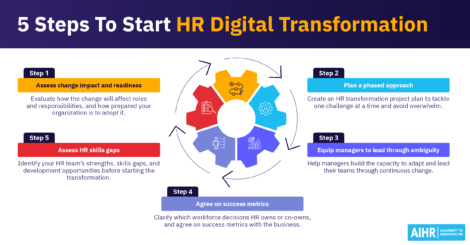
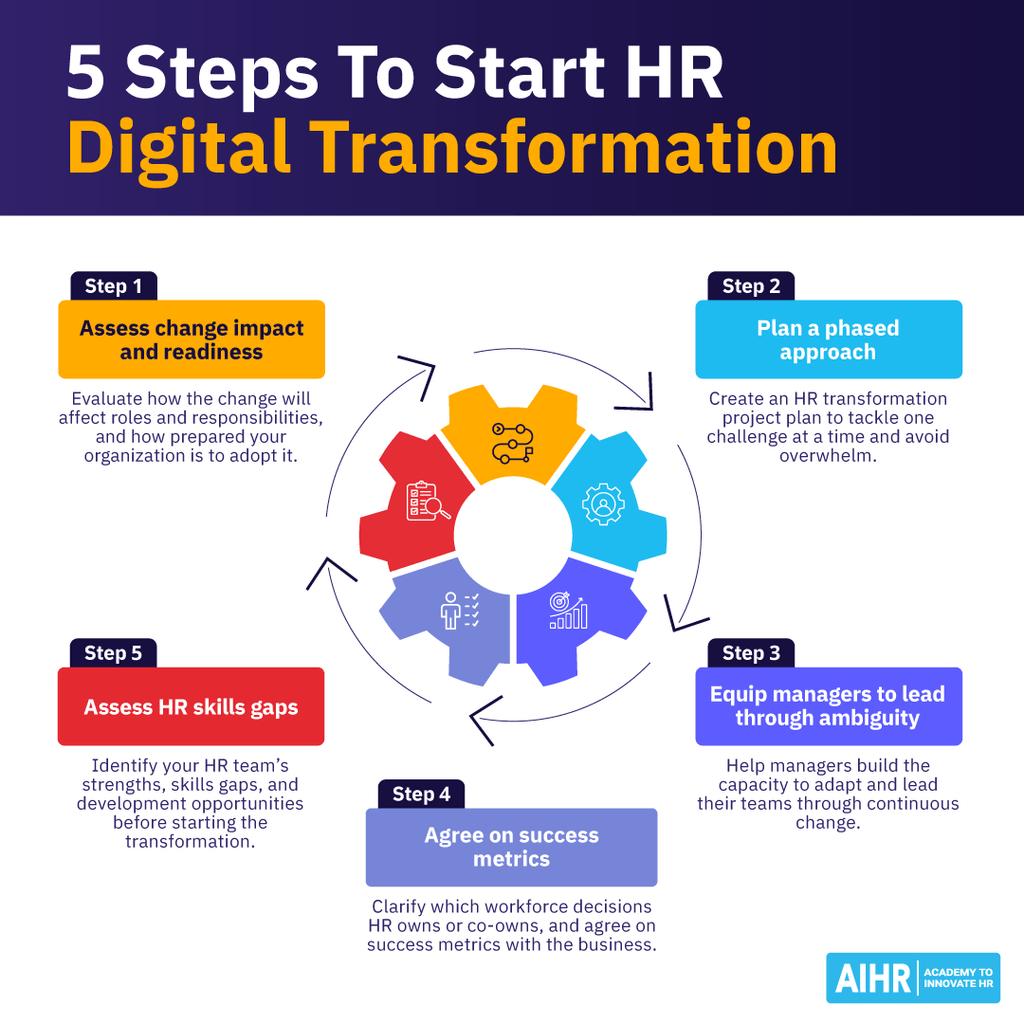
Each of these challenges makes it clear that HR digital transformation is a complex process. With careful preparation, though, you can address many of them before they slow you down. Here are some steps to help you get started:
- Conduct a change impact assessment (CIA) and a change readiness assessment: The former will provide you with insight into how the change will affect workforce dynamics, responsibilities, and roles. The latter is a practical tool HR leaders use to evaluate how prepared their organization, teams, and individuals are to adopt and sustain an intended change. Together, they help you surface the challenges that are unique to your organization, so you can plan for them before you start.
- Plan a realistic and phased approach rather than trying to solve all challenges simultaneously: HR digital transformation is an ongoing process. Creating an HR transformation project plan allows you to address one challenge at a time and avoid overwhelm.
- Equip managers to lead through ambiguity: Continuous HR digital transformation also implies continuous change management. Among other things, this means HR needs to treat change as a constant factor and focus on building the capacity to keep adapting. A key element of this is equipping managers to lead through ambiguity, since they need to carry most of the change on a daily basis.
- Agree on success metrics with the business: Clarity is essential for transformation success. HR teams need to know what workforce decisions they (co-)own and agree on success metrics with the business, so they can take (or share) accountability.
- Assess skills gaps in your HR team: Before you plan a full HR digital transformation, you may want to evaluate where your team stands in terms of the skills required to navigate such a process. Conducting a targeted HR skills assessment will offer you a clear view of your team’s gaps, strengths, and development opportunities.
A final word
The success of HR digital transformation depends as much on how you prepare and manage the process as on the technology. Focusing on the human side and guiding people through the change will help you avoid common pitfalls, from resistance to change to fading leadership support.
And since transformation continues long after launch, especially as AI keeps changing what’s possible, your HR team’s skills become a big part of your plan. Investing in digital HR capabilities helps your team stay ready to lead each next phase of change.