
To make smart decisions that support both people and business goals, HR leaders need more than intuition. They need clear, accurate insights drawn from a variety of HR reports, including performance evaluation summaries, training effectiveness reviews, and strategic board-level dashboards.
HR reporting and analytics are becoming increasingly central to how HR functions create value. Research by SHRM shows that 71% of HR executives who use people analytics consider it essential to their organization’s HR strategy, highlighting how closely reporting is tied to informed decision-making and strategic influence.
Well-designed HR reports translate complex workforce data into insights that support prioritization, planning, and meaningful conversations with senior stakeholders.
In this article, we’ll walk through the different types of HR reports every HR leader should know about and share tips for creating reports that influence decisions and support outcomes the business cares about.
Contents
What is an HR report?
Why are HR reports important?
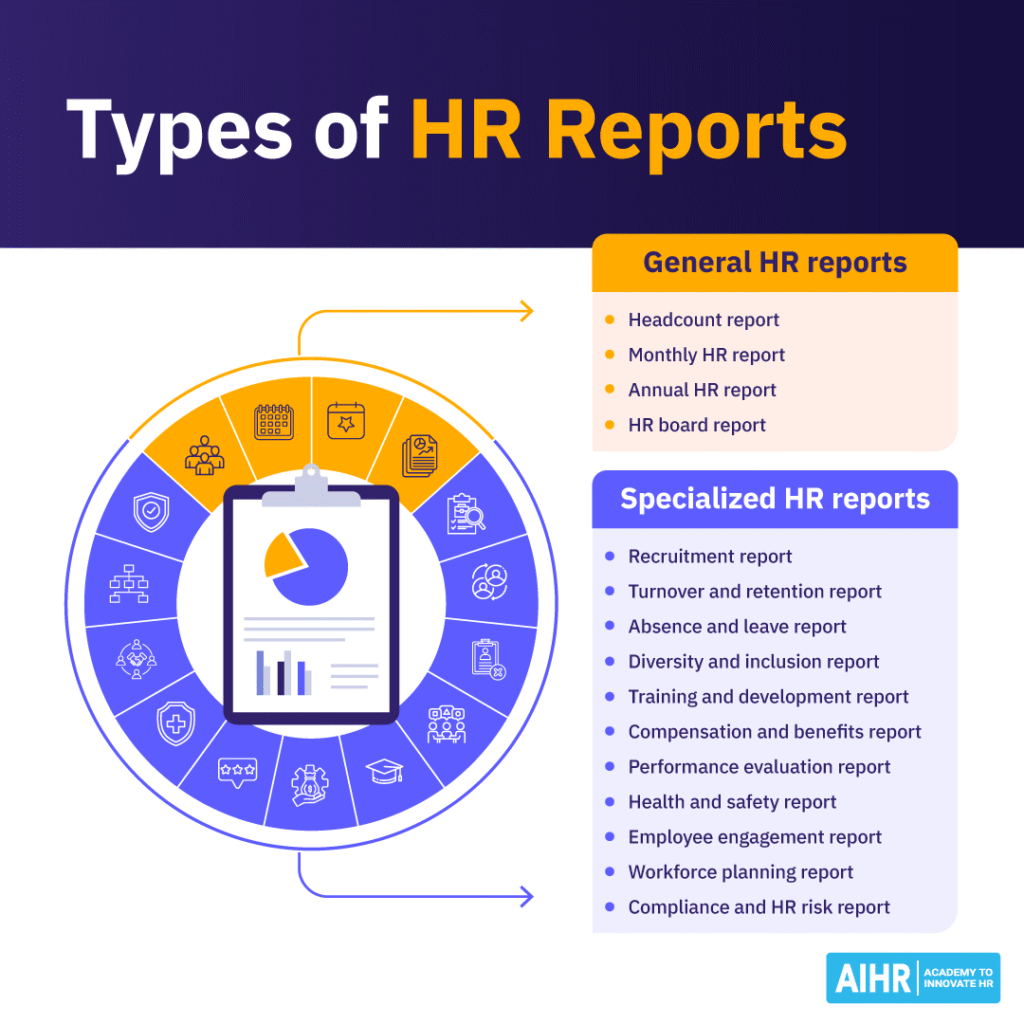
Types of general HR reports
Types of specialized HR reports
How to write an impactful HR report

What is an HR report?
An HR report is a structured document that presents HR data and metrics to provide a clear overview of an organization’s workforce and HR activities. It helps translate people data into insights that support planning, decision-making, and ongoing workforce management.
HR reports enable HR teams and business leaders to assess key areas such as recruitment, learning and development, compensation, workforce costs, and compliance. By tracking metrics like turnover, employee engagement, and policy adherence, HR reports make it easier to identify trends, evaluate performance, and adjust strategies where needed.
Beyond monitoring activity, HR reports also help assess the effectiveness of HR practices and their impact on the organization. They demonstrate how HR initiatives align with broader business goals and support outcomes such as increased productivity, enhanced retention, and organizational sustainability.
Why are HR reports important?
HR reports are more than just a way to track numbers. They help HR teams turn raw data into narratives that inform real decisions, improve workforce outcomes, and strengthen HR’s role in shaping strategy.
- They support better decision-making: HR reports provide evidence to back decisions around hiring, retention, performance management, and learning investment. Instead of relying on instinct, HR teams can use data to understand what is working, what is not, and where action is needed.
- They provide visibility into workforce trends: By consolidating data across various HR areas, reports make it easier to identify patterns such as rising turnover, skills gaps, or changes in engagement levels. This visibility helps HR teams address issues early and plan more effectively.
- They strengthen communication with senior stakeholders: Clear, well-structured reports help HR explain workforce dynamics in a manner that business leaders can understand. This makes it easier to track progress, identify risks, and link HR initiatives to broader organizational objectives.
- They enable proactive workforce planning: Regular reporting allows HR teams to anticipate challenges rather than react to them. Insights from HR reports can inform succession planning, workforce capacity planning, and future skills development.
- They help align HR initiatives with business priorities: HR reports link people data to outcomes the organization cares about, such as productivity, growth, and cost management. This alignment supports more focused HR strategies and helps demonstrate the value of HR’s contribution.
Types of general HR reports
From monthly snapshots to annual reviews that inform strategic planning, various types of HR reports are designed to serve specific purposes. These documents form the bridge between raw data and informed decisions and are the key to unlocking your workforce’s full potential.
Here are four common types of general HR reports:
1. Headcount report
A headcount report provides a snapshot of the total number of employees within an organization at a specific point in time. It’s a fundamental tool for understanding the composition and size of the workforce.
This report typically includes details about various employee characteristics, such as their department, location, job level, and employment type (full-time, part-time, or contract).
What to include in the report
A headcount report enables HR Managers and organizational leaders to gain insights into staffing levels and workforce demographics. It answers essential questions like:
- How many employees do we have? The answer to this seemingly basic question is crucial for resource allocation and strategic planning. It’s especially valuable during budgeting or when assessing the need for additional hiring or workforce reductions.
- Where are our employees located? By breaking down the headcount by location or department, organizations can identify areas with high or low concentrations of employees. This aids in resource allocation, identifying potential expansion opportunities, and ensuring that workforce distribution aligns with business needs.
- What types of employees do we have? Understanding the composition of the workforce in terms of job levels, employment types, and other characteristics helps in tailoring HR strategies, such as recruitment, training, and benefits programs, to meet the diverse needs of employees.
A well-structured headcount report should include an executive summary for quick insights, visual elements like charts and graphs to make the data more digestible, and an analysis of any challenges or risks related to workforce management.
Key metrics to include are the total headcount, departmental breakdown, diversity metrics (e.g., gender or ethnicity), turnover rate, and a historical comparison to identify trends, such as growth or contraction in the workforce.
This report serves as the foundation for effective workforce planning and helps you make informed decisions about your organization’s most valuable asset – its employees.
2. Monthly HR report
A monthly HR report provides a snapshot of HR activities, metrics, and developments for a specific month. It helps HR professionals and organizational leaders make data-driven decisions, monitor progress, and maintain alignment between HR strategies and business objectives.
By offering a regular and systematic view of the workforce, the monthly HR reports enable organizations to proactively address workforce-related challenges and optimize their HR practices.
What to include in the report
- Executive summary: A brief overview of the most critical highlights and key takeaways from the month’s HR activities.
- Key metrics and KPIs: Data-driven insights into important HR metrics such as recruitment numbers, turnover rates, employee engagement scores, and training and development activities.
- Notable HR activities: A summary of significant HR initiatives, projects, and events that took place during the month, such as new hires, promotions, or training programs.
- Challenges and risks: Identification of any challenges or risks encountered by the HR department and the actions taken or planned to address them.
- Trends and emerging issues: An analysis of emerging trends or issues within the workforce that require attention or further exploration.
Again, to enhance readability and engagement, monthly HR Reports often include visual elements such as charts, graphs, and tables. These make it easier for the audience to quickly grasp complex information and trends.
To earn a seat at the table, HR needs more than metrics – it needs the ability to translate data into insight and insight into action. That’s where strategic reporting capabilities make the difference.
With AIHR for Business, your HR team will learn how to:
✅ Master data storytelling and dashboarding to support executive decisions
✅ Shift from sharing operational updates to driving strategic conversations
✅ Present insights with clarity and confidence that resonate with business leaders
🎯 Give your HR team the tools to speak the language of leadership.
3. Annual HR report
An annual HR report provides a holistic review of HR activities and workforce management over the course of a year, facilitating strategic planning and goal-setting for the upcoming year.
A meticulous annual HR report includes an executive summary of the year’s achievements and challenges, visual representations like trend charts, and detailed sections on HR initiatives, policies, and outcomes throughout the year.
It should also outline HR’s strategic goals for the upcoming year. By consolidating data and insights into a single document, it provides a valuable resource for informed decision-making and continuous improvement in workforce management.
What to include in the report
- Executive summary: A concise overview of the year’s most significant achievements, challenges, and key takeaways.
- HR initiatives and policies: Detailed descriptions of HR projects, programs, and policy changes implemented during the year. This section outlines how HR strategies are aligned with the organization’s goals.
- Key metrics and performance indicators: An overview of key metrics such as turnover and retention rates, progress on diversity and inclusion goals, employee engagement scores, and compensation metrics.
- Workforce demographics: A breakdown of the employee population by characteristics like age, gender, job roles, and tenure. This information helps in identifying trends and assessing workforce composition.
- Notable accomplishments: Highlights of significant HR achievements, such as successful recruitment campaigns, leadership development programs, or improvements in employee satisfaction.
- Challenges and lessons learned: Identification of challenges and setbacks encountered during the year, along with the lessons learned and steps taken to address them.
- Future outlook and plans: A forward-looking section detailing the HR department’s goals and objectives for the next year. This includes proposed initiatives, areas of focus, and strategies to address any anticipated challenges, as well as organizational changes.
- Visual elements: Annual HR reports include visual aids like charts, graphs, and infographics to present data and trends to help stakeholders quickly grasp the most critical information.
4. HR board report
An HR board report is a comprehensive summary of crucial HR data and initiatives for presentation to a board of directors or senior management about the state of HR within the organization.
It showcases how the HR strategies and activities contribute to the company’s overarching goals and vision, offering transparency into HR initiatives and emphasizing HR’s role in driving business success.
You can effectively communicate HR results, issues, and priorities to key stakeholders with a ready-to-use HR board pack template, saving you time and ensuring consistency. With a template, you can always provide the most relevant information in a structured format to get the desired attention, understanding, and support from the board.

What to include in the report
An impactful HR board report discusses:
- Executive summary: A concise summary of the most significant HR achievements, challenges, and key takeaways. This section provides a quick overview of the report’s contents.
- Workforce profile: A detailed overview of the organization’s employee demographics, including age, gender, job roles, tenure, and other relevant characteristics, with graphs and charts. This section offers insights into the composition and diversity of the workforce, facilitating informed strategic planning and decision-making.
- Key metrics and performance indicators: This section provides insights into HR metrics and KPIs relevant to the board, like productivity, recruitment impact, turnover and retention, and succession planning.
- Strategic initiatives update: A review of ongoing or recently completed strategic HR initiatives, detailing their current status, outcomes, key learnings, and any upcoming milestones. This keeps the board informed about the progress of key projects and HR’s contribution to achieving broader corporate goals. It’s also an excellent opportunity to highlight significant HR accomplishments during the reporting period, such as successful recruitment campaigns, talent development programs, or improvements in workplace culture.
- Risks and mitigation strategies: Identification of challenges or risks encountered by HR and the strategies or actions taken to mitigate them. This demonstrates HR’s proactive approach to addressing workforce-related issues such as HR compliance, effective talent management, and technology adoption.
- Discussion points: Topics or issues that HR would like to bring to the board’s attention for further discussion or feedback, like emergent issues, policy and procedure changes, and strategic shifts. This section creates a platform for open dialogue between HR and the board, ensuring alignment and collaboration.
- Focus of the upcoming period: Highlighting the objectives and initiatives HR will focus on in the next reporting period. In this part of the report, summarize the rationale behind your plans, milestones, potential challenges, and necessary resources.
Types of specialized HR reports
While general HR reports provide useful insights into the state of your HR efforts, specialized HR reports help you and your stakeholders further understand the intricacies and nuances of workforce management.
Similar to general HR reports, specialized reports should also include executive summaries and recommendations sections to provide a clear overview of the key insights and next steps to the report viewers.
Let’s take a look at what each specialized HR report covers.
5. Recruitment report
A recruitment report provides a detailed analysis of an organization’s recruitment activities and processes. It’s a tool that enables HR and talent acquisition managers and decision-makers to evaluate the effectiveness, efficiency, and overall performance of their talent acquisition efforts and improve the recruitment process.
It helps organizations understand how effectively they attract, select, and hire candidates to meet their workforce needs. Additionally, it helps make data-driven decisions to improve recruitment strategies.
What to include in the report
An effective recruitment report should include the following:
- Recruitment metrics: Detailed data on recruitment metrics and key performance indicators (KPIs) in a given period, such as the number of job openings, time to hire, cost per hire, and quality of hire.
- Candidate experience insights: Feedback and data related to the experience of candidates throughout the recruitment process, including satisfaction surveys and any areas of improvement.
- Diversity and inclusion: Data on the diversity of the candidate pool, highlighting the organization’s progress toward diversity and inclusion goals in the recruitment process.
- Recruitment challenges: Identification of challenges or bottlenecks encountered during the recruitment process and the strategies or improvements implemented to overcome them.
Recruitment reports often include visual representations of data, such as recruitment funnel charts or applicant flow diagrams, to make complex information more accessible.
By assessing the effectiveness of your talent acquisition initiatives, your organization can continuously improve its recruitment processes and attract top talent to support its growth and success.
6. Turnover and retention report
If your organization struggles with high employee turnover, a report that analyzes which employees are leaving the organization and which are staying can help you understand potential reasons and patterns and tackle the issue at its root.
What to include in the report
- Turnover and retention rates: Analysis of the overall employee turnover and retention rates.
- Reasons for turnover: A breakdown of the reasons why employees leave the organization.
- Tenure analysis: How long employees typically stay with the organization, categorized by job roles or departments.
7. Absence and leave report
Continuous absenteeism can be symptomatic of larger underlying issues. An absence and leave report aims to monitor patterns in employee absenteeism, reasons for extended leaves, and other related metrics.
Such insights help identify potential problems, whether in employee wellbeing, workplace environment, or organizational culture, and take corrective measures.
What to include in the report
- Total absences: A count of total absences over a specified period.
- Reasons for absence: Categorization and analysis of reasons provided for absences, such as sickness, personal reasons, or unpaid leaves.
- Frequency analysis: Metrics indicating how often employees are absent and any patterns that emerge.
- Extended leave tracking: Monitoring of longer-term leaves like parental, sabbatical, or long-term illness.
8. Diversity and inclusion report
Organizations investing in DEIB initiatives can benefit from a detailed breakdown of the organization’s workforce by gender, age, ethnicity, and other demographic factors.
Assessing the outcomes of diversity and inclusion efforts helps identify areas of improvement and implement strategies to achieve a more inclusive workplace.
What to include in the report
- Demographic breakdown: Data on employee distribution by gender, age, ethnicity, and other relevant categories.
- DEIB initiatives outcomes: Results and impact of specific DEIB programs or initiatives undertaken.
- Representation by job level: Analysis of diversity representation across different job levels and roles.
- Inclusion feedback: Insights from employee surveys or feedback mechanisms regarding inclusivity in the workplace.
9. Training and development report
This report assesses the effectiveness and impact of training programs, providing details on participation rates, completion statistics, and post-training performance improvements.
With this data, companies can refine their training strategies to better cater to employee needs and organizational goals.
What to include in the report
- Training program participation: Numbers on how many employees participated in each training.
- Completion rates: Metrics on how many employees completed the training sessions they started.
- Post-training evaluations: Feedback and scores from post-training assessment.
- Training cost per employee: Providing a clear perspective on the financial aspects of training and development to guide future budgeting and resource allocation.
10. Compensation and benefits report
Fair compensation and benefits are among the most important factors in employee satisfaction and retention.
This report delves into the organization’s compensation structures and benchmarks them against market standards. By analyzing the perceived value of benefits by employees, businesses can make informed adjustments and build competitive and appealing compensation packages.
What to include in the report
- Salary benchmarking: Comparison of the organization’s salary structures against industry or regional averages.
- Benefits valuation: A detailed breakdown of the perceived value and utilization of provided benefits.
- Pay equity analysis: Analyzing potential pay disparities within the organization across gender, race, age, or other factors.
- Employee feedback on compensation: Results from any surveys or feedback mechanisms related to EFTs.
11. Performance evaluation report
Regular feedback and evaluation are vital for employee and organizational growth. A performance evaluation report provides an aggregate view of employee performance scores, areas of excellence, and potential improvement areas.
With these insights, HR can implement strategies to enhance overall team performance and address individual development needs.
What to include in the report
- Performance scores: An overview of scores from performance evaluations, further broken down by department, job level, etc.
- Feedback themes: Common themes or feedback areas from evaluations.
- Areas of improvement: Identified areas where employees may need additional training or support.
12. Health and safety report
Depending on your organization’s industry, a health and safety report provides essential insights for creating a safe work environment.
Such a report meticulously documents workplace incidents, potential risks, and the effectiveness of existing safety protocols. By spotlighting areas that need attention, organizations can effectively address health and safety issues and create a safe and hazard-free workplace for all employees.
What to include in the report
- Incident data: Detailed data on any health or safety incidents that occurred in the workplace.
- Risk assessments: Evaluations of potential risks in the workplace.
- Safety protocol reviews: Analysis of the effectiveness and adherence to established safety protocols.
13. Employee engagement report
An employee engagement report assesses employees’ perceptions of their work, leadership, and overall experience within the organization. It helps HR teams understand motivation levels, commitment, and potential drivers of performance or attrition.
Engagement reports are typically based on survey data and are often reviewed alongside retention, performance, and wellbeing metrics to provide context around workforce sentiment.
What to include in the report
- Engagement scores: Overall engagement levels and scores by department, role, or location.
- Key engagement drivers: Areas that most strongly influence engagement, such as leadership, growth opportunities, or recognition.
- Trends over time: Changes in engagement scores compared to previous periods.
- Qualitative feedback: Themes from open-text survey responses that explain the data.
- Action areas: Identified priorities and recommended actions based on engagement insights.
This report helps HR leaders focus efforts on the factors that most influence employee commitment and productivity.
14. Workforce planning report
A workforce planning report looks ahead rather than backward. It helps organizations assess whether they have the right people, skills, and capacity to meet future business needs.
This type of report is often used in strategic planning cycles and connects closely with business growth plans, restructuring, or digital transformation initiatives.
What to include in the report
- Current workforce overview: Headcount, roles, skills, and employment types.
- Future workforce needs: Forecasted roles, skills, and capacity requirements.
- Skills gap analysis: Areas where current capabilities fall short of future needs.
- Supply and demand scenarios: Potential workforce risks under different business scenarios.
- Recommended actions: Hiring, reskilling, succession planning, or role redesign.
Workforce planning reports support long-term decision-making and help reduce reactive hiring or capability gaps.
15. Compliance and HR risk report
A compliance and HR risk report focuses on areas where the organization may be exposed to legal, regulatory, or people-related risks. It is particularly relevant for senior leaders, auditors, and boards.
This report helps HR demonstrate due diligence and proactive risk management.
What to include in the report
- Compliance status: Adherence to labor laws, internal policies, and regulatory requirements.
- Policy breaches or incidents: Summary of reported violations or grievances.
- Training compliance: Completion rates for mandatory training, such as ethics, safety, or harassment prevention.
- Risk areas: Identified people-related risks, such as contractor misclassification or overtime exposure.
- Mitigation actions: Steps taken or planned to address identified risks.
This type of report supports governance efforts and reinforces HR’s role in protecting the organization.
How to write an impactful HR report
Being able to turn workforce data into meaningful insight is a core skill for any HR Manager. Impactful HR reports do exactly that. They help move conversations beyond activity tracking and toward decisions that shape policies, priorities, and outcomes.
An effective HR report is more than a summary of metrics. It provides clarity on what is happening in the workforce, why it matters, and what should happen next. That makes the way reports are structured, framed, and presented just as important as the data itself.
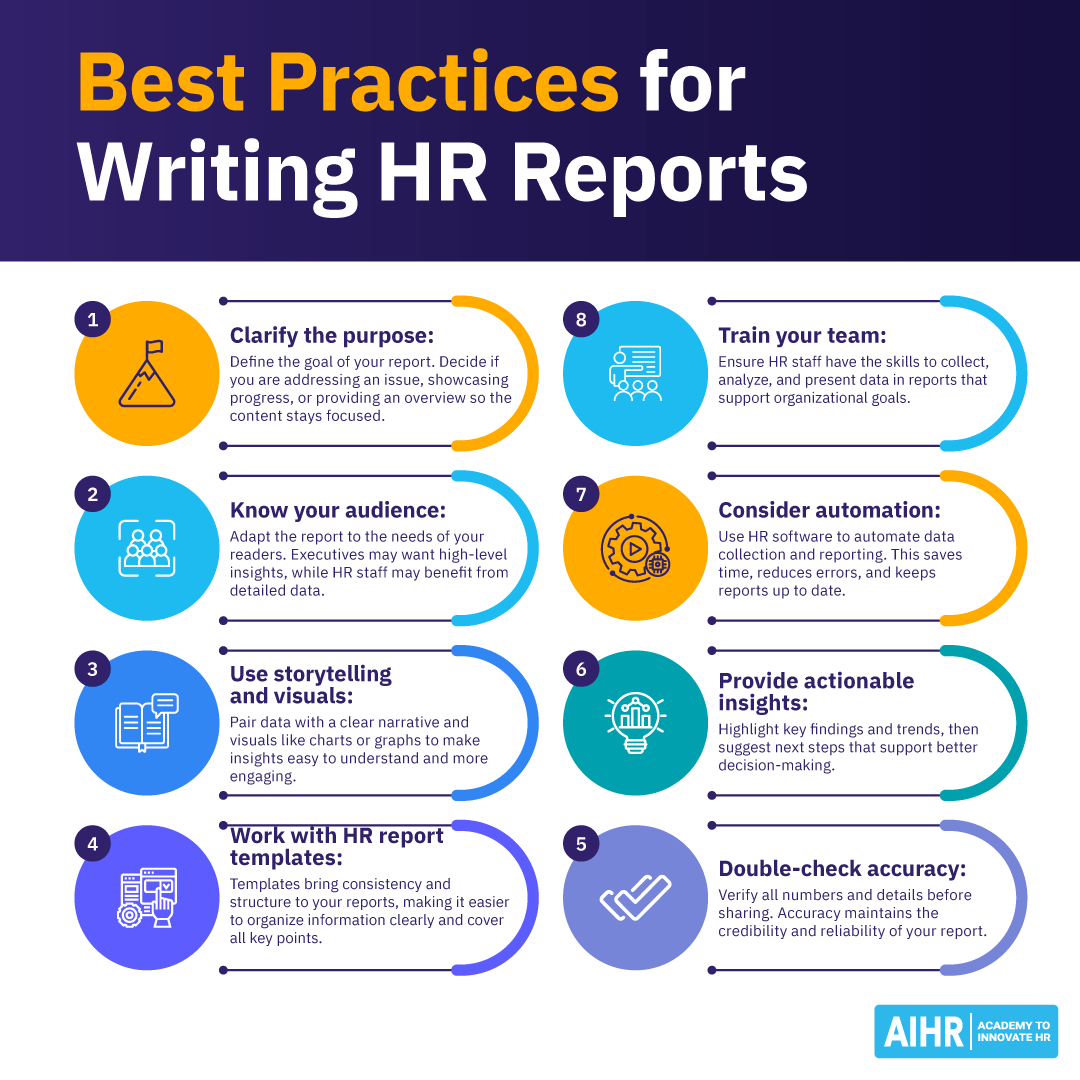
Here are some best practices to keep in mind when creating HR reports:
- Clarify the purpose: Begin by defining the report’s objective. Is it intended to highlight performance trends, flag risks, support a decision, or provide a regular update? A clear objective helps you determine what to include, what to exclude, and how much detail is necessary.
- Know your audience: Different stakeholders need different levels of detail. A board or executive audience will focus on trends, risks, and implications, while HR team members may need more operational detail. Tailoring the report to its audience enhances relevance and increases the likelihood that your insights will be acted upon.
- Use storytelling and data visualizations: Data alone rarely drives action. Context does. Combine key metrics with a clear narrative that explains what the numbers mean and why they matter. Visual elements such as charts, graphs, and tables help make complex information easier to understand and quicker to absorb.
- Use HR report templates for consistency: Templates help standardize structure and formatting, which makes reports easier to read and compare over time. They also reduce preparation time and help ensure important sections are not overlooked, especially when multiple team members contribute to reporting.
- Double-check accuracy: Credibility depends on accuracy. Always verify data sources, calculations, and time frames before sharing a report. Outdated or incorrect data can undermine trust and weaken the impact of your insights.
- Focus on actionable insights: Go beyond describing what happened. Highlight key trends, patterns, or anomalies and explain their implications. Where possible, include clear recommendations or next steps to support decision-making and problem-solving.
- Consider automation where possible: HR systems and reporting tools can automate data collection and updates, reducing manual effort and the risk of errors. Automation also makes it easier to produce timely, repeatable reports without overloading the HR team.
- Build reporting capability across the HR team: Strong reporting should not rely on one person. Invest in developing your team’s skills in data interpretation, reporting standards, and storytelling so insights are consistent and aligned with business needs.
By applying these practices, HR reports become clearer, more relevant, and more influential, supporting better decisions and a stronger strategic contribution from HR.
Key takeaway
Each type of HR report serves a specific purpose, offering insight into different areas of workforce management. When HR Managers understand which reports to use and what each is designed to achieve, they can communicate priorities more clearly, highlight progress, and support better decision-making.
Using a range of HR reports also strengthens HR’s strategic role. By turning workforce data into clear, relevant insights, HR Managers are better positioned to guide the organization toward sustainable growth, stronger engagement, and long-term success.