
An effective talent acquisition strategy can mean the difference between being able to attract, develop, and retain top talent at your organization and a severe skills shortage that prevents the business from reaching its goals.
But getting and keeping top talent on board is a challenging, ongoing task that requires time, strategy, and money. Plus, rapid advances in technology require your talent acquisition strategy and process to evolve accordingly. A recent survey of hiring managers found that 99% are already using AI in some part of the hiring process, and better still, 98% saw significant improvements in hiring efficiency using AI.
As your organization grows, it’s necessary to reassess your talent needs and ensure your talent acquisition strategies align with your company’s vision and mission.
In this article, we’ll explore what a talent acquisition strategy looks like, how to develop an effective TA strategy, along with some best practices and examples to help you bring your plan to life.
Contents
What is a talent acquisition strategy?
A practical talent acquisition strategy framework
How to build a talent acquisition strategy
Bringing your talent acquisition strategic plan to life
Free talent acquisition strategy template
7 talent acquisition strategy examples
What is a talent acquisition strategy?
A talent acquisition strategy helps organizations source, attract, and retain the right people who fit the organizational culture, can provide a lot of value, and help the business meet its long-term goals. Developing a successful talent acquisition strategy requires careful planning, analysis, and long-term thinking.
The strategy is usually owned and executed by the talent acquisition team that often sits within the larger Human Resources department. In some cases, it’s a standalone department, reporting directly to the CEO.
Organizations worldwide face significant talent shortages across many sectors, including healthcare, IT, and finance, and as AI and technology transform many job functions, skills gaps are on the rise. A common mistake in addressing a problem like this is to hire to fill vacancies as quickly as possible. However, this often leads to high attrition rates because the employees hired are not aligned with the company’s culture or future goals. This is the key difference between recruitment and talent acquisition, with the latter having a long-term focus.
Successful talent acquisition takes a more holistic approach to hiring, which helps cultivate an engaged workforce that meets long-term goals. 77% of talent leaders say their TA strategies focus on total value creation for the business rather than saving money. After all, the success of the business depends on the people who make up your workforce. That’s why talent should always be a priority.

A practical talent acquisition strategy framework
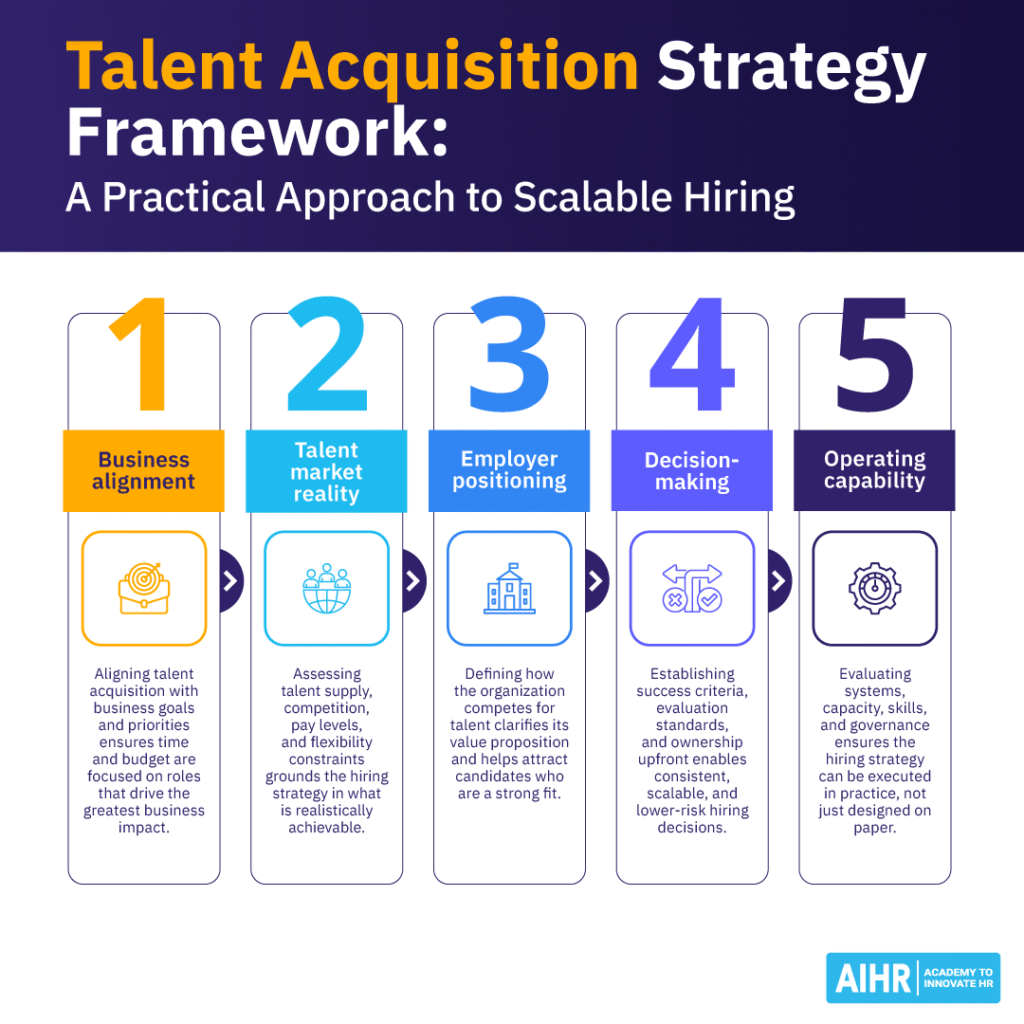
Having a simple talent acquisition strategy framework can help you develop a strategy that is easy to repeat. According to AIHR, a practical TA strategy framework features the following elements:
- Business alignment: Aligning talent acquisition with the business’s wider goals ensures TA resources prioritize roles with the greatest impact on business outcomes. Moving away from treating roles as isolated vacancies and aligning hiring decisions with business objectives and priorities creates synergy and ensures that TA efforts help the business achieve its goals.
- Talent market reality: By assessing the available talent supply, competition, pay levels, location constraints, and flexibility expectations in the job market, hiring strategies are grounded in the resources that are actually available to the organization, which helps TA teams set realistic role scope, timelines, and budgets.
- Employer positioning: When an organization clearly defines how it competes for talent – including its value proposition, trade-offs, and target profiles – the hiring strategy is coherent and recognizable in the talent market, and helps to attract the right candidates.
- Decision-making: Defining how hiring decisions will be made before you begin hiring, and establishing success criteria, evaluation standards, and ownership are key to an effective talent acquisition strategy. Clear decision-making reduces rework, inconsistency, and risk, while allowing the hiring strategy to be scaled across roles and departments.
- Operating capability: Operating capability ensures that the talent acquisition strategy reflects how hiring actually gets done in action, not on paper. By evaluating whether the organization has the systems, capacity, skills, and governance to deliver on its hiring strategy, you can identify gaps and acquire additional resources to bridge these.
How to build a talent acquisition strategy
Using the TA framework outlined above, we’ve broken each of its elements down into smaller steps to help you build an effective talent acquisition strategy at your organization.
1. Consider your business goals and priorities
Begin by collaborating with key stakeholders and business leaders to get clear on the main objectives and priorities of the business over the next 1-5 years. The unique goals of the business should inform your TA strategy.
For example, if one of the main goals of the business is to expand operations and open a new head office in a new continent, then your TA strategy would need to include information on the talent market in that new area and how you plan to attract and hire the right candidates there, while adhering to local employment laws.
2. Engage in strategic workforce planning
Strategic workforce planning can help organizations ensure that the right people are in the right roles at the right time, prevent skills gaps, and prevent over- and understaffing. Workforce planning is essential for many reasons, including aging workforces, cost savings, time management, and flexibility.
HR and TA teams need to ensure they can attract and hire people with the right skills for the right roles while remaining within budget. It’s equally important to plan for potential issues in the future, such as changes in roles driven by AI, mass retirements, and an unpredictable, competitive work landscape.
A strong strategy is only effective when your TA team can execute it consistently. That requires practical skills across sourcing, selection, and stakeholder collaboration, as well as a strong strategic mindset.
With AIHR’s Talent Acquisition Boot Camp, your team will learn to:
✅ Use sourcing frameworks and outreach strategies that improve candidate quality
✅ Strengthen collaboration with hiring managers and workforce planning
✅ Track and improve key metrics like time-to-fill and quality-of-hire
✅ Act as strategic talent partners to the business.
🎯 Equip your team to deliver on your TA strategy and see results already after the first month!
3. Analyze the external environment & market factors
Identify key political, economic, social, technological, legal, and environmental market factors that can impact talent acquisition. For example, government policies and tax laws, inflation rates and unemployment levels, changes in societal values and attitudes toward work (for instance, as Gen Z enters the job market), growing environmental concerns, employment laws, and data protection laws. All of these factors can affect your talent pool and their expectations.
Conducting a PESTLE analysis can help you identify the external factors above and analyze the impact of each on TA and the wider business. From here, you can identify the ones with the most significant potential impact and develop strategies to minimize threats.
4. Understand talent market limitations
When analyzing the talent market, you might encounter various limitations and challenges, including a shortage of qualified candidates, emerging skills (e.g., AI expertise), competition for top talent, changing candidate expectations, and insufficient local talent pools. Talent leaders must be aware of and understand these potential limitations, and develop a plan to address them that aligns with business strategy.
For example, if one of the market limitations is a skills shortage in a certain area of expertise, could you focus on hiring for potential and including skills training as part of the role to develop these skills?
5. Determine who you want to attract
Before attracting candidates, organizations need clarity on who they want to attract and why. This goes beyond listing skills and qualifications, and requires deliberate choices about target profiles, potential trade-offs, and where flexibility is acceptable. Clear target talent profiles help ensure roles are positioned realistically in the market and aligned with how the organization wants to compete for talent.
Regular alignment with hiring managers is key to keeping these profiles relevant as business needs and market conditions change, and to avoid defaulting to overly narrow or outdated requirements that limit the available talent pool.
6. Assess and refine your employer brand
Once you are clear on who you want to attract, the next step is to assess whether your employer brand supports that goal.
Having a strong employer brand and reflecting this throughout your online presence is essential. Candidates today actively research an organization to find out what it’s like to work there before applying for a role or accepting an offer. They will browse your social media accounts, visit your careers page, and check Glassdoor for employee reviews. Even the copy you use in your job descriptions matters, and adds (or takes away from) your employer brand.
Every interaction a candidate has with you should be seamless in reflecting your unique mission, values, and culture. It needs to reinforce a coherent message about who the organization is for, and who it is not.
7. Conduct a competitor analysis
Identifying talent competitors – companies that are hiring for the same talent profiles as you – can help you see what your strengths and weaknesses are. Methods include analyzing your competitors’ Employee Value Proposition (EVP) and comparing it with your organization’s, as well as monitoring their online presence to better understand their proposition and identify gaps.
8. Document a clear process for hiring decisions
First, define each stage of your recruitment and selection process, including the specific criteria, key stakeholders, and decision-makers involved. This includes identifying your hiring needs, sourcing and screening candidates, running assessments and virtual and in-person interviews, making a decision, and making a formal offer. Clarify who makes decisions at each stage to prevent ambiguity.
Using scorecards throughout recruitment and selection can help reduce bias, ensure consistency, and maintain transparency for everyone involved. Documenting this entire process helps you justify decisions made at each stage and make continuous improvements for the TA team and your candidates.
9. Establish clear decision-making protocols
How is the final hiring decision made for each role? For example, does the hiring manager make the final decision with input from the full panel, or does the department manager have the final say with input from the hiring manager?
Whenever a hiring decision is made, it must be justified. Document the reasons why one candidate was chosen over the others, and link this back to the scorecards that have been completed during the process.
10. Ensure your TA team has the skills to execute the strategy
Even the strongest talent acquisition strategy will fall apart if the team executing it lacks the required skills. Modern TA teams are expected to advise the business, navigate complex talent markets, make data-informed decisions, and use technology effectively. Ensuring your team members have these skills makes the difference between a strategy that looks good on paper and one that actually delivers results.
For example, investing in new hiring technology adds little value if TA professionals lack the skills to translate insights from those tools into better hiring decisions.
AIHR’s Talent Acquisition Capability-First Transformation Roadmap outlines how you can develop your team to become strategic growth enablers for your business.
11. Assess your current talent acquisition systems
Analyze your current TA systems and processes to pinpoint bottlenecks and inefficiencies. From here, list them in order of priority to avoid overwhelm, and begin to address them one at a time.
For example, do you have a lengthy hiring process with a long time to offer? Top candidates are likely to receive multiple offers from the market, so it’s essential that you make your offer before they accept another job. It’s equally important to leave all your candidates with a positive hiring experience, even if they don’t receive an offer. That’s why your TA team should analyze the state of candidate communication during the process.
12. Make improvements and monitor them
If you have streamlined your recruitment process and reduced your time to hire, monitor whether this is helping increase your offer acceptance rate from top candidates and improve the overall hiring experience for all candidates. If you’ve employed data-driven tools like skills-based assessments, are they helping your team make more objective hiring decisions and improve the quality of candidates who move to the interview stage?
Use your Applicant Tracking System (ATS) and AI tools to gather insights and measure performance across your hiring journey, for example, quality of hire, offer acceptance rate, and time to hire, to gauge the effectiveness of your improvements. Continue to make adjustments over time to improve operations.
Bringing your talent acquisition strategic plan to life
Here are some best practices to help you operationalize your talent acquisition strategy.
- Build talent pipelines: To build robust talent pipelines, consider looking at alternative sources, such as specialized online forums or candidates who are not actively seeking a new job. Create relationships with industry leaders, universities, and colleges so that you can connect with candidates early on and get to know them beyond their resumes.
- Design an effective selection process: Your selection process should resemble a funnel that begins with role definition and approval, followed by application, screening & pre-selection, interview, assessment, references & background checks, a decision, and if a candidate is successful, a job offer and contract. Ensure that your funnel helps you hone in on the most suitable candidates for your organization and the role in question based on relevant criteria. Move candidates through the funnel as efficiently as possible.
- Build a positive candidate experience: A successful talent acquisition strategy creates a positive experience for all candidates, regardless of whether they are hired or not. Review your current application and selection process from the candidate’s perspective. For example, emails and automated messages sent, wording in job descriptions, waiting time, and ease of applying.
- Use technology and AI: Speak to your TA team to identify any technology gaps that are preventing the company from attracting and hiring top talent and from creating a positive candidate experience. If your TA team is happy and has the tools they need to do their job, they’ll be in a strong position to attract top talent. With technology advancing rapidly, digital transformation is essential if you hope to compete for the best candidates. However, only 35% of professionals in HR feel equipped to use AI in their work. Support your team by starting small with a chatbot to answer candidate questions in real time or schedule interviews. Maintain human input at all stages to mitigate the potential bias and risks associated with AI.
- Use data in your decision-making: The right data insights can help you determine where your top candidates are coming from so that you can focus your efforts on those sources. It can also tell you whether certain questions in your application process or the length of your application deter candidates from completing it, so you can adjust or eliminate these questions. You may also discover that images and videos highlighting company culture could encourage applications. A/B testing key elements can be incredibly valuable. Software and applicant tracking systems can help you sort through your talent pool, assess candidates, and recruit.
- Implement talent acquisition metrics and KPIs: TA metrics help you track hiring success and optimize your recruitment process. For example, your time to hire, quality of hire, applicants per opening, application completion rate, and so on. KPIs then help you connect hiring performance to business outcomes, such as new-hire retention, ramp-up time to productivity, hiring manager satisfaction, and performance outcomes for critical roles. With this knowledge, you can determine whether your company is hiring the right people and make targeted improvements.
- Bridge the skills gaps within your TA team: Identify capability gaps in areas such as talent market analysis, stakeholder advisory skills, data-driven decision-making, and the use of hiring technology and AI. From there, invest in targeted learning and development to build these capabilities and ensure your team can support strategic hiring decisions in practice. Programs like AIHR’s Talent Acquisition Boot Camp are designed to help TA professionals build the skills needed to translate hiring strategy into consistent, measurable results.
Free talent acquisition strategy template
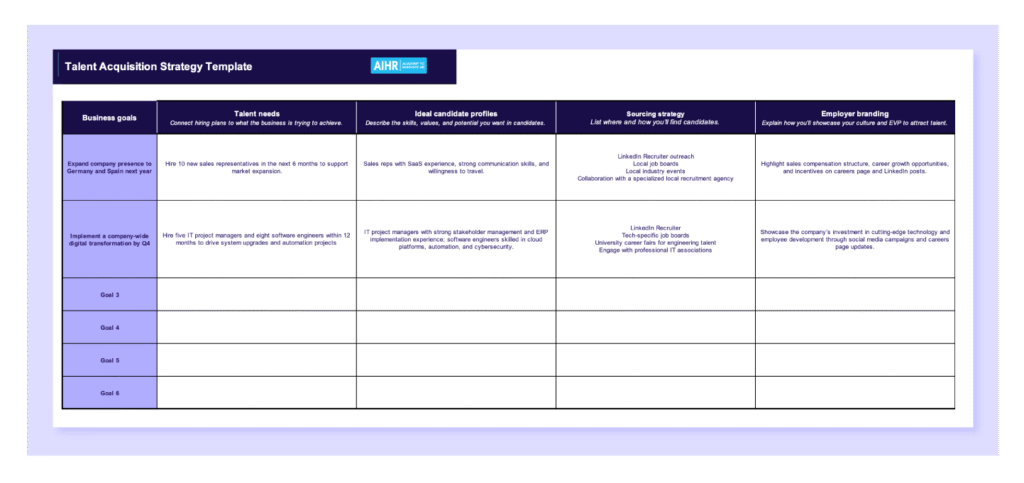
To move from ideas to action, talent acquisition leaders need a clear way to capture and communicate their strategy. That’s where a talent acquisition strategy template can make a difference.
Rather than documenting every step of the hiring process, the focus is on clarifying what matters most and why. The template serves as a central document to outline company goals, ideal candidate profiles, sourcing strategy and selection plans, assessment criteria, as well as success metrics, all in one structured sheet.
7 talent acquisition strategy examples
Here are seven examples of talent acquisition strategies from different industries and company sizes. Each illustrates a specific lever you can use to strengthen your own TA approach.
1. Accenture: Candidate & employee experience
Hiring more than 150,000 people each year, Accenture ambitiously decided to redesign its global recruitment approach with a 360-degree recruitment concept. Rather than optimizing isolated parts of the hiring process, the aim was to design a strategy that delivers a consistently positive experience for all stakeholders and supports long-term talent outcomes.
To inform this strategy, Accenture introduced pulse surveys to gather key data at multiple touchpoints in the candidate journey, as well as quarterly feedback from hiring managers. This provided detailed insights into what candidates and internal stakeholders were experiencing and where improvements would have a strategic impact.
One of the actions the combination of these insights led to was creating a series of training resources for hiring managers across the company to improve both the candidates’ and recruiters’ experience. Lessons from the data recognized time constraints and broke the training down into manageable pieces that could be slotted into busy schedules in small chunks.
2. Delaware North: Digitized talent acquisition strategy
Global hospitality leader Delaware North was struggling to establish a unified TA platform across countries and needed to address regional differences in the recruiting process and system requirements while maintaining consistency.
By implementing a digitized talent acquisition strategy with a unified platform rollout (iCIMS) across multiple countries, they were able to standardize hiring, reduce silos, and boost collaboration between recruiters. Key achievements included a reduced average time to complete an application from over 5 minutes to 2:44, and an increased application completion rate from 50% to 95%.
3. Mastercard: AI-driven talent acquisition for talent pipelining
Mastercard leveraged AI tools through Phenom’s talent platform to improve candidate experience, pipeline growth, automation, and analytics. This included implementing a globally-relevant career site with workflows, automated interview scheduling, and AI-driven candidate insights and matching.
The new process resulted in faster interview scheduling (88% scheduled within 24 hours), a larger talent pipeline (around 900,000 profiles), and higher conversion and engagement metrics.
4. Global tech company: Streamlined hiring process
A global technology company partnered with Randstad Enterprise to streamline its recruitment process by reducing manual tasks, thereby improving efficiency and the candidate experience. By implementing a scalable and flexible talent business process outsourcing (BPO) solution, the tech company improved its agility and efficiency and accelerated its global hiring program. Interview scheduling times were reduced, resulting in a 27% decrease in time to hire.
5. HelloFresh: Innovative employer brand
HelloFresh created two innovative employer brand campaigns to drive engagement and growth in its global TA strategy. The first initiative, “Cooking Eggs,” had regional leaders preparing meals while highlighting their local culture, and led to a 174% increase in career site traffic and a 40% surge in external applications. The second initiative, “Cooking Up a Career,” showcased internal mobility success stories and led to internal candidates comprising almost 33% of total applications.
Together, these initiatives – utilizing personalized engagement tools and analytics – helped HelloFresh develop a compelling employer brand that resonated with people across markets and significantly boosted their recruitment and retention efforts.
6. Talking Rain: DEIB initiatives
Washington-based beverage company Talking Rain wanted to diversify its workforce to scale globally and strengthen its culture. After finding that most hires were male and White, predominantly from employee referrals, they switched to a more traditional and inclusive referral model. Women applicants grew from 22% in 2020 to 50% a year later, while BIPOC candidates increased from 32% to 42%.
7. Rostrum: Cost efficiency
UK-based marketing communications agency Rostrum worked with RS Talent Solutions to streamline their recruitment process, aiming to improve time to hire, the quality of hires, and cost efficiency. By implementing an ATS, reducing time spent screening CVs, amplifying their employer brand on social media, and revamping their job descriptions, Rostrum managed to make 18 hires in 12 months (filling their hiring quota for the year), freed up management time by an additional 42 hours over 12 months, and saved £36,500 in recruitment costs.
Key takeaways
No matter what size your organization is or where it currently sits on a journey of growth, a talent acquisition strategy can help you define what a high-quality candidate looks like for your company and get to work attracting, hiring, and retaining people who align with that. Leverage emerging tools and technology, including AI, to help you streamline your hiring journey and create a positive experience for both your candidates and recruiters.