
A solid recruitment policy is indispensable for organizations that want to attract the right candidates, especially when competition is tough and top talent is scarce. In fact, three in four employers believe there’s currently a talent shortage.
In response, many organizations are forced to innovate their approach to recruitment, for example, by adopting skills-based hiring to expand their talent pools. These changes often require companies to revisit and formalize their recruitment policies to keep the hiring practices aligned with business strategy, compliant with regulations, and consistent across teams.
This article discusses how to write a recruitment policy and what to include in one. It also provides a free recruitment policy template to help you strengthen your organization’s recruitment process.
Contents
What is a recruitment policy?
Why is a recruitment policy important?
What to include in your recruitment policy
Benefits of using a recruitment policy template
Key elements of a recruitment policy template
Free recruitment policy template
How to write a recruitment policy in 9 steps
4 recruitment policy examples

What is a recruitment policy?
A recruitment policy, also referred to as a recruitment and selection policy or hiring policy, is a formal document that sets the principles, standards, and procedures an organization follows to attract, assess, and hire employees. It acts as the blueprint for every stage of the recruitment process, from identifying talent needs and advertising vacancies to evaluating candidates and making final hiring decisions.
A well-defined recruitment policy enables talent acquisition teams, hiring managers, and leaders to make fair hiring decisions, align hiring with business goals, comply with labor regulations, and maintain consistency across departments.
Why is a recruitment policy important?
Hiring decisions shape your workforce, culture, and long-term performance. Without clear guidelines, recruitment can quickly become inconsistent, inefficient, and exposed to risk. A robust recruitment policy helps your organization:
- Define a clear and consistent hiring process, guiding every step from identifying vacancies to making informed hiring decisions
- Standardize recruitment across departments, preventing fragmented or inconsistent approaches
- Promote fairness and objectivity, ensuring all candidates are assessed using the same criteria and treated with respect and integrity
- Support compliance with labor laws, helping hiring managers and recruiters follow relevant regulations more easily
- Reinforce organizational culture and values, aligning hiring decisions with the company’s principles and reputation
- Encourage objective decision-making, fostering a positive employee experience and a more inclusive workplace that values diverse perspectives
- Reduce inefficiency and bias, preventing unclear expectations, inconsistent evaluation standards, and misaligned decisions
- Mitigate legal and reputational risks, lowering the likelihood of discrimination claims and employer brand damage.
What to include in your recruitment policy
Your recruitment policy should define the guiding principles, governance structure, and standards that shape how your organization hires. Rather than documenting every operational detail, it should set clear expectations and provide direction across departments.
A comprehensive recruitment policy typically addresses:
- Purpose and scope of the policy: Clarify what the policy covers and how it supports business growth, workforce planning, and talent strategy.
- Roles and accountability: Define who is responsible for different aspects of hiring, including TA, hiring managers, and leadership.
- Legal and ethical standards: Confirm compliance with labor laws and outline the organization’s commitment to fair and responsible hiring.
- High-level recruitment framework: Provide an overview of the hiring stages without documenting every procedural step.
- Equal opportunity commitment: Reinforce the organization’s stance on equitable, inclusive, and merit-based hiring.
- Internal mobility principles: Clarify how internal candidates are considered and how transparency is maintained.
- Data protection standards: Explain how candidate information is handled in line with privacy regulations.
- Use of third parties: Set expectations for external recruitment partners and vendors.
Benefits of using a recruitment policy template
Rather than drafting a recruitment policy from the ground up, you can use a structured template as a starting point. This approach offers several practical benefits, including:
- Saves time and effort: A solid template gives you the full structure, so you can focus on tailoring the content to your organization instead of starting from scratch.
- Ensures consistency across recruitment and TA teams: A shared template keeps recruitment processes consistent across departments and locations.
- Helps smaller teams start faster: Small teams can adopt a structured approach more quickly without having to rely on ad hoc methods.
- Reduces legal risks by covering essential components: Good recruitment policy templates cover legal basics, helping you stay compliant and avoid missing key rules.
- Easier to tailor to company-specific needs: Because templates are customizable, you can easily adapt them to fit your company’s culture, industry, and goals.
- Supports training and onboarding of talent acquisition team members staff: New team members can quickly get up to speed using the policy as a guide, flattening the learning curve and driving a seamless transition during onboarding.
- Encourages regular policy reviews: When laws or hiring needs change, you can update specific sections easily without redoing the entire policy.
A well-designed recruitment policy creates clarity around how hiring decisions are made. To apply it effectively, however, your TA team needs the practical skills to source the right candidates, collaborate with hiring managers, and monitor hiring outcomes.
AIHR’s Talent Acquisition Boot Camp helps teams build these capabilities through practical learning integrated into everyday recruiting work. Many organizations begin seeing improvements within the first 1–3 months.
In the program, your team will learn to:
✅ Implement structured sourcing and selection practices aligned with your recruitment policy
✅ Work more closely with hiring managers to ensure consistent hiring decisions
✅ Use hiring metrics to track progress and refine recruitment processes
✅ Strengthen their role as strategic partners in delivering hiring outcomes.
🎯 Equip your team to turn recruitment policy into better hiring outcomes.
Key elements of a recruitment policy template
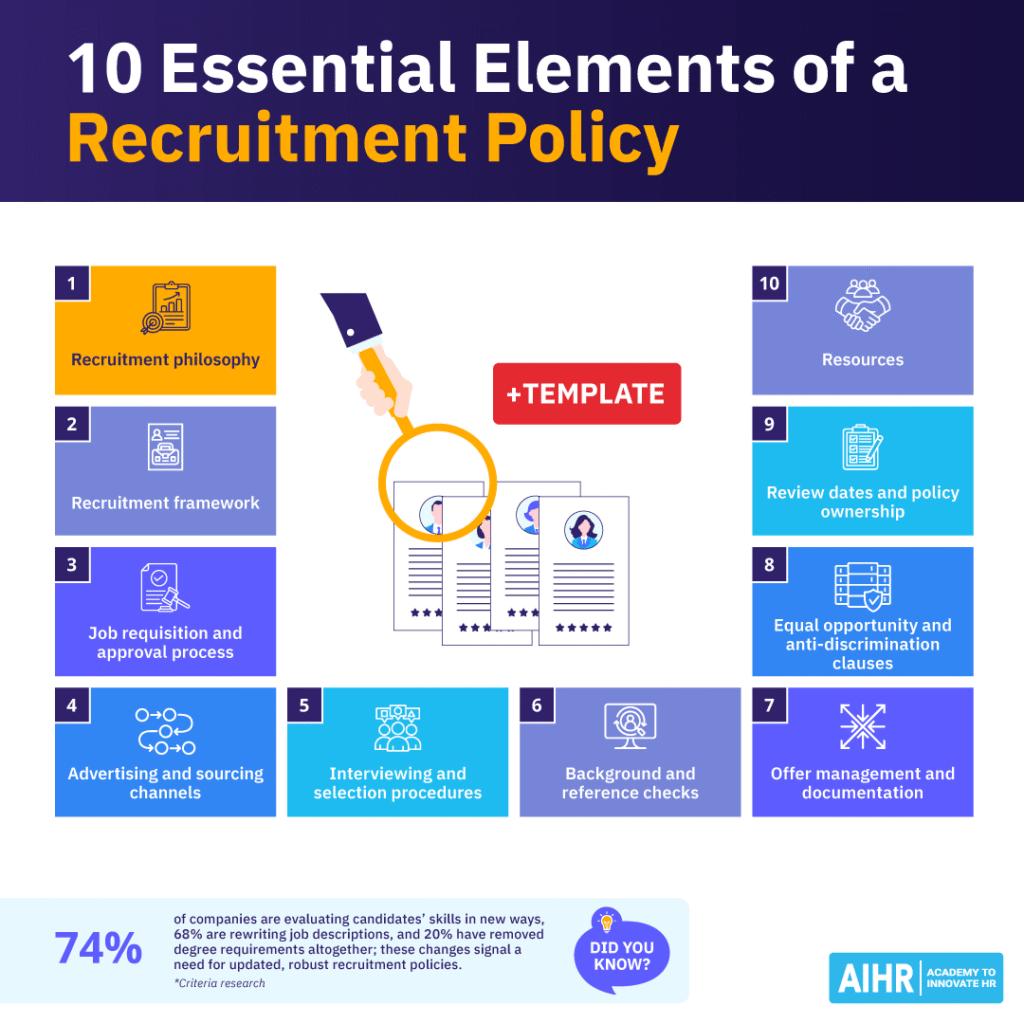
When formalizing your recruitment policy, a structured template helps ensure consistency and completeness. The following components should form the foundation of your template:
The company’s recruitment philosophy
The recruitment philosophy sets the tone for an organization’s talent acquisition approach. It reflects the company’s beliefs about its people, how it evaluates potential, and how it balances skills, experience, and cultural fit. Write a concise statement reflecting your organization’s definition of great talent and the qualities it prioritizes in team-building.
Recruitment framework
This outlines the structure for hiring activities, detailing the steps, stakeholders, and decision points involved. It brings consistency to the recruitment process while allowing flexibility for different roles and departments. Develop a visual or written process flow mapping all the recruitment stages, so all involved parties understand their responsibilities.
Job requisition and approval process
Formalizing how the company identifies, documents, and approves hiring needs ensures precise business requirements, not ad hoc decisions, drive its recruitment process. This helps control costs, maintain headcount, and prioritize critical roles. Create a standard requisition form and approval workflow, including justifications for each role and necessary budget approvals.
Advertising and sourcing channels
Specifying channels and methods for attracting candidates promotes efficiency and reach. Depending on the role and target audience, these may include job boards, professional networks, or recruitment agencies. Refer to an updated list of preferred job boards, sourcing platforms, and recruitment partners tailored to different role types and seniority levels.
Interviewing and selection procedures
Develop and link to structured interview guides and scoring rubrics aligned with your recruitment framework’s competencies and values. Standardize interviewing and selection processes to ensure fair, consistent candidate assessment. Lay out clear procedures to guide interview formats and selection criteria, reduce unconscious bias, and improve hiring quality.
Background and reference checks
Incorporating checks into the recruitment process adds due diligence, verifying candidate qualifications, experience, and suitability. Clear guidelines also protect the organization from compliance risks and poor hiring decisions. Define roles needing specific checks and their timing, and ensure you obtain candidate consent beforehand.
Offer management and documentation
A transparent process for preparing, approving, and delivering job offers ensures accurate, consistent terms aligned with company policies and promotes a positive candidate experience. I recommend the use of a standard offer letter template reviewed by legal counsel and the establishment of a procedure for internal approvals before extending offers.
Equal opportunity and anti-discrimination clauses
Include these clauses to reinforce the organization’s commitment to fair hiring practices and clear compliance with legal and ethical standards. Review the clauses to ensure they reflect current legislation and are consistently applied throughout recruitment communications and procedures.
Review dates and policy ownership
Assign ownership of the recruitment policy and set review dates to ensure the document stays updated and meets the organization’s needs as it grows or adapts to market changes. Identify a policy owner—typically a senior talent acquisition leader—and schedule a formal review annually or biennially (or whenever significant changes occur in employment law or business strategy).
Resources
List and link to available resources relevant to the recruitment process, such as your company’s employee referral program or the application process for current employees looking to fill open roles via internal hiring.
Free recruitment policy template
If you need a starting point to help create your recruitment policy, download AIHR’s free recruitment policy template. It’s also customizable, so you can tailor it to match your organization’s recruitment needs.

How to write a recruitment policy in 9 steps
The nine steps below guide you through creating a recruitment policy that supports governance, consistency, and effective hiring across your organization.
Step 1: Define your recruitment goals
Clarify what you want the recruitment policy and process to achieve for the organization. Setting clear, measurable goals will shape subsequent decisions. Align goals with business priorities, consider practical objectives, and engage leadership to confirm that the goals align with long-term organizational needs.
Step 2: Gather input from talent acquisition, legal, and leadership
Collaboration ensures the policy is comprehensive, practical, and compliant. Consult your TA team for insights on recruitment challenges, and involve legal advisors early to ensure compliance. Ask for leadership input to align the policy with company values and strategic objectives, and use structured interviews or workshops to gather meaningful feedback.
Step 3: Map your existing hiring process
Familiarize yourself with the current recruitment framework before making improvements. Document every stage, from job requisition to onboarding, and identify who makes decisions for each one. Additionally, create a process map or workflow diagram to visualize the full recruitment cycle and note any variations between departments or teams.
Step 4: Identify gaps or compliance risks
A clear view of weaknesses will help you address potential problems using the new policy. Look for inconsistencies or delays in the current process, identify potential bias or unfair practices, and ensure legal compliance. This will allow you to identify and address areas for improvement in the current process and refine it in the new policy.
In addition to process risks, team capability gaps may also surface. For example, your TA team may lack the skills, tools, or structure needed to implement consistent, skills-based, or data-informed hiring practices. Addressing these gaps ensures your recruitment policy is not just well-written, but executable.
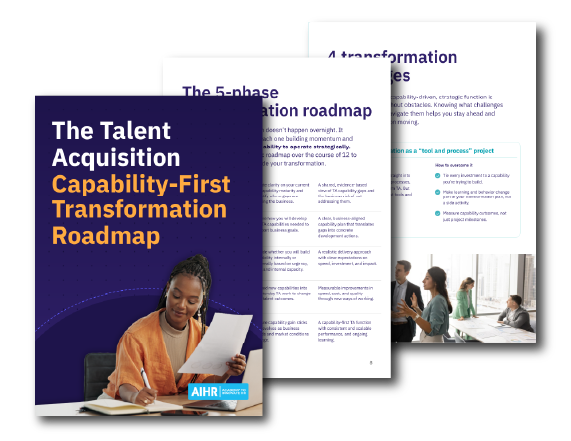
To support this, AIHR’s Talent Acquisition Capability-First Transformation Roadmap offers a structured, phased approach to assess current capability maturity and build the skills your TA function needs to deliver hiring outcomes consistently and with business impact.
Step 5: Choose a recruitment policy template
A good template provides structure and saves time. Select a recruitment policy template that includes essential components like recruitment philosophy, approval processes, and compliance standards. Look for templates recommended by recruitment and talent acquisition professionals or industry bodies, and ensure the template allows easy customization.
Step 6: Customize the template to fit your company’s values
Tailor the template to reflect your organization’s hiring approach. Adapt language and tone to suit company culture and clarify procedures for key steps like job requisition, advertising, and selection. You should also incorporate DEIB hiring commitments and ensure consistency with other internal policies and documents.
Step 7: Review with stakeholders
Collaborative review leads to a stronger, more practical policy. Share the draft with the TA team, legal, leadership, and hiring managers, and request specific, constructive feedback from them. Based on this, revise the policy to address concerns and suggestions while maintaining clarity and consistency. After this, all stakeholders should approve the final version before implementing it.
Step 8: Train hiring managers on the policy
Training ensures the policy is understood and applied correctly. Provide training sessions or workshops to explain the recruitment framework and hiring policy, with practical examples and scenarios to clarify expectations. Additionally, they distribute written guides or quick-reference materials and offer follow-up support for managers who may need further guidance.
Step 9: Update the policy regularly
Keeping the policy current maintains its relevance and effectiveness. Assign responsibility to a senior member of the recruitment or talent acquisition team to oversee this and set up a review schedule (annually or after major legal or organizational changes). Update the policy to reflect new laws, technologies, or strategic priorities, and be sure to communicate these updates clearly to all relevant teams.
4 recruitment policy examples
Below are four real-life company examples of effective recruitment policies:
Example 1: The University of York
The University of York’s recruitment policy revolves around meritocracy, equal opportunities, and professionalism, ensuring an inclusive recruitment process. It bases its recruitment decisions on merit, with structured procedures to identify the best candidate for each role. It also supports candidates with disabilities, making necessary adjustments for a fair recruitment experience.
Example 2: CUTS International
CUTS International emphasizes a transparent, merit-based recruitment approach, ensuring equal opportunities for all candidates. The organization has established clear procedures to ensure it provides equal employment opportunities and avoids discrimination based on race, gender, sexual orientation, nationality, age, and other immutable personal characteristics.
Example 3: Google
Google publicly outlines its approach to hiring on its careers pages. Their recruitment process aims to identify and hire individuals who are aligned with the company’s mission and values, emphasizing fairness, consistency, and a commitment to diversity and inclusion. It also handles candidate information per its Applicant and Candidate Privacy Policy, ensuring confidentiality and compliance with data protection regulations.
Example 4: Microsoft
Microsoft shares elements of its hiring approach externally through its careers site and employer communications. The company’s hiring process is designed to identify individuals who not only meet technical and behavioral requirements but also align with the company’s disciplined, systems-focused approach to problem-solving. Hiring at Microsoft plays a critical role in reinforcing a data-aware culture driven by leadership accountability and structured collaboration.
To sum up
In light of the shift toward skills-based hiring, talent acquisition leaders must ensure their recruitment policy reflects current realities. A well-defined policy supports consistent decision-making, compliance, inclusivity, and a stronger candidate experience, especially in hybrid and remote environments where processes can easily become fragmented.
Your policy should go beyond just listing the steps of the hiring process. It should reflect your organization’s recruitment philosophy, clarify responsibilities, and integrate compliance, equity, and digital tools. When built correctly, it provides the structure needed for high-quality, bias-aware hiring decisions and helps your TA team scale talent acquisition strategically.