
If you’re comparing HRCI vs SHRM, you’re likely trying to figure out the best way to validate your HR expertise and accelerate your career. Both organizations offer respected credentials that can boost your credibility, open doors to promotions, and increase your earning potential.
That said, HRCI and SHRM take different approaches to credentialing, and understanding what each prioritizes will help you make a more informed decision. There’s also a third approach worth considering, one that focuses less on validating existing knowledge and more on building new HR skills that are in demand right now.
The real questions you should be asking are:
- Do you prefer a knowledge-based exam focused on HR laws and compliance, or a competency-based exam focused on situational judgment?
- Are you looking to validate existing knowledge, or do you also need to build new skills in areas like people analytics, business partnering, or AI in HR?
- Is your goal a credential that signals expertise to employers, continuous skill-building that equips you to make a measurable impact at work, or both?
- How much time and money are you prepared to invest in professional development?
- Do you need to specialize in a particular HR domain, or do you want a broad HR generalist credential?
We’ll break down the HR credentialing options so you can make an informed decision about what’s most worthwhile to invest in.
Contents
The three main HR credentialing paths
SHRM vs HRCI vs AIHR at a glance
HRCI overview
SHRM overview
AIHR overview
Key differences between HRCI, SHRM, and AIHR
SHRM vs HRCI vs AIHR pricing compared
SHRM vs HRCI vs AIHR: Which should you choose?
The three main HR credentialing paths
Here’s a summary of the two popular HR certification providers:
HRCI (HR Certification Institute) is the established standard for knowledge-based HR certification, with a credentialing history spanning over 50 years. Its credentials, particularly the PHR and SPHR, are known for their rigorous focus on the technical and operational aspects of HR, including laws, regulations, and compliance.
HRCI offers eight different certifications covering everything from associate-level to global HR, making it the broadest credentialing portfolio in the industry. Its certifications are accredited by the National Commission for Certifying Agencies (NCCA), a distinction no other HR certification body holds. HRCI’s emphasis on knowledge validation makes it especially valuable for HR professionals in compliance-focused roles.
SHRM (Society for Human Resource Management) is the world’s largest HR professional association, offering two competency-based certifications (SHRM-CP and SHRM-SCP) that emphasize the practical application of HR knowledge in real-world scenarios. Beyond certification, SHRM provides a comprehensive ecosystem of resources, including an HR Knowledge Center with access to advisors, an extensive library of templates and tools, legislative updates, and the world’s largest HR conference.
SHRM works with an optional membership model for HR professionals who want both a credential and a professional home, though the annual membership fee on top of certification costs adds up.
Both HRCI and SHRM are respected pathways for validating your HR expertise, and many professionals hold credentials from one or both organizations. But if you’re also looking to build practical, future-ready HR skills that complement your professional certification, there’s a different kind of investment worth considering.
AIHR (Academy to Innovate HR) takes a different approach to HR professional development. Rather than certifying existing knowledge, AIHR’s online certificate programs teach HR professionals the practical skills the modern Human Resources profession requires, from the broad competencies that underpin high-impact HR work to specialized domains including people analytics, digital HR, talent acquisition, organizational development, and AI in HR. With 16 certificate programs and 85+ courses, AIHR emphasizes hands-on learning with real-world projects and capstone assignments. Once you complete a program, you earn a digital certificate to showcase your new expertise.
AIHR is recognized by SHRM to offer Professional Development Credits (PDCs) for SHRM-CP or SHRM-SCP recertification activities, and its programs also earn recertification credits for HRCI credentials, meaning AIHR complements these certifications by filling the gap between credential validation and ongoing capability building.
HRCI vs SHRM vs AIHR at a glance
HRCI and SHRM both validate your existing HR expertise, each through their own approach. AIHR builds practical HR capabilities through specialized online learning and awards a digital certificate you can share when you’re finished. For many HR professionals, these three approaches to professional development are complementary.
- HRCI validates HR knowledge through rigorous, knowledge-based certification exams with NCCA accreditation.
- SHRM validates HR competency through situational judgment exams, complemented by an optional but valuable professional membership.
- AIHR builds practical HR capabilities through specialized online courses, hands-on projects, and real-world applications, earns recertification credits for both SHRM and HRCI, and awards digital certificates of completion.
Primary focus
Knowledge-based HR certification
Competency-based HR certification + membership
Practical skills-based online learning with digital certificates
Number of credentials offered
8 certifications
2 certifications + specialty credentials
16 certificate programs, 85+ courses
Exam approach
Technical knowledge, laws, compliance
Situational judgment + knowledge
Capstone projects + assessments
Eligibility requirements
Varies by credential (none for aPHR)
None for SHRM-CP; 3 years strategic HR for SHRM-SCP
None (open to all)
Recertification
60 credits every 3 years
60 PDCs every 3 years
Lifetime digital certificates + continuous access with subscription
Membership required
No
Optional ($299 / year / Professional tier)
Included in subscription
Global recognition
180 countries
100+ countries
180+ countries
Community
HRCI ENGAGE (free)
SHRM Connect (members only)
Access to a 25,000+ member community included in subscription
AI and analytics in HR training
Growing content
Emerging content
Core curriculum focus
Starting cost
Exam prep:
PHR Cert Prep with Video: $699 list price or $649 bundled price when purchased with the exam application; format is listed as Book / Audio / Web. HRCI also lists Second Chance Test Insurance as optional at $250.
SPHR Cert Prep with Video: $699 list price or $649 bundled price; format is also Book / Audio / Web. Optional Second Chance Test Insurance is $250
Exam fees:
PHR exam: $495 = $100 application fee + $395 exam fee
SPHR exam: $595 total = $100 application fee + $495 exam fee
HRCI ENGAGE community is free.
Exam prep:
Online only: $820 member / $1,130 non-member
Online + printed books: $1,020 member / $1,330 non-member
Exam fees:
SHRM-CP early-bird: $420 member / $520 non-member
SHRM-CP standard: $495 member / $595 non-member
SHRM-SCP early-bird: $520 member / $620 non-member
SHRM-SCP standard: $595 member / $695 non-member
Professional membership: $299/year.
$1,125/year (1 certificate program), or $1,850/year (Full Academy Access).
No additional membership costs.
Included in Full Academy Access:
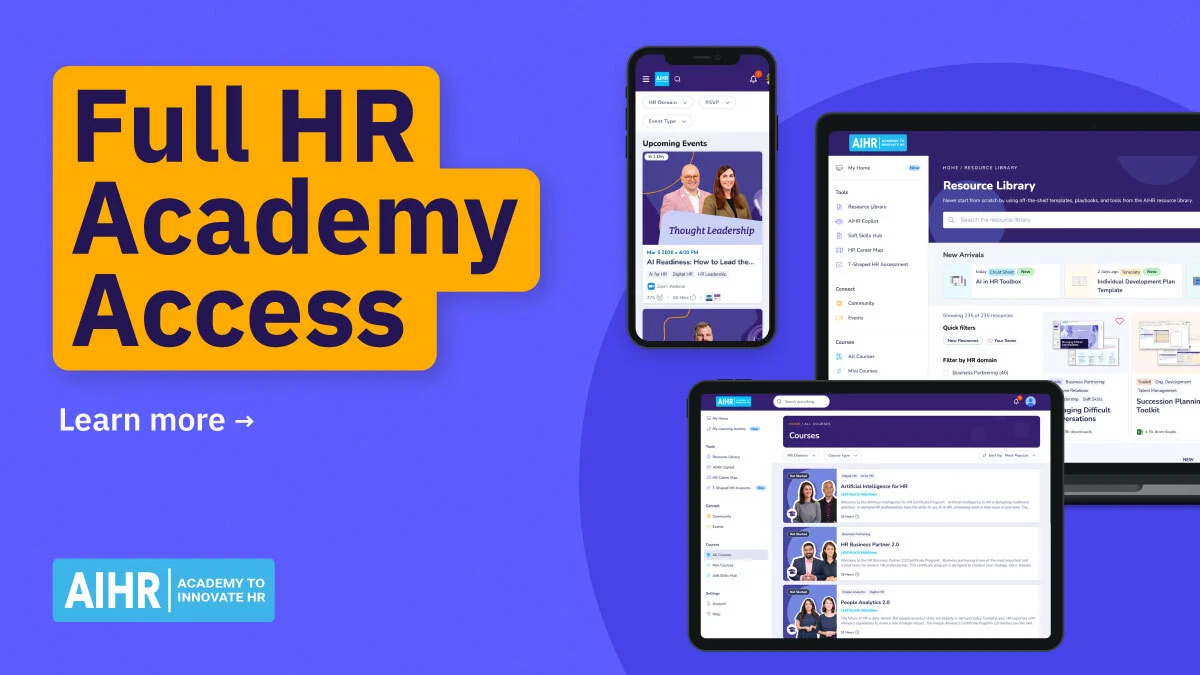
Personal coaching, templates & toolkits, Soft Skills Hub, mini courses, peer community & weekly live webinars, AIHR Copilot (AI-powered assistant), and a T-Shaped Competency Assessment.
Best for
Compliance-focused HR professionals
HR generalists seeking broad credibility
HR professionals building modern, specialized competencies and looking to earn PDCs and recertification credits
HRCI overview
Who it’s for
HRCI serves HR professionals at every career stage who want to validate their technical HR knowledge through a formally accredited certification. HRCI’s name reflects its core values: Human-centered, Responsibility, Collaboration, and Innovation.
In practice, that means that HRCI has a credential for wherever you are in your career. If you’re new to HR and have no experience yet, there’s an entry-level option. If you’re a mid-career professional focused on day-to-day HR operations, there’s a credential for that too. And if you’re a senior or global HR leader involved in strategy and policy, HRCI has designations at that level as well.
Over 95% of Fortune 500 companies have HRCI-certified professionals in leadership roles, which means these credentials carry real weight when you’re looking to move up or stand out.
Types of HRCI certifications
HRCI offers eight distinct certifications organized in tiers:
- Associate level: The Associate Professional in Human Resources (aPHR) and its international counterpart (aPHRi) require no prior HR experience, making them accessible entry points for those starting their HR careers.
- Professional level: The Professional in Human Resources (PHR), Professional in Human Resources – International (PHRi), and Professional in Human Resources – California (PHRca) target mid-career HR professionals. The PHR and PHRi emphasize technical and operational HR knowledge, while the PHRca focuses on California-specific laws and practices. These require a combination of education and one to four years of professional HR experience.
- Senior and global level: The Senior Professional in Human Resources (SPHR), Senior Professional in Human Resources – International (SPHRi), and Global Professional in Human Resources (GPHR) are designed for experienced professionals in strategic or global roles. The SPHR and SPHRi typically require four to seven years of experience, depending on education level, while the GPHR requires two to four years of global HR experience.
Key benefits
HRCI certifications offer several tangible benefits.
Research shows that certified professionals are more likely to be hired and to be employed full-time. Supervisors also rate them higher on job performance, strategic HR capability, and potential for future positions. According to the HumRRO study for HRCI, PHR holders earn around 7% more than non-certified peers, while SPHR holders see a significantly larger salary premium of approximately 31%.
Some studies indicate that holding a PHR or SPHR can double a person’s chance of promotion within five years. The NCCA accreditation is a meaningful differentiator within the HR credentialing space, representing the gold standard in professional credentialing quality assurance.
Eligibility criteria for HRCI certifications
HRCI eligibility requirements vary by credential.
The aPHR has no experience requirement, requiring only a high school diploma or equivalent. For other certifications, eligibility is based on a combination of education and professional HR experience. The PHR requires between one year (with a master’s degree) and four years (with a high school diploma) of professional HR experience. The SPHR requires between four years (with a master’s degree) and seven years (with a high school diploma).
International and specialty certifications have their own eligibility structures detailed in HRCI’s certification handbooks.
Exam format
HRCI exams are computer-based and administered at Pearson VUE testing centers or through OnVUE online proctoring.
The exams include multiple-choice and scenario-based questions designed to assess not just what a candidate knows but how they can apply that knowledge in practical HR situations. Each exam has a specific content outline that details the functional areas and knowledge domains covered.
Community, resources, and support
HRCI launched HRCI ENGAGE, a free online community for HR professionals globally, in early 2025. The platform includes community spaces organized by geography and business vertical, an HR job board, video events, continuing education webinars, and moderated discussions.
HRCI also provides the HRCI Learning Center with over 220 (paid) courses, the Human Resource Body of Knowledge (HRBoK), and certification handbooks. Customer support is available through a Customer Experience Call Center and email.
Recertification and ongoing development
All HRCI certifications are valid for three years.
To recertify, professionals must earn a specific number of recertification credits (60 for PHR, SPHR, and GPHR; 45 for aPHR and aPHRi) by participating in approved professional development activities. At least one ethics-focused credit is mandatory. HRCI allows up to 15 surplus credits to carry over to the next cycle if earned in the final 12 months. If you’d rather not track credits, you can retake the exam instead.
The HRCI Learning Center offers pre-approved courses that earn recertification credits, though users need to manually enter the activity ID from completed courses into their recertification application.
AIHR certificate programs are also eligible for HRCI recertification credits, earning you between 22 and 35 credits per program.
SHRM overview
Who it’s for
SHRM serves HR professionals at all career stages and is particularly well-suited for those who want both a credential and a comprehensive professional membership with access to resources, research, and a global network of HR peers.
It’s also one of the most widely recognized HR bodies in the world. Nearly 340,000 members across 180 countries hold SHRM credentials or membership, and 95% of Fortune 500 companies turn to SHRM for HR expertise. If name recognition matters for your career goals, that’s a strong signal.
Types of SHRM certifications
SHRM offers two primary certifications:
- SHRM-Certified Professional (SHRM-CP): Designed for HR professionals engaged in operational roles, focusing on implementing HR policies, serving as a point of contact for staff, and performing day-to-day HR functions.
- SHRM-Senior Certified Professional (SHRM-SCP): Aimed at senior-level professionals in strategic roles, emphasizing the development of HR strategies, influencing business outcomes, and driving organizational performance.
SHRM also offers specialty credentials in targeted areas such as Talent Acquisition, Workplace Investigations, People Analytics, and Inclusive Workplace Culture. These require completing a specific learning program and passing an online assessment.
Key benefits
SHRM certification is widely recognized and carries significant weight with employers. Beyond the credential itself, SHRM membership unlocks a comprehensive ecosystem of resources. The organization provides a vast library of customizable templates, how-to guides, and sample policies. Members also receive access to the HR Knowledge Center with certified HR advisors available by phone, email, or live chat.
According to SHRM, their Professional Membership unlocks over $13,000 in resources, and members report saving 7 to 14 hours per month using SHRM’s tools and templates.
Eligibility criteria for SHRM certifications
The SHRM-CP has no degree or prior HR experience prerequisites, making it accessible to professionals at any stage of their career. The SHRM-SCP is for those already working at a strategic level, with at least three years of strategic HR duties (a minimum of 1,000 hours per year) but does not require a specific degree.
Exam format
Both SHRM certification exams are based on the SHRM Body of Applied Skills and Knowledge (SHRM BASK), which encompasses nine behavioral competencies (such as Leadership & Navigation, Ethical Practice, Business Acumen, and Analytical Aptitude) and three HR knowledge domains (People, Organization, and Workplace).
The exams consist of both knowledge-based and situational judgment questions, assessing a candidate’s ability to apply their knowledge to real-world scenarios. The exams are accredited by the Buros Center for Testing. Candidates take exams at Prometric testing centers.
Community, resources, and support
SHRM provides a robust support ecosystem for HR professionals. SHRM Connect is an exclusive online peer-to-peer forum organized into topic-based groups such as Employment Law, Talent Acquisition, and Compensation & Benefits.
The organization has over 600 affiliated chapters, primarily in the United States, providing in-person networking and professional development. SHRM hosts events ranging from the Annual Conference & Expo (the world’s largest HR conference) to specialized regional events.
The SHRM HR Jobs career center is a dedicated job board for HR professionals. Members also receive legislative updates, the HR Quarterly magazine, daily news digests, and access to interactive tools like the State Labor Law Comparison Tool and the Salary Benchmarking Tool.
Recertification and ongoing development
SHRM-CP and SHRM-SCP holders must earn 60 Professional Development Credits (PDCs) every three years or retake the certification exam.
PDCs can be earned through a variety of qualifying activities, including SHRM seminars, webcasts, e-learning courses, and approved third-party programs. SHRM offers a SHRM On Demand subscription for access to recorded sessions from past conferences, and its extensive catalog of e-learning courses is designed for flexible, self-paced study.
AIHR certificate programs also qualify for the credits, earning you between 22 and 35 PDCs per program.
AIHR overview
Who it’s for
AIHR is for HR professionals who want to build practical, in-demand skills. You can pursue it alongside an HRCI or SHRM credential, or entirely on its own.
AIHR certificate programs are aimed at HR professionals across all specializations, from generalists and business partners to talent acquisition specialists and people analytics practitioners. It also serves aspiring HR professionals who are new to the field, as well as HR leaders looking to upskill their teams. Trusted by over 85,000 HR professionals across 180+ countries, AIHR is one of the largest online learning platforms dedicated exclusively to HR.
A core part of AIHR’s philosophy is that HR is a strategic function with direct business impact, not limited to compliance and policy administration.
Because AIHR is global by design, its content focuses on universally relevant, future-focused capabilities such as AI competence, strategic workforce planning, data-driven decision-making, and strengthening HR’s role as a proactive business partner. HR professionals in compliance-focused roles will find SHRM and HRCI better suited for that need, while AIHR complements those credentials with strategic and specialist skill-building.
Types of AIHR certificates
AIHR offers 16 certificate programs and 85+ courses spanning the full breadth of modern HR:
- Certificate Programs: AIHR’s Certificate Programs offer structured learning paths that help HR professionals build deep expertise in a specific domain, such as People Analytics, Business Partnering, or Learning & Development. Examples of certificate programs include People Analytics, Digital HR 2.0, Learning & Development, HR Manager, HR Generalist, and Artificial Intelligence for HR.
- Mini Courses: Short, focused courses on timely topics provide quick upskilling opportunities without the commitment of a full program. Mini courses also award a certificate of completion, which makes them a strong option for focused upskilling. Examples of mini courses include AI Strategy for HR Leaders, HR Consulting Skills, HR KPIs and OKRs, High-Impact Performance Management, Gen AI Prompt Design for HR, and HR Trends & Strategies.
- Standalone Courses: These cover specific topics and often act as building blocks within broader certificate programs or personalized learning journeys. While learners can browse these courses individually on the AIHR website, they are generally accessed through a certificate program or Full Academy Access rather than purchased one by one. Examples of standalone course modules include Getting Started with AI for HR, Using Gen AI in HR, Mini MBA for HR, and AI Strategy for HR.
Each certificate program requires approximately 30–40 hours of study time to complete, and all members receive 12 months of platform access to work through programs at their own pace.
Key benefits
AIHR’s core advantage is practical, applicable learning. Every certificate program is developed by internal HR subject matter experts alongside external practitioners, using a “Tell-Show-Do-Apply” methodology that takes you from foundational concepts through to a real-world capstone project. You don’t just learn about people analytics, for example, you complete a hands-on project that you can bring directly into your organization.
All programs are built around AIHR’s proprietary T-Shaped HR Competency Model, which defines the capabilities HR professionals need to drive business impact. It combines broad core competencies like Business Acumen, Data Literacy, and AI Fluency with deep expertise in one or more HR specializations.
Members with Full Academy Access get additional support: a personal learning coach, hundreds of downloadable templates and playbooks, weekly live events with HR experts, and the AIHR Copilot. The Copilot is an AI-powered assistant that can answer HR task questions, help draft documents, and act as an on-demand advisor. Members also get AI-powered Personalized Learning Journeys that build a focused learning path based on your goals and context.
All programs are 100% online and self-paced, available on desktop and mobile.
Eligibility criteria for AIHR certificates
There are no formal eligibility requirements for AIHR programs.
Anyone can enroll regardless of their education level or years of HR experience. This open-access model makes AIHR a strong option for career changers, early-career HR professionals, and specialists who want to branch into new HR domains without needing to meet experience thresholds first.
Exam format
AIHR’s assessment model differs from HRCI and SHRM. Instead of high-stakes proctored exams, AIHR’s certificate programs are designed to help you build practical, job-relevant skills in a structured way.
As you progress through the program, you complete coursework, quizzes, and assignments that reinforce your learning, and you finish with a capstone project, a final exam, or both, depending on the program. This approach helps you apply what you learn and demonstrate your knowledge with confidence.
Members who do not pass on their first attempt may retake the capstone project. This approach emphasizes demonstrated capability alongside knowledge retention.
Community, resources, and support
AIHR members have access to an active global community of over 25,000 HR professionals from more than 180 countries.
The community is supported by a dedicated team that ensures questions get answered. Weekly live events featuring subject matter experts provide ongoing learning opportunities, and many of these events earn PDCs for SHRM and recertification credits for HRCI. The Resource Library contains hundreds of customizable templates, guides, toolkits, and cheat sheets, all vetted by experienced HR professionals and regularly updated to reflect the latest best practices.
AIHR also provides an interactive Career Map tool to help professionals visualize career paths and identify the skills needed to advance, along with a T-Shaped HR Competency Assessment for benchmarking strengths and weaknesses against a global population. Customer service reports a 93% satisfaction rate, and Full Academy members receive a personal learning coach.
Recertification and ongoing development
AIHR operates on a subscription model rather than a recertification cycle.
Members with Full Academy Access receive continuous access to all current and future certificate programs, courses, templates, and live events for the duration of their subscription. This means professional development is ongoing, with new content on emerging topics added regularly.
Since AIHR’s programs earn PDCs for SHRM and recertification credits for HRCI, members can work toward maintaining their credentials while building new skills, making credential maintenance and skill development part of the same learning journey.
Key differences between HRCI, SHRM, and AIHR
Core focus and philosophy
The most important difference lies in what each organization is designed to do.
HRCI is a credentialing body focused on validating HR knowledge through rigorous, NCCA-accredited exams. Its strength is in confirming that you understand HR laws, regulations, and technical practices.
SHRM is a professional membership association that combines competency-based certification with a broad ecosystem of resources, advocacy, and community. Its strength is in providing an all-in-one professional home for HR practitioners, with particular depth in U.S. regulatory guidance and workplace policy.
AIHR is an online learning platform focused on building practical, modern HR skills. Its strength is in teaching you new capabilities, from people analytics to AI in HR, that you can apply in your role.
In practical terms: HRCI tests the depth of your technical HR knowledge, SHRM tests how you’d apply what you know in real-world situations, and AIHR teaches you new skills and frameworks that complement both approaches.
Scope and specialization
HRCI offers the widest range of formal certifications, with eight credentials covering associate, professional, senior, international, global, and California-specific HR. This tiered and specialized structure allows professionals to pursue credentials closely aligned with their role and geography.
SHRM offers two primary certifications (SHRM-CP and SHRM-SCP) plus a growing suite of specialty credentials. The two-tier structure is straightforward, and SHRM’s value extends well beyond certification into its membership resources, advocacy efforts, and professional community.
AIHR offers an extensive curriculum of specialized learning programs. With 16 certificate programs covering areas like People Analytics, Digital HR, AI in HR, and Organizational Development, AIHR provides focused training in modern, specialized skills that go deeper into specific HR domains. These programs complement the broader foundations of SHRM and HRCI credentials.
Continuous learning and future-readiness
HRCI and SHRM both require recertification credits every three years, which keeps professionals engaged in ongoing development. SHRM’s extensive catalog of seminars, webcasts, and e-learning, along with HRCI’s Learning Center, provides structured pathways for earning these credits.
AIHR’s subscription model provides unlimited access to a constantly expanding curriculum.
New programs on emerging topics (such as AI in HR and generative AI for HR professionals) are added regularly. Weekly live events, a growing resource library, and an AI-powered learning assistant keep the content current. Because AIHR courses earn PDCs for SHRM and recertification credits for HRCI, the platform can serve double duty, building new skills while contributing to credential maintenance.
Barrier to entry
HRCI and SHRM both have entry-level options with minimal barriers. SHRM’s SHRM-CP requires neither a degree nor prior HR experience, while HRCI’s aPHR requires only a high school diploma and no HR experience.
However, for senior-level credentials (SHRM-SCP, SPHR), both organizations require progressively more HR experience, which means professionals pursuing advanced certifications must meet specific thresholds.
AIHR has no eligibility requirements for any program. Anyone can enroll in any certificate program, making it an accessible option for HR professionals at any stage, whether they’re entering HR for the first time, pivoting from another field, or looking to deepen their expertise in a specific area.
SHRM vs HRCI vs AIHR pricing compared
Exam / credential cost (entry level)
PHR: $495 total = $100 application fee + $395 exam fee
SHRM-CP: $420 member / $520 nonmember early bird; $495 member / $595 nonmember standard
No separate exam fee. Certificate cost is part of the $1,125 certificate program price.
Prep / learning options (entry level)
PHR Cert Prep with Video: $699 list or $649 bundled
SHRM Certification Prep System: $820 member / $1,130 nonmember online only; $1,020 member / $1,330 nonmember online + printed books
Single Certificate Program: $1,125 for 12 months access to 1 program
Prep / learning options (senior level)
SPHR Cert Prep with Video: $699 list or $649 bundled
Same prep pricing as above; prep is used for both SHRM-CP and SHRM-SCP
No separate senior-level exam fee. Certificate cost is part of the $1,125 certificate program price.
Membership / community access
Free for HRCI ENGAGE community
$299/year for Professional Membership
No separate member fee required; access is included in the Single Certificate and Full Academy Access cost
All-access option
No all-certification subscription
No all-certification learning subscription
Full Academy Access: $1,850/year or $185/month with a 12-month minimum commitment
Exam / credential cost (senior level)
SPHR: $595 total = $100 application fee + $495 exam fee
SHRM-SCP: $520 member / $620 nonmember early bird; $595 member / $695 nonmember standard
No separate exam fee. Certificate cost is bundled into the $1,125 program price.
SHRM vs HRCI vs AIHR: Which should you choose?
The right choice depends on where you are in your career, what you need most, and how you prefer to invest in your development.
Choose HRCI if:
- You work in a compliance-focused or operational HR role where deep knowledge of HR laws and regulations is essential
- You want an NCCA-accredited certification recognized for its rigor and technical depth
- You need a specialized credential for international, global, or California-specific HR
- You prefer a certification cost structure without ongoing membership fees
- Employer-required or employer-preferred credentials include PHR, SPHR, or GPHR.
Explore HRCI’s certification portfolio and find the right credential for your career stage.
Choose SHRM if:
- You want a recognized credential combined with a comprehensive professional membership
- You value access to HR advisors, legislative updates, templates, and a large professional community
- You’re in a generalist or strategic HR role where demonstrating broad competency matters
- You want to be part of the world’s largest HR professional association, with over 600 chapters, primarily in the United States
- Employer-required or employer-preferred credentials include SHRM-CP or SHRM-SCP.
Learn more about SHRM membership and certification to see if the all-in-one model fits your needs.
Choose AIHR if:
- You want to build practical, applicable skills in areas like people analytics, business partnering, or AI in HR, on its own or in addition to your credentials
- You’re looking for continuous learning access rather than a point-in-time exam
- You’re transitioning into HR from another field or want specialized training that goes deeper than what certification exams cover
- You already hold an SHRM or HRCI credential and want focused training that also earns PDCs and recertification credits
- You want to develop strategic HR capabilities that connect HR activities to business outcomes
- You want to make a career leap or transition to a new HR specialization and be ready from day one.
Explore AIHR and start building the skills that complement your other HR credentials.
The optimal path for many HR professionals
These options work well together, and many HR professionals find the greatest value in combining them.
An HRCI or SHRM certification establishes your professional credibility and demonstrates validated expertise to employers. AIHR builds the specialized, practical skills in HR domains like people analytics, AI in HR, and organizational development that deepen your capabilities beyond what certification exams alone cover.
And because AIHR’s programs earn PDCs for SHRM and recertification credits for HRCI, your skill-building and credential maintenance happen as part of the same learning journey.
The HR profession is evolving rapidly. The professionals who will thrive are those who can demonstrate both validated expertise and practical, modern capabilities. Whether you start with a credential, a skills program, or both, the most important thing is to invest in your growth today.
Ready to complement your credentials with future-ready HR skills? Start your learning journey with AIHR and see why over 85,000 HR professionals trust us to help them make a bigger impact.