An organization’s reputation may attract good employees, but a conducive immediate environment is necessary to keep them. Effective HR operations can give staff access to tools that help them do their jobs efficiently, provide a safe physical work environment, and support personal autonomy. But to achieve this, a good HR Operations Manager is needed.
This article explores the details of the HR Operations Manager position, including the roles and responsibilities, and preferred educational qualifications, and supporting certifications associated with it.
Key takeaways
- HR Operations Managers oversee the day‑to‑day administrative functions of the HR department.
- They design, implement, and continuously improve core HR processes (e.g., onboarding, payroll, benefits, and off‑boarding).
- They supervise HR Coordinators/HR Administrators, delegating tasks and fostering a culture of operational excellence.
- By streamlining operational tasks, they free HRBPs and leaders to focus on strategic initiatives, such as talent development.
Contents
What is an HR Operations Manager?
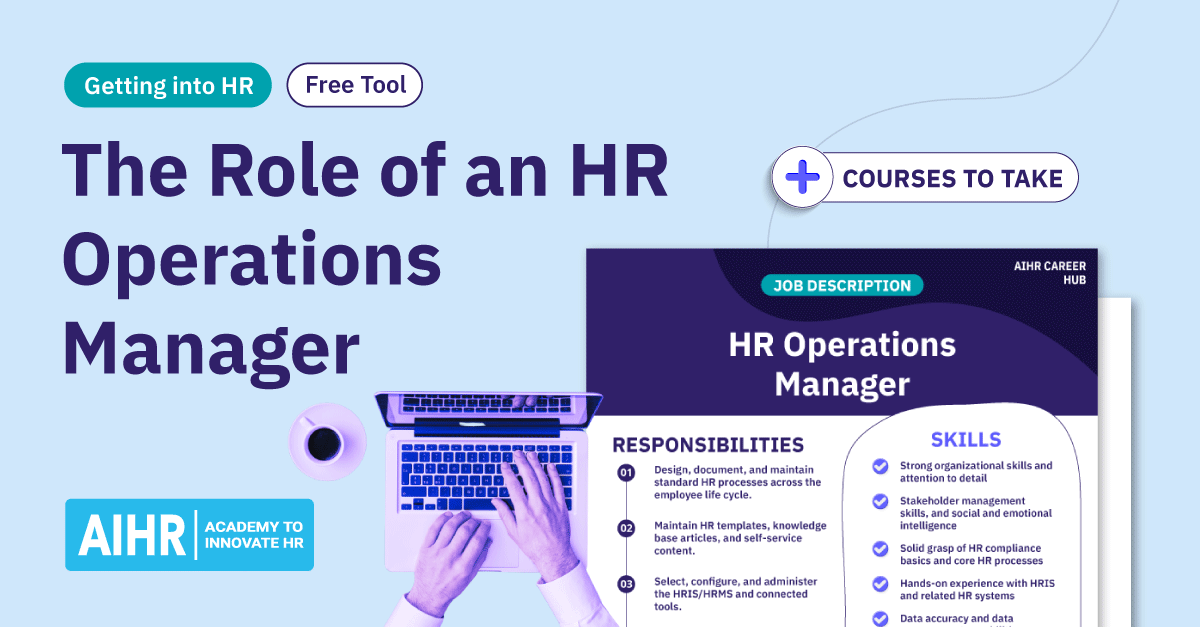
HR Operations Manager job description
HR Operations Manager skills
HR Operations Manager qualifications
Average HR Operations Manager salary
Potential career path of an HR Operations Manager
AIHR certificate programs to take
What is an HR Operations Manager?
An HR Operations Manager oversees the HR department’s day‑to‑day administrative and transactional functions. These include payroll, onboarding and offboarding, maintaining the company’s Human Resource Information System (HRIS), and executing HR initiatives.
Their primary goal is to ensure all HR processes run smoothly, efficiently, and in compliance with legal and policy requirements. Because they have influence on almost every aspect of the employee life cycle, the HR Operations Manager plays a crucial role in shaping a positive employee experience.

HR Operations Manager job description
An HR Operations Manager runs the systems and workflows that power the employee life cycle, making sure HR services are consistent, compliant, and easy for employees and managers to use. While the role has traditionally been administrative, it’s increasingly moving into process design, data, and continuous improvement as automation reduces manual work.
Roles and responsibilities of an HR Operations Manager
Here are the day-to-day duties and responsibilities of an HR Operations Manager:
HR service delivery and employee lifecycle
HR Operations Managers collaborate with HR leadership to establish clear service-level agreements (SLAs) for key processes. These include employee onboarding timelines, payroll processing windows, benefits enrollment periods, and response times for employee inquiries.
Based on this, they go on to set expectations for both HR and the wider organization, creating measurable standards they can monitore and improve. As such, they must:
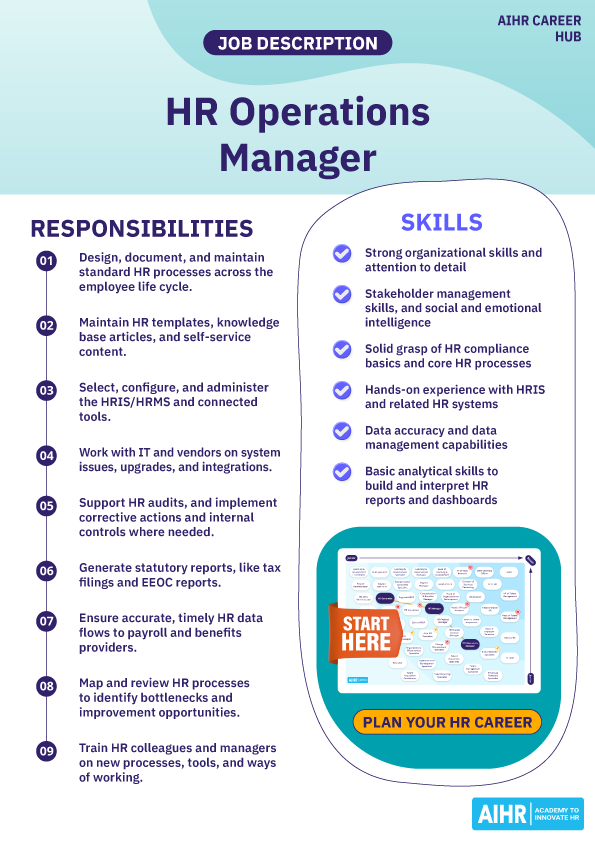
- Design, document, and maintain standard HR processes across the employee life cycle (hire, move, promote, offboard)
- Oversee day-to-day HR service delivery (helpdesk/ticketing, shared services) and act as the escalation point for complex cases
- Coordinate onboarding and offboarding workflows across HR, IT, payroll, facilities, and managers
- Maintain HR templates, knowledge base articles, and self-service content for employees and managers.
HR systems, data and reporting
Quality data highlights where service is slipping and where to reallocate resources. As such, the HR Operations Manager should be comfortable with technology and have a basic understanding of data analysis. They have to:
- Select, configure, and administer the HRIS/HRMS (e.g., Workday, BambooHR, Personio) and connected tools (payroll interfaces, ATS, LMS, performance systems)
- Track key metrics (time to onboard, payroll error rate, ticket resolution time) via dashboards
- Ensure HR data quality and consistency by defining and enforcing data standards and access controls
- Work with IT and vendors on system issues, upgrades, and integrations
- Build and maintain standard HR dashboards and reports, and support ad hoc data requests
- Conduct regular data reviews with HR teams.
Compliance, policy, and risk management
In many ways, the HR Operations Manager acts as the bridge between legal and the overall HR department. In this capacity, they must:
- Translate HR policies and legal requirements into practical, compliant operational procedures
- Ensure processes and documentation meet labor law, data privacy, and internal policy requirements
- Support HR audits, and implement corrective actions and internal controls where needed
- Maintain employee records
- Generate statutory reports like tax filings and EEOC reports.
Payroll, benefits, and vendor coordination
HR Operations Managers should be skilled at managing multiple stakeholders to ensure service objectives, timelines, and EX needs are consistently met. In this regard, they have to:
- Coordinate with external providers (e.g., payroll processors, benefits carriers, and recruitment agencies)
- Ensure accurate, timely HR data flows to payroll and benefits providers
- Partner with payroll and finance to resolve data issues and support annual cycles (salary review, bonuses, renewals)
- Monitor vendor performance and support selection, onboarding, and implementation of HR/benefits vendors.
Continuous improvement and optimization
HR processes must always be efficient and economical, and meet employee requirements. What works one year may not work the next, as organizational needs evolve and technological advances influence the work environment. Additionally, HR Operations Managers must adapt processes in response to changes in employee sentiment. To ensure this, they must:
- Map and review HR processes to identify bottlenecks and improvement opportunities
- Lead or support projects to standardize, automate, and digitize HR processes and self-service
- Track HR operations KPIs, and use insights and feedback to improve service quality and efficiency
- Train HR colleagues and managers on new processes, tools, and ways of working
- Gather feedback from employees and managers to help fine-tune operations
- Pilot new tools or workflows.
Master HR operations to boost your career and business success
Learn the skills you need to be adept at HR operations, and become an invaluable part of your organization’s long-term success.
🎯AIHR’s HR Manager Certificate Program will enable you to:
✅ Gain a deep understanding of business, organizational design and HR operating models
✅ Align HR strategies with business goals and clearly contribute to the bottom line
✅ Understand how to increase your efficiency and strategic impact by prioritizing HR initiatives
HR Operations Manager skills
The HR Operations Manager must ensure procedures meet compliance and regulatory requirements. For instance, they’re the first point of contact when HRIS errors occur, or a key learning consultant quits just before a series of seminars begin. This means they require strong organizational skills and attention to detail.
They must also have strong change and stakeholder management skills, and social and emotional intelligence, to work well with HRBPs, managers, IT, payroll, finance, and vendors. A solid grasp of HR compliance basics, core HR processes, and the employee life cycle is also necessary.
At the same time, they must understand employment law, labor regulations, data privacy and security requirements like GDPR. They should also be able to translate HR/legal language into simple, practical guidance, making strong communication skills important for this role.
An HR Operations Managers usually has a team of reports to handle execution. However, they should still have hands-on experience with HRIS and related HR systems, as well as designing, documenting, and optimizing HR processes and workflows.
The HR Operations Manager needs to make strategic decisions, which is why strong data accuracy and data management skills are necessary. They also need basic analytical skills to build and interpret HR reports and dashboards. These skills enable HR Operations Managers to optimize processes, and spot problems before they snowball.
HR Operations Manager qualifications
To become an HR Operations Manager, you can pursue formal education; however, organizations often value practical experience and specialized knowledge even more highly. Let’s unpack what qualifications you may need:
Educational requirements
Here are the minimum educational requirements for becoming an HR Operations Manager in the U.S.:
- Bachelor’s degree in HR, Business, or a related field
- Some organizations may accept three to five years of experience as an alternative.
Work experience
While organizations and industries vary, here’s the experience you will generally need to be considered for an HR Operations Manager job:
- Three to five years’ experience in HR shared services, operations, or coordination, or a generalist HR role with strong operational responsibilities
- They would have gained experience working with HRIS and related HR systems, as well as documenting and improving HR processes and policies.
- Exposure to working in multi-country or multi-site environments is a plus. It showcases the ability to handle complex operational processes while keeping track of compliance and legal protocols.
Recommended certifications
Although optional, relevant certifications within the HR operations field can help advance your career. Here are some popular AIHR certifications:
- HR Manager Certificate Program: This program can help develop leadership and strategic HR skills, and enable HR Operations Managers to make impactful organizational decisions, drive HR strategy, and maximize team performance.
- People Data & Business Insights Certificate Program: This program equips HR Operations Managers with advanced people analytics and data literacy skills to align HR practices with business needs, and drive data-driven decision-making.
- HR Generalist Certificate Program: This program provides foundational knowledge and practical tools to build and implement key HR processes, ensuring operational excellence and strategic alignment within the organization.
Average HR Operations Manager salary
The HR Operations Manager is a mid-career Human Resources position. According to Revelio Labs, he source of the salary data on AIHR’s HR Career Map, the annual wage for this role typically varies from $86,000 to $113,000. These figures are based on real-time workforce data and labor market trends.
However, do also note that factors such as geographic location, industry, years of experience and the seniority of the role being applied for will influence this salary range.
Potential career path of an HR Operations Manager
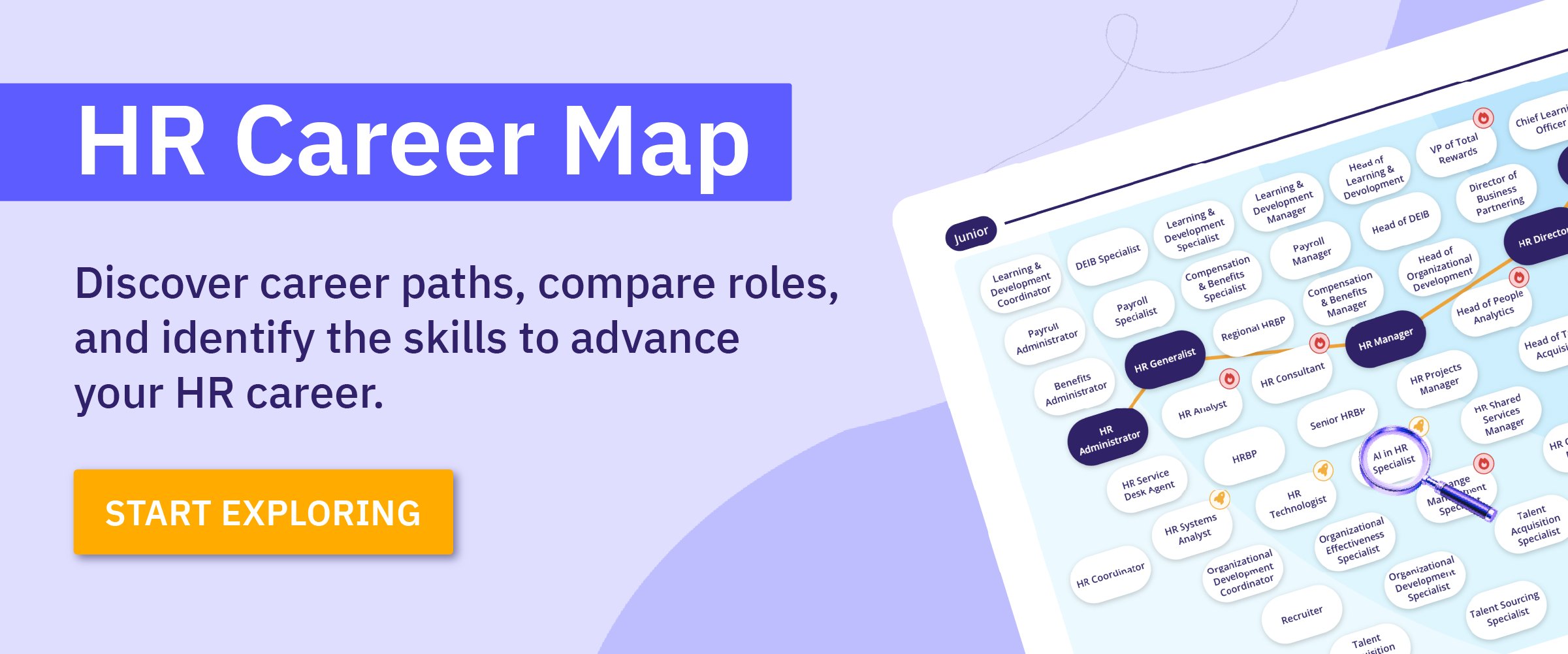
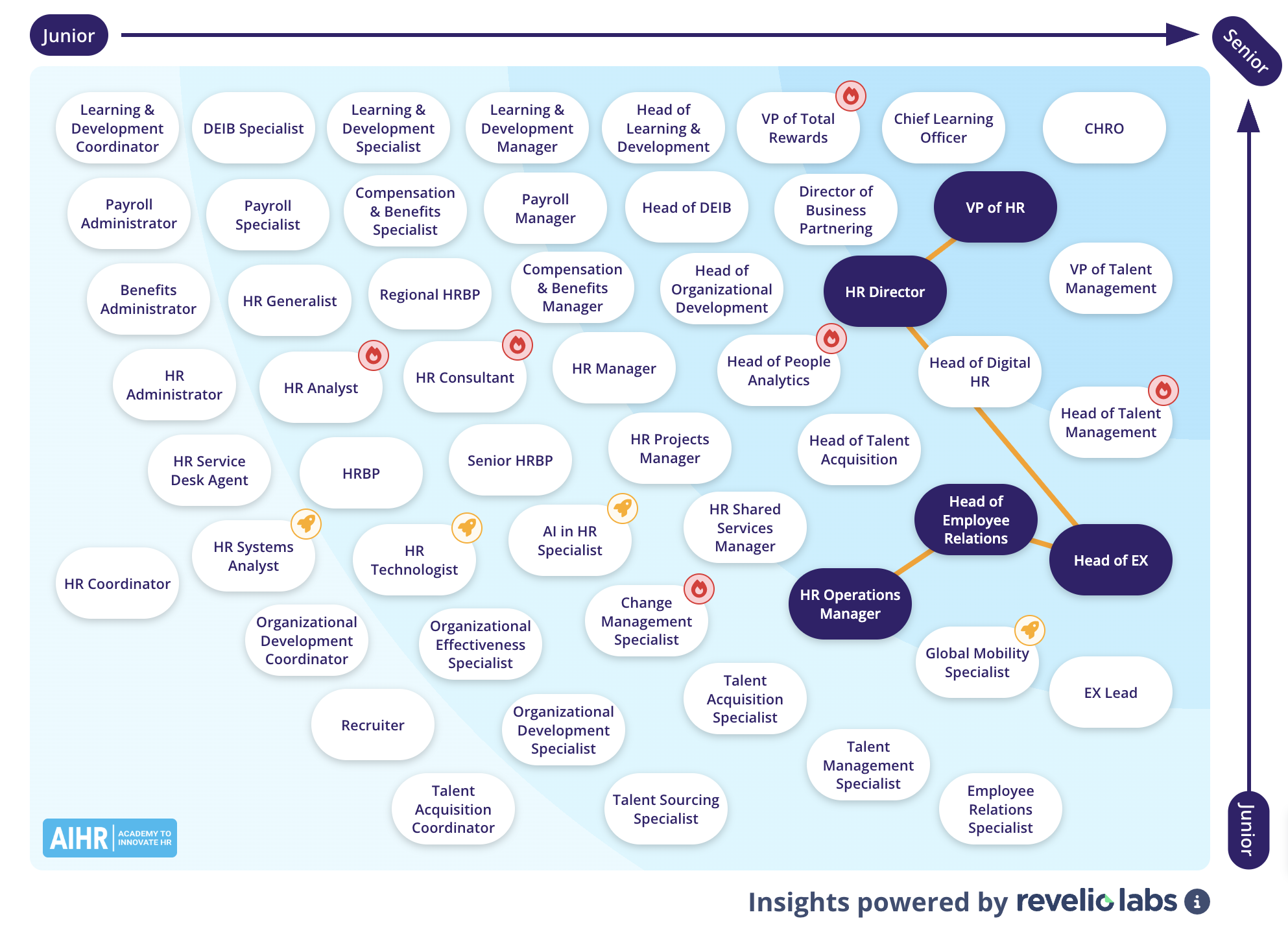
A career in HR operations is a good fit for you if you have strong organizational skills and the ability to remain calm under pressure. Using AIHR’s HR Career Map, you’ll see the path usually progresses from execution-heavy, administrative roles to more specialized or strategic positions, even leading up to the role of CHRO.
The typical career trajectory
The natural progression within the HR operations stream often follows this path:
Head of Employee Relations
- Handles workplace issues and employee relations to ensure a fair, compliant, and productive environment
- Tasks include acting as strategic advisor to shape culture and lead large-scale initiatives, developing and implementing HR policies, and designing EX programs
- Average pay (U.S.): $105,000 to $196,000 per year.
Head of EX (Employee Experience)
- Improves the employee experience by mapping and enhancing key moments in the employee life cycle to drive satisfaction and engagement
- Tasks include helping develop or improve people management processes, analyzing people management indicators, and developing initiatives from insights collected.
- Average pay (U.S.): $99,000 to $197,000 per year.
Senior and executive roles
A Head of EX can advance to senior leadership roles, where they must oversee HR as a whole and align it with organizational goals. Below are some examples:
HR Director
- Manages efficient end-to-end HR service delivery within a business unit, ensuring consistency, compliance, and quality across the employee lifecycle
- Tasks include overseeing Human Resources functions, managing the HR budget, tracking HR metrics, guiding hiring managers on ER issues, and ensuring legal compliance
- Average pay (U.S.): $88,000 to $198,000 per year.
VP of HR
- Ensures HR alignment with business objectives across regions or departments, balancing consistency with local relevance for scalable, compliant HR delivery
- Tasks include overseeing major HR initiatives, driving continuous improvement across talent, culture, and operational areas, and working closely with senior leaders.
- Average pay (U.S.): $123,000 to $207,000 per year.
AIHR certificate programs to take
AIHR offers three certificate programs to help HR Operations Managers strengthen crucial skills for their role:
HR Manager Certificate Program
The HR Manager Certificate Program helps develop strategic HR management, leadership, and decision-making skills. You’ll learn to design and implement HR strategies that drive organizational performance, manage complex people challenges, and lead HR teams effectively. The curriculum also covers change management and talent development.
People Data & Business Insights Certificate Program
The People Data & Business Insights Certificate Program grows expertise in people analytics, data literacy, and digital agility. This allows you to turn raw HR data into actionable insights, optimize strategic workforce planning, and align HR strategies with business goals. The program also boosts your ability to communicate the value of HR initiatives to stakeholders.
HR Generalist Certificate Program
The HR Generalist Certificate Program provides a comprehensive foundation in core HR processes (e.g., recruitment, onboarding, compliance, and ER). It also equips you to build a strong organizational culture, manage risk, and contribute to business continuity, making you instrumental in achieving both operational efficiency and HR strategic objectives.
To sum up
HR Operations Managers ensure all HR functions operate smoothly and efficiently. Although their tasks may seem heavily administrative, they have the opportunity to be more hands-on, giving them the insight required to contribute more authoritatively to strategic decision-making.
HR Operations Managers are also familiar with employee sentiment, as they’re constantly exposed to day-to-day employee experiences. Being in this position means you have the opportunity grow into more strategic or technical functions, like Head of Employee Relations, Head of EX, HR Director, or VP of HR.