Without regular HR audits, the hidden risks in your HR processes, systems, and policies can quietly undermine your business and leave you exposed to employment law violations. For example, the U.S. Department of Labor’s Wage and Hour Division has recovered more than $259 million in back wages for employees through its enforcement efforts.
However, the value of an HR audit goes beyond compliance. It helps you review whether your HR operating model and people processes still support changing business priorities and new demands. Rather than waiting for problems to surface, an HR audit helps you identify issues early, improve HR practices, maintain compliance, and support long-term business success. It can also provide a strong starting point for broader HR transformation.
In this article, we explain why HR auditing matters, outline the main types of HR audits, and walk through how to conduct one effectively. We’ve also included a downloadable HR audit checklist and template.
Key takeaways
- An HR audit helps organizations catch hidden risks in their people processes before they turn into bigger legal or operational problems.
- It strengthens compliance, improves employee experience, and helps HR better support business goals.
- Different types of HR audits focus on different areas, including records, HR functions, legal compliance, policies, and workplace safety.
- A strong HR audit follows a clear process, from setting goals and gathering data to fixing issues and communicating changes.
- Templates and checklists can make the audit process easier to run and easier to turn into action.
Contents
What is an HR audit?
Why conduct an HR audit?
Types of HR audits
Free HR audit checklist
Free HR audit templates and guide
7 steps for an effective HR audit process
HR audit report: What to include
FAQ
What is an HR audit?
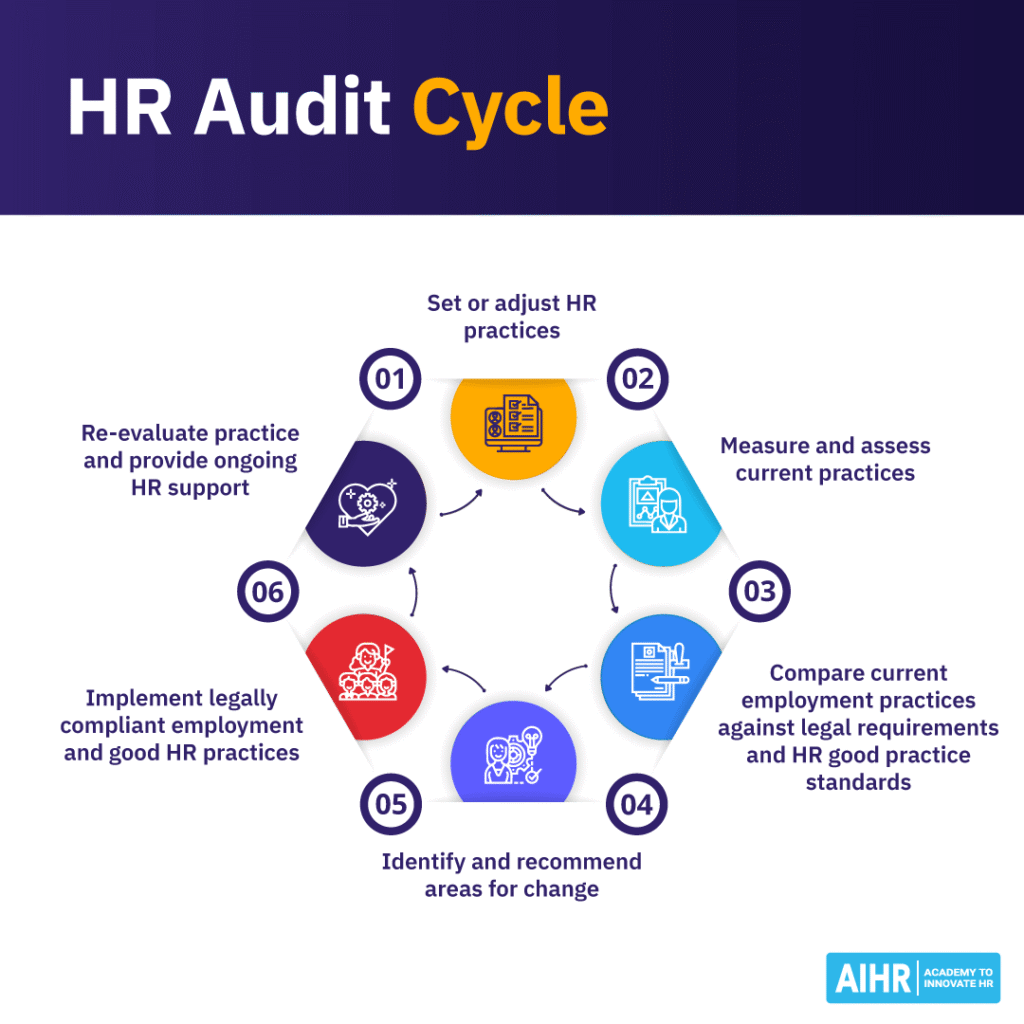
An HR audit is a structured, objective review of HR processes, practices, and policies to assess whether they are legally compliant and working effectively to support the organization. It involves identifying gaps and inefficiencies while also recognizing areas of strong performance.
A Human Resources audit is similar to an internal process audit. It gives organizations the opportunity to strengthen HR functions and align them more closely with organizational goals and employee needs. Put simply, it is like giving your HR department a report card that shows how effective it is.
In practice, an HR audit often includes several focused reviews, such as an HR compliance audit, a policy audit, a records audit, or a process audit. The format can also vary depending on the goal. For example, some organizations use a high-level review to spot risks, while others use a detailed HR audit checklist to assess each part of the employee lifecycle. This makes the audit useful not only for identifying problems, but also for building a clear action plan.
Why conduct an HR audit?
Although conducting an HR compliance audit is not mandatory, every area it reviews can benefit from the process, helping improve overall HR effectiveness. There are several reasons why HR audits should be a priority for your organization.
A thorough HR audit:
- Improves employee experience: An HR audit gives you the opportunity to strengthen the parts of your processes and policies that shape employees’ day-to-day experience. This can build trust, improve the work environment, and help employees feel more supported. In turn, that can strengthen retention and make the organization more resilient.
- Ensures corporate compliance: You should never assume that your policies comply with all applicable regulations. Employment laws continue to change, and new requirements are regularly introduced. To achieve and maintain compliance and to avoid fines, penalties, and lawsuits, organizations need HR compliance audits that identify potential risk areas early. The HR audit process also shows stakeholders, such as owners, boards, or investors, that the company is proactively managing people-related risks.
- Strengthens HR’s strategic impact: Making sure HR practices support current and future organizational goals, while connecting HR data to the reality of your policies and procedures, helps show how HR contributes to business success.
- Helps prevent adverse impact in employment practices: Identifying hidden risks across the employee lifecycle, such as employee misclassification, disparate impact in recruitment, inconsistent discipline, and outdated policies, allows your organization to address them before they become serious problems.
- Creates equitable and fair compensation: Financial audits and compensation analyses can help organizations assess whether their salary structures and compensation packages are defensible and competitive. This supports recruitment and retention efforts while also helping reduce unfair pay discrepancies.
- Identifies inefficiencies in systems and practices: At the very least, HR audits can uncover gaps, redundant tasks, or overly lengthy processes, helping you make changes that reduce errors and save time and money.
Did you know?
There is limited precise data on how common HR audits are. This suggests they are not as standardized or consistently tracked as financial audits, and that many companies may not conduct them as routinely as they should.

Types of HR audits
Different types of HR audits focus on different areas of human capital. When you conduct a general HR audit, you can assess which people processes in your organization need immediate attention. Depending on your organization’s needs, you may want to take a more granular approach.
You can run the audit by forming a committee of internal HR professionals to review an area they do not usually manage, or you can use a third-party HR audit service.
Here are the various types of HR audits and some examples of what they entail:
1. HR compliance audit
An HR compliance audit focuses on whether your people policies, documentation, and practices align with employment laws and internal standards. This can help you spot issues before they become legal or employee relations problems.
A compliance-focused audit is especially useful when:
- Your organization has grown quickly
- You have updated policies but have not reviewed how they are applied
- You operate across different locations or jurisdictions
- You have had recurring issues with leave, pay, classification, documentation, or manager consistency.
While a general HR audit looks at the full HR function, an HR compliance audit goes deeper into risk areas such as recordkeeping, wage and hour practices, leave administration, hiring documentation, workplace safety, and policy application.
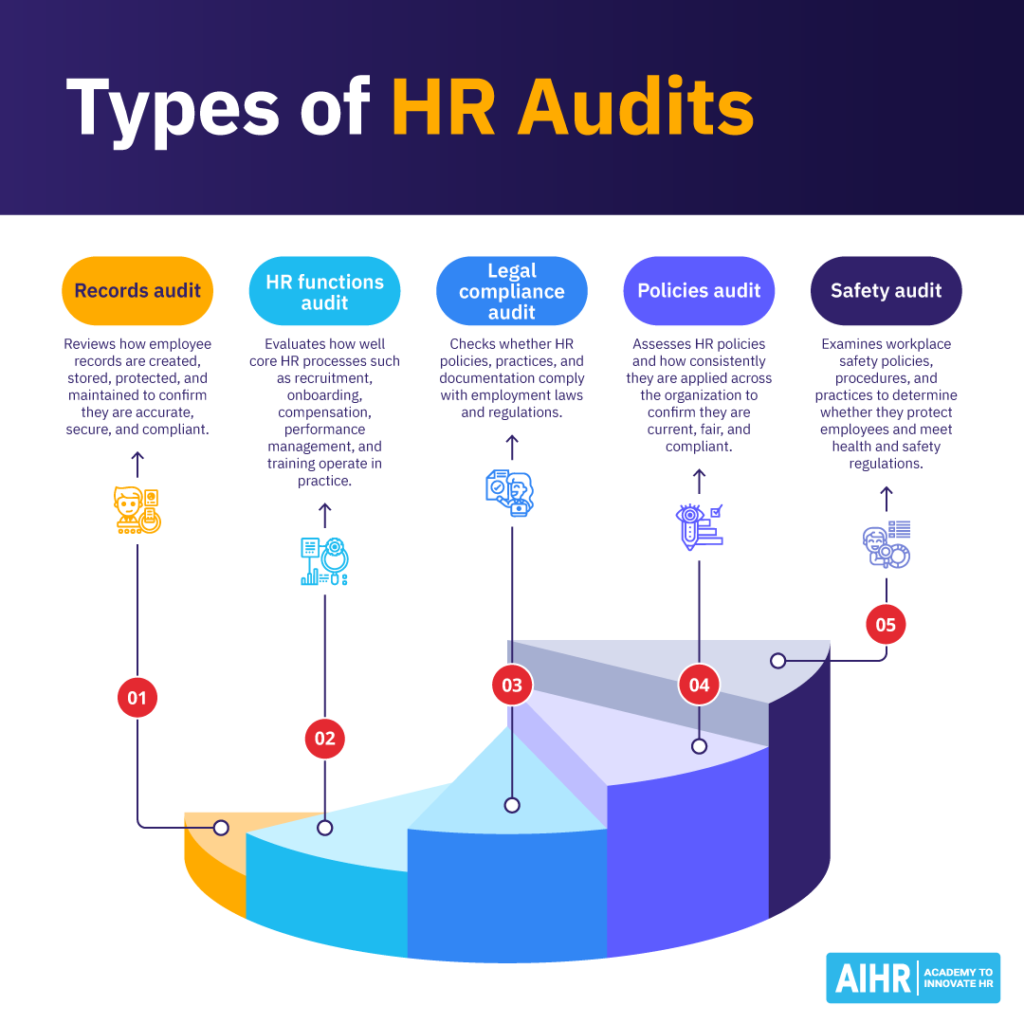
2. Records audit
An HR records audit focuses on how your organization creates, stores, and maintains employee-related records and documents to confirm they are secure, complete, accurate, and legally compliant.
- Employee files: Do you encrypt and protect digital personnel files from unauthorized access? Do you organize hard copies properly and store them in a secure location?
- I-9 audit: Do you keep complete and accurate I-9 forms on file for all employees to verify employment eligibility and comply with the Immigration Reform and Control Act (IRCA)?
- Payroll records: Do you maintain detailed payroll records, and who can access them?
- Records retention: Do you follow retention and destruction practices for employee records?
3. HR functions audit
An HR functions audit reviews how well your core HR processes work in practice and whether they follow internal standards and legal requirements.
- Recruitment and hiring: Do you document recruitment efforts thoroughly, from job ads to interviews and selection? Do you meet Affirmative Action requirements where applicable?
- Onboarding practices: How structured is your onboarding program, and do you collect feedback from new hires?
- Compensation and salary: Is pay competitive and consistent for comparable work? Do you classify employees correctly, for example, exempt or non-exempt, full-time or part-time, and employee or independent contractor?
- Performance and training: How do you conduct performance evaluations, and what training and development support do employees receive?
4. Legal compliance audit
A legal compliance audit, sometimes called a human resources compliance audit, reviews whether HR policies, practices, and records meet applicable employment laws and regulations
- EEOC: Do you follow EEOC guidelines? Are there any potential violations?
- Fair Labor Standards Act (FLSA): Do you comply with the FLSA’s minimum wage, overtime, child labor, and basic wage and hour recordkeeping requirements?
- Family and Medical Leave Act (FMLA): Do employees know about their right to job-protected, unpaid leave for certain family or medical reasons? What process do you use to review, approve, and monitor FMLA leave requests?
- Americans with Disabilities Act (ADA): Do you provide equal opportunities and reasonable accommodations for workers with disabilities in accordance with the ADA? Do you apply your ADA policy consistently?
- Benefits: Do you offer access to affordable healthcare packages and retirement plans when required? How do you communicate and manage COBRA options?
A strong HR audit helps you uncover compliance gaps, improve HR processes, and align people practices with business goals.
With the HR Generalist Certificate Program, you’ll learn to:
✅ Assess and improve core HR policies and processes
✅ Manage HR operations with more structure and consistency
✅ Track HR performance with the right metrics and KPIs
5. Policies audit
A policies audit looks at all of your written HR policies and how they’re applied to make sure they are current, consistent, legally compliant, and aligned with your organization’s goals.
- Progressive discipline: Does your disciplinary process include clearly defined steps? Do managers follow it consistently? Does it align with your performance standards and code of conduct?
- Termination policy: Does your termination policy align with state at-will employment laws? Have you documented terminations thoroughly and handled them consistently and fairly?
- PTO policy: Do you offer paid time off to all eligible workers? Do you track and update PTO in line with your policy and applicable laws?
6. Safety audit
A safety audit reviews your work environment, safety policies, and day-to-day practices to determine how well they protect employees and comply with workplace health and safety regulations.
- Safety systems: Do you have written safety policies, procedures, and training in place? Do teams consistently maintain incident reporting, inspections, and maintenance records?
- OSHA hazards: Do you maintain an OSHA log carefully? Do you provide adequate personal protective equipment, including uniforms when needed?
- MSDS/SDS: Can employees easily access Material Safety Data Sheets (MSDS) or Safety Data Sheets (SDS) for the hazardous materials they work with? Can they quickly refer to those sheets to improve understanding or respond to emergencies?
HR tip
When should you conduct an HR audit? Taking a proactive approach is always better than reacting after problems arise. Choose a time of year that best fits your organization’s schedule and workload. For many organizations, a slower period works best because it gives HR and leadership more capacity to review processes thoroughly and act on the findings. The beginning or end of the year can also be a useful time to benchmark progress and plan improvements.
Free HR audit checklist
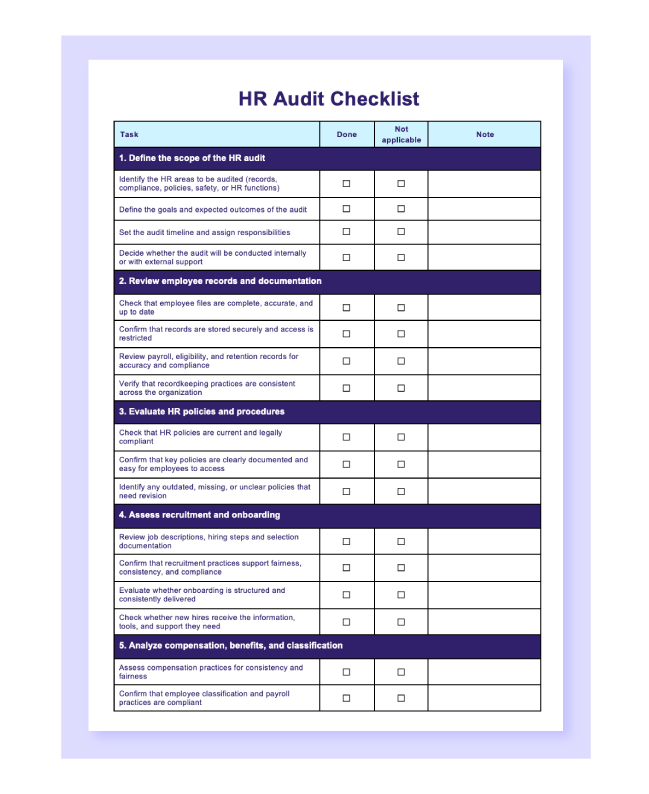
Wondering how to conduct an HR audit? Start with this practical HR audit checklist. It covers the main areas to review so you can spot gaps, reduce risk, and decide where to take action first. Below is a brief overview of the HR audit checklist; you can also download a Word version.
1. Scope and audit setup
- Identify the HR areas to audit, such as records, compliance, policies, safety, or specific HR functions
- Define the goals and expected outcomes of the audit
- Set the timeline and assign responsibilities
- Decide whether the audit will be conducted internally or with external support.
2. Employee records and documentation
- Check that employee files are complete, accurate, and up to date
- Confirm that records are stored securely and access is restricted
- Review payroll, eligibility, and retention records for accuracy and compliance
- Verify that recordkeeping practices are consistent across the organization.
3. HR policies and procedures
- Check that HR policies are current and legally compliant
- Confirm that key policies are clearly documented and easy for employees to access
- Identify any outdated, missing, or unclear policies that need revision.
4. Recruitment and onboarding
- Review job descriptions, hiring steps, and selection documentation
- Confirm that recruitment practices support fairness, consistency, and compliance
- Evaluate whether onboarding is structured and consistently delivered
- Check whether new hires receive the information, tools, and support they need.
5. Compensation, benefits, and classification
- Assess compensation practices for consistency and fairness
- Confirm that employee classification and payroll practices are compliant
- Review benefits eligibility, administration, and communication
- Identify any pay, benefits, or classification risks that need follow-up.
6. Performance management and development
- Review performance management processes and supporting documentation
- Confirm that managers apply performance practices consistently
- Assess training and development opportunities available to employees.
7. Legal compliance and workplace safety
- Review HR practices against applicable employment laws and regulations
- Confirm compliance with wage and hour, leave, and non-discrimination requirements
- Check that safety policies, reporting procedures, and records are in place
- Confirm that employees can access relevant safety information, training, and equipment.
8. HR systems, workflows, and reporting
- Review HR systems and workflows for gaps, delays, duplication, or manual effort
- Identify processes that could be simplified, standardized, or automated
- Assess whether HR data and reporting support decision-making.
9. Findings and next steps
- Summarize the main strengths, gaps, and risks identified during the audit
- Prioritize issues based on impact and urgency
- Assign owners and timelines for follow-up actions
- Set measures to track progress after the audit.
Free HR audit templates and guide
Our HR Audit for People Processes template helps you review key areas like recruitment, onboarding, and compliance, with downloadable template versions available in Google Sheet and PPTX formats.

Simply follow the guide, fill in your audit details, and get a clear overview of where your HR practices stand.
7 steps for an effective HR audit process
Before beginning the audit, step back and look at the bigger picture. Start by understanding the organization’s broader strategy and objectives so the audit is guided by the value it should add, not just by immediate problems that need fixing. If you focus only on current pain points, the audit can easily become reactive and have limited long-term impact. A more strategic starting point helps you identify which HR areas matter most and how the audit can better support business goals.
Use the following steps to plan and carry out an HR audit that supports compliance, reduces risk, and strengthens HR effectiveness.
Step 1: Determine what to audit
As mentioned above, you can focus on many types of HR audits. Start by defining your organization’s broader goals and the value you want the audit to add. Then decide which HR area or process to review and what you want to achieve. This helps keep the audit strategic rather than purely reactive. Avoid trying to do everything at once, and set a realistic timeline for completion.
Check out our detailed HR Audit Guide with a downloadable HR audit template to make your auditing process easier.
Step 2: Get buy-in from management
To make lasting changes that positively affect your organization, you need support from executive management. Their buy-in matters even more if you need budget approval to hire a third party to conduct the audit.
Frame the HR audit as a business initiative that reduces risk and improves performance. Connect it to pain points leaders already understand, such as legal exposure, payroll errors, turnover, or reputational risk.
Step 3: Decide who will conduct the audit
Decide whether you will conduct the audit internally or bring in external support. If multiple people will take part, assign responsibilities clearly from the start. You should also set expectations for how the evaluation will work and what it should deliver.
Step 4: Gather the data
Start by collecting all relevant policies, records, and data related to the area you are auditing. For example, if you are auditing recruitment processes, you can pull data from your ATS. Make sure you have the proper authorization to access and use the data.
Do not rely on quantitative data alone. To validate findings and themes, gather qualitative input as well, such as interviews with HR leaders or practice leads. These conversations help contextualize the data and reduce bias in interpretation.
Key HR audit questions to ask
As you gather information, ask questions that help you test whether a process is both documented and followed in practice. For example:
- Are our HR policies current, and when were they last reviewed?
- Do managers apply policies consistently across teams?
- Where do delays, workarounds, or repeated errors happen in HR processes?
- Are required employee documents complete and easy to access?
- Do our hiring, pay, leave, and performance practices match what our policies say?
- Which HR issues create the most business risk or employee friction?
- What feedback are employees and managers giving about current HR processes?
These questions help move the audit beyond a document review and toward a more realistic picture of how HR operates day to day.
Step 5: Review your findings
Take time to organize and analyze the information you collected. Note where practices do not align with policy or law, classify issues by risk level, and look for root causes such as weak controls, unclear policies, or lack of training.
Identify any potential issues and opportunities for improvement. For example, you may prevent future injuries by increasing how often the company orders PPE for workers.
Step 6: Plan and implement improvements
Start with the most urgent problem areas, especially those that create the greatest legal or operational risk for your organization. Then work through the rest of your priorities to strengthen weak processes and policies.
Your remediation plan should include clear action steps, timelines, owners, and any needed training, policy updates, additional controls, or technology fixes. Instead of trying to fix everything at once, focus first on the changes that matter most and that your team has the time and capacity to handle. Set milestones and check-ins along the way so you can track progress, keep the work moving, and make adjustments when needed. This helps turn the audit into an ongoing way to improve HR effectiveness, rather than treating it as a one-time compliance exercise.
Step 7: Be transparent about the changes
Employees will want to know about the changes and improvements you make to HR processes. Keep them informed and ask managers to update their teams regularly. Transparency helps employees understand and accept the changes, and it can reduce doubts about why the organization is making them.
HR audit report: What to include
Once your HR audit process is finished, prepare a formal write-up that makes the findings easier to understand and act on. An HR audit report provides leaders and other stakeholders with a consolidated summary of strengths, improvement areas, and issues that must be addressed to support decisions on budget, staffing, and priorities. It also documents your organization’s good-faith efforts to address problems and creates a baseline for future audits.
An HR audit report should include the following:
- An executive summary that highlights key strengths, top risks or gaps, and recommended actions
- A description of the HR areas you audited, why you selected them, what information you used, how you gathered it, and any limitations of the review
- An explanation of the findings and supporting evidence for each audit area. Include a brief description of the current state, the issues or gaps you identified, and any notable strengths or good practices
- A risk rating for each major finding, such as high, medium, or low, along with the potential business impact
- The likely root cause of each gap or vulnerability, such as process, training, system, policy, or capacity issues
- A proposed action plan for each significant HR issue, including ownership and timelines, organized into quick wins and longer-term projects.
To sum up
An HR audit helps you spot legal risks, process gaps, and people issues before they grow into larger problems. While the process can take time and resources, it often pays off by helping you strengthen compliance, improve HR operations, and better support employees and business goals.
If you want to build the broader skills needed to review, improve, and run core people processes with confidence, AIHR’s HR Generalist Certificate Program is a practical next step. It covers the foundations of running an HR function, from policy frameworks to payroll and end-to-end HR processes, and includes hands-on tools and templates you can apply in your day-to-day work.
FAQ
An HR audit is a systematic review of HR policies, practices, documents, and processes to check legal compliance, identify risks or inefficiencies, and assess how well HR supports the organization’s goals.
An HR audit should cover the HR areas most relevant to your organization’s goals and risks. This may include employee records, recruitment and hiring, onboarding, compensation and classification, performance management, benefits, leave policies, termination procedures, workplace safety, and compliance with employment laws.
If you are wondering how to conduct an HR audit, the process usually includes these broad steps:
1. Determine what you want to audit and define your goals
2. Get buy-in from management and secure the support you need
3. Decide who will conduct the audit, whether internally or with outside help
4. Gather the relevant HR policies, records, and data
5. Review your findings to identify gaps, risks, and root causes
6. Plan and implement improvements based on your priorities
7. Communicate the changes clearly and monitor progress.
The time required for an HR audit depends on your organization’s size, the scope of the review, and the resources available. A focused audit may take a few weeks, while a broader review that covers multiple HR functions may take longer.
DIY HR audits may cost very little beyond the HR staff time involved. Outsourced audits for small businesses typically range from $2,000–$15,000, depending on company size, scope, and provider. Factors that drive higher costs include multiple locations, industry-specific rules, audit depth, and follow-up support