
A strong candidate experience is no longer a “nice-to-have.” CareerPlug’s Candidate Experience Report found that 66% of candidates said a positive experience influenced their decision to accept a job offer, while 26% declined offers because of poor experiences, such as unclear expectations or lack of communication.
Candidates expect a process that is clear, fair, and human from start to finish, particularly now that AI plays more and more of a role in recruitment.
This guide explains what candidate experience is, why it matters, and how to improve it across every stage of the candidate journey. You’ll learn how to map the candidate experience, identify key metrics to track, understand the roles involved in managing candidate experience, and use AI and automation without compromising the human touch.
This will all help you design a candidate-first hiring process that supports both better hires and stronger retention.
Contents
What is candidate experience?
How to measure candidate experience
Why candidate experience matters for your hiring and retention metrics
Candidate experience job roles
6 foundations of a positive candidate experience
Candidate feedback: How to ask, What to say, and when
Building a candidate experience career site
Examples of companies with a compelling candidate experience site
Using AI and technology in candidate experience
How to improve candidate experience

What is candidate experience?
Candidate experience is how job seekers perceive and react to every touchpoint in your hiring process, from the first impression to final feedback. It is the lens through which candidates decide whether to engage with your organization, stay in your process, and accept (or decline) a job offer.
Candidate experience is related to, but different from, a few other concepts:
- Employer brand refers to your reputation as an employer in the market.
- Employee experience (EX) reflects how employees feel about their entire journey with your organization, from first encounter through onboarding, development, and even after they leave.
As hiring processes become more digital and data-driven, candidates expect a journey that is clear, fair, and human. Getting candidate experience right helps you stand out in a market where job seekers are increasingly selective about the employers they commit to.
Mapping the candidate journey
To get a clear picture of what the candidate journey looks like in your organization, create a candidate experience map. This is a practical tool for visualizing the different stages of the journey, capturing candidate expectations at each stage, and identifying friction points.
Below is an example you can adapt to your own hiring process.
| Candidate experience stage | Candidate expectations | Potential friction points | How to optimize this stage |
| Awareness and attraction | Visibility of your employer brand on social media, employee testimonials, and a strong careers page.. | A careers page that is not up to date or mobile-friendly; negative reviews from former employees on platforms like Glassdoor. | Keep your careers page current and mobile-friendly. Respond to reviews where possible. Ask employees which parts of the employee experience can be improved and act on the feedback. |
| Application | Clear, transparent job descriptions, including salary range; a simple, short, and mobile-friendly application process. | Vague job descriptions without a salary range (or with a very wide range); a lengthy application process that requires many documents and is not optimized for mobile. | Use templates or AI tools to write clear, inclusive job descriptions. Keep the application process short and straightforward, and ensure it works smoothly on mobile devices. |
| Screening | Regular updates on the status of their application; clear communication about next steps and timelines. | No updates, even after candidates ask; no communication regarding next steps or a clear timeline. | Make sure every candidate gets an update after each stage of the process, including the next steps and expected timeline. Automate routine status updates where possible. |
| Interviewing | A structured interview and clear expectations; an interview guide that helps them prepare. | No structured interview; the hiring manager has no clear evaluation criteria. | Use structured interviews and train hiring managers and other interviewers on effective, bias-aware interview techniques. Provide candidates with basic information on what to expect. |
| Offer and decision | An e-signature option for quick and secure signing; fast responses to questions about the offer. | Long response times to candidate questions; delays in sending or returning the signed offer. | Be highly responsive in this final and crucial stage. Consider having someone contact the candidate to walk them through the offer letter or employment contract. |
| Onboarding | A smooth transition from the candidate experience into the employee experience; a well-structured, well-guided process. | A big gap between the candidate experience and employee experience that leads to disappointed new hires; no structured onboarding, causing new hires to feel lost. | Align the candidate and employee experience through a joint effort by recruiters, HR, and hiring managers. Consider implementing a buddy system so an existing employee can guide the new hire through their first weeks. |
Mapping your own candidate journey helps you see your process from the candidate’s perspective and gives you a concrete starting point for improving candidate experience.
How to measure candidate experience
Measuring candidate experience helps you detect issues early and see whether your improvements are working. Some useful candidate experience metrics include:
Candidate Net Promoter Score (cNPS)
cNPS is based on the well-known Net Promoter Score metric, which measures customer satisfaction. You can calculate it using this formula:
| Candidate NPS = | % of promoters – % of detractors | |
Application drop-off rate
The percentage of candidates who start the application process but do not finish it. The formula is:
| Application drop-off rate = | (Number of candidates who started the application – Number of candidates who completed the application) | x100 | |
| Number of candidates who started the application | |||
Interview-to-offer ratio
The number of interviews conducted for each job offer that has been extended. A low ratio indicates that your sourcing and screening processes are bringing in qualified candidates. You can calculate it using this formula:
| Interview-to-offer ratio = | Number of interviews conducted ÷ Number of offers extended | |
You can also flip this and calculate offers per interview if that’s easier for stakeholders.
Offer acceptance rate
Offer acceptance rate measures the percentage of job offers that candidates accept. A high rate usually indicates an effective hiring process and a compelling value proposition. The formula is:
| Offer acceptance rate = | Number of offers accepted | x100 | |
| Number of offers extended | |||
Candidate survey participation rate
The percentage of candidates who respond to your surveys tells you something about their engagement and willingness to provide feedback. Here’s the formula:
| Candidate survey participation rate = | Number of completed surveys | x100 | |
| Number of surveys sent | |||
To measure candidate experience, collect and interpret data from several sources, including your applicant tracking system (ATS), candidate surveys, and HR dashboards.
Data in action
When T-Mobile embedded the AI-powered writing platform Textio into its recruiting workflows, it saw 17 percent more women applicants and reduced time to fill by five days. After TheKey Conciergerie and Nursing adopted the AI-powered recruiting platform Humanly, the company doubled its conversion rate and cut its time to apply by a factor of ten.
Why candidate experience matters for your hiring and retention metrics
Candidate experience isn’t only about how candidates feel. It also shows up in your numbers. A poor experience can increase the time to hire, lower offer acceptance rates, reduce referrals, and lead to early turnover within the first six to 12 months.
Job descriptions
Non-inclusive, vague, or unrealistic job descriptions shrink your potential talent pool. When the right candidates scroll past your vacancy, you end up with fewer qualified applicants, less diversity, and more unfilled roles.
This pushes up time to hire and can lower quality of hire because you’re choosing from a smaller pool.
Application process
A lengthy or complex application process (especially one that isn’t mobile-friendly) leads to high drop-off rates. Even interested candidates may abandon their application if it feels like too much work.
This increases your application drop-off rate, forces recruiters to source more candidates to fill the funnel, and slows down the time to fill.
Interviews
Unstructured interviews with unclear expectations can make the process feel inconsistent or unfair. Strong candidates may disengage or choose another employer, which lowers your offer acceptance rate and can harm your employer brand when they share their experience with others.
Preboarding and onboarding
A gap between signing the offer and day one, followed by weak onboarding, quickly erodes excitement and trust. This increases no-show rates and early attrition, as new hires often leave within the first few months because reality doesn’t match their expectations.
Craft human-centered hiring experiences with design thinking
Deliver recruitment experiences that leave a lasting impression. Go beyond process optimization and learn to design every candidate interaction with purpose and empathy.
🎓 In AIHR’s Strategic Talent Acquisition Certificate Program, you’ll learn how to:
✅ Use design thinking to map the full candidate journey
✅ Create consistent, branded experiences from application to onboarding
✅ Translate candidate feedback into actionable improvements
✅ Build a CX strategy that supports your TA goals and brand identity
Candidate experience job roles
Many organizations rely on dedicated roles to support and improve the hiring journey. Two of the most common are the Candidate Experience Specialist and the Candidate Experience Manager.
Candidate Experience Specialist role
A Candidate Experience Specialist usually sits within the talent acquisition or people operations team. The role focuses on creating a smooth and supportive hiring journey, making sure candidates feel informed and respected from their first interaction through to the final decision.
Candidate Experience Specialist duties
- Candidate communication: Serve as the first point of contact for candidates throughout the process, ensuring timely, consistent, and clear communication.
- Process optimization: Identify opportunities to enhance elements of the candidate experience, including templates, tools, and interview scheduling processes.
- Candidate advocacy: Gather candidate feedback (for example, through pulse surveys) and anticipate their needs to proactively resolve delays or issues.
- Employer brand stewardship: Act as an ambassador for the company’s employer brand and keep candidate-facing content up to date to ensure consistency and alignment.
Candidate Experience Manager role
A Candidate Experience Manager typically oversees the overall hiring journey, guiding both strategy and daily operations to support a consistent, candidate-first approach.
Candidate Experience Manager duties
- Experience strategy: Designs and updates the broader candidate experience strategy, setting standards for communication, responsiveness, and process consistency across recruiting teams.
- Data and insights: Tracks and analyzes key metrics, including application completion rate, offer acceptance rate, and customer Net Promoter Score (cNPS), to identify trends, pinpoint issues, and recommend improvements.
- Process leadership: Partners with talent acquisition leads to streamline workflows, remove bottlenecks, and improve tools or systems that impact candidates.
- Team enablement: Coaches recruiters and coordinators on best practices and communication guidelines, helping teams deliver a consistent experience.
- Cross-functional collaboration: Works with employer branding, HR operations, and hiring managers to keep messaging aligned and make sure candidates receive accurate, up-to-date information.
- Escalation support: Steps in to address sensitive or complex candidate situations, helps resolve issues quickly, and safeguards the organization’s reputation.
6 foundations of a positive candidate experience
Let’s explore how you can build a strong candidate experience in your organization. Here are six candidate experience best practices to follow.
1. Clarity
Clarity is essential. Candidates should be aware of their progress throughout the process and what to expect next.
Examples
- Write clear, realistic job descriptions
- Provide candidates with an update after every step of the process, including next steps and timelines
- Make sure candidates know who to contact with questions and how to reach them.
2. Transparency
Transparency and clarity go hand in hand. Being open and communicating effectively creates transparency around expectations.
Examples
- Be transparent about your company culture and values during the hiring process. Your organization is not for everyone, and that is fine.
- In the job description and throughout the candidate journey, be honest about what candidates can expect in terms of the job, potential career opportunities, and salary.
3. Simplicity
An effective candidate experience strategy focuses on simplicity. The fewer obstacles candidates face, the better.
Examples
- Aim for an application process that takes only a few clicks to complete
- Keep candidate communication simple and to the point
- Make your application process mobile-first, or at the very least, very mobile-friendly.
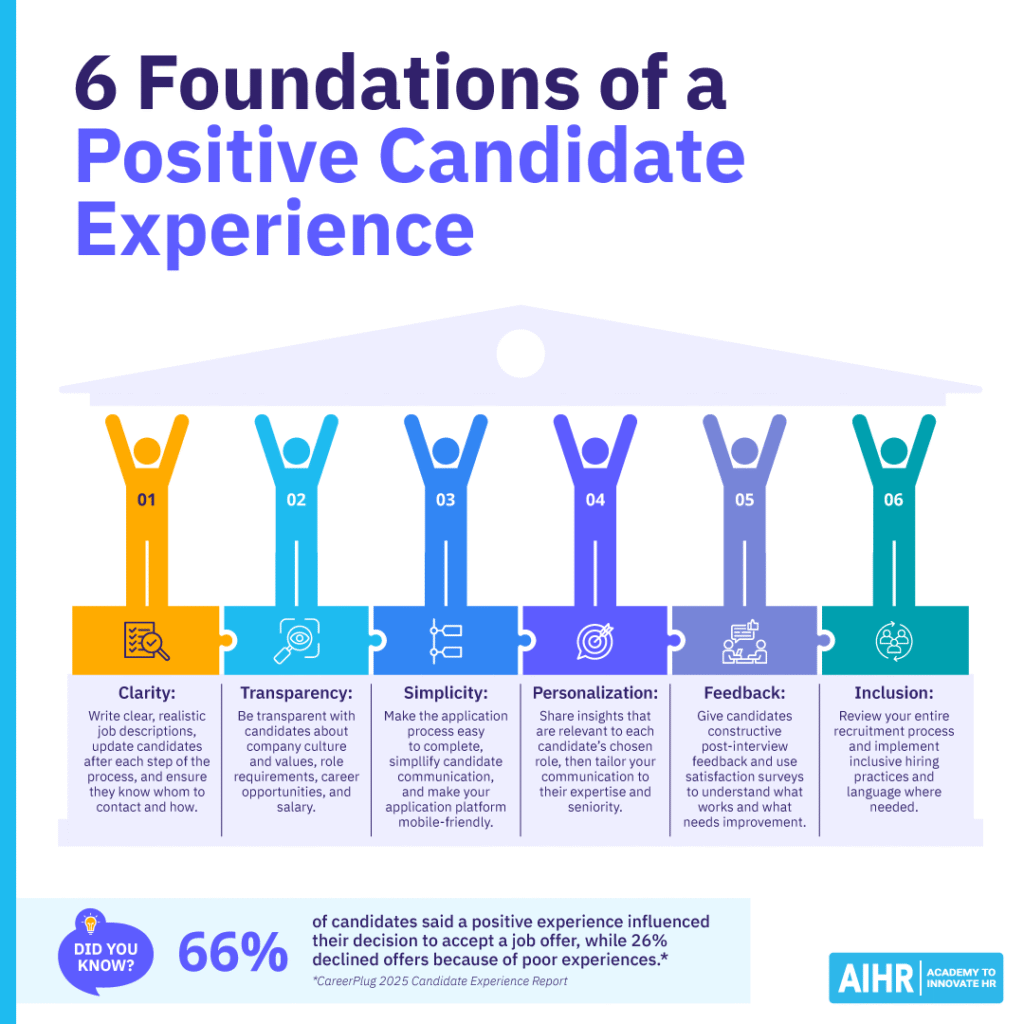
4. Personalization
A personalized candidate experience creates a sense of recognition and value. Automation should help you tailor communication, not make it generic.
Examples
- Share insights that are relevant to a candidate’s chosen role
- Tailor your communication to their expertise and seniority.
5. Feedback
A structured hiring process makes it easier to build in moments to give and collect feedback.
Examples
- Ensure candidates receive constructive feedback after their interviews when possible
- Send out a candidate satisfaction survey to understand what aspects of the process are working well and what areas could be improved.
6. Inclusion
A modern candidate experience is inclusive from start to finish. This strengthens both your hiring outcomes and your employer brand.
Examples
- Review your entire recruitment and hiring process and implement inclusive hiring practices where needed
- Regularly review job descriptions, assessments, and interview processes for potential bias.
Candidate feedback: How to ask, What to say, and when
Candidate feedback is an important pillar of a strong candidate experience. It closes the loop, shows candidates that their opinion matters, and can improve how they feel about your process, even if they were rejected.
How to ask for candidate feedback
Make it easy and respectful for candidates to share their views. You can:
- Add a short survey link in your offer and rejection emails
- Send a separate follow-up email that clearly explains why you’re asking for feedback and how long it will take
- Embed a simple one- or two-question poll in the email to encourage quick responses.
Keep the survey short (three to five questions) and make it clear that their answers will not affect current or future opportunities with your organization.
What to say in your feedback request
The way you frame your request matters. Aim for clear, human language. For example:
“Thank you again for taking the time to go through our hiring process. We’re always looking to improve, and your feedback would be very helpful. This short survey takes about two minutes to complete and will not affect any future applications.”
You can then include questions such as:
- On a scale of 1–5, how would you rate the clarity of our job description?
- Was the application process easy to complete?
- How do you think our interview process could be improved?
- On a scale of 1–5, how would you rate your overall experience with our hiring process?
When to ask for candidate feedback
The best time to send a candidate experience survey is when candidates have completed all the stages relevant to them, typically immediately after a hiring decision has been made. At that point, they can reflect on the complete journey.
For longer processes or senior roles, you can also send a brief survey after key milestones (for example, after the final interview) and follow up with a more comprehensive survey once the process is complete.
For more example questions and a sample template, check out our article on creating a candidate experience survey, which includes a free, downloadable candidate feedback template.
Candidate feedback examples
Here are some interview feedback examples:
- Unsuccessful interview feedback message: “Your skills, knowledge, and experience are impressive. However, some of your answers lacked detail. Adding more depth will strengthen your interview performance.”
- Constructive interview feedback message: “You clearly researched our company, and your enthusiasm for the job was obvious. Next time, it might be helpful to work on organizing your answers more clearly so that your points are easy to follow.”
- Positive interview feedback message: “You demonstrated in-depth knowledge of the topics we discussed during the interview, and your positive attitude made it a joy to interview you.”
Building a candidate experience career site
Your careers page is a reflection of your company’s culture and an invitation to potential candidates. As such, the experience people have on your careers site should be excellent.
Some career site best practices to consider:
- Showcase your culture: Include a “Get to know us” section that briefly shares your organization’s history, culture, and values.
- Include your mission and vision: Help candidates understand your direction and purpose.
- Add employee benefits: Describe the benefits you offer, including development opportunities.
- Use real employee testimonials: Employee testimonials provide candidates with a glimpse behind the scenes and a trustworthy endorsement from individuals who are already part of the company.
- Describe the hiring process: Let potential candidates know what they can expect if they decide to apply.
- Optimize your careers page: Ensure the basics, such as page speed, mobile experience, and accessibility, are in order.
What makes a great “apply” experience
Consider including:
- Job search filters that allow candidates to quickly find relevant roles
- A quick-apply option in as few clicks as possible
- Visible next steps after candidates submit their application
- An easy mobile application process in three or fewer steps.
Examples of companies with a compelling candidate experience site
You can use real-life careers sites for inspiration when designing or improving your own.
Rituals
Rituals’ careers site highlights its wellbeing-focused brand, shows clear pathways for shop and office roles, and uses employee stories to bring the culture to life. It also offers a dedicated “Life at Rituals” section and clear navigation for different job types, which makes it easier for candidates to see where they fit.

Electronic Arts (EA)
EA’s careers site showcases its mission and values, offers tailored journeys for early-career and experienced candidates, and clearly explains teams, locations, and application steps. There is also a separate “Interviewing with EA” page that sets expectations up-front and helps candidates prepare for the process.

Using AI and technology in candidate experience
Using generative AI in recruitment can significantly improve your hiring outcomes and your candidates’ experience. Today, there are AI tools to support every phase of the candidate journey, from sourcing to interviews and beyond.
Here are some practical examples of how AI can support candidate experience.
1. AI chatbots for always-on candidate support
Instead of waiting for office hours, candidates can get answers to common questions at any time. For example, a candidate browsing your careers site at night might ask a chatbot:
- “What is the salary range for this role?”
- “Is this position remote or hybrid?”
“What does the interview process look like?”
The chatbot can respond immediately with information pulled from your job descriptions, FAQs, or policies, and then offer to connect the candidate with a recruiter if the question is more complex. This reduces candidate uncertainty and eliminates the need for back-and-forth emails for your team.
2. AI-assisted job descriptions that feel more inclusive
AI tools can help you review and improve your job descriptions. They can:
- Highlight jargon or very complex sentences
- Flag words that might sound aggressive or unwelcoming
- Suggest simpler, more inclusive alternatives.
For example, instead of saying you want a “sales rockstar” or an “aggressive negotiator,” an AI tool might suggest “experienced sales professional” or “confident negotiator.” These alternatives are clearer and more inclusive, making it easier for a wider range of candidates to see themselves in the role.
In practice, you might:
- Paste your draft job description into an AI tool
- Ask it to highlight non-inclusive or unclear wording
- Review suggested alternatives and select options that align with your tone of voice.
3. Automated status updates and personalized messages at scale
AI can help you keep candidates informed without adding manual work. For example:
- When a candidate submits an application, they receive an immediate confirmation that explains the next steps and an expected timeline
- When their application moves from screening to interview, they automatically get a tailored email with a short overview of who they will meet and how long the conversation will take
- If a candidate is no longer in the process, they receive a clear, respectful rejection message rather than hearing nothing.
This type of automation reduces “silent treatment,” a common source of frustration for candidates, and helps you maintain a consistent tone across large volumes of communication.
4. Smarter assessments and interview preparation
AI-powered testing platforms can adapt assessments based on a candidate’s answers. For example, if a candidate performs strongly on basic questions, the system can move them more quickly to more advanced questions, rather than requiring them to complete a long, generic test.
You can also use AI to generate:
- Interview guides tailored to the role and seniority level
- Role-specific case questions or scenarios
- Short, plain-language summaries of the role to share with candidates before they meet the hiring manager
5. Keeping the human in the loop
AI should support your hiring process, not replace the human element. Candidates still want to:
- Talk to a real person at important moments
- Receive feedback that feels personal
- Know that people, not only tools, are making decisions about their application.
A practical approach is to let AI handle reminders, scheduling, basic questions, and standard updates, while recruiters and hiring managers focus on conversations, interviews, and feedback.
This balance helps you create a candidate experience that is efficient and modern, but still feels human.
How to improve candidate experience
Let’s examine some concrete steps to enhance the candidate experience. Here are six elements to consider:
- Review your job descriptions: Are they inclusive, clear, and realistic? Do they match the actual responsibilities and expectations of the role?
- Simplify your application process: Do you have a “three-click process”? Is your process mobile-first? Are you requesting only the information you truly need at this stage?
- Provide a single point of contact: Do candidates know who to go to with questions? Make sure each candidate has one main point of contact for consistency.
- Help candidates prepare: Small gestures matter. For example, have someone reach out to candidates the day before their interview to check whether they have everything they need.
- Humanize the recruitment process: Many candidates feel cautious about organizations using AI in hiring, so maintain a human touch. For instance, send rejection emails from a human email address instead of a “no reply” address and personalize the message where possible.
- Do not underestimate the importance of onboarding: One in three new hires leave within 90 days because reality and expectations do not align, or because communication and onboarding are ineffective. Implement a robust preboarding and onboarding process to ensure a smooth transition from candidate to employee.
To sum up
An organization’s candidate experience heavily influences its ability to attract and retain high-quality candidates. It shapes candidates’ first impressions of the company and impacts its reputation as an employer.
Building a solid, candidate-first journey that is tied to measurable results allows you to track what is working and what needs improvement. Over time, this helps you refine both your process and the experience you offer candidates.