
If you’re exploring ways to grow and validate your HR knowledge, you’ve likely come across both AIHR and HRCI. Whether you’re looking to earn a credential that employers recognize, build practical skills you can apply on the job, or stay current with emerging HR trends, understanding how these two options compare will help you make the right investment in your career.
AIHR and HRCI represent two different approaches to HR professional development, and they aren’t direct competitors but serve different purposes and meet different needs. HRCI validates what you already know through high-stakes certification exams, while AIHR teaches you new, in-demand skills through hands-on online learning. In fact, AIHR programs earn recertification credits that count toward maintaining HRCI credentials, creating a natural bridge between the two.
So the real question isn’t “which is better?” but rather “which approach serves your career goals right now, and could you benefit from both?”
Getting to know each option
In short, here’s what both HR professional development providers offer:
AIHR (Academy to Innovate HR) offers 16 certificate programs and over 85+ courses across modern HR topics like business partnering, people analytics, digital HR, and AI in HR. Its practical, hands-on approach equips HR professionals with the skills needed to become more strategic and data-driven, with resources like hundreds of templates, an AI Copilot tool, and a global community of over 85,000 members and alumni.
With a single certificate program starting at $1,125 or $1,850/year for Full Academy Access, AIHR focuses on building capabilities and awards digital certificates that complement formal credentials, helping professionals apply what they know to drive real business outcomes.
HRCI (HR Certification Institute) is a leading credentialing organization for HR professionals, with over 50 years of history and more than 120,000 active certification holders globally. HRCI offers eight certifications, from the entry-level Associate Professional in Human Resources (aPHR) to the senior-level SPHR and global GPHR, that validate mastery of technical HR knowledge, laws, regulations, and compliance. With National Commission for Certifying Agencies (NCCA) accreditation across most of its certifications, an HRCI credential signals professional credibility and can boost earning potential.
HRCI certifications focus on validating existing knowledge through rigorous, independently administered assessments. Exam fees range from $300 to $495, depending on the certification level, with an application fee of $100 and official prep materials adding $449 to $1180 on top of that.
Both providers serve HR professionals, but they approach professional development from different directions: HRCI certifies your knowledge, while AIHR builds it. Many professionals find the greatest value in using both.
Contents
AIHR vs HRCI at a glance
AIHR overview
HRCI overview
Key differences between AIHR and HRCI
AIHR vs HRCI pricing compared
AIHR vs HRCI: Which should you choose?
AIHR vs HRCI at a glance
AIHR | HRCI | |
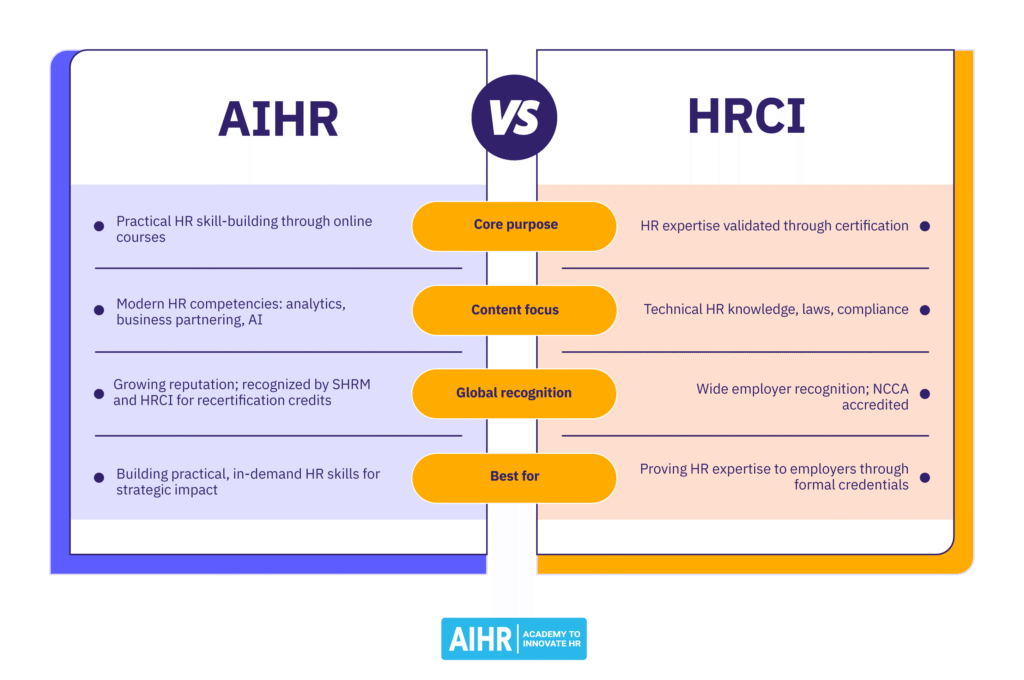
Core purpose | Practical HR skill-building through online courses | HR expertise validated through certification |
Primary approach | Self-paced, hands-on online learning | High-stakes certification exams |
Number of credentials / programs | 16+ certificate programs, 85+ courses | 8 certifications |
Content focus | Modern HR competencies: analytics, business partnering, AI | Technical HR knowledge, laws, compliance |
Practical application | Hands-on labs, capstone projects, templates and resources for on-the-job support | Exam-based validation of competency |
Global recognition | Growing reputation; recognized by SHRM and HRCI for recertification credits | Wide employer recognition; NCCA accredited |
Ongoing learning resources | Access to certificate programs, courses, templates, AI tools, weekly live events | Learning Center with on-demand courses |
Community | 25,000+ member global community | HRCI ENGAGE (free, launched 2025) |
Starting cost | $1,125 (single certificate program) | $400+ (aPHR exam fee, preparation materials additional) |
Best for | Building practical, in-demand HR skills for strategic impact | Proving HR expertise to employers through formal credentials |
AIHR overview
AIHR is an online learning platform for HR professionals, trusted by over 85,000 members and alumni across 180+ countries. Its approach to professional development is built around teaching practical skills that HR professionals can apply immediately to drive measurable business impact. Upon completing a program, learners earn a digital certificate to showcase their new expertise.
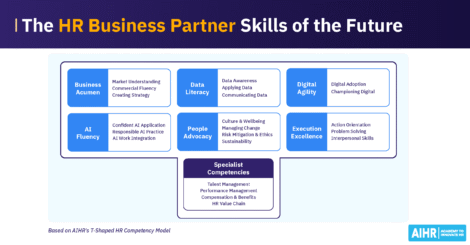
A core part of AIHR’s philosophy is that HR is a strategic function, not just a compliance function. This philosophy is reflected in AIHR’s proprietary T-Shaped HR Competency Model, which sits at the heart of its curriculum. The model defines what effective, future-ready HR looks like: professionals who have both the broad foundations to operate across business contexts and the specialist depth to lead in specific HR domains.
Being global by design, AIHR does not focus on jurisdiction-specific compliance content. Instead, its curriculum emphasizes universally relevant, future-focused capabilities: innovation, data-driven decision-making, AI competence, strategic workforce planning, and strengthening HR’s role as a proactive business partner.
This makes AIHR a natural complement to credential-granting organizations like HRCI, which focus on validating technical knowledge, including laws and regulations.
Who it’s for
AIHR serves HR professionals across multiple career levels, from early-career to senior, including HR generalists, HRBPs, People Ops, Talent Acquisition, and People Analytics professionals. AIHR certificate programs are especially valued in organizations that prioritize modern, strategic HR skills. In tech-forward companies and industries undergoing digital transformation, proficiency in people analytics, digital HR, or AI applications are just as relevant as traditional HR credentials.
Types of AIHR certificate programs
AIHR’s curriculum covers modern HR disciplines through 16 certificate programs and over 85 courses. These span People Analytics, Digital HR, Talent Acquisition, Organizational Development, Learning and Development, Compensation and Benefits, HR Business Partnering, and Diversity, Equity, Inclusion, and Belonging. A growing emphasis on AI in HR, with courses on AI strategy, prompt design, and practical applications, positions AIHR at the forefront of the profession’s technological evolution.
The platform also includes a Soft Skills Hub for developing essential non-technical capabilities like communication, conflict resolution, and negotiation. Mini courses on topics like Generative AI Prompt Design for HR and ChatGPT for HR offer quick upskilling on specific, timely topics without committing to a full certificate program.
Key benefits
- Practical, hands-on learning: AIHR uses a Tell-Show-Do-Apply methodology that moves from concept to real-world application through case studies, projects, hands-on labs (such as creating HR dashboards or drafting AI policies), and capstone projects.
- Comprehensive learning ecosystem: Beyond courses, members access hundreds of downloadable templates, playbooks, and tools, the AIHR Copilot (an AI-powered assistant built on AIHR’s proprietary content library), weekly live events, and AI-powered Personalized Learning Journeys.
- Eligible for recertification credits: AIHR’s programs are recognized by SHRM, HRCI, HRPA, CPHR, ATD, and CIPD, meaning completing AIHR courses can earn recertification credits toward maintaining HRCI certifications.
- Structured competency framework: AIHR’s programs are organized around a proprietary T-Shaped HR Competency Model that promotes balanced development: broad HR knowledge combined with deep functional specialization.
- Career development tools: AIHR Career Map powered by market data from Revelio Labs, helps professionals visualize career paths, identify skill gaps, and plan development trajectories. AIHR is also a registered education institute on LinkedIn, enabling one-click credential verification by recruiters.
- Team training solutions: For organizations, AIHR offers team licenses starting from $2,990 (minimum 2 users) that include team reporting and analytics, a dedicated Learning Consultant for teams of 15 or more, and customizable learning paths.
Learning approach and exam format
AIHR’s self-paced format allows professionals to learn on their own schedule through desktop or mobile app access. Courses are structured into modules with bite-sized video lessons, followed by practical exercises and real-world projects. Certificate programs typically require 30–40 hours of study time to complete.
Successfully completing the capstone project is compulsory for earning the digital certificate and associated recertification credits. Members who don’t pass on their first attempt get an additional retake.
A personal learning coach (for Full Academy Access members) provides accountability and guidance that self-directed learning often lacks. AI-powered Personalized Learning Journeys let members answer questions about their goals and receive a curated path of 3 to 6 content items mapped to those objectives.
Community, resources, and support
AIHR integrates the community directly into its learning platform, with over 25,000 HR professionals from 180+ countries. AIHR subject matter experts participate in discussions, helping ensure questions receive knowledgeable responses. The community is designed to complement the learning experience, allowing members to discuss course concepts, share implementation experiences, and get peer feedback on real-world challenges.
AIHR’s support ecosystem also includes dedicated Learning Consultants for team licenses, weekly live events with HR experts (many of which earn recertification credits recognized by SHRM and HRCI), and the AIHR Copilot for on-demand, AI-powered answers to HR questions. The Resource Library offers practical tools for immediate on-the-job application.
Limitations to consider
- Self-paced learning requires discipline: As with any online platform, staying on track without scheduled classes or in-person sessions requires personal motivation and time management.
- Different from a formal certification credential: AIHR certificates demonstrate practical skills and strategic capability, but they differ from traditional industry certifications like those offered by HRCI.
- No location-specific compliance content: AIHR focuses on strategic, globally relevant capabilities rather than local and regional employment laws and regulations. Professionals needing compliance-focused education will want to supplement with other resources.
HRCI overview
HRCI has earned its reputation as a trusted credentialing body in HR through five decades of rigorous standard-setting. Its approach centers on a comprehensive Body of Knowledge (HRBoK) that defines benchmark HR practices, and its exams are designed to validate whether professionals have mastered the technical and operational aspects of Human Resources.
Who it’s for
HRCI certifications are designed for HR professionals at every career stage who want to validate their technical HR knowledge through a formal, independently assessed credential. The certifications are particularly valuable for professionals in compliance-heavy roles, regulated industries, or organizations where demonstrating mastery of HR laws and regulations is essential. Many HR job postings specifically list PHR, SPHR, or GPHR as a requirement or preferred qualification.
Types of HRCI certifications
HRCI’s eight certifications form a comprehensive credentialing framework covering the full spectrum of HR career stages and specializations:
- The Associate Professional in Human Resources (aPHR) provides an entry point for those new to the field, requiring no prior HR experience.
- The Professional in Human Resources (PHR) targets operational HR professionals focused on operations, program implementation and U.S. laws.
- The Senior Professional in Human Resources (SPHR) is designed for strategic HR leaders involved in policy-making and organizational planning.
- International variants (PHRi, SPHRi, GPHR) serve professionals working across borders, along with an associate international certification (aPHRi) and a California-specific certification (PHRca).
Eligibility varies by certification level. The aPHR requires no prior HR experience, making it accessible to anyone entering the field. The PHR and SPHR require a combination of education and professional HR experience, with higher-level certifications requiring more years of strategic-level work. International certifications (PHRi, SPHRi, GPHR) have their own eligibility requirements tailored to global HR practice.
Key benefits
- Breadth of certifications: HRCI offers eight certifications spanning every career stage, from the aPHR for those just entering the field to the SPHR for senior strategists and the GPHR for global HR professionals. This makes itone of the most comprehensive credentialing portfolios in the HR space.
- Employer recognition: HRCI credentials are recognized in over 100 countries and carry weight in job postings that specifically list PHR, SPHR, or GPHR as a requirement or preferred qualification.
- NCCA accreditation: HRCI is accredited by the National Commission for Certifying Agencies (NCCA), which is considered the gold standard for professional credentialing programs. According to HRCI, they’re the only HR certification body that seeks and maintains this third-party accreditation.
- No annual membership fee: Unlike some professional organizations, HRCI does not require an annual membership fee.
Learning approach and exam format
The certification exams are computer-based assessments with multiple-choice and situational questions designed to assess not just theoretical knowledge but the ability to apply HR principles to real-world situations. They are developed using extensive research and contributions from hundreds of HR volunteers worldwide. Exams are administered through Pearson VUE testing centers or online proctoring, providing global accessibility.
HRCI also offers its own “Cert Prep” packages through the Learning Center, which include on-demand access to a digital learning platform with videos, practice exams, flashcards, interactive games, and instructor-led training options. The platform allows candidates to create personalized study plans.
Maintaining an HRCI credential requires earning recertification credits over a three-year cycle (60 credits for most certifications, 45 for aPHR-level). The HRCI Learning Center supports this with on-demand courses covering topics from core HR functions to leadership and compliance. Credits from pre-approved courses can be submitted toward recertification by entering the Activity ID into your HRCI account.
Community, resources, and support
HRCI launched HRCI ENGAGE in early 2025, a free online community open to all HR professionals regardless of certification status. The platform features community spaces organized by geography and business vertical, an HR job board, video events with continuing education webinars, and live chats with industry experts. With members from over 150 countries participating in thousands of conversations, HRCI ENGAGE aims to be a trusted space for peer-to-peer knowledge sharing and networking.
HRCI also publishes research and provides resources through the HRCI Resource Network, including guides and toolkits on topics like AI, workforce shifts, and recruiting trends.
Limitations to consider
- Validates existing knowledge rather than building new skills: HRCI exams assess what professionals already know but do not include structured learning or skill-building components. Those looking to develop new capabilities will need to invest in separate training resources alongside their certification.
- Preparation materials add to the total cost: Beyond exam and application fees, most candidates purchase third-party study materials or HRCI’s own Cert Prep packages to prepare effectively. These additional costs need to be factored into the overall investment.
- Core certifications emphasize U.S. employment law: The PHR and SPHR exams are heavily focused on U.S. laws and regulations, which may be less relevant for professionals working primarily outside the United States. International certifications (PHRi, SPHRi, GPHR) are available but cover a different scope.
- High-stakes, single-exam assessment format: Certification is determined by a single pass-or-fail exam, which may not fully reflect the breadth of a professional’s practical HR capabilities or on-the-job experience.
- Limited coverage of emerging HR disciplines: Exam content is grounded in established HR knowledge areas and may not keep pace with rapidly evolving topics such as people analytics, AI in HR, or digital transformation.
Key differences between AIHR and HRCI
While both AIHR and HRCI serve HR professionals, they approach professional development from distinct angles. Here are the most important differences to understand:
Core focus
AIHR’s approach centers on continuous skill-building. It helps HR professionals learn new capabilities in areas like people analytics, digital HR transformation, and AI-powered practices through practical, applied learning they can immediately use on the job. AIHR programs also earn recertification credits recognized by HRCI (as well as SHRM, HRPA, CPHR, ATD, and CIPD), allowing professionals to build new skills and maintain their existing credentials at the same time.
HRCI’s approach centers on credential validation. It assumes that HR professionals acquire knowledge through education and work experience, and provides rigorous, independent assessments to prove it. The certifications serve as a signal to employers that the holder has demonstrated competence in areas like talent management, employee relations, compensation, workforce planning, and compliance.
Learning and assessment approach
AIHR’s learning experience is application-driven. Learners engage with bite-sized lessons, study real-world case studies, complete interactive assignments and hands-on labs, and finish with capstone projects that require applying learned concepts to practical HR challenges.
HRCI is assessment-based. Candidates study, prove their knowledge through a high-stakes exam, and maintain their credentials through continuing education credits. The exams use situational multiple-choice questions designed to test the real-world application of HR principles.
Content focus
AIHR’s curriculum emphasizes business- and future-focused capabilities: business acumen, consulting skills, people analytics, digital HR, AI in HR, organizational development, and more. The content is continuously updated to reflect emerging trends and practices.
HRCI exams cover technical HR knowledge, laws, regulations, and compliance. The content is defined by HRCI’s Body of Knowledge and detailed Exam Content Outlines, reflecting established professional standards.
Career recognition
AIHR’s recognition is growing, particularly in tech-focused and data-driven industries. AIHR certificates are positioned as a mark of practical, strategic HR expertise, representing an additional layer of capability beyond compliance-level qualifications. AIHR is recognized by SHRM, HRCI, HRPA, CPHR, ATD, and CIPD for PDCs and recertification credits.
HRCI credentials carry over 50 years of established trust among employers. They are recognized in over 100 countries, and many job postings specifically list HRCI certifications as requirements or preferred qualifications.
AIHR vs HRCI pricing compared
AIHR and HRCI represent different types of professional investments rather than competing options. Understanding the full picture requires looking beyond the initial price tag.
AIHR offers two main pricing tiers for individual professionals.
A single Certificate Program costs $1,125 for 12 months of access. The Full Academy Access plan costs $1,850 per year or $185/month with a 12-month minimum commitment. This tier includes unlimited access to all 16 certificate programs, 85+ courses, hundreds of templates, the AIHR Copilot, weekly live events, personal coaching, the Career Map, the Soft Skills Hub, and all future content updates.
For team upskilling, pricing starts from $2,990 (minimum 2 users). This includes team reporting, analytics, and a dedicated Learning Consultant for teams of 15 or more.
HRCI charges per certification exam with a consistent structure: a $100 non-refundable application fee plus an exam fee that ranges from $300 for associate-level to $495 for senior and global-level certifications. The total cost for a single certification ranges from $400 (aPHR) to $595 (SPHR, SPHRi, GPHR). However, most candidates also invest in preparation materials, whether through HRCI’s own Cert Prep packages or third-party study resources, which can significantly add to the total investment.
Recertification every three years requires earning credits through professional development activities, many of which carry their own costs, plus a recertification application fee. On the other hand, HRCI does not require an annual membership fee, which distinguishes it from some professional organizations.
The investment calculus depends on your goals. HRCI certification provides a specific credential that employers require or prefer, at a defined cost. AIHR’s Full Academy Access provides a broad learning ecosystem for continuous skill development. And since AIHR courses earn recertification credits recognized by HRCI, Full Academy Access can simultaneously build new skills and satisfy recertification requirements, potentially reducing the total cost of maintaining both.
AIHR vs HRCI: Which should you choose?
The choice between AIHR and HRCI depends on where you are in your career, what you need right now, and how you want to grow.
Choose AIHR if:
- You want to build practical, in-demand skills in areas like people analytics, digital HR, and AI
- You prefer hands-on learning with real-world projects over exam-based validation
- You’re looking for an all-in-one learning ecosystem with courses, templates, tools, and community
- You need to upskill in emerging HR domains that help you drive strategic business impact
- You want continuous access to new courses and content as the HR field evolves
- You’re looking for team training solutions with reporting, analytics, and dedicated support
- You value personal coaching, AI-powered learning tools, and a structured competency framework for ongoing development
- You want to earn recertification credits toward HRCI, SHRM, or other credentials while developing new, practical capabilities
Build future-ready HR skills and stay ahead of industry change with AIHR.
Choose HRCI if:
- You need a formal credential that many employers require or prefer in job postings
- You work in an industry or organization where HR credentials are tied directly to pay grades or promotion criteria
- Your role is heavily focused on compliance, employment law, and regulatory requirements
- You want to validate your existing HR expertise through an independently accredited assessment
- You want a credential backed by independent third-party accreditation
- You need specialized credentials for international HR (GPHR) or California-specific regulations (PHRca)
- You want a certification investment without an ongoing annual commitment (though recertification every three years involves additional costs)
Earn a globally recognized HR credential with HRCI and validate your expertise.
Using both together:
For many HR professionals, it makes sense to combine AIHR and HRCI in their professional development journey.
HRCI certifications provide the formal credentials that establish your professional standing, while AIHR builds the practical, modern skills that make you effective in an evolving workplace. Since AIHR programs earn recertification credits recognized by HRCI, completing AIHR courses maintains your HRCI credentials while simultaneously building new capabilities, creating a natural alignment between skill development and credential maintenance.
An HR professional might earn their PHR or SPHR through HRCI to establish credibility, then enroll in AIHR’s Full Academy to continuously build new capabilities in analytics, digital transformation, and AI, all while earning the recertification credits needed to keep their HRCI designation active.
The ultimate question is not which option is better, but what your goals and priorities are.
AIHR and HRCI serve different but complementary purposes in an HR professional’s development journey. HRCI provides the credential that validates your expertise. AIHR provides the education that expands it. The professionals who will thrive in the future of HR are likely to invest in both throught their career.