

An effective HRBP team is a strategic partner for the organization’s business leaders, understands the company’s priorities, and develops HR strategies that support these goals. Organizations with efficient HR Business Partners report better employee performance and profits of 22% and 9%, respectively.
In this article, we discuss how to build a successful HR business partner team. We touch on the concept of HR business partnering, core HRBP responsibilities, relevant skills, and explore various strategies to build a team.
Contents
The concept of HR business partnering
Core responsibilities of the HRBP team
Essential HR business partner skills to have in your team
7 steps to develop a high-performing HRBP team
Key takeaways
- HR business partnering is a strategic capability, and its importance is growing as HR takes on a more business-facing, value-driving role.
- Future-ready HRBPs act as trusted advisors, supporting business leaders in turning business priorities into practical people solutions.
- Strong HRBP teams combine business, data, digital, AI, people advocacy, and execution skills to deliver practical HR solutions.
- Building a high-performing HRBP team requires focused upskilling, strong business alignment, and consistent ways of working with clear success metrics.
The concept of HR business partnering
It’s important to note the distinction between the HR Business Partner (HRBP) role, the HRBP function, and HR business partnering as a capability.
HR Business Partner is a job role in many organizations. In this role, an HR professional works closely with business leaders to understand their priorities and turn workforce needs into practical HR solutions.
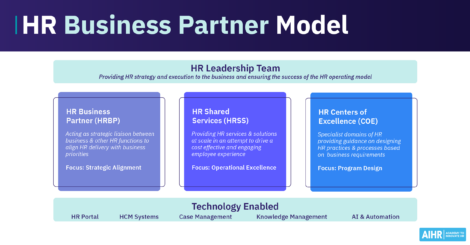
The HRBP function refers to how this work is organized. In larger companies, HRBPs often support a specific business unit, department, or region. This setup is usually part of a broader HR business partner model, which defines how HRBPs, Shared Services, and Centers of Excellence work together.
HR business partnering as a capability goes beyond the HRBP job title. It’s a way of working every HR function needs to build: understanding the business, identifying people-related needs, and creating HR solutions that support organizational goals.
This capability has three core elements:
- A clear strategy for how HR works with the business
- A mindset focused on driving value for the business
- A skillset that allows HR professionals to turn business needs into practical HR solutions.
As AI takes over more administrative and repetitive HR tasks, HR teams need to spend more time on work that requires business judgment, stakeholder influence, and problem-solving. This is where HR business partnering becomes essential.
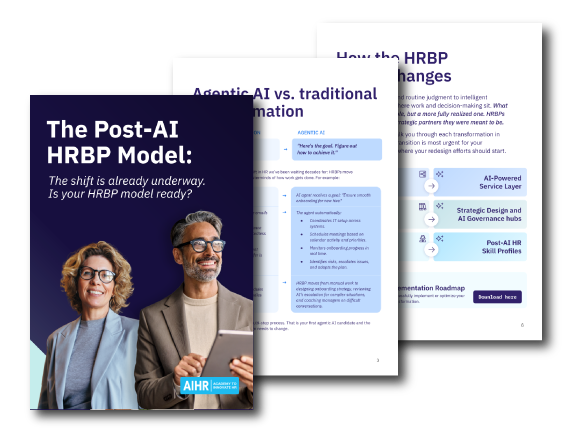
The HRBP model is also changing as AI becomes part of HR work. HRBPs need to develop more specialized profiles, depending on where they create the most value for the business. You can learn more about this shift in AIHR’s free guide, The Post-AI HRBP Model.
Core responsibilities of the HRBP team
A future-ready HRBP team has various core responsibilities, including:
- Strategically contributing to business goals
- Collaborating with leaders and managers
- Acting as consultants and coaches
- Data-driven decision-making
- Building a competitive organization.
Let’s unpack these responsibilities:
Strategically contributing to business goals
Strategic HR business partners have strong business acumen and know how to apply it. They understand the market environment in which their organization operates, know how certain developments may impact the business, and know how to address them. These professionals know the business inside out, from its main competitors to its customers, and its operating model to its unique selling points.
A strategic HRBP connects the organization’s business goals to HR activities and practices and has a solid understanding of all relevant stakeholders, enabling them to actively contribute to the business’s success.

Collaborating with leaders and managers
As mentioned earlier, HRBP team members often work with one particular department or business unit. They have a close working relationship with their department’s managers and leaders and know how to best support them.
Part of this is being proactive. For example, instead of asking ‘How can I help you?’, a future-ready HRBP reviews data before meeting with a manager to see where they may need support. This data could involve turnover statistics, employee satisfaction scores, or learning and development effectiveness rates.
Acting as consultants and coaches
Since HRBPs have a thorough understanding of the business and its strengths, weaknesses, and challenges, they understand how current and future developments may impact the people in the company. As such, they are able to coach the organization’s leaders on handling people-related matters effectively and provide valuable advice to key stakeholders.
Examples of what this looks like in practice include:
- Staying up to date on the latest employment laws and regulations in their geographic area and providing guidance where necessary to ensure compliance
- Building and maintaining a good relationship with business leaders through, among other things, regular (in-person) meetings, and offering HR advice when needed
- Assisting where necessary when the organization develops and implements new HR processes and policies.
Data-driven decision-making
Data literacy is a core HR competency for every HR professional, including HRBPs. It enables your team to analyze, interpret, and apply data to inform decisions, demonstrate measurable business impact, and improve outcomes. We already mentioned how a future-ready HRBP prepares for a meeting with one of ‘their’ managers by looking at relevant data to see how they can best support that manager.
There is, however, another element that is important for HRBPs when using data to inform their decisions: a strong contextual understanding of the business. For instance, when the company has an attrition problem in its Southeast Asian facilities, the HRBP team members need to consider different data than when they’re looking to open a production facility in Eastern Europe.
Building a competitive organization
Another key responsibility of HRBPs involves building a competitive organization, a company that attracts and retains the right talent and is able to win new clients.
For an HR business partner, this means they need to focus on two main things:
- Enabling the organization to attract and retain the right people for the business. Examples of what this looks like include:
- Collaborating with fellow HR team members to develop effective recruiting strategies
- Developing a transparent and fair compensation plan that combines different types of compensation and is tailored to the specificities of each local area the company operates in
- Implementing an employee recognition program that helps improve employee engagement, productivity, and performance.
- Supporting the business where needed to strategize, train, and adjust to build the best product or service for its clients. This can involve activities such as:
- Helping managers navigate people-related and organizational issues
- Guiding managers in areas like employee training and performance management.
Essential HR business partner skills to have in your team
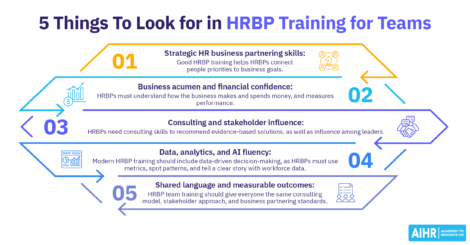
To fulfill these responsibilities successfully, your HRBP team needs the right mix of business, consulting, and HR skills. AIHR’s T-Shaped HR Competency Model defines the core competencies every HR professional needs, combined with deeper expertise in specific HR areas. The six competencies below are part of this model and are essential for every HRBP team that wants to stay relevant and fit for the future.
- Business Acumen: The HRBP role requires a strong commercial awareness and understanding of the business.
- Data Literacy: A future-ready HRBP knows how and when to use data and can communicate it effectively to various audiences.
- Digital Agility: A successful HRBP team understands how technology can make HR and people operations more effective while improving the employee experience. This means knowing which tools to use, where automation can reduce manual work, and how digital solutions can support better workforce decisions.
- AI Fluency: Similarly, HRBPs who have AI fluency can interpret AI-generated information, identify where AI could support decisions, and know when to apply human judgment.
- People Advocacy: HRBPs are people advocates, guiding managers through periods of (organizational) change and coaching them on how to balance their team’s wellbeing and productivity.
- Execution Excellence: For the HRBP team of the future, problem-solving, managing conflict, and leading with empathy are important ingredients for successful action and execution.
Apart from these core competency domains, there are several specialist competencies that are becoming increasingly important for (future-ready) HRBP teams, including:
As discussed earlier, an important responsibility for HRBPs involves the attraction and retention of talent. To create a well-rounded employee experience, the HRBP team needs to deeply understand these fields.
Another skill that’s become increasingly important for HRBPs is change management. Knowing how to handle change initiatives and how to communicate to overcome resistance are essential for successful implementation and, as such, key techniques to transfer to managers.
7 steps to develop a high-performing HRBP team
Let’s explore strategies for developing a high-performing HR business partner team. Here are some options to consider:
Step 1: Define what “high-performing” means
This is your starting point. What outcomes are you aiming for with your (future) HRBP team? A high-performing HRBP team is not just responsive or well-liked by managers. It helps the business make better workforce decisions and solve people challenges before they become bigger issues. Define the outcomes you expect from the team, such as:
- Managers involve HRBPs early in business decisions
- HRBP priorities clearly link to business goals
- HRBPs spend most of their time on advisory and workforce planning work
- Operational HR tasks don’t consume most HRBP capacity
- Business leaders can see the value HRBPs add through clear outcomes and metrics.
Step 2: Clarify HRBP roles and decision rights
Clarify how responsibilities are divided across the broader HR team, including HRBPs, Shared Services, and Centers of Excellence (CoEs). This helps business leaders understand who to approach for what, prevents duplication of work, and allows HRBPs to focus on strategic business support instead of becoming the default owner of every people issue.
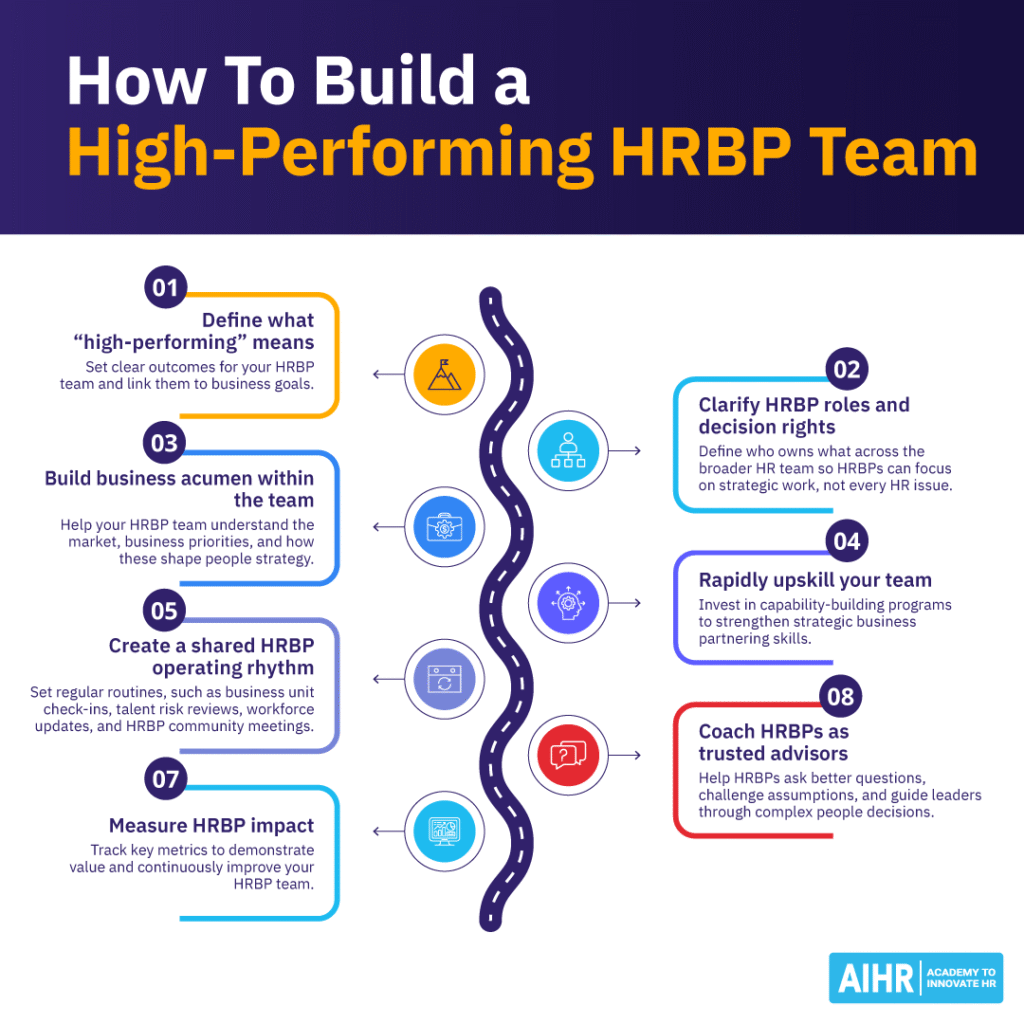
Step 3: Build business acumen
Business acumen has come up throughout this article for a reason. It’s what helps HRBPs move from giving HR advice to giving business-relevant advice. To build this skill, encourage HRBPs to join business reviews, read financial updates, shadow operational teams, and ask leaders sharper questions. For example: “Which people-related issues could stop this business unit from reaching its goals?”
Step 4: Rapidly upskill your team
Developing a high-performing HRBP team takes focused, practical training. Generic HR learning won’t be enough if your team needs to build stronger business partnering skills fast.
AIHR’s HRBP Boot Camp can help you do exactly that. It’s a 3-month, instructor-led, intensive program specifically designed to build strategic business partnering capability across HR teams. Leaders who signed their team up for the Boot Camp report seeing tangible results already after the first month of training.
Step 5: Create a shared HRBP operating rhythm
Create a clear cadence for how your HRBP team works with the business. This can include monthly business unit check-ins, quarterly talent reviews, workforce planning updates, and regular HRBP team meetings.
A shared operating rhythm helps HRBPs stay close to business priorities rather than react to issues as they arise. It also creates consistency across the team, so every business unit gets the same level of support.
Step 6: Coach HRBPs like strategic advisors
Help HRBPs build the confidence and skills to advise, not just support, business leaders. This means coaching them to ask better questions, challenge assumptions, and guide leaders through complex people decisions.
For example, instead of accepting a hiring request at face value, an HRBP should ask what business problem the leader is trying to solve. The answer may point to a different solution, such as redesigning roles, shifting capacity, or upskilling the existing team.
Step 7: Measure HRBP impact
Measure the impact of your HRBP team at the business unit or manager level, not just across HR as a whole. This helps you understand where HRBPs are adding value and where additional support may be needed. Examples of useful HR business partner metrics include:
- Employee engagement: For instance, by calculating the eNPS (Employee Net Promoter Score).
- Wellbeing metrics: For example, you should keep an eye on absenteeism rates, sick leave days, and employee healthcare expenses.
- Retention rates
- Internal mobility and promotion rates
- Manager satisfaction with HRBP support
Tracking these metrics over time also helps HRBPs connect people initiatives to business outcomes more clearly.
A final word
The strength of your HRBP team depends on the skills your HRBPs build and apply every day. Business acumen, data literacy, consulting skills, and digital agility all help HRBPs turn business needs into practical HR action.
By investing in these skills, you help your HRBP team become more confident, credible, and effective in supporting business leaders.