
AI skills for your résumé are no longer optional. 66% of business leaders say they wouldn’t hire someone without AI skills, and 71% say they’d rather hire a less experienced candidate with AI skills over a more experienced one who lacks such skills. You don’t need to be a data scientist to stay competitive, but you do need to demonstrate experience in the AI skills in demand today.
This article explores what AI fluency means for you as an HR professional, and why AI now sits at the core of the modern HR competency profile. It also looks at the 12 types of AI skills worth adding to your résumé, alongside practical examples of how to frame each one.
Key takeaways
- The bar has shifted: AI skills are no longer a differentiator, but a baseline requirement for HR professionals.
- Employers are looking for specific AI use cases, such as real-world experience with screening tools, GenAI for job ads, people analytics, and workflow automation.
- In AIHR’s T-Shaped HR Competency Model, AI fluency sits on the universal baseline, which makes it a capability every HR professional needs.
Contents
What are AI skills for HR?
Why AI skills are important for HR professionals
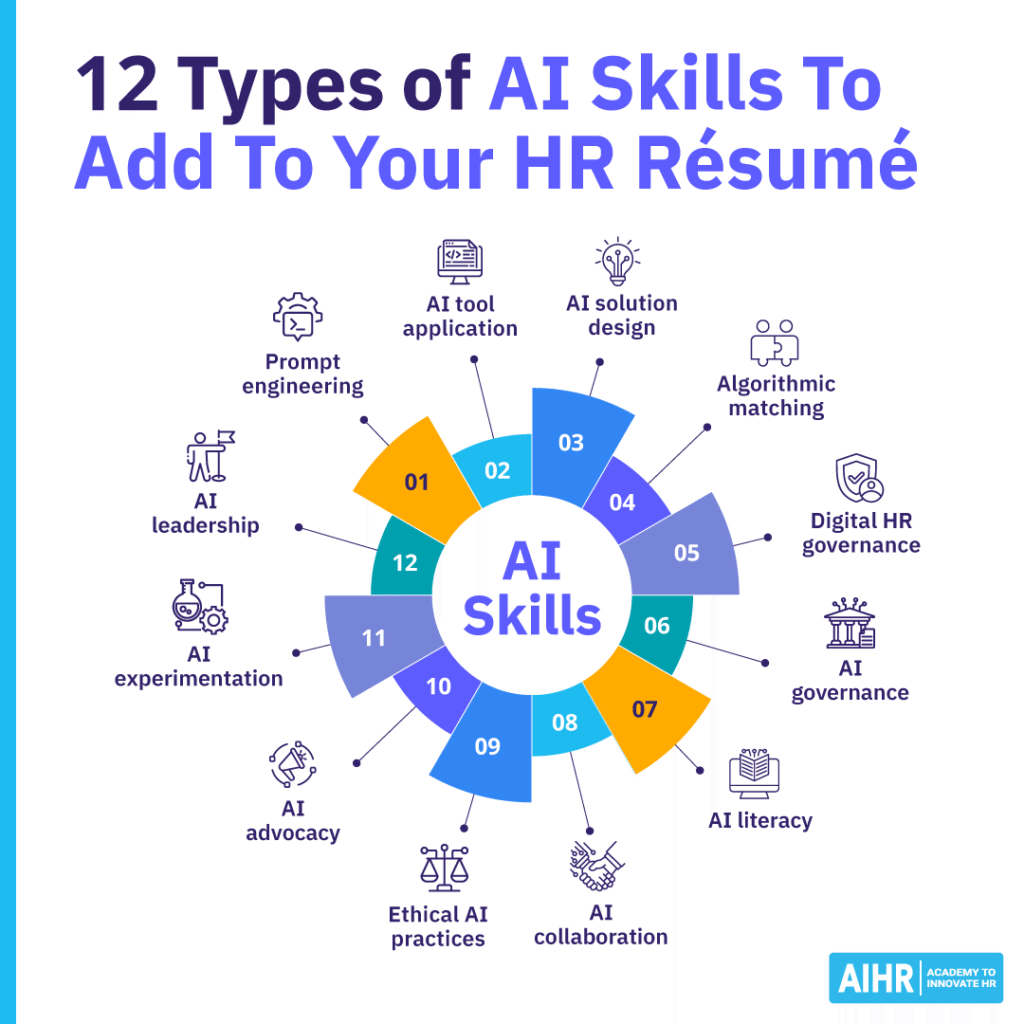
12 types of AI skills to add to your HR résumé
AI fluency is a baseline expectation
The T-shaped HR professional

What are AI skills for HR?
AI skills for HR have moved beyond simply using ChatGPT to help you write a job description. The future of HR is about integrating AI into virtually every aspect to enrich, optimize, and automate HR operations. This means knowing when to use AI, how to interpret what it gives you, and how to apply it in ways that improve the HR function.
In AIHR’s model, this shows up as AI fluency: working with AI confidently and thoughtfully, and using it to support your judgment rather than replace it. In practice, it looks like an HR professional who uses AI consistently to produce faster hiring decisions, cleaner feedback processes, and better employee experiences.
Why AI skills are important for HR professionals
Overall demand for generative AI across non-tech industries has surged 800% in just three years, and more than half of all job postings requiring AI skills now fall outside IT and computer science.
The pay difference seals the argument. AI skills don’t just improve employability, they also increase earning power. Job postings that list AI skills pay 28% more than comparable ones that don’t, translating to nearly $18,000 more in salary per year. So, the question isn’t whether AI skills belong on your HR résumé; it’s whether yours are good enough to further your career.
It also helps to remember the practical reasons HR teams build AI capabilities for:
- Making HR work more scalable: AI can handle your time-intensive routine tasks (e.g., scheduling, screening, feedback analysis) while you stay in control of the tasks that matter. The result is faster delivery without cutting corners on quality or oversight.
- Improving decision quality. AI can surface patterns in data that gut feel misses. When you can interpret those outputs critically, you make faster but better-informed decisions.
- Applying AI responsibly: As an HR professional, you must understand AI’s limits, (e.g., bias, inventing facts, or failing in situations it’s not trained on), especially in hiring, performance management, and workforce planning.
12 types of AI skills to add to your HR résumé
The following 12 types of generative AI skills for résumés are the most in demand, regardless of the industry you work in or want to work in:
1. Prompt engineering
Generative AI output is only as useful as the input that shapes it. Good prompting isn’t about how you phrase your requests, but about building structured, repeatable frameworks that produce consistent results across recruiting, performance, and policy work.
In practice, this means a shared prompt library your entire HR team uses, rather than starting from scratch every time someone needs a job description or a feedback summary.
Skills to list
- Prompt design and refinement for specific HR use cases
- Building reusable prompt templates and guidelines
- Translating complex business problems into well-thought-out, scalable AI-ready inputs.
Résumé examples
- “I designed standardized prompt templates for recruiting, performance feedback, and policy FAQs, improving AI output relevance and reducing manual rework by 40%.”
- “I coached HR team members on effective prompting techniques, increasing AI tool adoption and quality outputs across the HR function.”
2. AI tool application
Knowing which AI tools to use and when to use them is a skill in itself. While it can help to have experience using a wide range of AI tools, the ability to assess them against a real workflow problem is more crucial. You should know how to apply AI tools effectively and know when they’re not the right fit, without wasting time or resources.
Skills to list
- Selecting and applying AI tools to specific HR workflows
- Evaluating tool outputs for accuracy and relevance against selection frameworks and criteria
- Integrating AI tools into existing HR processes and systems.
Résumé examples
- “I was responsible for evaluating and piloting three AI writing tools for HR communications, and recommending which one to adopt based on output quality, cost, and data security criteria.”
- “I managed a pilot program for AI tools used in HR communication, comparing performance across key use cases and advising stakeholders on the best platform to adopt.”
3. AI solution design
Being able to use existing tools represents one level of AI fluency. Designing AI-enabled solutions from scratch (mapping the problem, identifying where AI can add value, and specifying exactly how it should work) is the next. In practice, this means translating an HR problem into a blueprint brief vendors, IT, or a vibe coding app can act on.
Skills to list
- Articulating and mapping HR challenges into solutions and user journeys
- Scoping AI use cases with clear success criteria
- Collaborating with IT and vendors to design HR-specific AI workflows.
Résumé examples
- “I led the design of an AI-powered employee onboarding assistant in collaboration with IT and L&D, defining use cases, user personas, success metrics, and escalation logic.”
- “I scoped an AI solution for manager feedback analysis, identifying data inputs, output format, and human review checkpoints to brief our vendor.”
Learn to use AI skills to boost your HR career
Build the AI skills you need to make your HR résumé stand out from that of your peers, advance your HR career, and increase your earning power.
AIHR’s Artificial Intelligence for HR Certificate Program will help you:
✅ Understand the different types of AI, including purposes and benefits
✅ Apply an AI adoption framework to transform workflows and processes
✅ Apply advanced prompting techniques and adapt to your role
✅ Learn best practices for using Gen AI safely, securely, and ethically
4. Algorithmic matching
Matching algorithms are now embedded in most enterprise hiring and talent platforms. The HR professionals who get the most from them, however, are those who correctly identify their blind spots and understand how they rank, filter, and recommend.
Skills to list
- Understanding and configuring matching logic in Applicant Tracking Systems (ATS) and talent platforms
- Auditing algorithmic outputs for bias or fit quality in ATS
- Combining algorithmic shortlists with human judgment in ATS.
Résumé examples
- “I was responsible for configuring matching criteria in our ATS to align with updated role profiles. The outcome was a 22% increase in screen-to-hire efficiency.”
- “I audited algorithm-generated candidate shortlists on a quarterly basis to identify potential bias patterns. I then presented my findings and recommended adjustments to the Talent Acquisition leadership team.”
5. Digital HR governance
Experience in implementing AI guardrails is a top priority for employers. Digital HR governance means building the policies, data standards, and accountability frameworks that make AI use in the HR function reliable, consistent, and auditable.
Skills to list
- Developing data governance standards for HR systems
- Managing access controls and data integrity in HRIS platforms
- Creating documentation and audit trails for AI in HR decision-making.
Résumé examples
- “I’ve developed HR data governance frameworks covering data classification, retention, and access controls across various people systems.”
- “I am experienced in establishing guidelines and standards for AI-assisted hiring decisions, ensuring audit-readiness and consistency across business units.”
6. AI governance
Where digital HR governance covers data and systems, AI governance is more specific. It focuses on the use, monitoring, and accountability of AI models. This skill is in demand due to regulatory and reputational risks from ungoverned AI use, as well as HR responsibilities that require sensitivity (e.g., promotions, performance reviews, personal data, and disputes).
Skills to list
- Building AI use policies and accountability frameworks for HR
- Monitoring AI tools for performance drift or unintended outcomes
- Aligning HR AI use with organizational risk and compliance requirements.
Résumé examples
- “I drafted the HR AI use policy, covering acceptable use cases, required disclosures, and escalation procedures for contested AI-assisted decisions.”
- “I’ve implemented a quarterly review process for AI tools in use across HR functions – assessing performance, bias indicators, and alignment with legal requirements.”
7. AI literacy
AI literacy is the foundation of everything else on this list. It entails having sufficient working knowledge about how different AI systems work (i.e., what they’re good at, where they fail and why) in order to use them effectively.
Skills to list
- Evaluating AI tools and vendor documentation critically
- Communicating AI capabilities and limitations to HR stakeholders
- Understanding core AI concepts relevant to HR, such as LLM tools for drafting job descriptions or summarizing interview notes, ML algorithms for predictive hiring and attrition, and NLP tech that ‘reads’ resumes or powers chatbots.
Résumé examples
- “I delivered a total of 45 hours of AI literacy workshops for business partners, explaining how Large Language Models (LLMs) work, their common disadvantages, and practical use cases relevant to different roles.”
- “I assessed three AI-powered engagement survey tools, identifying gaps between stated functionality and their actual output quality.”
8. AI collaboration
HR professionals are not directly responsible for building AI systems, but many have to work with the teams that do. AI collaboration entails knowing how to partner effectively with data scientists, engineers, and AI vendors. This helps ensure the tools they build actually reflect what HR needs, not just what IT thinks HR needs.
Skills to list
- Translating HR requirements into technical briefs for AI development teams
- Participating in cross-functional AI project teams as an HR subject matter expert
- Providing structured feedback on AI tool performance to technical stakeholders.
Résumé examples
- “I served as HR Lead in a cross-functional AI product team, translating recruitment workflow and user journey requirements into feature specifications reviewed by engineering.”
- “I established a feedback loop between the HR function and the data science team, enabling faster iteration on our people analytics dashboard.”
9. Ethical AI practice
Using AI in HR can create real ethical risk in sensitive areas, such as whom your AI tools screen out, suggest for promotion, and flag as an employee attrition risk. Ethical AI practice means actively finding and fixing risks, not just signing off on a compliance checklist.
Skills to list
- Conducting bias audits on AI-assisted HR decisions
- Applying ethical frameworks to AI use case evaluation
- Ensuring transparency and explainability in AI-assisted people decisions.
Résumé examples
- “I was responsible for leading a bias audit of the AI screening tool used in graduate recruitment. I identified demographic disparities and worked with the vendor to recalibrate model inputs.”
- “I developed an ethical review checklist for new AI use cases in HR, which the company adopted as standard practice before any new AI tool deployment.”
10. AI advocacy
When it comes to new AI projects, someone has to make the case for them to leadership, as well as to employees who might worry about how AI will impact their jobs. AI advocacy is the skill of building the internal support and momentum needed to turn a pilot into standard practice.
Skills to list
- Building the business case for AI investment in HR
- Managing stakeholder resistance and change communication around AI adoption
- Championing responsible AI use within the HR function and wider business.
Résumé examples
- “I presented the business case for AI-assisted performance feedback to the CHRO and CFO, securing budget approval and executive sponsorship for a 12-month pilot.”
- “I led change communications for an AI tool rollout affecting 200 managers, and successfully reduced reported anxiety around AI use by 38% in a post-launch survey.”
11. AI experimentation
Not every AI initiative will succeed. Savvy HR professionals build AI expertise by testing quickly, evaluating honestly, and moving on when something isn’t delivering. In doing so, they avoid investing time and resources in ineffective tools.
Skills to list
- Designing and running structured AI pilots in HR contexts
- Defining success metrics and evaluation criteria before deployment
- Synthesizing pilot results and making informed, evidence-based recommendations.
Résumé examples
- “I established a lightweight AI testing framework for HR, enabling faster evaluation of new tools without committing to full procurement cycles.”
- “I ran a 60-day AI pilot for job description optimization, testing three tools against our benchmarks for inclusivity, clarity, and time-to-post. This resulted in the full adoption of one tool across the TA team.”
12. AI leadership
This is arguably the most advanced skill on the list. It separates HR professionals who simply use AI in daily tasks from those who determine how AI will fundamentally reshape the HR discipline. AI leadership means setting the direction, building capability across your team, and keeping AI adoption aligned with both business goals and people values.
Skills to list
- Setting AI strategy and mapping the future of the HR function
- Building AI capability across the HR team
- Aligning HR AI use with organizational purpose, values, and workforce strategy.
Résumé examples
- “I developed and executed a two-year AI capability roadmap for HR, covering tool adoption, skills development, and governance. This led to measurable efficiency gains across hiring, onboarding, and L&D.”
- “I established an AI HR Center of Excellence (CoE), coordinating tool evaluation, best practice sharing, and upskilling across a team of 30 HR professionals across four markets.”
AI fluency is a baseline expectation
AI fluency is no longer a specialist skill reserved exclusively for tech-oriented roles. It’s become a baseline expectation for any HR professional who wants to advance their career by driving real business value.
As employers increasingly seek out AI capabilities, strong AI skills on your résumé will differentiate you from other candidates. AI is transforming how HR works, and HR professionals who know how to work effectively with AI can move faster and deliver more value.
This is why AIHR counts AI fluency among core competencies in its T-Shaped HR Competency Model. This model covers the baseline capabilities every HR professional needs to stay modern and effective, regardless of specialization. Whether you work in rewards, L&D, or employee relations, your ability to evaluate and apply AI practically will strengthen your business impact.
At the same time, AI’s focus has shifted from experimentation to transformation, and the pressure to keep up with this comes from the top. In fact, 74% of CEOs believe their roles are at risk if they fail to deliver measurable AI results. This is because businesses with strong AI capabilities outperform their competitors by two to six times in shareholder value.
For HR, this means moving beyond using AI as a casual tool and instead embedding it into the core DNA of the function.
At Zapier, for example, 97% of employees now use AI in their daily work, a milestone the company achieved in under two years. Zapier screens candidates on how they use AI in their work to improve role-specific workflows, and evaluates its employees on their use of AI for transformative business outcomes.
The T-shaped HR professional
Unlike other functions where adoption is top-down with a focus on managerial roles, HR’s transformation is uniquely balanced across all seniority levels. This means that to remain competitive, HR professionals must integrate AI into their development.
AIHR’s T-Shaped HR Competency Model embraces this philosophy by placing AI fluency within the universal ‘horizontal bar’. This covers the essential skill set every HR practitioner needs to master in order to solve complex problems and apply data-driven insights at speed, regardless of your specialty. Take the T-Shaped HR Assessment to discover your strengths and skills gaps, and what to build to become truly irreplaceable.
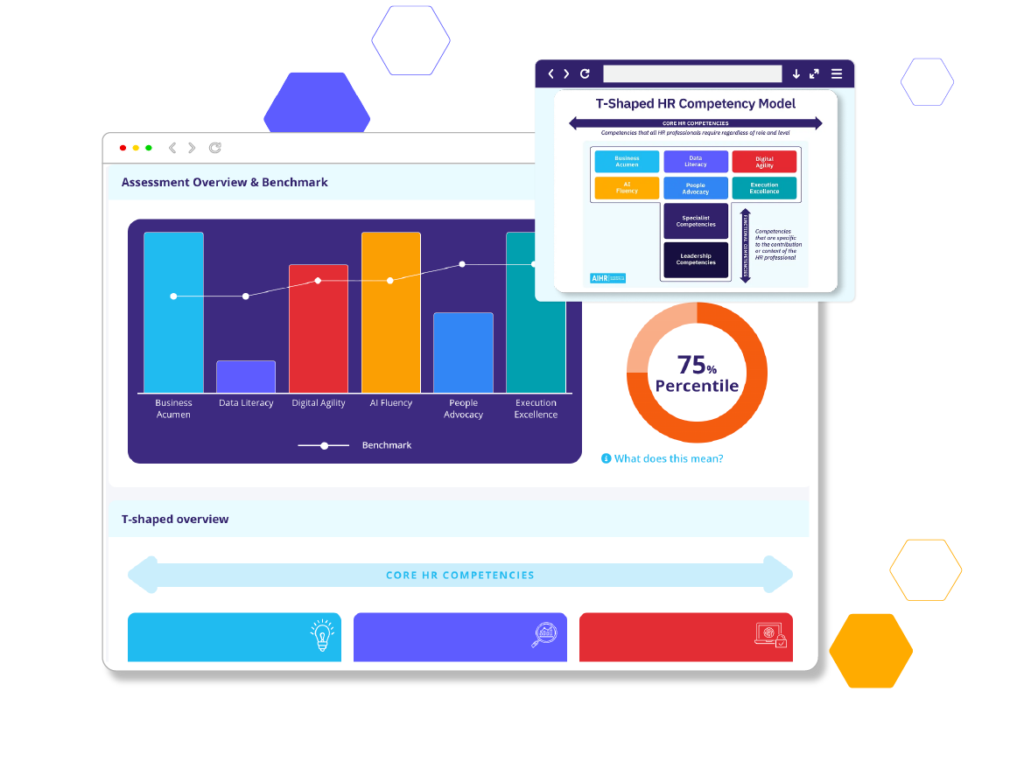
Whether your ‘vertical’ expertise is in L&D or talent acquisition, AI expertise is the capability that will keep your profile relevant across recruitment, performance, and rewards.
To sum up
AI fluency is fast becoming a core HR competency, and the 12 skill types in this article provide the basis for your roadmap to mastery. However, it’s important not to simply treat these as a checklist for your résumé, but to use them as a guide ot help you proactively evolve your role.
By auditing your current AI knowledge and volunteering for pilot programs, you can actively build the high-impact use cases that will define your future career.