

As HR teams support growing and increasingly complex organizations, access to accurate and consistent information becomes harder to maintain. In many businesses, policies, guidance, and workflows are scattered across shared drives, inboxes, and tools, making it difficult for HR teams to respond consistently or at speed. The result is duplicated effort, avoidable errors, and HR capacity tied up in routine queries instead of higher-value work.
To address this issue, BNP Paribas implemented a centralized HR portal featuring a structured knowledge base, self-service capabilities, and case management. This resulted in approximately 50% of employee queries being resolved directly through portal content. This article explores how HR knowledge management can help you achieve similar results, and how best to go about it.
Key takeaways
- Centralizing HR knowledge into a single, structured source cuts repeat work and enables faster support without adding headcount.
- Strong governance (clear ownership, version control, and review cycles) reduces inconsistency, legal and employee relations risk, and keeps policies audit-ready.
- Self-service works best when it’s built for action — showing staff what applies to them, what to do next, and what to expect — so fewer issues escalate to HR.
- Treat HR knowledge management as operational infrastructure: integrate it into daily workflows and measure impact through specific outcomes.
Contents
What is HR knowledge management?
Why is knowledge management important for Human Resources?
10 HR knowledge management best practices to follow
6 best tools for HR knowledge base management
What is HR knowledge management?
HR knowledge management is the structured approach by which HR leaders centralize, govern, and utilize HR information, enabling their teams to apply it consistently as the organization evolves. In practice, it means maintaining a single trusted source for HR policies, processes, workflows, templates, compliance guidance, and institutional knowledge.
This enables HR teams to make sound decisions, reduce rework, and apply standards consistently across departments and locations. Just as importantly, it enables scalable employee self-service, shifting routine questions away from HR and freeing capacity for higher-value work.
For HR leaders, the value goes beyond efficiency. Fragmented knowledge slows execution, causes inconsistencies, and pulls senior HR professionals into avoidable firefighting. Well-designed knowledge management reduces friction, strengthens service quality and compliance, and creates the capacity HR needs to focus on long-term organizational priorities.

Why is knowledge management important for Human Resources?
HR benefits from effective knowledge management in the following ways:
Increased efficiency without adding headcount
When policies, processes, templates, and FAQs are all in one trusted location, HR teams spend less time searching, clarifying, and recreating work. This allows HR to work more consistently, make decisions faster, and respond with confidence.
Additionally, new hires onboard faster, senior HR staff experience fewer interruptions, and managers receive consistent guidance that reduces follow-ups and escalation. Even small time savings across high-volume activities like onboarding, leave, or benefits administration can create meaningful capacity.
Greater consistency and reduced risk
Unclear or inaccessible HR knowledge leads people to rely on interpretation instead of policy when making decisions. This creates inconsistencies across teams and locations, increasing the likelihood of complaints and disputes. A well-governed knowledge base serves as a shared reference point for applying policies, promoting fairness, and enhancing HR’s credibility.
Improved employee experience
Employees need quick, reliable answers to routine questions. Self-service access to accurate guidance on leave, benefits, performance, and policies allows them to find what they need when they need it. Clear information also reduces frustration and lowers inbound HR requests, freeing HR teams to focus on complex, sensitive, or higher-value work.
Better compliance and audit readiness
Centralized, version-controlled information lowers the risk of outdated policies or inconsistent advice. A well-developed knowledge base creates a clear audit trail, showing which policy applies, when the company last updated it, and how to interpret it. For MNCs facing regulatory change or uncertainty, for instance, this improves defensibility and minimizes risk.
Institutional knowledge protection amid change
Undocumented critical knowledge worsens the impact of turnover — in this context, crucial information leaves along with experienced staff who resign, leading to unnecessary delays.
Documenting processes and decision criteria turns individual expertise into organizational capability. New hires ramp up faster, error rates drop, and reliance on a few experts shrinks, making HR more resilient.
Space for HR to be more strategic
Strong HR foundations enable progress on talent and workplace priorities. Clear processes and reliable knowledge systems free HR from avoidable administration.
When routine work is streamlined, senior HR professionals can focus on workforce planning, capability building, and organizational change. This strengthens HR’s role as a strategic partner and increases its impact on business performance.
Enable your team to establish efficient HR knowledge management
Ensuring effective, robust HR knowledge management helps increase employee satisfaction and productivity, and softens the impact of turnover.
With AIHR for Business, your team will learn to:
✅ Align itself and other departments around shared frameworks
✅ Deliver reliable, fool-proof solutions that drive business impact at scale
✅ Adopt best practices and deliver measurable improvements across all HR areas
🎯 Help your team become HR knowledge management experts with accessible upskilling.
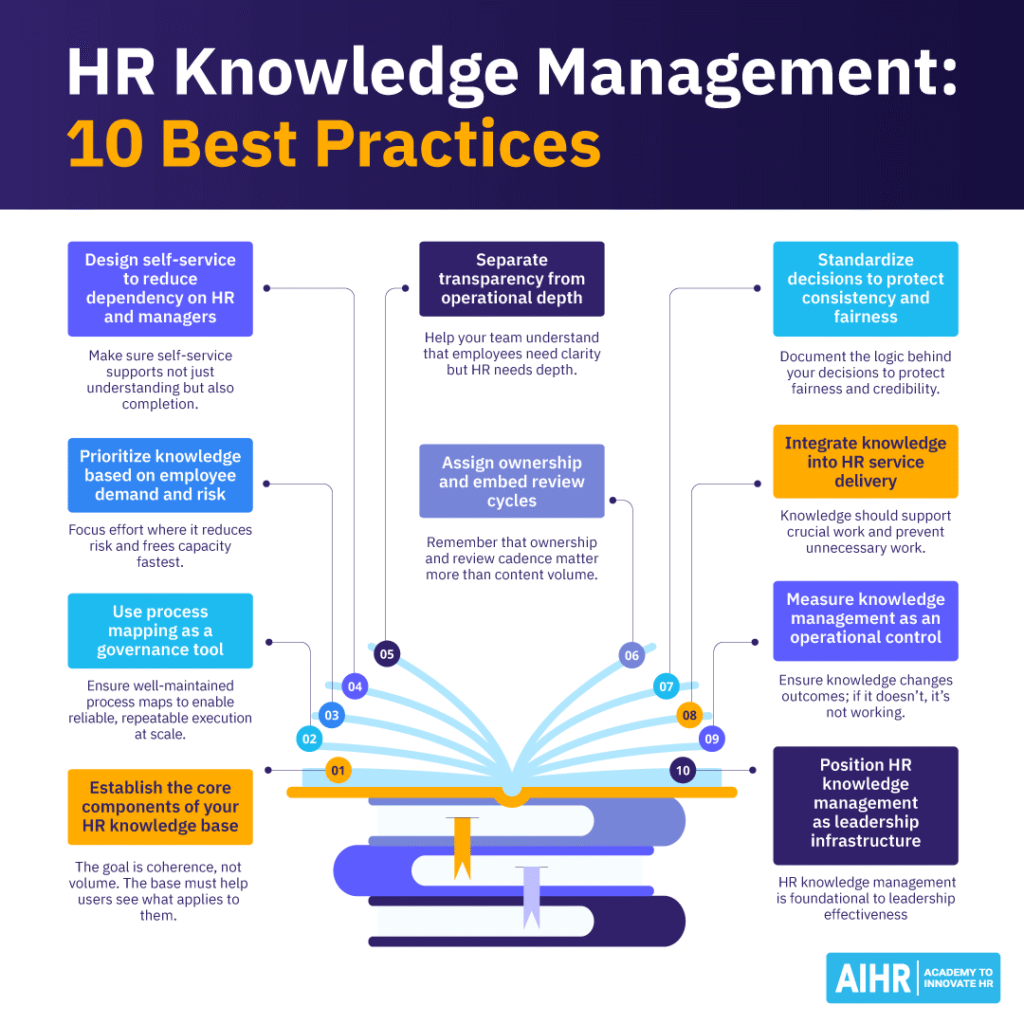
10 HR knowledge management best practices to follow
Follow the 10 best practices below to ensure HR knowledge management that results in greater efficiency, satisfaction, and productivity across your organization:
Establish the core components of your HR knowledge base
A good HR knowledge base brings together HR-critical information in one place, structured around HR work delivery methods and how employees actually seek answers. The goal is coherence, not volume; the base must help users quickly see what applies to them. It should include:
- HR policies and employee handbook content: Core policies (e.g., time off, benefits, code of conduct) should be easily accessible, clearly written, and up-to-date. These are typically the most searched topics among both staff and managers.
- HR processes and workflows: Document key end-to-end processes (e.g., hiring, onboarding, performance reviews, employee relations). Pair policy with step-by-step workflows to clarify what should happen and who owns each step.
- Templates, SOPs, and checklists: Standard templates for onboarding, performance reviews, exit interviews, and case handling reduce variation and expedite execution. They also simplify onboarding and support consistent outcomes.
- HR systems, tools, and data guidance: Provide clear guidance on which system to use, where data lives, and how to complete common tasks. This includes HRIS, payroll, benefits platforms, learning systems, and expense tools.
- HR structure and points of contact: Include an HR org chart, role responsibilities, and escalation paths. This helps employees reach the right person quickly and reduces unnecessary handoffs.
- Employee-facing FAQs and how-to guidance: High-performing knowledge bases answer real employee questions in plain language, with clear next steps. These include questions on topics like benefits, leave, and reimbursements.
Publicly available handbooks from companies like Remote, Basecamp, and Hotjar show how clarity and logical structure drive adoption.
Use process mapping as a governance tool
Process mapping turns HR knowledge management into a control mechanism rather than a documentation exercise. A clear process map shows how work flows, who owns each step, and where risk or delay occurs.
Different processes require different mapping approaches. Swimlane maps, for instance, clarify ownership across roles for onboarding or leave, while decision trees translate complex policies into repeatable decisions.
Process mapping also supports continuity. Documented workflows reduce reliance on individual knowledge, speed up onboarding, and lower error rates in high-risk areas like payroll or compliance. Ensure well-maintained process maps to enable reliable, repeatable execution at scale.
Prioritize knowledge based on employee demand and risk
Not all HR knowledge has equal impact. High-performing teams prioritize content based on employee demand and organizational risk. Repeated queries on benefits, leave, payroll, onboarding, or performance usually indicate unclear or inaccessible information. Addressing these gaps lightens workloads and improves accuracy.
Risk is the second lens. Some topics generate fewer questions but carry higher legal or ER risk (e.g., discipline, grievances, and contract changes). Effective teams address high-volume, high-risk topics first, followed by high-risk, lower-volume areas. It’s essential to focus effort where it reduces risk and frees capacity the most quickly.
Design self-service to reduce dependency on HR and managers
Self-service reduces HR workload when it’s designed for action, not just information. As such, you should make sure self-service supports not just understanding but also completion. Effective self-service answers three questions:
- What applies to me?
- What do I do next?
- What should I expect?
This requires combining policy with execution guidance. For example, expense content should include eligibility, step-by-step instructions, system guidance, timelines, and what happens in case of claim rejection. Good self-service also anticipates confusion and supports managers by reducing the need for interpretation and escalation.
Separate transparency from operational depth
High-maturity HR teams distinguish between employee-facing guidance and internal HR decision logic. Employees need clear, plain-language explanations of how policies work, while HR needs deeper guidance on edge cases, jurisdictional differences, and escalation rules. Mixing these audiences increases confusion and inconsistency.
For example, employees may require a simple explanation of leave eligibility, while HR must use an internal decision tree to handle complex scenarios. As such, it’s important to help your team understand that employees need clarity but HR needs depth.
Assign ownership and embed review cycles
Without clear ownership, knowledge bases degrade quickly. Every major content area should have a specific owner whose expertise matches the content. For instance, ER would own grievance and disciplinary guidance.
At the same time, review cycles must be explicit. You should review some content annually, while system, regulatory, or organisational changes should trigger other updates. This lowers the risk of outdated content and eroded trust. Remember — ownership and review cadence matter more than content volume.
Standardize decisions to protect consistency and fairness
Inconsistent decisions create ER risk that HR knowledge management can reduce by making decision logic explicit. Standardization provides guardrails without removing judgment. For example, performance management guidance would include standard templates, goal-setting frameworks, and calibration guidance.
Document the logic behind your decisions to protect fairness and credibility. Doing so reduces improvisation, limits escalation, and improves defensibility by showing that shared standards guide decisions.
Integrate knowledge into HR service delivery
Knowledge is most effective when it’s readily available at all times. If users must pause their workflow to search for answers, adoption drops, and tickets increase. High-performing teams provide relevant guidance, often resolving issues without HR involvement.
Additionally, internal guidance should be part of case management tools to support consistent handling. This helps knowledge shift from a passive reference to an active operational control. Essentially, knowledge should support crucial work and prevent unnecessary work.
Measure knowledge management as an operational control
Measured knowledge management by outcomes, not activity — usage metrics matter less than behavioural change. Useful indicators include fewer repeat questions, faster onboarding, shorter case resolution times, and lower escalation rates. These show whether knowledge is reducing friction and improving execution.
Search gaps, escalations, and error-prone processes also highlight where content needs strengthening. Ensure knowledge changes outcomes; if it doesn’t, it’s not working.
Position HR knowledge management as a leadership infrastructure
HR knowledge management is foundational to leadership effectiveness. Strong HR knowledge signals professionalism, reliability, and control. It enables consistent decisions, defensibility, and predictable service.
Clear, reliable knowledge allows HR leaders to spend less time firefighting and more time advising on workforce planning, capability building, and organizational change. This way, HR knowledge management can become a leadership infrastructure that supports fairness, compliance, and execution at scale.
6 best tools for HR knowledge base management
Here are six tools you can use to help manage your HR knowledge base efficiently:
1. Confluence
Confluence is a flexible, Wiki-style knowledge platform HR teams use widely to document policies, processes, and internal guidance. It supports structured spaces, templates, version history, and detailed permission settings, making it suitable for separating employee-facing content from internal HR operating knowledge.
2. Tettra
Tettra is a lightweight internal knowledge base designed for Human Resources teams that want fast access to trusted answers. It integrates directly with Slack and Microsoft Teams, allowing HR knowledge to surface clearly in daily workflows. Its simplicity makes it a good fit for HR teams whose main goal is to reduce repeat questions.
3. ApplaudHR
ApplaudHR is an HR service delivery platform that includes knowledge management as part of a broader HR case and document management solution. It’s highly suitable for HR teams that want to combine self-service knowledge, employee requests, and workflow automation in a single system.
4. Notion
Notion offers a flexible workspace that allows HR teams to build interconnected knowledge bases using pages, databases, and templates. It works well for teams looking to combine HR playbooks, process documentation, templates, and planning tools in one place.
5. Guru
Guru focuses on delivering verified knowledge in context. HR teams can assign subject matter experts to review and approve content, helping ensure accuracy over time. This tool helps knowledge surface directly in tools like Slack and Teams, which in turn, supports adoption and trust.
6. SharePoint (Microsoft 365)
SharePoint provides a secure, enterprise-grade platform for managing HR knowledge, especially for organizations already using Microsoft 365. It supports strong access controls, document governance, and integration with Teams and Outlook, making it suitable for larger or highly regulated environments.
To sum up
HR knowledge management is a core capability that shapes how effectively HR can operate, scale, and deliver value across the organization. Centralized, structured, and well-governed HR knowledge reduces friction, improves consistency and compliance, and protects institutional knowledge. Most importantly, it enables HR to deliver reliable service without adding headcount.
For HR leaders, the impact is both operational and strategic. Knowledge management moves HR from reactive, repetitive work to higher-value contribution. It helps HR support the workforce with clarity and confidence, while freeing up senior HR professionals to focus on workforce planning and OD. It also boosts HR’s credibility, making it a strong strategic business partner.