

A talent management strategy template gives HR leaders a practical framework for building the workforce their organization needs for long-term success. The need for a more deliberate approach to talent has never been greater. According to the recent World Economic Forum’s Future of Jobs Report, 63% of employers identify skills gaps as the biggest barrier to business transformation over the next five years.
As organizations navigate AI adoption, changing workforce expectations, and increasing competition for critical capabilities, talent decisions are becoming central to growth, productivity, and resilience.
Yet many organizations still manage recruitment, learning, succession planning, and performance as separate activities. A talent management strategy brings these efforts together under a single workforce vision, helping HR leaders align talent investments with business priorities, build future-ready capabilities, and create a more agile organization. A structured template provides a clear starting point, letting leaders focus on strategic priorities rather than building their approach from scratch.
Contents
What is a talent management strategy?
Why your business needs a talent management strategy
Why use a talent management strategy template
What to include in your talent management strategy template
Sample talent management strategy
Best practices for developing a talent management strategy
Key takeaways
- A talent management strategy connects workforce decisions directly to business objectives, ensuring organizations have the skills and leadership required for future growth.
- A structured talent management strategy template provides a practical framework for aligning recruitment, development, performance, succession planning, and retention around shared talent priorities and business goals.
- The template should summarize the organization’s talent vision, strategic objectives, key initiatives, and success measures across core talent management areas.
- A strong template keeps talent decisions focused, consistent, and easier for leaders to review over time.
What is a talent management strategy?
A talent management strategy is a structured approach to attracting, developing, engaging, deploying, and retaining the people an organization needs to achieve its business objectives. It aligns workforce decisions with organizational priorities, ensuring the right talent is available in the right roles at the right time, while building the capabilities required for future growth.
For HR leaders, a talent management strategy provides a framework for managing the entire employee life cycle, from workforce planning and recruitment through to learning and development, performance management, succession planning, and retention. By connecting talent initiatives to business outcomes, your organization can strengthen leadership pipelines, address critical skills gaps, improve workforce agility, and create a sustainable competitive advantage.

Why your business needs a talent management strategy
Business strategies fail when the workforce can’t execute them. As AI, automation, and scarce skills reshape work, HR leaders need a clear way to connect commercial priorities with workforce capability, leadership readiness, and talent development. A strong talent management strategy helps you address four business-critical issues: skills constraints, strategy execution, hiring risk, and organizational resilience.
Skills are becoming a growth driver
The commercial case for a talent management strategy is already visible. PwC’s recent Global AI Jobs Barometer found that industries most exposed to AI achieved three-times higher growth in revenue per employee, at 27% compared with 9% in industries least exposed to AI. The same report found that workers with AI skills earned an average 56% wage premium, more than double the 25% premium recorded the previous year.
This suggests two things: AI-related skills are linked to stronger productivity gains, and companies are willing to pay a premium for employees who have them. A talent management strategy helps organizations decide which skills to build internally, which to hire for, and how to retain scarce capabilities before they become too expensive to compete for.
Business plans depend on workforce execution
A talent management strategy should translate business priorities into workforce decisions. When leaders set a growth, transformation, or efficiency goal, HR needs to define the roles, skills, structures, and development pathways required to achieve it.
If a bank is investing in AI-enabled customer service, technology implementation isn’t enough. The organization needs workforce planning, role redesign, data governance capability, digital learning, manager readiness, and clear transition plans for people whose work is changing.
If a manufacturer is modernizing operations through automation, it needs technicians, engineers, supervisors, and planners who can work across equipment, data, safety, and process improvement. The strategy only succeeds when the workforce can execute it.
Technology investment needs stronger talent insight
As emerging skills become more important to business performance, organizations need a clearer view of the capabilities they already have and the ones they still need to build or buy. Deloitte’s 2026 Global Human Capital Trends survey found that 95% of executives are concerned about the accuracy of the data gathered on candidates’ skills and capabilities, reflecting growing uncertainty about whether applicants possess the skills employers need.
Similarly, McKinsey’s Superagency in the Workplace report highlights a growing disconnect between AI ambition and workforce readiness. While 92% of organizations plan to increase their AI investments over the next three years, only 1% consider themselves mature in AI deployment. At the same time, 46% of leaders identify workforce skill gaps as a significant barrier to adoption.
The findings suggest that technology investment alone is unlikely to deliver a competitive advantage. Organizations need clearer talent data, stronger workforce planning, and targeted development to turn AI investment into business value.
Capability gaps widen without continuous development
Even when organizations hire for the right skills, new employees may still need time and support to perform at the expected level. Deloitte’s research found that 66% of managers and executives say most recent hires were not fully prepared for the work, with experience identified as the most common gap.
Without a focus on continuous development, those gaps can persist beyond onboarding. Managers spend more time filling knowledge gaps, employees take longer to perform confidently, and teams may struggle to build the capabilities the business needs next.
A strong talent management strategy helps prevent this by connecting onboarding, development, performance, and future capability planning into one continuous system.
Why use a talent management strategy template
A talent management strategy template helps HR leaders move from planning to execution by providing a structured framework that they can consistently apply across the organization. It also creates a single source of truth for talent priorities, making it easier to align stakeholders around a shared direction.
Key benefits of using a talent management strategy template include:
- Creates a concise strategic summary: Provides a clear, high-level view of the organization’s talent priorities, objectives, and initiatives, making the strategy easier to reference, review, and update.
- Supports communication with business leaders: Translates HR priorities into a format that executive teams can quickly understand, helping secure alignment, sponsorship, and investment.
- Aligns talent initiatives with business objectives: Ensures workforce planning, recruitment, learning and development, succession planning, and retention efforts all support broader organizational goals.
- Provides consistency across the organization: Establishes a common framework that business units, HR teams, and leaders can use when making talent-related decisions.
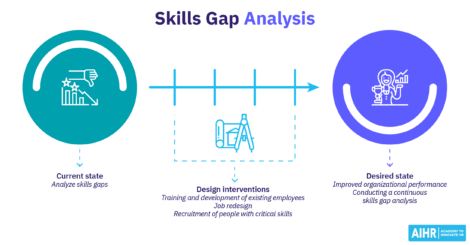
- Identifies capability gaps more effectively: Creates a structured process for assessing current workforce capabilities against future business requirements, enabling targeted interventions.
- Improves workforce planning: Helps organizations anticipate future talent needs, critical roles, succession risks, and emerging skills requirements.
- Supports prioritization and resource allocation: Enables HR leaders to focus investment on the initiatives that will have the greatest impact on organizational performance and future capability.
- Creates accountability for execution: Clearly documents objectives, responsibilities, timelines, and success measures, making progress easier to track and report.
- Accelerates strategy development: Reduces the time required to build a talent management strategy from scratch while ensuring key strategic components are not overlooked.
- Simplifies progress measurement: Makes it easier to monitor outcomes, evaluate effectiveness, and refine talent initiatives as business needs evolve.
- Supports organizational agility: Provides a structured foundation that can be adapted as workforce requirements, market conditions, and business priorities change.
To execute a talent management strategy well, HR teams need the right skills, tools, and shared approach to connect talent decisions to business goals.
AIHR for Business helps your people function build the expertise to:
✅ Align talent management priorities with business needs
✅ Apply practical tools and templates to support HR execution
✅ Develop shared standards across HR roles and teams
✅ Build the skills to turn strategy into measurable outcomes
🎯 Equip your HR team to deliver talent initiatives with greater consistency and impact.
What to include in your talent management strategy template
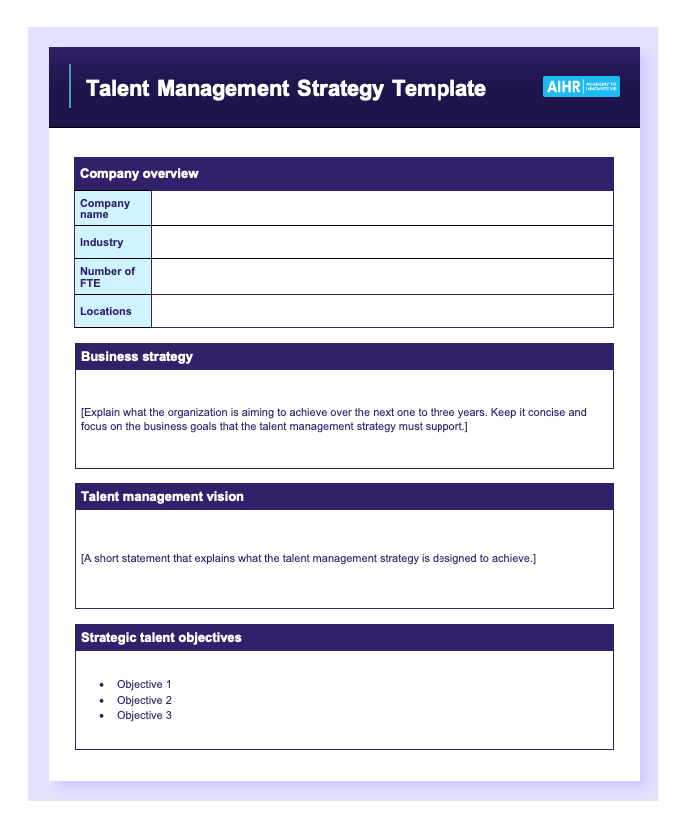
A talent management strategy template should provide a high-level view of how the organization will attract, develop, engage, and retain the talent needed to achieve its business objectives.
A robust template starts by summarizing the company context, business strategy, talent management vision, and strategic talent objectives. From there, it breaks the strategy into six core components based on AIHR’s talent management framework: talent strategy and planning, talent acquisition, employee performance management, training and development, succession planning and talent identification, and total rewards.
Rather than documenting every process or initiative in detail, use each of these to summarize three things:
- Strategic priorities: What the organization needs to focus on
- Key initiatives: What HR and business leaders will do
- Success measures: How leadership will track progress
1. Company overview
This gives the strategy basic context.
You can include:
- Company name
- Industry
- Employee headcount
- Locations
- Business model or operating context, if relevant
2. Business strategy
This explains what the organization is aiming to achieve over the next one to three years. Keep it concise and focus on the business goals that the talent management strategy must support.
3. Talent management vision
This is the short statement that explains what the talent management strategy is designed to achieve.
Example:
Develop the leadership, digital, and customer-facing capabilities needed to support expansion into new markets and improve how teams respond to changing customer needs.
4. Strategic talent objectives
This section turns the vision into a small set of priorities. These should be broad enough to guide the full strategy, but specific enough to shape action.
Here are a few examples of what you could include in this part:
- Build critical skills for future business needs
- Strengthen leadership pipelines
- Improve retention in critical roles
- Increase internal mobility
- Improve performance, engagement, or productivity
- Support workforce readiness for transformation.
Then move into the six areas:
5. Talent strategy and planning
This section establishes the connection between business strategy and workforce strategy. The focus should be on defining where the organization needs to build, buy, borrow, or redeploy talent to support future growth.
6. Talent acquisition
This section outlines how the organization will attract and hire the talent it needs. The emphasis should be on ensuring the organization can secure the capabilities required to execute its strategy.
7. Employee performance management
This section describes how performance and professional development will be aligned with organizational goals. The objective is to create clarity around expectations, performance outcomes, and continuous improvement.
8. Training and development
This section focuses on building the skills and capabilities required for current and future business needs. Pay particular attention to skills that support organizational transformation, digital adoption, innovation, and future workforce readiness.
9. Succession planning and talent identification
This section outlines how the organization will build leadership pipelines and prepare future talent for success. The goal is to reduce leadership risk while ensuring continuity for business-critical roles.
10. Total rewards
This section summarizes the organization’s approach to attracting, motivating, and retaining talent through its employee value proposition.
The focus should be on ensuring rewards support both business performance and employee engagement.
Free talent management strategy template
Use this free Word template to structure your talent management strategy in a clear, leadership-ready format. It helps you summarize your business strategy, talent vision, strategic objectives, key initiatives, and success measures across the core areas of talent management.
Sample talent management strategy
The following example shows what a completed talent management strategy template might look like in practice. While every organization’s priorities will differ, this example demonstrates how HR leaders can summarize key objectives, initiatives, and success measures in a concise strategic document.
Company overview
- Company: Nexus Manufacturing Group
- Industry: Advanced Manufacturing
- Employees: 2,500
- Locations: Five production facilities across North America
Business strategy
Over the next three years, Nexus Manufacturing Group aims to increase automation across its production facilities, expand into two new markets, improve operational efficiency, and strengthen its position as an employer of choice within the manufacturing sector.
To support these goals, the organization requires stronger digital capabilities, a more robust leadership pipeline, improved retention of technical talent, and greater workforce agility.
Talent management vision
Equip Nexus’s workforce to deliver automation-led growth by strengthening digital manufacturing skills, leadership readiness, and retention in critical production roles.
Strategic talent objectives
- Develop the digital and technical capabilities required to support automation and smart manufacturing initiatives.
- Reduce turnover in critical technical and leadership roles.
- Strengthen succession coverage for all business-critical positions.
- Increase internal mobility and career progression opportunities.
- Improve employee engagement and workforce productivity.
1. Talent strategy and planning
Strategic priorities | • Align workforce capabilities with automation and digital transformation goals • Identify future skills requirements across engineering, operations, data analytics, and maintenance • Build workforce plans for expansion into new geographic markets • Improve workforce forecasting capabilities |
Key initiatives | • Conduct annual strategic workforce planning reviews • Develop a company-wide skills framework • Create a critical roles inventory • Implement workforce analytics dashboards |
Success measures | • Skills inventory completed across all business units. • Workforce plans developed for 100% of critical functions. • Critical role coverage identified and monitored quarterly. |
2. Talent acquisition
Strategic priorities | • Attract high-demand technical talent • Strengthen employer brand within manufacturing and engineering communities • Increase diversity across leadership and technical roles • Improve hiring efficiency |
Key initiatives | • Launch targeted engineering graduate program • Expand partnerships with technical colleges and universities • Implement an employee referral program • Improve the candidate experience process |
Success measures | • Reduce average time-to-fill from 62 days to 45 days • Increase quality-of-hire score by 15% • Increase diversity representation in the leadership pipeline by 20% |
3. Employee performance management
Strategic priorities | • Strengthen alignment between individual performance and business goals • Improve manager capability in performance conversations • Build a culture of accountability and continuous improvement |
Key initiatives | • Introduce quarterly performance check-ins • Train all people leaders in coaching and feedback skills • Align performance goals to strategic business priorities • Refresh recognition program |
Success measures | • 95% completion rate for quarterly performance conversations • Improve manager effectiveness scores by 10% • Increase employee understanding of performance expectations |
4. Training and development
Strategic priorities | • Build digital manufacturing capabilities • Strengthen leadership capability at all levels • Accelerate internal career development • Support future skills requirements |
Key initiatives | • Launch Digital Manufacturing Academy • Create leadership development pathways for supervisors and managers • Introduce a mentorship program for high-potential employees • Implement personalized learning plans |
Success measures | • 80% participation in critical capability programs • Increase internal promotion rate from 32% to 45% • Improve learning application scores by 20% |
5. Succession planning and talent identification
Strategic priorities | • Build leadership bench strength • Reduce succession risk in critical positions • Identify and develop future leaders earlier |
Key initiatives | • Conduct annual talent reviews • Establish high-potential talent program • Create succession plans for all executive and senior leadership roles • Introduce stretch assignments and cross-functional projects |
Success measures | • Succession plans in place for 100% of critical roles • At least two identified successors for all executive positions • Increase internal leadership appointments from 55% to 75% |
6. Total rewards
Strategic priorities | • Improve retention of critical talent • Strengthen employee value proposition • Enhance employee wellbeing and engagement |
Key initiatives | • Review compensation competitiveness annually • Introduce skills-based recognition awards • Expand wellbeing benefits • Launch career growth and recognition program |
Success measures | • Reduce voluntary turnover from 18% to 12% • Improve employee engagement score by 10% • Increase retention of high-performing employees to 95% |
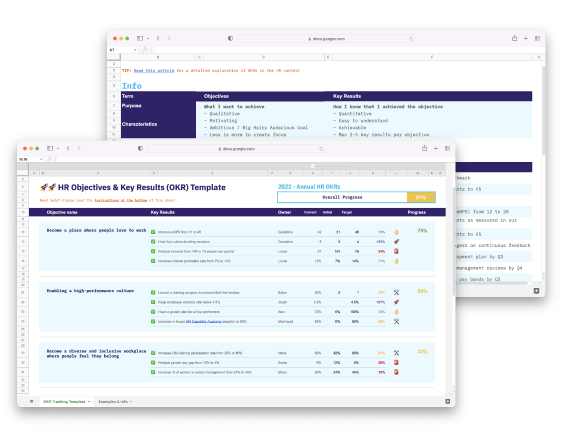
Need a clearer way to track progress against your talent strategy? Download AIHR’s HR OKR Tracker Template to connect talent objectives to key results, owners, targets, and monthly progress updates.
Best practices for developing a talent management strategy
An effective talent management strategy creates alignment between what the business wants to achieve and the people, skills, and leadership needed to achieve it. These best practices can help HR leaders build a talent management strategy that delivers measurable business value.
1. Align talent management strategy with business strategy
Talent management should begin with the organization’s strategic priorities rather than existing HR programs. Many financial services organizations, for example, have redesigned workforce plans around digital transformation initiatives. Rather than focusing solely on recruitment, they have invested in data literacy, digital capability development, and leadership readiness to support large-scale technology adoption from within the organization.
Do this: Meet with executive leaders and identify the three to five business priorities expected to have the greatest impact over the next three years. Then define the critical roles, skills, and leadership capabilities required to deliver them.
2. Build around skills, not just jobs
As AI and automation reshape work, organizations increasingly need visibility into capabilities rather than simply headcount. Future-forward businesses now maintain skills inventories that let them identify capability gaps, redeploy talent internally, and target learning investments more effectively.
Do this: Select one critical business function and conduct a skills assessment. Compare current capabilities against anticipated future requirements and identify the most significant gaps requiring investment.
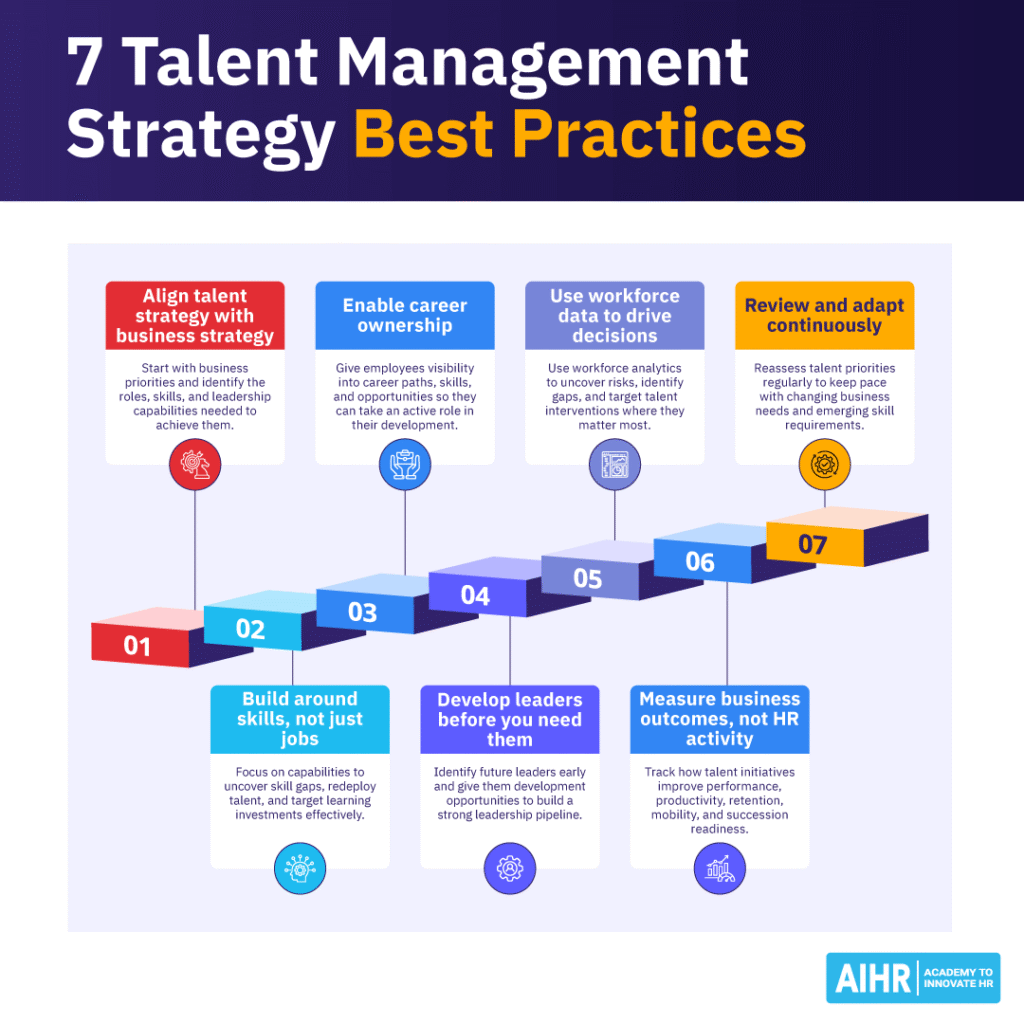
3. Enable career ownership
Employees are more likely to build relevant skills and pursue internal opportunities when they understand what future roles require. Career ownership gives employees clearer visibility into growth paths, skill expectations, and the steps they can take to progress within the organization.
Do this: Review your current career paths, role profiles, and internal job postings. Identify where employees lack clarity on required skills, progression criteria, or available opportunities. Create a plan to improve visibility through career frameworks, skills profiles, manager conversations, and internal mobility resources.
4. Develop leaders before you need them
Organizations that consistently build leadership pipelines experience less disruption during transitions and are better positioned to sustain performance during periods of change.
Use talent reviews to identify high-potential employees early, allowing enough time for development, coaching, and stretch assignments. This helps reduce disruption during leadership transitions and supports performance during periods of change.
Do this: Identify the ten most business-critical leadership roles in the organization and assess whether at least one ready-now or ready-soon successor has been identified for each position.
5. Use workforce data to drive decisions
Workforce analytics can reveal patterns that would otherwise remain hidden, including turnover risks, leadership gaps, hiring challenges, and capability shortages. For example, a manufacturing organization experiencing high turnover among frontline supervisors may discover that leadership capability, onboarding quality, and workload management are contributing factors. With these data-backed insights, they can target interventions more precisely.
Do this: Select three workforce metrics that have a direct impact on business performance, like voluntary turnover, productivity, or quality of hire. Review trends quarterly and use the findings to adjust talent priorities.
6. Measure business outcomes, not HR activity
Many organizations track talent management activity but struggle to demonstrate business impact. Business leaders want to understand whether talent investments are helping the organization execute strategy more effectively. Metrics should therefore connect talent initiatives to organizational performance wherever possible.
For example, instead of reporting only learning completion rates, organizations can measure how capability development has improved productivity, reduced turnover, increased internal mobility, or accelerated succession readiness.
Do this: Review every talent metric currently reported to leadership and ask whether it demonstrates business impact. Prioritize measures that show how talent initiatives contribute to organizational performance, growth, or risk reduction.
7. Review and adapt continuously
Organizations that revisit their talent strategy on a regular basis are better positioned to respond to emerging skills needs, leadership requirements, and competitive pressures. This is particularly important as AI continues to change roles and create new capability requirements across industries.
The objective is not to create a static strategy document, but to establish a strategic framework that can adapt as the organization evolves.
Do this: Schedule an annual talent strategy review involving HR, business leaders, and executive stakeholders. Evaluate progress against objectives, reassess future capability requirements, and update priorities for the year ahead.
A final word
A talent management strategy template is no longer simply an HR document. It’s a business tool that helps organizations translate strategy into workforce capability. A well-designed template provides the structure to make important workforce decisions consistently and strategically.
By aligning talent priorities with business objectives, identifying future capability needs, and creating accountability for execution, HR leaders can build a workforce that is more agile, resilient, and prepared for change. The organizations that invest in talent as deliberately as they invest in technology, operations, or growth initiatives will be best positioned to create sustainable competitive advantage in the years ahead.