
In brief
- The traditional L&D model is misaligned with how work, skills, and people actually function today. It’s optimized for delivering content, while capabilities are now built into the flow of fast-changing work.
- Four structural realities are reshaping L&D: content abundance without impact, accelerating skill decay, the rise of work as the primary learning environment, and learners who have already moved on from the old model.
- The response is not a new platform or better courses. It is a different operating logic: a shift from learning delivery to capability design.
- Five practices define what that looks like in action: learning in the flow of work, personalization at scale, skills intelligence, designing for disruption, and continuous learning culture.
The environment in which Learning and Development departments operate has undeniably shifted. AI adoption, sustained pressure on productivity, and faster cycles of change are redefining how work gets done. As a result, the way people build skills and capabilities is changing just as quickly.
Skills that were in demand two years ago are becoming obsolete. Employees are developing their most important capabilities not inside the LMS, but through their work, their networks, and the tools they reach for when no one is watching. And the business is increasingly impatient with learning that can’t demonstrate its contribution to anything that matters.
This article explores the changes reshaping L&D and outlines the next practices HR and L&D leaders should adopt to align development with how work happens today.

The realities L&D leaders need to confront now
Most L&D practitioners have already felt the shift in their organizations. The symptoms are familiar: L&D gets invited into conversations after the leadership has already made decisions. The learning catalog keeps growing, but business leaders still say L&D isn’t strategic. Employees quietly confess they learn more from a ten-minute conversation with a colleague or a quick AI query than from the programs L&D spent months designing.
These symptoms point to four realities that organizations must address to ensure learning aligns with how business and employees actually operate.
1. More content is not translating into more capability
Organizations have never had access to more learning content. AI has accelerated that abundance to an almost absurd degree: any team with a prompt and a platform can produce modules, pathways, and resources faster than they can ever be consumed.
And yet, skill gaps are widening. The disconnect is staggering: 86% of companies lack “talent velocity”, the ability to see, build, and mobilize skills in real time. The volume of content is not the problem; the absence of intelligence about which content reaches the right person at the right moment is.
Measuring content production or catalog size is the wrong thing to do. The true challenge is not supply, but precision: connecting learning to the moment of need, the specific gap, the individual’s context. L&D functions that haven’t made this shift are managing a library that fewer and fewer people are visiting.
What this means for L&D: Producing more content is no longer a meaningful differentiator. The focus must shift to ensuring learning is relevant, timely, and directly applicable.
2. Skills are evolving faster than structured learning can respond
In fast-moving sectors, technical skills become outdated within 3 years. Sometimes faster. Employers now expect 39% of core skills to change by 2030, reflecting the rapid evolution of capability requirements. At the same time, AI is already reshaping work: 71% of organizations report that AI has changed job roles and required skills, and 82% expect further disruption in the next three years. The half-life of knowledge is shortening across almost every domain.
L&D programs designed around stable role profiles are structurally behind before they launch. By the time the department designs, pilots, refines, and deploys a course, the landscape has shifted. While some may frame this as a project management issue, it is fundamentally a question of design philosophy. Learning ecosystems that continuously evolve will outperform programs that don’t.
What this means for L&D: Development approaches need to be more flexible, allowing learning to adapt continuously as skill requirements evolve.
3. Learning is happening in work, not outside it
Most meaningful capability development happens through experience, challenge, feedback, and peer learning, not formal programs. Yet most L&D investment still concentrates on the small fraction of learning that happens in structured settings.
The leverage point is not better content. It’s shaping the conditions under which people grow through their work: stretch assignments, structured reflection, feedback loops, and communities where knowledge flows. L&D’s greatest opportunity is in finally building the infrastructure to support it.
What this means for L&D: The greatest opportunity lies in shaping how work itself supports learning, rather than expanding standalone learning offerings.
4. Employees are learning independently of L&D
People now arrive at work with years of experience navigating personalized, on-demand, algorithmically curated content in every other part of their lives. They stream what they want, when they want, in the order they want. The expectation of relevance, timeliness, and agency has crossed over into the workplace, and generic programs feel increasingly jarring against that backdrop.
Self-directed learning already happens across the organization. L&D needs to understand where it happens, support it, and turn it into measurable capability growth. Employees are learning from colleagues, AI tools, YouTube, and communities of practice that exist entirely outside anything L&D has sanctioned or measured. The learner has moved on; however, the function hasn’t always followed.
What this means for L&D: The function needs to shift from directing learning to supporting and enabling it within a broader ecosystem.
Rethinking the foundations of L&D
These shifts point to a deeper issue: L&D is still largely organized around delivering learning, while capability is built through work. Addressing this requires a change in how L&D is structured and how it creates value.
Moving from delivery to capability enablement
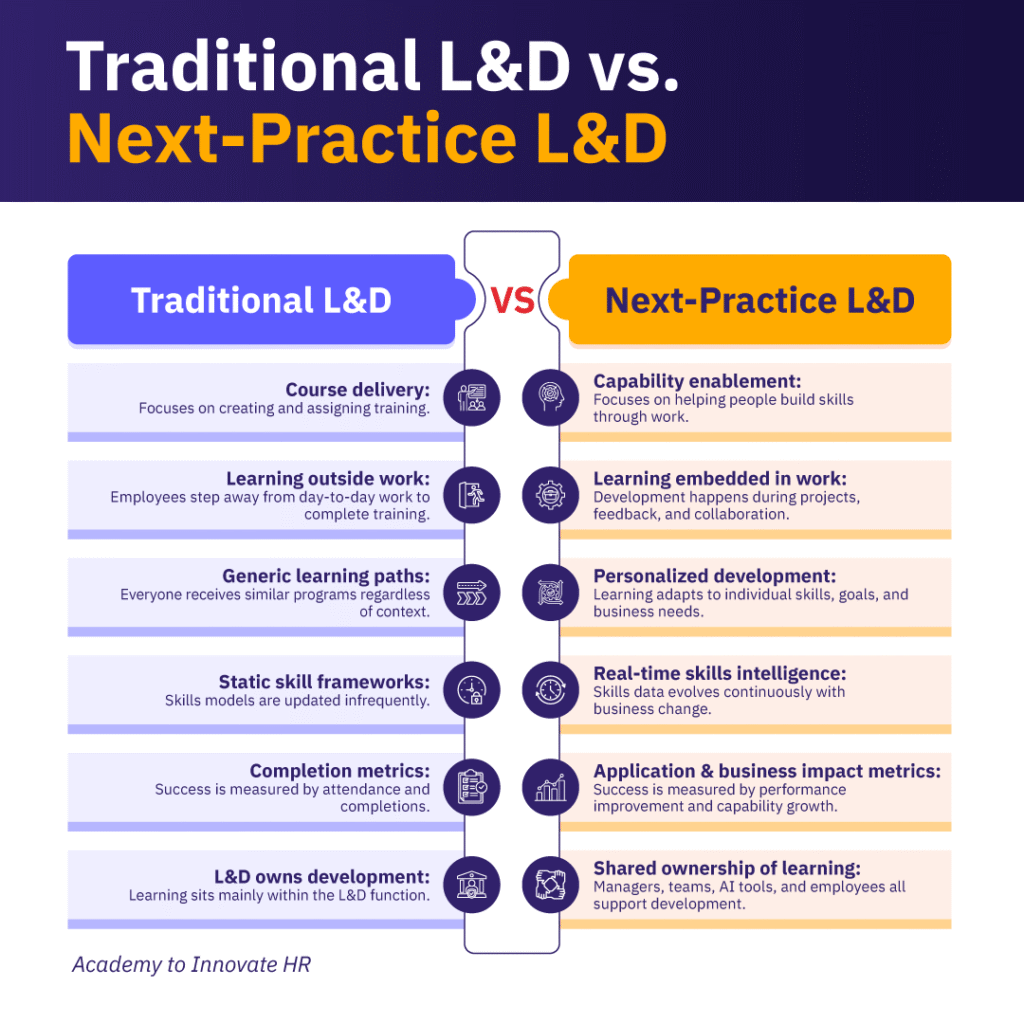
Traditional L&D models focus on programs, content, and participation. Teams often measure success by what they deliver and what employees complete.
This changes what L&D prioritizes:
- Moving away from content as the primary output and toward shaping how capability is built
- Focusing on how development connects to real work, decisions, and performance
- Measuring impact through application and outcomes, not participation or completion.
For HR and L&D leaders, this represents a shift in mandate. L&D becomes less about delivering solutions and more about influencing how the organization develops capability at scale through work design, manager enablement, and integration with business priorities.
From structured learning to continuous development
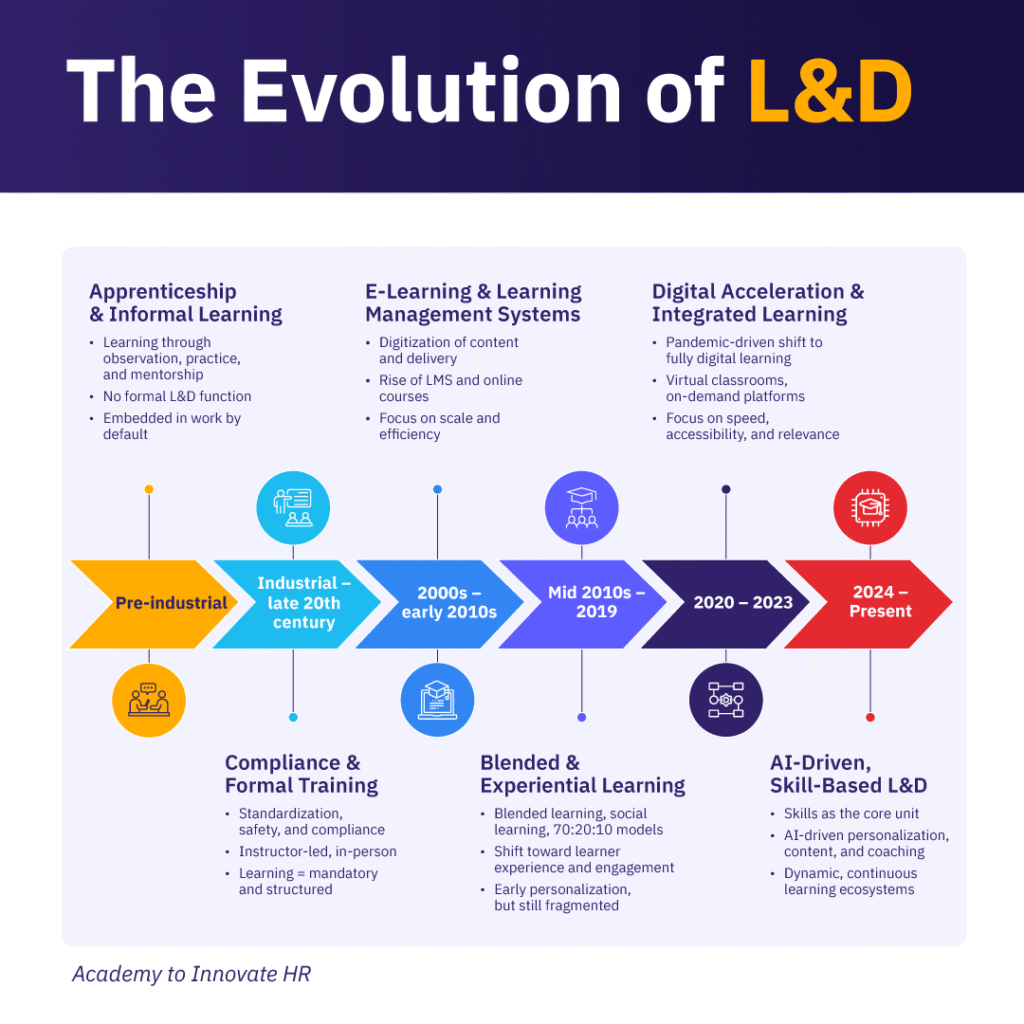
Many organizations still organize learning into events: courses, programs, and scheduled interventions that sit outside of day-to-day work. In practice, capability develops continuously. It is shaped through ongoing problem-solving, feedback, collaboration, and exposure to new challenges.
Next-practice L&D aligns with this reality by supporting development as an ongoing process rather than a series of discrete activities. Learning is embedded into workflows and supported by real-time inputs through tools, data, feedback, and access to expertise.
For HR and L&D, this means rethinking how development is triggered and sustained. Instead of relying on periodic programs, they need learning mechanisms that help employees build, apply, and refine skills in the flow of work.
From a functional focus to shared ownership
Capability building cannot be confined to L&D or HR alone. While these functions play a critical role, they don’t control the primary drivers of development.
Managers shape learning through how they assign work, give feedback, and support growth. Teams influence how knowledge is shared and applied. Technology, particularly AI, increasingly supports real-time learning.
Next-practice L&D recognizes this and shifts from ownership to enablement, creating the conditions that allow others to develop capability effectively.
This requires closer integration across HR, the business, and technology functions. It also requires clearer accountability within the business for developing talent, rather than positioning L&D as solely responsible.
L&D next practices in action
Organizations that respond well to these shifts focus on changing how development happens, not expanding the program catalog.
Five practices consistently support this transition.
1. Embedding learning into everyday work
The idea that learning happens through work is well established. What has changed is the ability to act on it. AI-powered tools and embedded knowledge systems now make it possible to support learning in the moment, without requiring employees to step out of their workflow or navigate separate platforms.
This shifts the focus from program design to ecosystem design. L&D’s role becomes one of curating, connecting, and embedding learning into the work itself, rather than continuously creating new content.
It also changes how development is enabled. Managers play a central role by structuring work to include stretch, challenge, and reflection as part of normal operations, not as separate initiatives.
And it changes how the L&D function measures impact: moving from completion to what people do differently as a result. In many cases, the most effective intervention is not a course, but a well-designed moment within the work.
→ Practical guidance: Identify a critical skills gap and map where it shows up in day-to-day work. Introduce small interventions at those points, like prompts, reflection questions, or peer conversations, and track what changes in practice over time.
2. Personalization at scale
Personalization in learning and development is not new. What is new is the ability to deliver it meaningfully at scale.
Earlier approaches often resulted in slightly varied learning paths that still felt generic. Today, organizations can use data such as skills profiles, performance signals, and career goals to tailor development in ways that reflect individual context.
This shifts L&D from assigning learning to enabling access. Instead of directing employees through predefined pathways, organizations create environments where individuals can find relevant opportunities through projects, mentors, communities, and targeted resources.
It also requires designing for progression. Development is not just about what someone needs now, but what they can build next based on adjacent skills and future roles.
→ Practical guidance: Review a widely used learning program and compare it against the actual needs of a sample of participants. Use the gaps to redesign how you target and deliver development.
3. Using skills insight to guide decisions
Most L&D functions still design training around roles. Next-practice L&D designs around skills.
This requires visibility into which skills matter now, which are emerging, and which are declining in relevance. Without this, learning investments are often based on outdated priorities.
Future-ready skills intelligence replaces comprehensive, static frameworks with a focused, usable view of the skills the business needs now that can also evolve as priorities shift.
This insight also needs to be actionable. Skills data should inform decisions across workforce planning, learning investment, and internal mobility, not sit within a single system.
AI can play a role here by identifying patterns across job postings, project work, and performance data, helping organizations detect shifts earlier.
→ Practical guidance: Engage business leaders to identify the capabilities they expect to need in the near future, and compare these against current development efforts. Use the gaps to redirect focus.
4. Designing for disruption
AI and automation already shape how many roles operate. L&D now needs to build AI into capability development, from skills planning to on-the-job learning, instead of separating it into standalone training.
Designing for disruption involves embedding AI and digital fluency into skill pathways, while also developing the judgment required to use these tools effectively. Knowing how to use AI is only part of the equation; knowing when to rely on it and when to challenge it is equally important.
Creating space for experimentation is critical. Teams need opportunities to test tools, understand limitations, and build practical experience.
This also has implications for L&D itself. There is a credibility gap when teams design AI-related development without using these tools in their own work. Internal capability gives L&D the foundation to keep pace with changing business needs.
→ Practical guidance: Establish regular, low-stakes opportunities for teams to experiment with AI tools on real problems, and capture insights to inform broader development approaches.
5. Reinforcing learning through culture and leadership
Programs can support learning, but culture is what helps it scale.
What leaders prioritize, what managers reinforce, and what organizations recognize all shape whether learning happens in practice.
Managers, in particular, remain a key constraint. They influence how work is assigned, how feedback is given, and whether development is supported or deprioritized.
L&D’s role is less about delivering content and more about shaping these conditions: making learning visible, normalizing reflection, and ensuring that growth is recognized alongside performance.
This also includes enabling peer-to-peer learning. In many organizations, the most valuable knowledge flows informally across teams, rather than through formal channels.
→ Practical guidance: Identify teams where learning is already strong and examine the behaviors that enable it. Use these insights to inform leadership expectations and management practices across the organization.
A practical decision-making framework for HR leaders
Moving to L&D next practices is not a one-time shift. It is a series of decisions about where to invest, what to prioritize, and how to build capability across the organization.
Without a clear structure, those decisions tend to default to what is familiar: more programs, more content, and incremental changes.
This framework provides a simple way to guide those choices. You can use it to assess current efforts or to shape new initiatives.
Context: Where does learning actually happen?

- Is learning happening where work actually happens?
- How much development is driven by real work versus formal programs?
Together, these questions reveal whether L&D supports capability building in the flow of work or stays too close to formal program design.

- Whether to shift investment from classroom programs toward on-the-job learning or embedded support
- How to rebalance L&D spend between formal and informal learning
Relevance: Are we targeting the right need, at the right moment?
- Are we connecting the right learning to the right person at the right time?
- Does learning adapt to where individuals already are?
These questions test whether learning is targeted enough to influence performance, rather than broadly distributed.
-
Whether to move from cohort-based programs to needs-based interventions
-
When to trigger learning and how to personalize development pathways
Capability: Are we focusing on what matters most?
- Are we building the capabilities the business actually needs next?
- Which skills will matter most in the next 6–12 months?
These questions force prioritization and help avoid spreading resources too thinly.
- Which capability gaps to address first
- Whether to invest in building capability internally or sourcing externally
Flow: Can people apply and develop skills through work?
- Do people have the space and support to learn as part of their everyday work?
- How easily can they apply and develop skills across teams, projects, or roles?
These questions highlight whether the work environment enables or blocks development.
-
Whether workflows, manager support, or time allocation need to be redesigned
-
How to enable mobility, stretch assignments, and cross-functional learning
Adaptability: Can L&D keep pace with change?
- Can our learning approach evolve as fast as business needs change?
- Are we using data and AI to continuously adjust priorities?
These questions assess whether L&D is flexible enough to respond to shifting skill demands.
-
Whether workflows, manager support, or time allocation need to be redesigned
-
How to enable mobility, stretch assignments, and cross-functional learning
Use these questions to:
- Review existing programs and investments
- Pressure-test new initiatives before committing resources
- Align L&D priorities with business needs.
Applied consistently, this framework helps HR leaders move from delivering learning to enabling capability, ensuring development is relevant, applied, and aligned with how work actually happens.
The opportunity
The real pressure on L&D is to stay relevant to the business, not simply deliver training better.
Organizations that continue to invest in learning models disconnected from how work happens will struggle to build the capabilities they need, regardless of how much content they produce.
For HR and L&D leaders, this is a defining moment. L&D can remain a function that supports the business at the margins, or it can become central to how the organization builds, deploys, and evolves capability.
New platforms and programs won’t drive this shift on their own. It depends on different choices about where learning happens, how L&D enables it, and what outcomes the business expects.
The starting point is straightforward: stop asking what learning to deliver, and start deciding how to build capability where work actually happens.