Evidence-based decision-making is widely regarded as best practice across industries, yet many organizations still struggle to implement it effectively. Despite the growing number of tools available to collect, analyze, and turn workforce data into insights, 83% of companies worldwide surveyed by Deloitte report low workforce analytics maturity.
Organizations with higher maturity levels use more advanced analytics practices to drive measurable business results. So what are they doing differently, and where is workforce analytics headed next? To answer that question, let’s take a closer look at the key workforce analytics trends shaping the field.
Contents
What is workforce analytics?
10 workforce analytics trends

What is workforce analytics?
Workforce analytics is the ongoing practice of using workforce data to generate insights that help leaders understand, predict, and improve workforce outcomes. Rather than focusing only on what has already happened, it supports better decision-making by identifying patterns, trends, and relationships that affect performance, productivity, and workforce planning.
Workforce analytics goes beyond basic HR reporting and dashboards. While it may draw on data from HR systems, it also incorporates information from across the organization and applies more advanced analytical techniques, including statistical analysis and, in some cases, AI and machine learning. The goal is not just to describe the workforce, but to anticipate future needs, test assumptions, and inform decisions that contribute to overall organizational success.
10 workforce analytics trends
1. Predictive and prescriptive analytics are becoming the standard in HR
The bottom line: Workforce analytics is moving from explaining past outcomes to shaping future decisions. HR is increasingly expected to help leaders anticipate workforce risks and make informed trade-offs, rather than simply reporting on historical data.
Workforce analytics is moving beyond backward-looking reporting toward forward-looking decision support. Predictive and prescriptive analytics are increasingly being used to inform headcount planning, risk management, and skills decisions.
Predictive analytics helps organizations anticipate what is likely to happen next. For example, organizations can utilize predictive models to forecast turnover, capacity gaps, or skills shortages over the next few years. Prescriptive analytics then builds on those insights by comparing potential responses such as hiring, redeploying talent, or investing in upskilling, and estimating the impact of each option.
As a result, HR’s role is shifting from producing forecasts to supporting decision-making. This means translating workforce scenarios into business-relevant insights by linking them to costs, delivery risks, and growth objectives. When HR, finance, and business leaders work with the same predictive inputs, workforce planning becomes more coordinated, realistic, and responsive to change.
In this context, workforce analytics increasingly functions as an early-warning system, helping leaders identify potential workforce risks sooner and make informed trade-offs before issues escalate.
HR actions to take
- Integrate predictive workforce insights into budgeting and strategic planning cycles
- Prioritize clarity and interpretation over model sophistication alone
- Be transparent about assumptions and limitations to build trust with leadership.
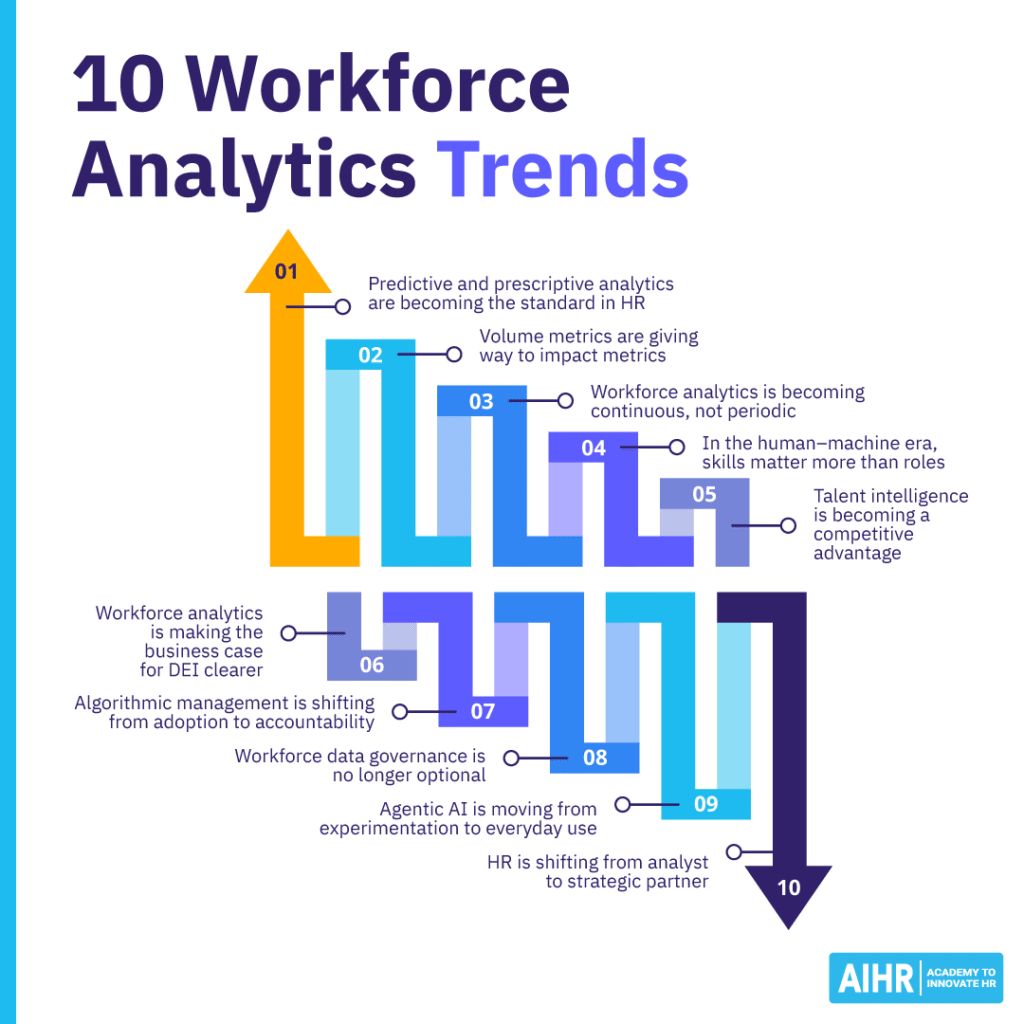
2. Volume metrics are giving way to impact metrics
The bottom line: HR is shifting its focus from reporting activity to measuring impact, using outcome metrics to guide people decisions and show how workforce initiatives contribute to business results.
Traditional HR metrics such as time-to-hire, cost-per-hire, headcount, and turnover rate are no longer sufficient on their own. Organizations are increasingly focusing on outcome-based measures that connect workforce decisions to business performance and help demonstrate return on investment.
Instead of asking how many people were hired or how quickly roles were filled, leaders want to understand whether HR initiatives are improving productivity, retention, customer outcomes, or delivery capability.
For example, an organization might run a quarterly pulse survey asking employees to rate statements such as “I feel my work contributes to the organization’s goals” on a 1–5 scale. The average score becomes an employee engagement index (for example, 4.2 out of 5).
When tracked over time, this outcome metric can be linked to downstream results such as a reduction in voluntary turnover, improvements in productivity, or higher customer satisfaction scores. These connections allow leaders to focus interventions, such as manager coaching or recognition programs, on areas that influence both employee experience and business performance.
Rather than replacing traditional metrics entirely, impact metrics add context and meaning. They help explain why changes in workforce indicators matter and how people-related decisions contribute to organizational outcomes.
HR actions to take
- Identify one or two critical business outcomes your organization prioritizes, such as customer retention, delivery speed, or innovation, and work backward to the workforce factors that influence them
- Reframe HR KPIs to reflect business impact, linking people metrics to outcomes like revenue growth, customer satisfaction, or operational performance.
Case study: Measuring leadership development impact
- The context: A UK-based division of a global conglomerate had launched a new operational leadership development program, but with tighter budgets, HR needed to show it was driving results, not just getting good feedback.
- The action: HR tracked what changed after the program using real outcomes, not just completion rates. They compared participants to a control group and looked at things like performance scores, promotions/internal moves, team eNPS, productivity, and cost-saving contributions.
- The impact: Participants scored 20 to 30% higher on performance, had 25% higher internal mobility, and teams led by participants improved +12 points in eNPS compared to the control group.
3. Workforce analytics is becoming continuous, not periodic
The bottom line: Workforce analytics is shifting from periodic reporting to continuous monitoring, enabling earlier detection of workforce risks and more timely interventions.
Many organizations have already shifted toward outcome-based workforce metrics, and the frequency at which those metrics are reviewed is also changing. Static, monthly, or quarterly reports are giving way to continuous analytics that surface signals in near real time.
This shift is less about adding new metrics and more about shortening the feedback loop. Instead of waiting weeks to assess the impact of a policy change or program rollout, HR teams can track workforce signals as they emerge and respond while adjustments are still possible.
Modern analytics platforms and business intelligence tools make it possible to monitor trends, thresholds, and risk indicators on an ongoing basis. Alerts can be triggered when patterns deviate from expectations, helping HR and business leaders focus attention where it is needed most.
Continuous analytics changes the role of workforce data from retrospective reporting to operational decision support, particularly in areas such as retention, engagement, and capacity management.
HR actions to take
- Define which workforce signals require continuous monitoring versus periodic review
- Set thresholds and alerts for changes that warrant attention or action
- Embed analytics into regular management routines rather than treating reports as standalone outputs.
4. In the human–machine era, skills matter more than roles
The bottom line: Skills-based workforce planning depends on analytics that go beyond job titles, enabling organizations to map individual capabilities, learning potential, and proximity to critical roles.
As a result, organizations are starting to think less in terms of fixed jobs and more in terms of skills. The focus is shifting from questions like “How many developers do we need?” to “Which capabilities do we need, where do gaps exist, and how can we build or source those skills?”
To support this shift, more advanced organizations are investing in dynamic skills inventories and internal talent marketplaces that make it easier to identify, develop, and redeploy talent. This approach enables faster responses to changing business needs and reduces reliance on external hiring. Industry data suggests that many organizations have already begun moving toward a skills-based model, with adoption continuing to grow.
AI is reshaping work, but its impact varies widely by role and task. While some activities can be largely automated, most jobs still require significant human judgment, oversight, or collaboration. Employers increasingly expect to respond to this shift by reskilling their workforce. Many anticipate that a substantial share of employees can be upskilled within their current roles, while others can be redeployed into new ones.
HR actions to take
- Track skills alongside roles, using separate metrics for current performance needs and future capability requirements
- Build skills adjacency models to identify which employees are closest to high-demand or emerging roles.
HR tip
If you want to build hands-on confidence with workforce analytics, check out our HR Dashboard Practice Dataset and Tutorial (Excel). It walks you through building a dashboard from real HR data so you can practice analysis and visualization skills that support trends like predictive modeling and real-time insights.
5. Talent intelligence is becoming a competitive advantage in the global talent market
The bottom line: Talent intelligence gives organizations a clearer, forward-looking view of their current and future workforce, helping them attract, develop, and retain critical skills more effectively in a competitive talent market.
Talent shortages remain a major constraint for organizations worldwide. According to Manpower Group, 74% of employers report difficulty finding the skills they need. At the same time, McKinsey research shows that only 12% of HR leaders engage in strategic workforce planning with a time horizon of three years or more. One reason for this gap is that many HR teams are still underusing advanced analytics and AI-enabled tools.
Talent intelligence addresses this challenge by bringing together data on candidates, employees, freelancers, and the external labor market, and turning it into actionable insight. By combining internal workforce data with external market signals and AI-driven analysis, talent intelligence supports better hiring, development, and workforce planning decisions.
Leading organizations no longer treat talent intelligence as a niche capability used only by recruitment teams. Instead, they embed talent insights into everyday workflows such as applicant tracking systems, HRIS platforms, and performance management tools. This ensures that hiring, mobility, and development decisions are consistently informed by data, not intuition alone.
HR actions to take
- Align workforce planning and talent intelligence with business strategy at the executive and board level
- Build skills taxonomies that connect internal capabilities with external labor market demand
- Secure investment in talent intelligence tools and data capabilities that support long-term planning.
Master workforce analytics to elevate HR’s strategic impact
Build the skills you need to turn workforce data into actionable insights that drive smarter decisions, improve retention, and boost business performance.
🎓 The People Analytics Certificate Program will help you to:
✅ Analyze and visualize workforce trends using Excel and Power BI
✅ Build predictive models to anticipate attrition and skill gaps
✅ Present data-driven recommendations that influence leadership decisions
6. Workforce analytics is making the business case for DEI clearer
The bottom line: Workforce analytics enables HR and DEI teams to demonstrate the impact of inclusion using business-relevant data, strengthening the case for sustained investment and action.
The business case for diversity, equity, and inclusion has been discussed for years, but translating it into concrete decisions has often been challenging. In practice, DEI initiatives can struggle to gain traction when their impact is difficult to measure or link directly to business outcomes.
Workforce analytics helps shift DEI from a values-driven conversation to an evidence-based one. By quantifying representation, tracking progression and pay outcomes, identifying patterns of bias, and linking inclusion metrics to performance indicators, analytics enables organizations to assess what is working and where gaps remain. This data-driven approach gives HR and DEI teams clearer insight into how inclusive practices affect retention, productivity, and internal mobility.
As a result, DEI efforts can be discussed in the same terms leaders use for other strategic priorities, such as risk, investment, and return. Rather than relying on broad commitments alone, organizations can focus on targeted interventions informed by measurable outcomes.
HR actions to take
- Define outcome-focused DEI metrics, such as representation ratios, internal mobility gaps, and pay equity indicators
- Provide leaders with drill-down views of DEI data by department, geography, and job level, supported by alerts when metrics move off track
- Review DEI analytics regularly, communicate progress transparently, and adjust initiatives based on what the data shows.
7. Algorithmic management is shifting from adoption to accountability
The bottom line: As algorithmic management matures, the focus is shifting from whether to use these tools to how they are governed, monitored, and explained.
Organizations are increasingly using software to support or automate managerial tasks such as work allocation, performance evaluation, and candidate screening. In the U.S., 90% of firms use at least one tool to instruct, monitor, or evaluate workers. While these systems are often adopted for efficiency and consistency, they do not automatically eliminate bias.
As algorithmic management becomes more embedded in workforce decisions, questions of accountability are coming to the forefront. If an automated system influences hiring, performance ratings, or career progression, responsibility is not always clear. OECD research shows that 28% of managers lack clarity around accountability for algorithm-driven decisions, and 27% struggle to understand how these tools generate recommendations.
With laws and regulations around data use and automated decision-making still evolving, organizations cannot rely on compliance alone. Weak governance and limited transparency can expose companies to legal, reputational, and employee trust risks.
HR actions to take
- Assess the impact of algorithmic tools before deployment
- Monitor models regularly for bias, performance, and unintended outcomes
- Establish clear governance and ownership for AI-supported decisions.
Did you know?
84% of senior HR executives indicate that they need guidance and direction to ensure the privacy and fairness of new information sources and tools at their disposal.
8. Workforce data governance is no longer optional
The bottom line: Workforce data governance underpins both employee trust and analytics maturity. Clear ownership, consent, transparency, and oversight are essential to using workforce data responsibly.
For workforce analytics to be sustainable, it needs to be legally compliant and trusted by employees. When people understand what data is being collected, why it is used, and how their privacy is protected, trust increases. Strong data protection practices also help organizations reduce legal risk and avoid reputational damage.
Workforce data governance is not a side task for HR. It is a cross-functional effort that requires clear leadership support and shared ownership across HR, IT, legal, and the business. Organizations with higher analytics maturity tend to formalize governance through documented standards, defined responsibilities, and auditable processes, similar to how financial controls are managed.
Rather than slowing innovation, effective governance enables organizations to scale analytics responsibly and with confidence.
HR actions to take
- Map all workforce data sources and classify them by sensitivity and risk
- Apply data protection impact assessments to high-risk analytics use cases
- Define employee rights around data access, correction, and explanations of automated decisions.
9. Agentic AI is moving from experimentation to everyday use
The bottom line: Agentic AI enables HR to anticipate workforce needs and act earlier, with data-driven support embedded directly into everyday processes.
Agentic AI is moving beyond experimentation and into practical, production-ready use across organizations. Unlike traditional AI tools that respond to prompts or queries, agentic systems can act autonomously toward defined goals, execute multi-step workflows, and adjust based on outcomes. This shift is turning AI from a passive support tool into an active participant in decision-making and execution.
In HR, agentic AI is beginning to support more complex, end-to-end processes rather than isolated tasks. Common use cases include simulating workforce scenarios, such as rapid growth or unexpected attrition, and recommending actions related to hiring, redeployment, or upskilling. Some organizations are also using AI agents to enforce policy constraints during automated processes, such as compliance checks or eligibility reviews.
In HR, agentic AI is increasingly used to support end-to-end processes rather than isolated tasks. Common use cases include:
- Simulating workforce “what-if” scenarios, such as rapid growth or sudden talent loss, and recommending actions related to hiring, redeployment, or upskilling
- Acting as policy-aware agents that apply rules and constraints while performing tasks like automated compliance checks
- Monitoring workforce signals and alerting managers when an employee shows signs of disengagement or performance risk.
When paired with clear governance and human oversight, these systems can help HR teams respond faster and more consistently. By automating workflows, learning from outcomes, and embedding guardrails into AI-driven decisions, organizations can move HR away from reactive, transaction-heavy work toward more proactive workforce management.
HR actions to take
- Pilot agentic AI in a single workflow that is repetitive, data-rich, and has clear success criteria, such as interview scheduling or onboarding administration
- Establish clear escalation and review mechanisms so exceptions, overrides, and compliance flags are logged and assessed regularly.
- Build baseline AI fluency in the HR team so people understand how AI works, where it can go wrong, and how to use it responsibly. A practical way to do this is through AIHR’s Artificial Intelligence for HR certificate program, which teaches the key skills HR teams need to apply AI strategically and safely in day-to-day work.
Case study: Agentforce in customer support
- The context: Salesforce rolled out Agentforce on help.salesforce.com, using agentic AI to deliver 24/7 customer support at scale.
- The action: They trained the agent on nearly 740,000 help-portal content items and continuously improved performance by reviewing real conversations, refining guardrails, and setting clear handoffs to human support for specific cases.
- The impact: Salesforce reports Agentforce has handled 500,000+ customer conversations and is resolving 84%+ of questions routed to it, which is a strong signal that agentic AI is running in everyday operations, not a pilot.
10. HR is shifting from analyst to strategic partner
The bottom line: HR is moving from asking “What does the data show?” to “What action should we take, and what is the business impact?” Strong analytics skills are now table stakes, but strategic interpretation is what creates value.
As workforce analytics and AI become embedded in everyday HR work, the role of HR professionals is evolving. Rather than acting primarily as data specialists or report producers, HR is increasingly expected to translate insights into strategic recommendations that inform business decisions.
Workforce analytics now gives HR greater visibility into issues such as organizational design, workforce capacity, and capability gaps. When used effectively, this enables HR to contribute to executive-level discussions by linking workforce scenarios to financial performance, delivery risk, and long-term competitiveness. Doing so requires more than technical analytics skills. It also demands business acumen, stakeholder management, and the ability to communicate insights clearly and persuasively.
As a result, analytics literacy is becoming a baseline expectation across HR roles, while strategic thinking and decision support are becoming the differentiators.
HR actions to take
- Invest in analytics and HR technology that supports decision-making, and assess whether teams have the skills and capacity to use it effectively
- Develop analytics literacy across HR, alongside skills in business understanding, data storytelling, and executive communication.
Next steps
Taken together, these ten trends point to a fundamental shift in how organizations manage and compete through their workforce. Teams that embed evidence-based analytics into workforce decisions are better equipped to plan ahead, respond to change, and align people strategy with business priorities. For HR leaders, the question is no longer whether workforce analytics matters, but how quickly the organization can move from awareness to meaningful, strategic maturity.