
An interview guide keeps your hiring process structured and fair, ensuring you ask all candidates the same core questions, so you can compare them objectively. A good guide ties questions directly to required skills and behaviors, reduces bias, helps interviewers stay on track. It also makes documenting and justifying hiring decisions to stakeholders easier.
This article will look at why you should use an interview guide, what key elements to include in one, how to create one, and what pitfalls to avoid. It also provides a free, customizable interview guide template you can use to streamline your interview process.
Contents
What is an interview guide?
Types of interview guides
The benefits of using an interview guide
The 7 core elements of an interview guide
How to create an interview guide: 7 steps
Free interview guide template
Common mistakes HR makes when using interview guides
FAQ
Key takeaways
- A structured interview guide creates consistency across interviews, reducing bias and helping you compare candidates fairly and objectively.
- Using clear rating scales and scoring rubrics leads to more defensible hiring decisions and less reliance on gut feeling.
- A well-designed guide improves the candidate experience by standardizing communication, setting expectations, and ensuring a professional interview process.
- Interview guides are only effective when treated as living tools that are regularly updated and supported by interviewer training.
What is an interview guide?
An interview guide is a document that enables organizations to structure how they conduct their candidate interviews. It helps interviewers to know what to ask and in what order, and ensures the candidate experience is as good and similar as possible for all applicants to your company.
The contents of the interview guide will differ depending on factors like the role you’re hiring for, the interview method you decide to use, and your specific organizational requirements.

Types of interview guides
Let’s take a look at the different types of interview guides that exist and when to use them. The table below provides a practical overview.
Screening interview guide
- You need to evaluate a large pool of candidates quickly
- Determining whether candidates’ (salary) expectations and qualifications align with the positions they applied for.
Structured behavioral interview guide
- Measuring a candidate’s past experiences and behavior as a predictor for future results and success
- You need a consistent and legally defensible way to evaluate candidates.
Technical/case interview guide
- Assessing a candidate’s technical skills and knowledge in a particular industry
- Candidates need to complete a technical or coding challenge.
Panel interview guide
- Assessing a candidate’s ability to collaborate with various departments
- Hiring for cross-functional, senior or specialized roles.
The benefits of using an interview guide
Using an interview guide during the hiring process has several benefits:
- A structured process: All interviewers following the same steps in the same order creates structure. This reduces the chances of people forgetting to ask candidates certain questions or give them critical information.
- Positive interview experience: Negative interactions during interviews cause 36% of candidates to decline job offers. Using an interview guide ensures consistency by having all candidates go through the same process, improving the overall interview and candidate experience.
- Equal assessment and fairer interviews: Using the same interview method and asking candidates the same questions means you can also use the same scoring method to assess them. Clear criteria and rating scales reduce the risk of bias, helping support DEI initiatives.
- Better hiring decisions: Equal assessment and more objective interviews lead to more objective comparisons between candidates, as well as less second-guessing after interviews. This, in turn, results in better, more confident hiring decisions.
- More confidence and credibility: An effective interview guide — in combination with proper interview training — helps interviewers to be better prepared, ask stronger questions, and maintain a professional image in the eyes of candidates and stakeholders.
- Time savings: A structured interview process creates significant time savings — less time is lost in unstructured conversations, note-taking becomes easier, and stakeholders can reach an agreement faster after interviews.
The 7 core elements of an interview guide
Here are the seven elements a good interview guide should have:
1. Invitation and briefing
Ensure all candidates who make it to the interview round get the same invitation, including a briefing on what to expect from the interview, such as:
- How many people they will speak to
- Who will conduct the interview
- How long the interview is likely to last
- The interview format (e.g., virtual or in person)
- The purpose of the interview
- Whether they need to prepare anything beforehand and if so, what it is
- What documents they must provide (if any).
Below is an example of an interview invitation email you can send to candidates:
Subject: [Company Name]: Interview Availability
Dear [Candidate’s First Name],
Thank you for applying to the [Job Title] position at [Company Name]. We’ve reviewed your application carefully and we’re excited to invite you to interview for the role.
Your interview will be conducted [Format] and will be roughly [Interview Duration]. You’ll be speaking with [Interviewer’s Name], our [Interviewer’s Job Title]. The interview will be face-to-face/online, at [Office Address/Meeting Link].
Please use the following link to choose a suitable date and timeslot for the interview: [Link to Appointment Scheduling Page].
Thanks again for your interest in joining the [Company Name] team! We look forward to speaking with you soon.
Warm regards,
[Your Name and Email Signature]
2. Setting the stage
Create the same setting for every candidate to ensure all candidates get the same experience. Use a checklist like the one below:
- Candidate’s résumé
- References (if applicable)
- Work sample (if applicable)
- Interview guide
3. Welcome
Decide what you must mention when welcoming candidates to establish and reinforce the organization’s image to them. You might include:
- Key milestones in the company’s history
- The work environment
- The organizational culture
- The job itself
- The interview process
You can use the following welcome script and customize it to better fit each role:
“Hi, [Candidate’s First Name]; welcome to [Company Name]. I’m [Interviewer Name].
Before we begin, I’ll briefly explain the structure of this interview. We’ll begin with [First Part of Interview], followed by [Second Part of Interview]. Then, we’ll [Third Part of Interview]. The interview will last about [Expected Interview Duration].
Do you have any questions before we start?”
4. Questions to ask
Prepare a standardized set of questions to provide the interviewer with a uniform method of recording information, rating applicants and comparing candidates. You can use the STAR method, for instance:
- Situation: “Can you share an example when you needed to explain a complex idea to someone?”
- Task: “What was your responsibility in making sure they understood the idea?”
- Action: “What actions did you take to simplify the concept or adapt your explanation?”
- Result: “How did the person respond, and what was achieved as a result of your explanation?”
5. Candidate questions
Towards the end of the interview, the interviewer should ask the candidate if they have any questions about the job, company, team, etc. Below are some example candidate questions and how the interviewer can answer them:
“What are the company’s goals, and where is it heading in the next few years?”
- Share the company’s mission, vision and goals
- Explain how the role and the team the candidate will join contribute to the above.
“What kind of development opportunities does the company offer?”
- Mention the different professional development options the company offers employees, and how they can access them.
(For hiring managers) “How would you describe your management style?”
- Be honest about your management style and give some examples
- Let the candidate know they can contact your (former) team members to ask about their experiences with you as their manager.
(For hiring managers) “What would be my first project?”
- If you already know what their first project will be, tell them about it
- If not, give some examples of the first projects their predecessors have had
- Be honest about the timeline and when they realistically can expect to start working on their first project.
“What’s the biggest challenge the team is facing right now?”
- Share the team’s biggest challenge and how you’re planning to solve it.
“Why did my predecessor decide to leave?”
- Provide the main reason(s) their predecessor left.
- If they left on good terms, tell the candidate they can contact them for more information.
6. Wrap-up
Before saying goodbye to a candidate, do the following:
- Thank them for their time
- Tell them what the next steps are (when they can expect to hear from you again and how — by email or phone, etc.)
- Ask them for their references and how to reach those people
- Let them know who they should contact and how to contact them if they have any questions after the interview.
You can use a short closing script like this one:
“That’s it for today, [Candidate’s First Name]. Thank you so much for your time! We’ll inform you via email/phone by [Date]/within [X Days/Weeks] if you’ve made it to the next stage of the selection process, which is [Next Stage of Recruitment Process].
Before you leave, could you please give me/confirm the details of your references and let me know how we can reach out to them?
If you have any questions after this interview, you can contact [Contact Person’s Name] via email/phone at [Contact Person’s Email Address/Phone Number].”
7. Scoring
Once the candidate has left the interview, fill in their scores right away into your interview scorecard. Use the rating scale and scoring method you’ve agreed on with other stakeholders at the beginning of the recruitment process.
One way to score each candidate is to divide the interview questions they answered into different categories, e.g., person-job and person-organization fit. The former aims to determine a candidate’s compatibility with the relevant job requirements, while the latter focuses on a candidate’s compatibility with company culture. Each category’s weight will vary based on organizational requirements.
Build the necessary skills to improve your interview process
Learn to conduct efficient, fair and consistent interviews to provide attract and retain top talent, support hiring managers, and boost your employer brand.
🎓 With AIHR’s Sourcing & Recruitment Certificate Program, you’ll develop the skills to:
✅ Facilitate hiring manager interviews and conduct post-interview debriefing
✅ Apply additional screening techniques in the interviewing stage
✅ Create an employer branding strategy that resonates with your ideal candidates
How to create an interview guide: 7 steps
Let’s take a look at seven steps to create your own interview guide:
Step 1: Clarify the role and success profile
First, determine which position or department benefits from an interview guide the most. For example, if your customer service department is growing rapidly, this could be a good place to start. Then, based on the job description (and, if you have one, the job analysis), define must-have skills, behaviors, and results to clarify the role and draft a success profile.
Step 2: Choose the interview type and format
Decide what kind of interview type and format you’ll use; you can ask hiring managers and employees currently in the role you’re hiring for what they think is best to help you make your decision. The table below gives you an idea of what formats you could use and when to use each one:
Phone interview
Candidates live far away or abroad.
Panel interview
The role requires collaboration with various departments or involves serving multiple internal clients.
Virtual interview
Candidates live far away or abroad.
One-on-one interview
You want to meet the candidate in person, have them see the office or work environment, and spend time with them without distractions.
Group interview
You are hiring more than one person to do the same job (e.g., customer service representatives).
Step 3: Build your question bank
Combine behavioral, situational and role-specific questions to create a bank of interview questions to ask candidates. Before finalizing this question bank, request feedback from the hiring manager and employee(s) currently in the role you’re hiring for, then modify it based on their advice and recommendations.
Step 4: Set up your rating scale and scoring rubric
Once you’ve determined what interview questions to ask, you can decide what behaviorally anchored rating scale (BARS) and scoring rubric you’ll use to indicate each candidate’s performance level. For instance, if you’re assessing a candidate’s ability to take initiative, a BARS using a five-point scale could look like this:
1: Unsatisfactory
2: Needs improvement
3: Meets expectations
4: Exceeds expectations
5: Exceptional
1
Sticks to assigned tasks, waits for direction.
2
Hesitates to act without guidance. Completes assigned tasks but doesn’t go beyond the basics.
3
Shows initiative when prompted, and only on familiar tasks.
4
Acts without needing guidance and regularly identifies areas for improvement.
5
Proposes useful improvements or changes, takes proactive steps, and anticipates needs.
Step 5: Design the interview flow
Outline what your guide will look like, and include the following core elements:
- Interview invitation and briefing
- Interview setting (both online and offline)
- Candidate welcome
- Key questions
- Candidate questions
- Wrap-up
- Scoring
Additionally, include a suggested timing for each element in your interview guide.
Step 6: Add rules and guardrails
Include a short, handy list of interview dos and don’ts for the interviewers that covers the following:
Interview dos
- Prepare for the interview (read the candidate’s résumé, check their profile and references, etc.)
- Read the interview guide
- Write things down
- Allow the candidate to ask questions.
Interview don’ts
- Don’t be late for the interview
- Don’t oversell the role or the company; be honest
- Don’t make biased or quick judgments.
Step 7: Test and improve your guide
In addition to consulting with hiring managers and current employees while creating the interview guide, be sure to share the completed guide with them and ask for their honest feedback. Then, update your guide accordingly, and keep doing so on a regular basis in the future.
Free interview guide template
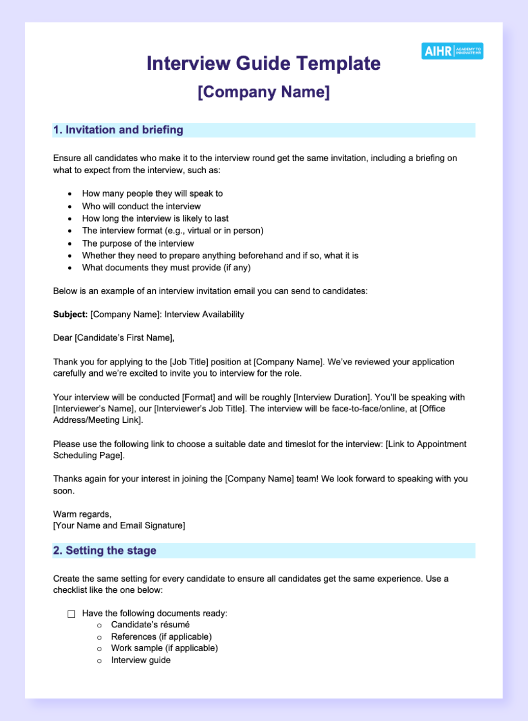
AIHR has created an interview guide template you can download for free and customize to suit each job’s requirements, as well as your organization’s needs. Use it to help standardize your interview and talent assessment processes, minimize bias, and make informed hiring decisions.
Common mistakes HR makes when using interview guides
An interview guide can be a great tool to guide interviewers, especially those who are new to this. However, there are also pitfalls to avoid, such as:
You treat the interview guide as a script
An interview guide should help you structure and conduct your interviews, not function as a script you follow word-for-word. Prepare yourself well for the interview, including follow-up probes. This will allow you to have a conversation with the candidate that isn’t ‘chained’ to the guide. Instead, the guide will be a support tool giving structure, as it’s intended to be.
You don’t update the guide promptly
To prevent your interview guide from becoming outdated, schedule a quick review session with all interviewers after every hiring round. The purpose of doing this is to help you determine whether or not the guide requires any updating to reflect changes to the roles you’re hiring for, your organization’s interview process, or relevant labor laws.
You rely on gut feeling instead of the rating scale
Using a rating scale instead of gut feeling helps you make clearer, more defensible hiring decisions. A scale forces you to assess candidates against specific, job-related criteria rather than personal impressions, minimizing bias and inconsistency. It also makes it easier to compare candidates fairly and accurately, and explain and justify hiring decisions.
You don’t train other interviewers
Having an interview guide is not enough. Not training other interviewers on how to apply it to their interviews can have them appearing unprofessional or unprepared, leaving a bad impression on candidates. Once the guide is ready, organize a briefing for everyone who’ll be using it to give them a chance to familiarize themselves with it and seek clarity on it.
To sum up
A well-designed interview guide helps you move fast, stay consistent, and keep top candidates engaged. By standardizing questions and using clear rating scales, you can reduce bias and give every candidate a fair shot. This not only improves hiring quality, it also strengthens your employer brand and builds confidence with hiring managers.
To get the most out of your guide, treat it as a living tool. Train interviewers on how to use it, keep it updated after each hiring round, and use structured scorecards to document outcomes. With a practical template, you can immediately bring more structure to your interviews, improve the candidate experience, and protect your organization from costly hiring mistakes.
FAQ
An interview guide is a document that enables organizations to structure the way they conduct their candidate interviews. It helps interviewers know what to ask and in what order, and ensures a consistent candidate experience for all applicants.
The main benefits of using an interview guide are a structured interview process, all applicants getting the same candidate experience, a more consistent candidate assessment process, and minimized risk of bias in the interview process.
An interview guide should include sections for the interview invitation, setting the stage for the interview, welcoming the candidate, the questions you’ll ask them, candidate questions, the end of the interview, and candidate scoring.