
Whether you’re just starting out in HR or already have years of experience, a clear HR career path transforms your skills and interests into purposeful growth. Even though 41% of HR professionals have considered leaving the field altogether, most have found a reason to stay. This demonstrates the long-term appeal and potential of an impactful HR career.
This article discusses what building an HR career involves, the various types of career paths you can pursue, and three HR career progression examples to help inspire you.
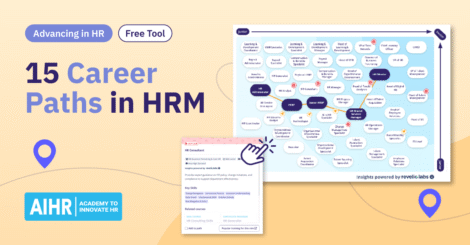
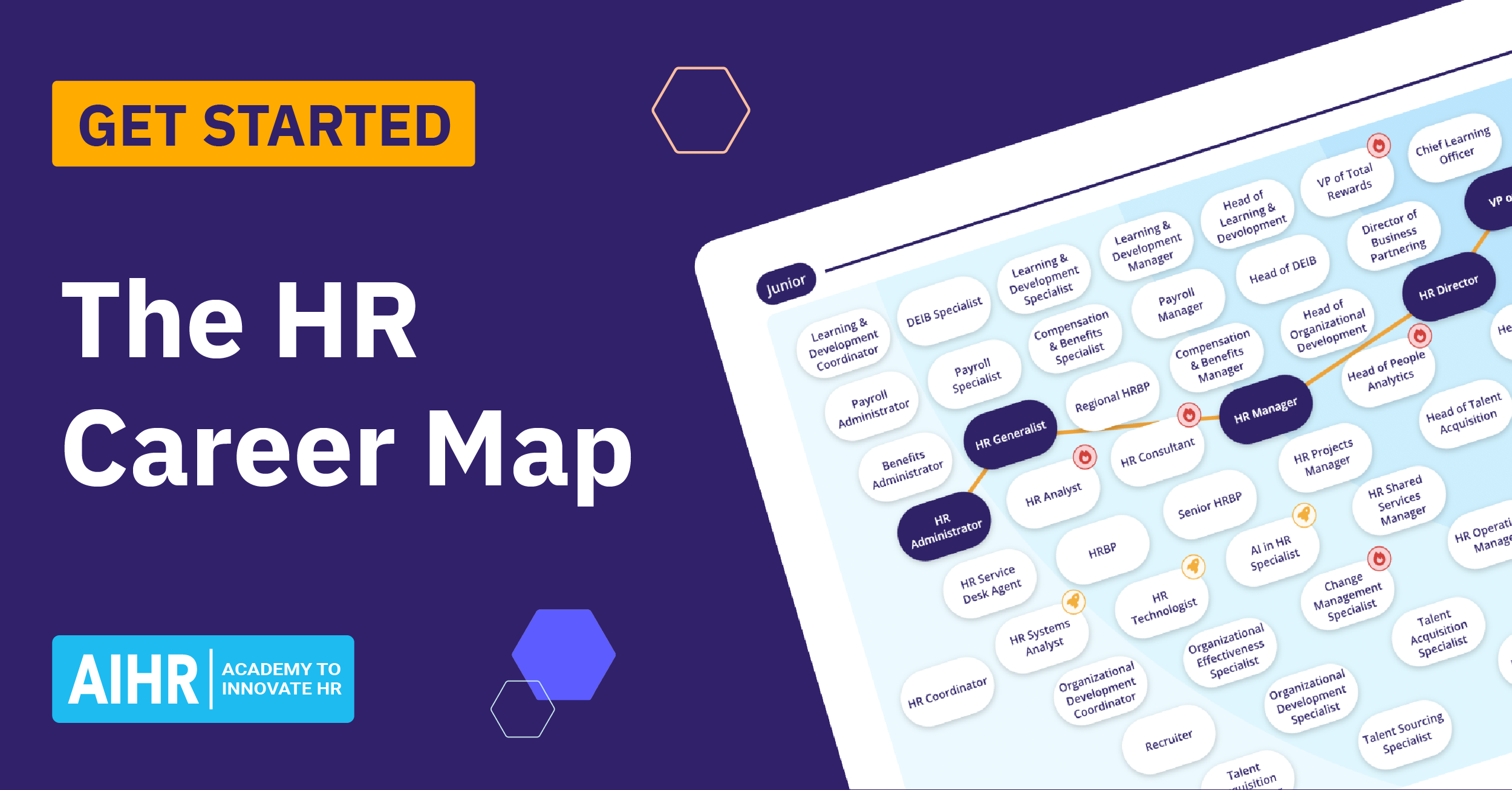
Want to picture what your own career path in HR could look like? Don’t hesitate to explore AIHR’s free HR Career Map tool!
Contents
The modern career path for HR
How to start a career in HR
Understanding HR career progression
Types of HR career paths
HR career path examples from practice
HR job titles by career level
How to choose your HR career path
Key takeaways
- Modern HR careers are strategic and data-driven, demanding business acumen, data literacy, and digital and AI skills beyond traditional HR tasks.
- HR career progression is often built on varied experiences across roles and functions, not a single ladder.
- Types of HR career paths include traditional vertical, specialist domain-driven, across disciplines within HR, in and out of HR, and squiggly; you can plan your journey using AIHR’s free HR Career Map tool.
- Continuous learning, adaptability, and cross-functional skills are key to future-proofing an HR career.
The modern career path for HR
Traditionally, people viewed the career path for HR as a series of steps leading up to the highest point of success — a strategic leadership position. Typical career progression went from HR Assistant to HR Manager and ultimately, overseeing a team as an HR Director or CHRO. Today, career trajectories in HR are much more varied, as we’ll discuss below.
HR roles, at all levels, have evolved to be more strategic and data-driven. A successful HR professional needs more than in-depth knowledge of compensation and benefits, talent acquisition, and learning and development. You must also understand business operations, including production, service delivery, and key profit drivers.
Still, 83% of HR professionals report feeling highly confident in operational and transactional tasks, while only 64% say they’re confident in translating strategy, aligning HR priorities, and using financial data for HR decision-making. The modern HR career development path must shift focus from operational and transactional tasks to becoming a strategic business partner.

Traditional vs. modern HR career paths
HR career paths have shifted from a predictable, title-driven progression to more flexible, business-focused journeys that prioritize impact, strategic capability, and continuous skill development. Here’s a summary of how the modern HR career paths have evolved:
Career direction
Linear, upward progression toward senior leadership roles.
Flexible, multi-directional paths that include vertical, lateral, and cross-functional moves.
Definition of success
Reaching a senior title such as HR Director or CHRO.
Building impact, influence, and capability, with leadership being one of several valid outcomes.
Skill focus
Strong emphasis on operational and transactional HR expertise.
Balance of HR expertise with business, data, and strategic decision-making skills.
Business exposure
Limited exposure to core business operations outside HR.
Active involvement in business operations, profit drivers, and organizational performance.
Use of data
Data is primarily used for reporting and compliance.
Data is used to inform strategy, influence leaders, and guide workforce decisions.
Career mobility
Progression is largely tied to available roles within one organization.
Movement across functions, industries, projects, and organizations is common and encouraged.
Learning and development
Learning is front-loaded early in the career, often tied to promotions.
Continuous upskilling throughout the career, especially in analytics, finance, and strategy.
HR’s role in the organization
HR is seen mainly as a support function.
HR acts as a strategic partner, advising leaders and shaping business outcomes.
How to start a career in HR
It’s essential to have strong foundational knowledge and competencies before embarking on a career in Human Resources. Here are four steps to help you get started:
1. Build your education and training
Develop foundational HR knowledge through a mix of formal education (such as a degree) and short-term learning like courses and certificates.
Tip: Degrees in HR, Business, Psychology, or similar fields are beneficial. Short courses in recruitment, employee relations, performance management, employment law, or organizational behavior help you expand your knowledge further.
2. Gain relevant experience
Apply experience from non-HR roles such as administration, customer service, operations, or people management to HR contexts and actively support HR-related tasks and initiatives in your current role.
Tip: Clearly connect your skills from other roles (communication, coordination, problem-solving, confidentiality) to real HR tasks and outcomes. Also,look for opportunities to contribute to HR activities like hiring, onboarding, and training through projects, shadowing, or internal moves.
3. Get certified
Attain an entry-level HR certificate (e.g., HR Coordinator or HR Generalist) and continue upskilling to meet changing business needs.
Tip: Focus on certifications that add value to the role you’re currently aspiring to, as well as your desired future HR roles.
4. Apply for entry-level HR roles
Look for entry-level HR positions once you’ve built relevant (transferable) skills, experience, and knowledge.
Tip: Common entry points include HR Assistant, HR Coordinator, or Recruiter, but hybrid or project-based roles can also open doors.
Understanding HR career progression
HR career path options are not just changing; they’re growing. Research shows that HR jobs have been growing steadily in most Western countries since the early 2000s. The HR Manager role is projected to grow by 5% within 10 years (faster than the average for other occupations), with a median salary starting at over $140,000. HR Specialists can expect an average of 81,800 job openings per year over the next decade. In fact, unemployment rates among HR professionals have been trending below the average rate in the U.S.
With the rise of new HR roles and responsibilities related to wellbeing, digital transformation, and sustainability, there are now more non-traditional HR career progression opportunities. HR professionals now switch between roles and companies more often, allowing them to take on different roles and still achieve the same end goals.
This means, for instance, if your end goal is to be a Chief HR Officer (CHRO), you don’t have to take the traditional path from HR Assistant to HR Specialist, HR Manager, and then to HR Director beforehand. It’s possible to begin your career as, for example, an HRIS Analyst, transition into an HR Ops Manager role, then become a Shared Services Manager before reaching the CHRO position.
You can easily visualize your career path with AIHR’s free HR Career Map tool, and it can look like the journey below:

Your career progression in HR is essentially a collection of meaningful experiences. With each role you take on, you gain a new set of skills and competencies that boost your personal and professional growth.
These skills will also enable you to advance further in your career. Remember — different companies (depending on size, structure, and industry) might require different skills, competencies, and portfolios for the same job. This means the possibilities are endless.
However, it also means you must go beyond your HR specialization and develop additional, more general HR competencies that are transferable between roles. These competencies will not only allow you to collaborate and innovate across the board but also adapt to changing work environments and future-proof your career in the face of global disruption.
Build the skills you need to advance in your HR career path
Invest in your learning to help you get started and increase your chances of success on your HR career path once you’ve mapped it out.
Full Academy Access gives you access to AIHR’s entire library of HR certificate programs and tools to help you progress in your career path. Gain the freedom to learn what you need, when you need it, and build the right skills on your own schedule.
🎯 Want to see what the program is like?
Preview real lessons before you enroll and know exactly what to expect.
Types of HR career paths
Did you know that just 8% of HR professionals start their careers in HR? Most don’t. HR professionals often start off in administrative and non-business roles, for example, as admin assistants, teachers, and social workers. Entry into HR is often unstructured and unplanned, which impacts career readiness, motivation, and the skills of entry-level HR professionals.
So, why do these people want to join the HR profession? AIHR’s research suggests that people move into HR because they have a desire to make an impact on businesses and their people. In fact, 37% of those surveyed in HR said that “translating business needs into impactful people interventions” is their number one preferred job activity.
Let’s explore the five types of HR career paths, including what each one looks like, what it’s motivated by, and its potential advantages and disadvantages.
1. Traditional vertical career path
A traditional vertical career path is defined by linear career progression, often beginning with an entry-level position, and making vertical career moves into increasingly more senior positions. HR professionals who tend to seek out this upward career mobility are often motivated by increased responsibility, leadership, status, and recognition.
To climb the career ladder in this way, it’s essential to build foundational functional skills, learn to effectively manage others, and form a strategic vision to guide the organization forward. This movement is often tied to opportunities that are available within the organization, but it can also involve stepping into a more senior role at another company.
The main advantage of a vertical career path is the relatively fast progression from entry-level roles to senior positions, often accompanied by increased responsibility, visibility, and pay. However, this path can also encourage overwork as individuals push to keep moving up, which increases the risk of burnout. In some cases, organizations may award more senior titles without a corresponding increase in skills or experience, creating a gap between role expectations and actual capability.
AIHR’s research shows that approximately 33% of people in HR take this career path.
An example of a traditional vertical HR career path: Serena begins her HR journey in an entry-level role as an HR Coordinator. From here, she moves into an HR Business Partner role, and then into a Senior HR Business Partner position, continuing to increase her responsibilities and leadership status. Next, she is promoted to HR Director, followed by Head of HR. Finally, she moves into the role of Chief People Officer (CHRO) at the organization.
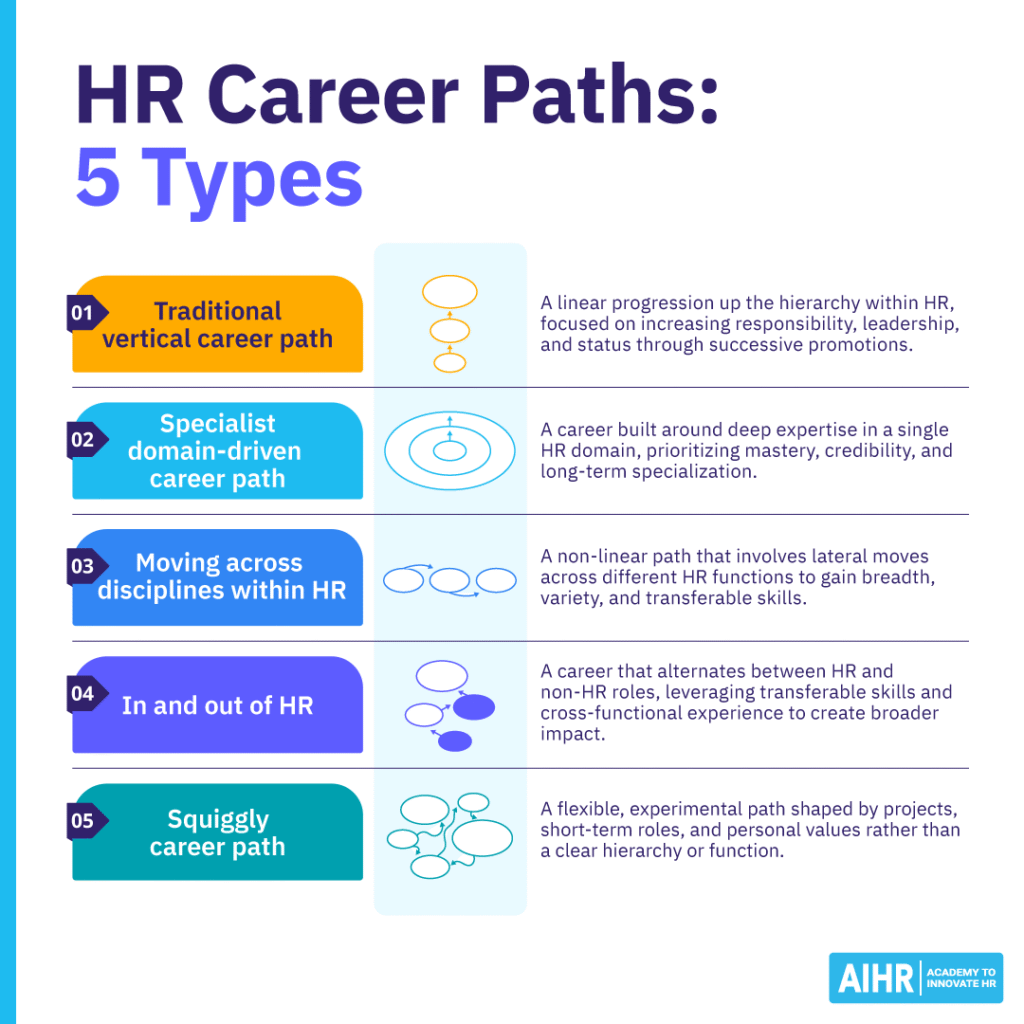
2. Specialist domain-driven career path
A specialist domain-driven career path focuses on selecting one specialist area of interest within HR and progressing in this niche. HR professionals who follow this HR career path tend to be motivated by mastery of their specialty: gaining credibility, developing specialist skills, and obtaining a deep knowledge and experience of one domain. People who carve out this type of career tend to love the scientific or technical aspects of their work.
This career path requires ongoing learning, visibility, and specialization. Movement is always aligned to specialist domains, for example, compensation and benefits, people analytics, or organizational development.
One of the advantages of taking this path is that you tend to spend a lot of time developing your skills and obtaining new qualifications, which often puts you in the minority of people who can do what you do, increasing your job prospects. As a result, people on this HR career path have the option to move into a similar role in a new industry or environment. However, there are some drawbacks. This path can lead to siloing, less mobility within an organization, and role narrowness.
According to AIHR’s research, around 17% of people take this type of HR career path.
An example of a specialist domain-driven HR career path: Ranahjai studied law at University and began his career as University law lecturer, before moving into HR and becoming an Industrial Relations Expert. By deepening his expertise, he was promoted to Industrial Relations Executive, where he now plays a critical role in maintaining and improving the relationship between his organization and its employees.
3. Moving across disciplines within HR
Moving across disciplines within HR is also known as a lateral career move, or a non-linear career path. People who take this path are often motivated by variety and grow bored if their area of work stays the same for too long. They enjoy exposure to lots of different disciplines and having a wide range of experiences at work. However, to succeed on this path requires individuals to build deeper functional and transferable skills, enabling them to arrive at a new discipline with a strong foundation to build on.
Movement along this HR career path is through opportunities within and outside of the organization, making it more flexible than a traditional path.
The main advantage of this path is the variety of experience, knowledge, and skills you’ll build by being exposed to many disciplines and departments within HR. This can be particularly helpful in understanding how all the operations within HR intersect. The main disadvantages are that it requires substantial transferable skills, can take longer to demonstrate impact, and requires exposure to the different HR domains in order to broadly develop.
AIHR estimates that 23% of HR professionals choose this career path.
An example of a lateral HR career path: Janelle begins her career in HR as an OD Administrator, then moves across into another entry-level, but more general role as an HR Coordinator. From here, she undertakes some specialist training so that she can move into an HRIS Analyst position.
After a while in this department, she has a desire to work with and develop people more, so she makes another lateral move but is promoted to HR Scrum Manager. She enjoys this work, but wants to move into operations, and secures a position as HR Operations Manager. Utilizing all the skills and experience she has developed so far, Janelle is promoted to Head of Employee Experience.
4. In and out of HR
The in-and-out HR career path involves moving from a non-HR role into HR, and potentially back out and in again. Individuals who choose this path are often motivated by curiosity, integration, and breadth. People on this path must master the application of transferable skills and create meaningful links between varying HR and non-HR roles. Movement here is aligned to the various opportunities available and role expansion, and is not purely bound by organizations.
The advantage of this career path is the much wider range of opportunities available, as well as the vital transferable experience acquired in both HR and non-HR roles. However, the main drawback of this route is that it can present an unclear career ambition and appear as if someone is simply “hopping” from one job to another.
AIHR has found that approximately 11% of people take this HR career path.
An example of an in and out of HR career path: Luca begins his career working as a Call Center Agent, but doesn’t enjoy the monotony of this role. He uses his skills to gain an entry-level HR role as a Learning and Development Administrator, and quickly rises to become a Learning and Development Specialist, followed by a Learning and Development Manager.
At this point, Luca is ready for a change and hungry to progress to the next level of his career, but his current organization doesn’t have a suitable opportunity. So, he secures a non-HR role as a Regional Manager at another company, where he spends a few years further developing his leadership skills. Following this, he’s keen to move back into HR, and takes a Regional HR Head position at the same company.
5. Squiggly career path
The final HR career path is a squiggly one, where someone makes a lot of moves across departments, and in and out of HR. These people are motivated by freedom, experimentation, and their personal values. To succeed, they must gain exposure, continually upskill themselves, and align with the core needs of the next role they’re pursuing. Movement in this path is through projects, short term-gigs, assignments and certifications.
The advantage of a squiggly career path is that this person can stay true to their changing personal and professional aspirations and prevent boredom. However, it can quickly lead to burnout, result in a lack of formal recognition, and loss of career identity.
AIHR estimates that around 17% of people take a career path like this in HR.
An example of an in and out of HR career path: Aoife begins her career as a freelance Fashion Consultant, but work dries up and she decides to move into HR as an entry-level Talent Researcher. She’s great at her job and is quickly promoted to Headhunter, but after taking a diversity and inclusion course, she follows her interests and transitions to a DEIB Officer role.
Again, she’s quickly promoted to DEIB Specialist, but after a few years, she feels stagnant in this role. A huge career change sees her leave her organization and take an external job in Public Relations, followed by a promotion to Head of Comms. Three years later, she decides to move back into HR and secures a position as a Senior HR Project Manager.
HR career path examples from practice
Now that you have a good idea of the various shapes and forms an HR career path can take on, let’s look at some examples to see how an HR professional can progress in real life. The following three stories are taken with permission from Andrea, Michael, and Lucy (we’ve changed their names for privacy reasons).
From HR Administrator to CHRO
Andrea has held various HR roles over the past 20 years after acquiring her Generalist HR degree. She started as an HR Administrator in one of her country’s biggest mining operations. This role was a valuable learning experience for her, as she not only mastered HR tools like ATS, CRM, HRIS, and HR analytics, she also gained end-to-end exposure to the HR value chain.
Being an HR Administrator helped prepare her for her first HR Generalist role two years later, when she moved to a financial services organization. In this position, she learned the ins and outs of many HR areas, such as recruitment, payroll, C&B, and HR compliance.
As an HR Generalist, she acquired versatile skills, enabling her to lead a number of HR initiatives before moving into a Senior HRBP role, this time in the telecommunications sector. As a Senior HRBP, she had the opportunity to work with the business on more strategic initiatives, collaborate with other HR specialists, and lead long-term projects.
After four years, Andrea moved on to her first HR executive role. She worked as the VP of HR of another telecommunications business that was undergoing an M&A process, and was responsible for one of their largest enterprise service lines. She capitalized on her comprehensive HR toolkit, building strategic partnership abilities and leadership experience to support senior leaders during the M&A.
Building on her executive and strategic leadership experience, she easily transitioned into the role of CHRO at a public sector organization 3.5 years later, leading the transformation of the organization’s HR function.
Currently, she’s a Senior CHRO at one of her country’s biggest multinational banks. She has gained enterprise-wide influence and management experience in a large-scale organizational transformation. She’s also in charge of the strategic HR agenda and solutions for her 30,000+ workforce.
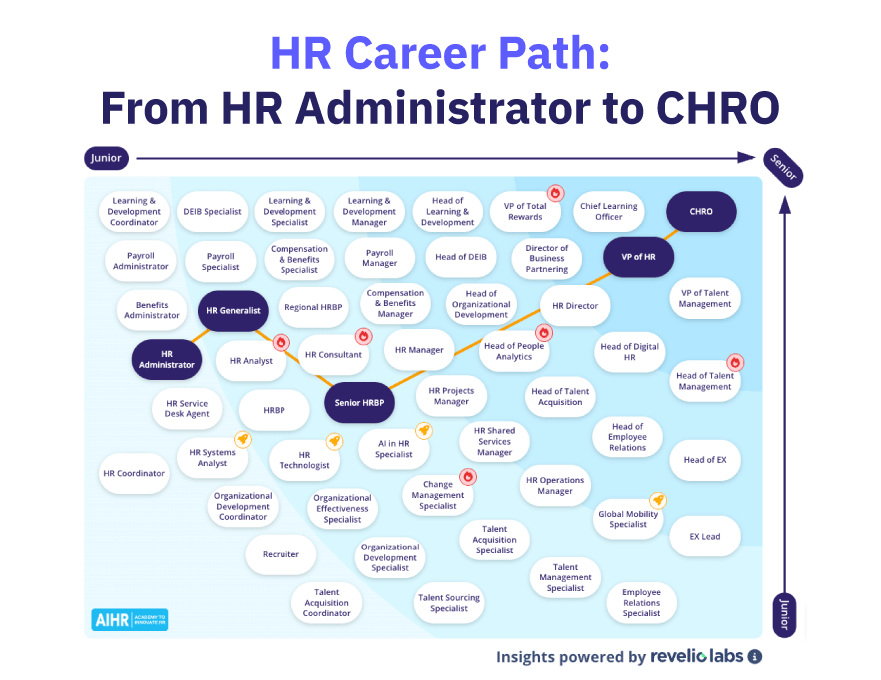
HR Administrator
HR Generalist
Senior HRBP
VP of HR
CHRO
From HR Consultant to CHRO
Michael started his career as an HR Consultant in the insurance sector. In his first role, he focused on supporting the HR group services team in implementing various interventions across the business. This experience allowed him to support the implementation of major change processes.
After realizing his true passion was engaging with the business, he moved into an HRBP role, where he was responsible for aligning HR initiatives with business objectives. He developed key skills in stakeholder management and strategic business partnership.
Due to his success in recruitment, he could move into a CoE, where he was responsible for the business’s end-to-end talent management portfolio as Head of Talent Acquisition. In this role, he developed expertise in talent strategy, performance management, and succession planning.
Over time, he also took on the L&D portfolio, which allowed him to become the Manager for OD and Learning, gaining skills in organizational design and creating large-scale L&D programs. After 14 years, Michael wanted to move into a different industry, so he became the Group OD Executive for a company in the logistics industry.
He mastered stakeholder management to optimize specialist HR functions and strategic HR consulting at the executive level. This prepared him for his next role as VP of Shared Services, which put him in charge of developing, implementing, and optimizing HR tech solutions for the business. This built his capacity for global system implementation and service delivery optimization. Currently, he is the CHRO of a global manufacturing business.
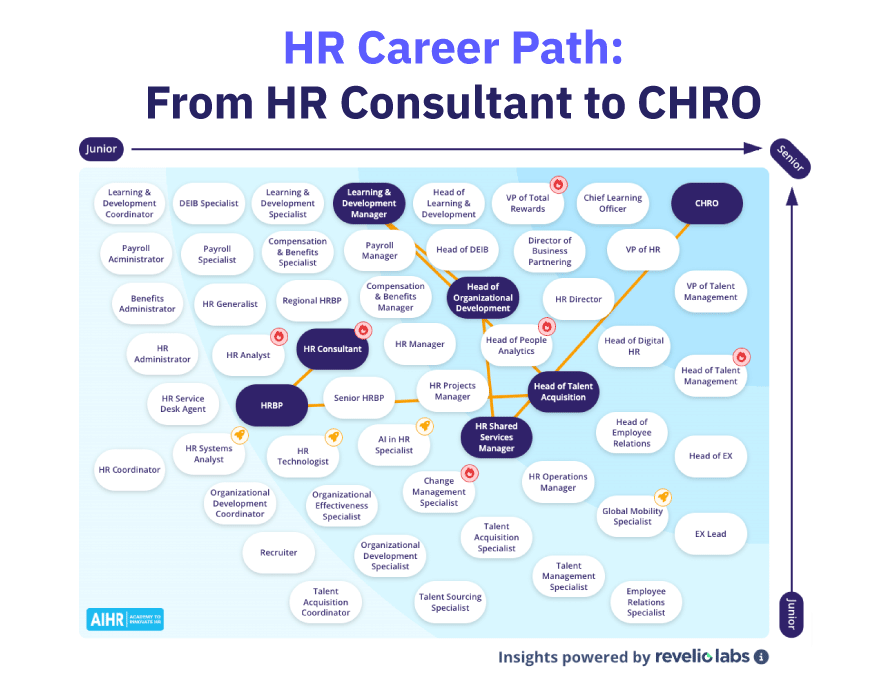
HR Consultant
HRBP
Head of Talent Acquisition
Manager for OD and Learning (L&D Manager)
Group OD Executive (Head of OD)
HR Shared Services Manager (VP of Shared Services)
CHRO
From OD Assistant to OD Head
Lucy is an HR professional with 12 years of experience in various roles within a multinational organization. She started her HR career path as an Organizational Design (OD) Assistant in the financial services industry. In this role, she supported the business in implementing various interventions. She gained a solid understanding of organizational design principles, project management, and HR reporting and analytics.
She later moved into an HRBP role, which taught her how HR engaged with and could add value to the business. At the same time, her role’s broad focus helped her understand all the stages of the employee life cycle better.
After four years, she moved into a CoE as an Organizational Development Specialist, where she gained expertise in strategic needs assessment, program implementation oversight, and end-to-end program design. Eventually, Lucy took up the role of Head of Organizational Development, making her responsible for the OD portfolio and giving her experience in setting the strategic direction for OD across the organization.
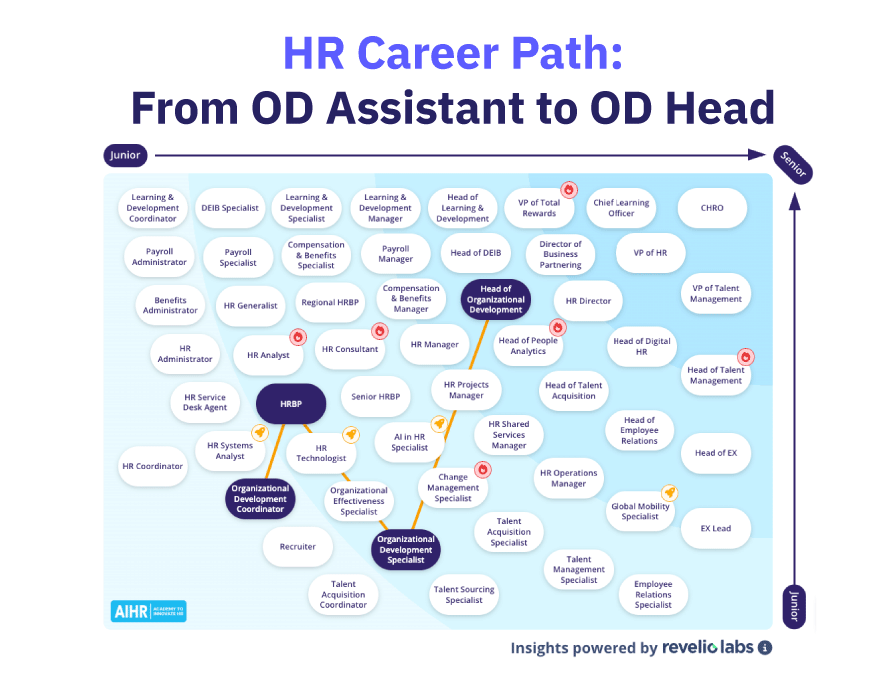
OD Assistant (OD Coordinator)
HRBP
OD Specialist
Head of OD
HR job titles by career level
When planning your HR career path, it helps to understand how HR roles are typically structured at different stages of seniority. While titles vary across organizations, most HR positions fall into entry, mid, senior, and executive levels, which gives a useful reference point for mapping possible next steps. Here’s an overview of the typical hierarchy with example job titles.
Entry-level
HR Assistant
Handles administrative tasks related to employee records, payroll, and the recruitment process.
HR Coordinator
Supports core HR functions, such as hiring, onboarding, benefits administration, and general HR administration.
Benefits Administrator
Manages and administers employee benefits programs, and ensures employees understand and receive their benefits packages.
Mid-level
HR Generalist
Assists in HR operations by handling administration, policy enforcement, and coordination tasks.
L&D Specialist
Creates and delivers training materials that support employee learning and business capability building.
HR Analyst
Leverages HR analytics to generate insights on workforce trends, supporting data-driven people strategies.
OD Specialist
Drives org design and change efforts that improve structure, clarity, and business performance.
Senior
HR Manager
Oversees the company’s HR department, ensuring its workforce is effectively supported and that HR initiatives align with strategic goals.
C&B Manager
Designs the employee benefits strategy, including salaries, bonuses, pensions, and rewards to ensure they are fair and competitive.
L&D Manager
Develops employee training and learning programs, skills needs analysis, and measures data-driven impact.
HR Director
Manages efficient end-to-end HR service delivery within a business unit, ensuring consistency, compliance, and quality across the employee lifecycle.
Executive
Chief Learning Officer
Designs and drives learning strategies and leadership development programs to build future-ready skills and strengthen internal mobility across the organization.
CHRO
Provides strategic leadership across HR by setting people priorities that align with business goals, ensuring long-term organizational success through talent, culture, and workforce planning.
Head of Talent Management
Develops and implements global talent management strategies that support the company’s business objectives and foster a culture of high performance and engagement.
Head of Employee Experience
Improves the employee experience by mapping and enhancing key moments in the lifecycle to drive satisfaction and engagement.
How to choose your HR career path
With so many different HR roles and career paths available, how do you choose the right one for you?
A good first step is to familiarize yourself with the different options we’ve discussed above. This way, you can make an intentional decision about your career progression, knowing what’s possible.
The second step is to take some time to reflect on various factors to help you better understand who you are, what you want, and how to get there.
Here are four guiding questions you can pose to yourself to make informed decisions about your HR career progression:
Question 1: Who am I and where am I?
Begin by reflecting on who you currently are and everything that has brought you to this point in your career. For example, what past interests led you here? What education do you have? What work experience (voluntary and paid) have you acquired to date? What are your key skills and competencies? Have you completed any additional certifications or courses?
It’s equally important to reflect on where you are personally and all of the choices, events, and learning lessons that have led you to this point. For example, if you’re a parent and looking to plan out your HR career path, you might make different choices than someone who is single and doesn’t have that responsibility to consider.
Question 2: What do I want and why do I want it?
Next, move into the present and consider your current aspirations. Make time to consider what your current interests and passions are, and which areas of HR these naturally align with. What motivates you, or would motivate you, in a work context? For example, are you primarily motivated by money and status, or are you intrinsically motivated by growth? What do you want out of your career as an HR professional?
Tap into resources like online articles, industry newsletters, and career pages to better understand different roles and what organizations are looking for with each of these.
Take as much time as you need to make a decision, but do make one. If choosing a path feels restrictive, it’s likely something less linear (a squiggly path) will suit you and offer more flexibility in the future.
Question 3: How will I get there?
Once you’ve got a clearer idea of which role(s) and path is most appealing and suitable for you, you can assess what skills and experience you need to build to get there.
What is standing in your way, and how can you navigate these obstacles?
Do you need to continue your education, enroll in an online course, or complete a certification to increase your chances of securing a role and make yourself stand out from other candidates? Is there anyone in your personal or professional network who can offer some guidance and wisdom? Is there a different role that would serve as a stepping stone to the one you really want?
Question 4: What will I want or who do I want to be?
The final step is to look to the future and consider where you want to go.
It’s okay if you don’t have a clear end goal – not everyone will. If this resonates, focus your attention on as far into the future as you can go. Perhaps there are two different areas of HR that really interest you, and you’re not sure which direction to go in. In this case, a general role as an HR Generalist or Administrator would help you explore both, and once you’re further in your career, you can make that decision.
Define some clear goals, and set expectations that align with who you are and what you want from your HR career. Think about what success in this field looks like to you – because it will be different for everyone. Remember to include your personal self in these decisions, and set goals that align with the other areas of your life.
There’s no one single way to determine the best HR career path for you. However, a skills-first approach has become increasingly critical. This applies especially to developing analytical, technological, and AI skills. You must think beyond advancing to particular HR job titles and continuously upskill to drive long-term HR career progression.
With the number of HR roles available and the different competencies each one requires, this can be a daunting task.
However, a quick and simple way to do this is to use AIHR’s HR Career Map. This will help you explore and compare suitable roles, identify the skills and training you need, get salary insights, and plan next steps to advance your HR career. It also allows you to discover emerging HR roles and trends based on regularly updated data, so even as the world of HR evolves, you can carefully consider your next career move.
Over to you
As an HR professional, you need a well-rounded set of skills to ensure you are able to turn existing and future challenges into opportunities for yourself. In this article, we’ve introduced the HR functional profiles and the different HR career path options you have within each functional profile. Each type of role requires a specific combination of core and functional competencies, divided into skills and behaviors. You can explore different HR roles in our HR Career Map.
However, understanding which skills and behaviors you need is only the first step. The next step should be to determine your current skills level and identify your own personal skills gap. Head over to our T-shaped assessment to measure your current HR competency level and identify the learning path you need to take to advance your career.